

Likes
Comments
Share
Hallo zusammen 🤙. Sie wächst sehr schön und macht keine Umstände
Likes
3
Share
@Kushizlez
Follow
Day 40-47 (May 31st- June 7th) (Day 41) For the first time in this grow these plants are looking halfway decent. Smell is ramping up too. I finally feel optimistic about this grow. (Day 42) The two jacks and the chunky blueberry are showing early signs of N/Mg deficiencies. I know it’s late in flower but since I’m experimenting with this tent, I’m going to give them one final feeding of nature’s pride 2-5-5.5 (tbsp) along with a teaspoon of oyster shell flour and some rock dust. Everything else I’m going to give a teaspoon of rock dust and oyster shell. There is no way these amendments will fully break down in time to be used by the plant but they could at least use the pH buffering and trace amounts of minerals after their recent leach. Everything but the BAOGC is covered in pistils that don’t really match their bud size. I hope they fill into their pistils because an over abundance of hairs drops the bag appeal like crazy. Over the last few cycles, indoor and outdoor, I’ve definitely learned that different strains and phenotypes mature at different times. Sometimes really radically too. (Day 43) None of the plants are fading at all but they’re still looking good. Black garlic I know should be fading but remains dark green and toxed. I popped a developing seed out of the main bud too. I wonder if that blueberry herm branch pollinated it at all. It seems like plants don’t really like that Destiny dark matter soil by itself. I find it works better mixed with coco or promix 1:1. (Day 44) I’m starting to think I might be mixing up the TWOG and BAOGC. BAOGC took forever to fatten up last round and the 2 phenos I suspected already look done. I was thrown off by the similar terps. The beauty phenos are definitely TWOG (Day 45) God these Jack Herer’s smell good. Nothing but fruity funk. Almost like a vanilla or blueberry yogurt. I would say this stuff has the most overpowering smell in the tent now. I’ve noticed they’re starting to foxtail like crazy. Blueberry#1 too. I’m watering a final low strength feeding of seaweed extract on everything. (Day 47) Everything really fattened up this week. Even at the beginning of the week I was saying I didn’t think they would fill out. Jack Herer and BAOGC specifically made some big gains and nearly doubled their density and still have quite a way to go on them too! The smell has ramped up and finally, everything is looking happy and healthy.
Likes
16
Share
@nonick123
Follow
Día 15 (27/01) Ha reaccionado bien al trasplante. A ver como se desarrolla en los siguientes días! Día 16 (28/01) Muestra un buen desarrollo con las primeras ramas formándose Día 17 (29/01) Subo a DLI 40 Muestra un color verde estupendo 😍 Día 18 (30/01) Tras subir el DLI la temperatura en el indoor ha subido a de 22ºC a 26 ºC, de modo que va a acelerar las necesidades hídricas Se sigue desarrollando estupendamente 😁 Día 19 (31/01) Seguimos a buen ritmo Creo que debería haber regado este día... (Visto como estaba de seca al día siguiente...) Día 20 (01/02) Elimino las ramas más inferiores (1er nudo) que siempre suelen quedar débiles en el stretch Riego con 350 ml H2O RO Día 21 (02/02) Empieza a estirarse! 😍 Está sedienta! Riego con 350 ml H2O En una semana a floración! FastBuds 15% DISCOUNT code "NONICK" 2fast4buds.com @fast_buds_official_ @fastbuds.official 💦 BioTabs 15% DISCOUNT code "GDBT420" biotabs.nl/en/shop/ @biotabs_official 🌱Substrate PRO-MIX HP BACILLUS + MYCORRHIZAE @promixmitch @promixgrowers_unfiltered 💡2 x Mars Hydro FC1500 EVO Led Grow Light (2024 NEW FC 1500-EVO Samsung LM301H 150W LED) - https://marshydro.eu/products/fc1500-evo-led-grow-lights/ - https://www.amazon.de/dp/B0CSSGN5D8?ref=myi_title_dp
Processing
Likes
6
Share
Hello everyone, Not much to say about this girl. This week I started giving her some nutrients so lets see how she turns out now... See you guys next week.. 🤘🤘👊👊👊
Likes
Comments
Share
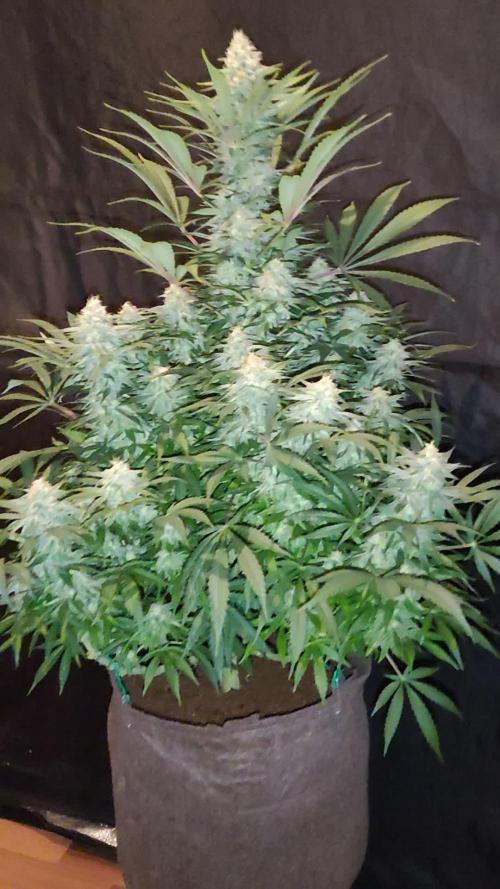
🍇 Purple Haze Photoperiod – Phenotype B | Week 4 (Vegetation) The Bush That Wants Every Ray of Light Week four belonged to Purple Haze B. While her sister is preparing for life on the AutoPot system, this girl is following a different path, remaining as a hand-watered control plant for what will become a very interesting side-by-side comparison later in the grow. Even though they are sharing identical conditions, genetics, nutrients, and training philosophy, every phenotype writes its own story. That is exactly why I love phenotype hunting. This one has chosen to become a compact jungle. ⸻ 🌱 Week 4 Overview What a transformation. During the week she exploded sideways, filling every available space with healthy branches and fresh growth. Instead of stretching upward, she invested her energy into building a dense, symmetrical canopy that is becoming thicker every single day. From above she already resembles a small green island. Large solar-panel fan leaves overlap beautifully while dozens of vigorous shoots continue racing toward the light. Every new node appears healthy, evenly spaced and ready to become another flowering site once the transition begins. The rich emerald color tells me everything is working together exactly as intended. Sometimes the healthiest plants are the ones that simply don’t give you anything to complain about. This is one of those. ⸻ 🌿 12/12 From Seed As with every plant in this project, Purple Haze B is being grown using my favorite 12/12 From Seed method. The lighting schedule stays at 12 hours from germination until harvest, allowing the plant to naturally progress through its life without ever experiencing a traditional vegetative photoperiod. The goal isn’t maximum size. The goal is efficiency, fast turnaround, excellent quality, and discovering how each genetic expresses itself under these conditions. Every phenotype reacts differently. That’s exactly what makes this project so exciting. ⸻ 🌱 Low Stress Training (LST) This week’s training focused exclusively on Low Stress Training. Rather than cutting or removing growth, branches are gently bent and positioned to create a flatter canopy. Why? Because every branch that receives equal light has the opportunity to become a productive flowering top. LST offers several advantages: • Improves light penetration throughout the canopy. • Encourages multiple dominant tops instead of one main cola. • Creates better airflow inside dense plants. • Produces a more even canopy before flowering. • Increases the number of quality bud sites. Watching this little bush respond over the week has been incredibly satisfying. Every adjustment rewarded me with even more vigorous growth just a day or two later. ⸻ ? Why This Plant Is Staying Hand Watered Although she’s growing inside an AutoPot container, this phenotype is intentionally NOT connected to the AutoPot system yet. She will serve as the comparison plant while her sister begins receiving gravity-fed irrigation. Everything else remains identical: • Same genetics. • Same substrate. • Same nutrients. • Same environment. • Same lighting. The only real variable will be irrigation. It should make for a fascinating comparison later in the grow. ⸻ 💧 What Is an AutoPot? The AutoPot system is a completely passive irrigation system that waters plants automatically without pumps, electricity or timers. Instead, it relies on one beautifully simple principle: Gravity. A nutrient reservoir sits slightly higher than the pots, allowing nutrient solution to naturally flow toward the plants. Each pot sits inside an AutoPot tray containing a very clever device called the AquaValve. ⸻ ⚙️ The AquaValve The AquaValve is the heart of the AutoPot system. It works like a miniature mechanical valve that opens and closes entirely on its own. Here’s how it works: • The tray fills with nutrient solution. • Once the plants drink everything available, the tray becomes empty. • Only then does the AquaValve reopen. • Fresh nutrient solution enters the tray. • The cycle repeats automatically. The result is a constant wet-and-dry rhythm without electronics, pumps or programming. The roots decide when they are ready for another drink. For me, that’s one of the smartest irrigation systems ever designed. ⸻ 🌱 Current Feeding This week the girls continued receiving the Plagron Terra program: • Terra Grow – 1.8 ml/L • Power Roots – 1 ml/L • Pure Zym – 1 ml/L • Sugar Royal – 1 ml/L Solution maintained at: * EC: 1.35 * pH: 6.1 The plants continue responding with lush, healthy foliage and vigorous new growth. ⸻ 🌡️ Environment Conditions remained stable throughout the week: * 🌡️ Day temperature: 33°C * 🌙 Night temperature: 25°C * 💧 Relative humidity: 63% * 🌱 Root zone temperature: 21°C * 💦 Nutrient solution: 26°C * 🌿 CO₂: 639 ppm Even with the warmer daytime temperatures, the plants have shown excellent vigor, with no signs of nutrient stress or environmental fatigue. ⸻ 📸 Final Thoughts Purple Haze B is quickly becoming one of those plants that constantly catches my eye whenever I open the tent. She isn’t trying to be the tallest. She’s building something even more exciting—a thick, compact canopy packed with potential flowering sites. In a few weeks we’ll discover whether the hand-watered approach can keep pace with her sister running on the AutoPot system. Either way… I’m pretty sure we’re all going to learn something. And that’s exactly why we grow. ⸻ 🙏 Thank You A huge thank you to everyone making this project possible. Genetics: Zamnesia Seeds 🌱 Nutrients & Substrate: Plagron 💧 Irrigation: AutoPot 💡 Lighting: Lumniflora and Future Of Grow LEDs 📖 Grow Journal: GrowDiaries Your support allows experiments like this to happen, and I hope sharing every step helps growers around the world learn right alongside me. Growers Love and see you all next week! 🍇🌿
Likes
39
Share
@SamDo
Follow
Slt, déjà la fin de la semaine 5. Les plantes ont très bien récupérées de leur topping et de leur défoliation. Les plantes semblent être en bonne santé. Je viens juste de refaire une défoliation et du LST, pour avoir la structure voulu et donner toute l’énergie de la plante pour les tiges principales, en espérant que cela soit profitable aux plantes. J’espère ne pas m’être trompé.🙏 En photos et vidéos je montre avant et après la défoliation et le LST, et le fonctionnement du sytème d’irrigation. A la semaine prochaine... Happy grow😎 Ps: le rendu des couleurs sur les vidéos et photos peu être bizarre à cause de la LED.
Likes
8
Share
@Satta
Follow
She's now kept fully indoors, producing more buds hopefully. I removed nearly all seeds developing in the popcorn buds, avoiding damage to the colas as much as possible. Tested the little charas built up on my tweezers, pretty dang potent I have to say. Temperature and humidity is a bit high and I can't do much about that for the time being, she's doing fine regardless. She used to have more of a freshly brewed coffee smell to her in the past 2 weeks, now that has turned into the smell of an entire pastry shop with an italian espresso machine running. I've removed a tiny branch with some popcorn buds that wasn't going to grow into anything substantial anyway, it dried until now and I gave it a try. VERY potent already, tingling body sensations straight away, clear headed and gently uplifting high just a touch towards the indica side, but otherwise very balanced.
Likes
3
Share
@TTerpz
Follow
Harvest day First day of dry 10/2/25
Likes
3
Share
@nag4wa
Follow
Started this week with 1.0 EC and slowly pushed up to 1.4, no signs of overfert. Also added some silicate and dolomite via foliar spray. Trying to find the best setup for this new grow tent
Processing
Likes
21
Share
Defoliated some leaves to let light in, chopped one down early as I run out of bud 🙄 it's good for less than 4 weeks flowering. Have them rice water starch again this week in with there food. A layer of frost is slowly forming 😎 hopefully they will fatten up nice and frost up really good to 🤞
Likes
24
Share
@OGOZHigh
Follow
Kleines Update : 27.05.24 Lemon Cherry Cookies und Papaya Cookies getoppt 28.05.24 Guava Auto angefangen mit LST Weitere Updates folgen
Likes
1
Share
Sie wird von Woche zu Woche kräftiger und hat keine Probleme mit den doch recht niedrigen Temperaturen nachts. Das Topping hat sie gut vertragen und trotzdem noch 10 cm in dieser Woche zugelegt. Nächste Woche nach den Eisheiligen erfolgt das Umtopfen in den Endtopf. So weit sieht es bisher gut aus.
Likes
16
Share
Everything looks fine Her the Planties have established in their Growingarea showing strong leaves and good little stems. 💀👽 Iam having Problems to upload the video and some Pictures too😨 website for for my Fertilisers: https://greenbuzzliquids.com/en/shop/ Code: mrs_larimar Breeder Info: 👉Black Sugar is an indica dominant hybrid of Black Domina, L. A. OG and Critical. It has kept the medicinal properties of L. A OG, a good flowering rate on the Black Domina lineage, and the compact size of the classic Critical strain. With its small growth, the strain produces large yields of up to 600gr/m2 on bushy branches. The buds are very dense and stinky. Black Sugar has a high THC level. The variety has a fruity citrus aroma. Dense smoke gives the effect of relaxation and body buzz. Good for Smoking before going to bed. It can become one of your favorite Seedsman strain Genetics Black Domina x L.A OG x Critical Harvest 450 - 500 g/m² Flowering 50 - 55 days THC 20.0% CBD 1.0%
Likes
13
Share
@Angry_Elf
Follow
Rolling into week 3 from seed roots are starting to drop through the net cups and down into the solution. Growth appears to be a lime green color, which would indicate that they are in need of more Nitrogen (N). One is struggling to keep up with the others and is looking a bit mutated and is not responding well to the nutrients I am using. I am going to add some 5.8 pH water to her rez and see if the dilution helps. Over all happy with the progress so far, Will post again next week with new progress.
Likes
11
Share
@Dreadnug
Follow
The Future #1 strain took to germination right away, was very flexible, and worked very good for SCROG. It produced heavy buds that are beautiful. Teh strain started very strong and grew excellent. The flowers was super dense, very crystally and sticky. It will be very interesting to see how they smoke. I had some pH issues with my water supply which impacted the grow and this strain seemed to be more light sensitive compared to another Anesia strain right next to it. Wet bud weight is prior to trimming. The buds off of this plant were HUGE!!!! Wet weight - 58.8 oz prior to trim; 14 colas; Terps: White - 70%, Amber - 30% After 3 days of drying, took them down to trim for my jars. Dry weights into jars: Future #1: 9.06oz I did pull them after a day to dry rack them for 12 hours due to a little bit higher moisture content then I would have liked (+70%rH). Re-jarred on 6/1/23 and now holding steady at around 60% rH. Cure Check In: 6/10 - 6/12/23: rH ~ 63 - 66%. Daily air exposure & fanning. Very smelly. Looking good - another couple weeks and will be ready.
Likes
5
Share
This plant seems to have grown much denser and better than my first plant. I just got the ac infinity ventilation setup with controller 69 for my 2x2, still trying to learn, hopefully grow #3 goes even better. Stay tuned
Likes
21
Share
@DE_BW
Follow
Flowering Week 3 The stretch is officially over, and the plant has settled at around 55 cm. Buds are stacking nicely, with an impressive number of bud sites and an exceptional amount of frost for such an early stage of flowering. Minor pest damage is still present, but overall the plant remains extremely healthy and vigorous—now it’s simply a matter of feeding consistently and letting her do the rest.
Likes
77
Share
So I finally got there in the end, here we have 3 x sherbert mimosa and 2 x gelato cake. Classing this as week 1 as I repotted today so this is what I'm using. Light = bloomplus bp2500 Exhaust is a ac infinity 6inch with digital controller Inkbird humidity controller with a ram 5l humidifier. Veg only! Soil= biobizz light mix Nutes= biobizz roots 1 week using the 10 week schedule at half dose this run. Ph= 6.4 Room humidity is 70% Temp is 28°c Happy growing guys 💪💚 Grown under the bloomplus bp2500 The 4 smaller ones are in light mix And the middle one is in all mix hence its got nute burn. I have fed them 4ml of biobizz roots to a litre of water. I made a 2l bottle to share between them at this point. Tomorrow I will start them with the following biobizz nutes as follows. 2ml per litre of fish shite 2ml per litre of bio heaven 2ml per litre of acti Vera 2ml per litre cal mag I mix the cal mag on its own and feed separately. Happy growing guys 💚💜 Last pics of this weeks progress just put on, what a growth spert in 6 days 😁💚💜
Processing
Likes
4
Share
I love these strain's from sweetseeds but special These one , ust the First time i Grow these one on my own, because of these i will havw to wait a little to see the beautiful colors i have see in the other's diaries, but i know the genetic family of these lady and i just can say Bravo, i will love to grow always these strain, has been 8 days and she's is 2 Time's bigger than the other strains for 6 seedbanks i have on my testing.
Likes
42
Share
Thank you. Gave her a cocktail to help with stress. Added 1st net for lateral support, not so much now, but for later. Blue light is absorbed by photoreceptor proteins called phototropins, which trigger a hormonal response that causes cells on the shaded side to elongate, making the plant bend toward the light. Try and fill this side a little. She is quite big already, just needs to find her stride again after the undue torture. 5 apex stems with 20-30 mini cola, let them develop a little, with the apical dominance shattered, all those 20-30 will all compete with each other as soon as that stretch is initiated. Key to a good stretch is making sure the plant is cycling efficiently, with large ATP conversions occurring lights out. For now, I'm keeping light intensity high. A plant will slow its vertical growth in very high light intensities, leading to a more compact form with thicker stems and leaves. This response is a protective mechanism against light stress, which can damage the photosynthetic apparatus and lead to symptoms like leaf scorching, yellowing, and brittleness. Instead of growing taller, the plant invests its energy into creating a more robust, stress-tolerant structure. Providing plants with necessary antioxidants helps protect the photosynthetic apparatus by scavenging reactive oxygen species (ROS) that cause damage from excess light. UV light exposure can impact the xanthophyll cycle by either enhancing its photoprotective role or causing damage, depending on the intensity and type of UV radiation. UV exposure can trigger the synthesis of more xanthophyll cycle pigments to increase the plant's capacity to dissipate excess energy, but it can also cause direct damage, particularly to Photosystem II, and may lead to a decrease in the de-epoxidation state (DEPS ratio) which indicates a reduced capacity to dissipate excess energy. Plants can respond to UV stress by increasing the synthesis of xanthophyll cycle pigments, such as violaxanthin and zeaxanthin, to improve their photoprotective capacity. UV-induced changes in xanthophyll cycle pigments can be linked to a plant's overall tolerance to high radiation stress. The xanthophyll cycle helps protect against photoinhibition, which is especially important when the plant is exposed to high levels of both UV and visible light. High doses of UV radiation can directly damage photosynthetic components, including the proteins, lipids, and pigments in the thylakoid membranes. Exposure to UV radiation can have a mixed effect on the de-epoxidation state (DEPS ratio) of the xanthophyll cycle pigments. In some cases, UV can inhibit the conversion of violaxanthin to zeaxanthin, resulting in a lower DEPS ratio and a reduced capacity for energy dissipation. However, the total pool of xanthophyll cycle pigments may increase, and this enhanced pool size could provide a greater potential for photoprotection despite a lower DEPS ratio. The xanthophyll cycle works alongside other mechanisms, such as the accumulation of flavonoids (UV screens), to protect the plant from UV-induced damage. Blue light repairs 100% UV-induced damage in plants through a process called photoreactivation, which uses a light-dependent enzyme called photolyase. This enzyme uses energy from blue and UV-A light to directly reverse the damaging pyrimidine dimers in the DNA caused by UV-B radiation, a key mechanism for maintaining the plant's genetic integrity. After carbon, light, water, temperature, and nutrients, the limiting factor of a plant's growth is often its own internal factors or the amount of a key ingredient. Chlorophyll concentration is one such factor, as the amount of this pigment limits how much light can be captured for photosynthesis. Other factors include chloroplast number, respiration rate, and the concentration of carbon dioxide in the atmosphere, as plants are often in a CO2-deficient condition. 60x60x18=64800seconds x 700 = 45,360,000moles. 45DLI Exposure to 165 µW/cm² of ultraviolet-B (UV-B) light for 3600 seconds = 1 hour, a extremely high, acute dose triggering stress responses and protective mechanisms. . The plant's photoreceptor protein, UVR8, senses the UV-B radiation. This triggers a signaling cascade that activates specific genes to protect the plant from damage. In response to the UV-B signal, the plant ramps up the biosynthesis of protective compounds like flavonoids, phenolic acids, and anthocyanins. These compounds absorb UV radiation and accumulate in the epidermal layers of leaves to shield inner photosynthetic tissues. The plant may increase leaf thickness or deposit more cuticular wax, creating a physical barrier to the radiation. The plant will produce more enzymatic and non-enzymatic antioxidants to neutralize the reactive oxygen species (ROS) produced by the UV-B radiation. The plant activates enzymes, including photolyases, to repair DNA damage caused by the UV-B. These repair mechanisms are critical for preventing permanent genetic mutations. While protective measures are activated, a high dose delivered over a short period can cause stress that overwhelms the plant's defenses. Photosynthesis is highly sensitive to UV-B. A high dose can inactivate Photosystem II (PSII), damage thylakoid membranes within the chloroplasts, and reduce chlorophyll content, which lowers the plant's overall photosynthetic capacity. Despite repair mechanisms, high UV-B doses can inflict persistent damage on the plant's DNA. The overproduction of reactive oxygen species can cause oxidative stress, leading to the oxidation of lipids and proteins and disrupting cellular function.