




@AstrasGrow
Follow
16.01. – Blüte Woche 9 komplett
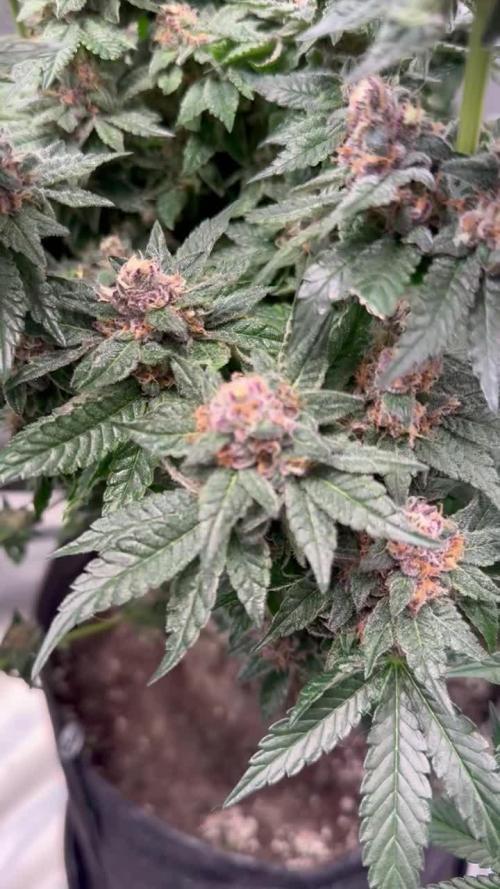
Wir sind jetzt im absoluten Endspurt angekommen. Heute sind exakt 9 Wochen Blüte um und man merkt ganz deutlich: die Pflanzen sind im finalen Reifeprozess angekommen. Die Buds sind fertig aufgebaut, schön kompakt und komplett mit einer dicken Schicht Harz überzogen – richtig frostig und reif.
Es wurde ein letztes Mal gegossen, und ab jetzt wird das Gießen komplett eingestellt. In der letzten Woche hat sie außerdem bereits kein Wasser mehr bekommen, damit sie langsam in den Finish-Modus kommt und sich nochmal richtig ausreifen kann.
Beim Trichome-Check zeigt sich ein richtig schönes Bild:
Die Trichome sind überwiegend milchig und es sind bereits ca. 20% bernsteinfarbene dabei. Damit ist das Erntefenster definitiv erreicht – die Potenz ist voll da und die Reife entwickelt sich jetzt genau in die Richtung, die ich haben möchte.
Ab heute stelle ich die Pflanze für 48 Stunden komplett dunkel, um ihr nochmal die letzte Ruhe vor dem Finale zu geben. Danach geht es in Richtung Ernte.
Fazit: Woche 9 war die perfekte Finish-Woche – jetzt heißt es nur noch Endreife, Dunkelphase und dann ist es soweit. ✂️🔥


@Raizativa
Follow
Riego:
1ml Bio grow
1ml Top max
1ml top bloom
1ml calmag
1ml Bio Heaven
0.5 Micorrizas colectivo científico
Se han ido ajustando los amarres de LST cada día por medio aprox.




@Ultraviolet_
Follow
67 days since April 16th, 2026
We become aware at such times of man's wonderful ability to bring seemingly unrelated elements into harmonic balance, and receive a glimpse into a world where everything exists in conscious sympathetic attunement to everything else. When we listen to a piece of music that seems to strike a beautiful chord somewhere inside us, or view a painting that simply glows with harmonic awareness well executed, we probably do not spare much time to contemplate the wonderfully intricate combination of vibrations that our sensors make it possible for us to perceive. We tend to appreciate the relationship between the parts of something by an awareness of the harmony or dissonance of the whole. This ability enables us to say "what a beautiful house!" instead of "analysis has proven that this collection of building materials exhibits certain elements of harmonic proportion." While this ability to instinctively appreciate the beauty of true harmony has an important role to play in evolution, a more analytical understanding of the laws involved can be most useful. This is especially so if we wish to create works of art where each part exists in true harmony, not only with the other part of that particular whole, but with the universe within which the creator and the created exist.
Everything vibrates. From the most dense matter to the most subtle cosmic rays, everything which our senses allow our thoughts to become aware of, can be specified in terms of wavelength or frequency of vibration. These two terms define the same thing, but from different points of view.
The following are the approximate wavelengths of various energy carriers:
Cosmic rays 0.000,000,001 mm
Gamma rays 0.000,000,1 mm
X rays 0.000,500 mm
Ultraviolet rays 0.003 mm
Visible light 0.006 mm
Infrared 0.01 mm
Sound waves 1 meter
Radio waves 300 meters
Violet light 400 nm to 450 nm
Blue light 450 nm to 500 nm
Green light 500 nm to 570 nm
Yellow light 570 nm to 590 nm
Orange light 590 nm to 610 nm
Red light 610 to 700 nm
1 nanometer (nm) = 0.000,000,1 cm = 1/10,000,000 cm
If a guitar string is plucked and we hear a sound, it is not too difficult for the human mind to associate this sound with the vibration of the guitar string. With color it is quite different. It is difficult for us to conceive that the color of a substance is not an inherent property of the substance itself, but an indication picked up by our senses of that substance's ability to absorb or reflect the light which happens to be shining on it at that moment. Neither the matter nor the light is colored. What happens is that the brain learns to differentiate between the frequencies reflected or transmitted by the substance the eyes are focused on. The same thing happens with sound. When we say "Oh! Listen, they're playing my favorite song," what we really mean is: "My brain has stored within it a particular pattern of frequencies. I have compared the new information being received with this stored pattern and have deduced the answer that the two patterns are similar within certain specified tolerances." The 'pleasure' involved could have something to do with our running the pre-recorded pattern at the same time, in 'sympathy' with the new pattern as it is received.
The word sympathy describes very well our ability to appreciate color and sound. It also describes the reason behind certain elements of harmony. For instance, if a substance vibrating at 100 cycles per second (tone 1) is in the proximity of another substance vibrating at 200 cycles per second (tone 2), we could perceive, if we had the right equipment, a certain sympathetic relationship between the two.
We will see from this that there is a uniform doubling of the first tone seen in the second. At various points along the waves, the two are the same in amplitude. At other points, they are at opposite poles to each other. This doubled frequency has more points of similarity to the original than any other frequency except the original itself. If the equipment we had available for measuring these two frequencies was a soundboard amplifier and a pair of ears, then we would hear what would sound to us like one tone. If we had the opportunity to hear one at a time, we would hear that although they sound the same, one is higher in pitch than the other. This characteristic of 'the same but different in pitch', musicians have called the octave. Any two tones produced where one has exactly doubled the frequency of the other is called an octave. Speaking in ratios, an octave would appear then as the ratio 2:1 or 1:2, depending on whether we are talking of an octave up or down.
A single note produced by almost any instrument will contain more than one wavelength or frequency. It will have a dominant frequency, the wavelength of which we would call the note's 'fundamental' or 1st harmonic. It will also have a varying number of upper harmonics, gradually fading in intensity into infinity or silence.
Natural harmonics always have the same pattern of intervals between them. The interval between the 1st and 2nd harmonic is a perfect octave; between the 2nd and 3rd a perfect fifth; between the 3rd and 4th a perfect 4th; and so on, the intervals becoming smaller and smaller until they lose any relationship with the western 12 tone scale as it exists at the moment. Just as an octave has certain elements of sympathy with its fundamental, so some intervals have been noted to be more perfectly in sympathy with the fundamental than others. The ratio of the 'perfect 5th' or interval of 7 semitones, as it occurs in the harmonic series, is 3:2 or 2:3, while that of the 'perfect fourth" is 4:3 or 3:4. All the tones in the western 12 tone scale can be expressed in terms of the ratio between the upper tone and its fundamental. This would seem to be an ideal way of generating a scale from any given fundamental and several attempts have been made to do this, the Pythagorean system being probably the most well known. Although when working with a single tone instrument playing on its own, the Pythagorean formula works wonderfully well, if we had several instruments tuned this way together and asked them to play almost any western music, we would find that at times they sounded quite out of tune to each other.
The lack of flexibility of the various scale systems based on the harmonic series has led to what is known as the 'tempered' scale. This uses as its primary unit of interval the ratio of the octave or 2:1. It then proceeds to divide the interval between any fundamental and its upper octave into 12 smaller intervals by applying the ratio: two to the one-twelfth power, to one (21/12:1). This equals 1.059463094, so by multiplying any frequency by this number, we will obtain the tempered semitone next up from our fundamental. We will also find that any tone twelve semitones up from any other tone, in a scale generated in this way, will have exactly double the frequency.
If we took the note middle C on a piano and halved the wavelength, we would have the note C one octave above. If we halved this, we would have the C above, and so on. However, within about 6 octaves, we would find that although a 'sound' was being produced, no human ear could perceive it. If we kept on going, halving and producing upper octaves of our fundamental C, we would proceed through the infrared band, into the visible light spectrum. If we happened to be outside during the day, we would, for one octave only, see the note C with our eyes. The next octave above would already be in the ultraviolet band, and outside the eye's sensitivity range. If we can think of color as being an indication of a substance's vibratory rate or wavelength, we may begin to see a relationship that could exist between the color and sound spectrums.
The logical extension of what has so far been said is that there exists a scale in the color spectrum that corresponds exactly to the scale in the sound spectrum, each color tone being an octave of the equivalent note in the sound range.
This is not the end of the story but only the beginning. If we can for the moment accept that any wavelength in one band has upper and lower octave stretching out to infinity, then the next question is 'fine, but what shall we use as our fundamental? A particular color? A particular sound frequency?' The musicians among us will probably say 'A 440'. This means that the note A should vibrate at 440 Hertz, or 440 times per second. They would tell us that this is standard pitch has been adopted by most orchestras around the world; pianos are tuned to it, instruments are constructed to formulas based on it, and so to them it would probably seem the most appropriate place to begin. Some of these musicians may know of the battle that is still raging with regards to this being the standard, but few would know why A = 440 Hz was chosen except that it worked when it was set to be a suitable compromise between the many different pitches in use at the time.
432 Hz is said to be mathematically consistent with the patterns of the universe. Studies reveal that 432 Hz tuning vibrates with the universe’s golden mean PHI and unifies the properties of light, time, space, matter, gravity, and magnetism with biology, the DNA code, and consciousness. When our atoms and DNA start to resonate in harmony with the spiraling pattern of nature, our sense of connection to nature is said to be magnified.
Another interesting factor to consider is that the A=432 Hz tuning correlates with the color spectrum, while the A=440 Hz is off. Audiophiles have also stated that A = 432 Hz music seems to be non-local and can fill an entire room, whereas A=440 Hz can be perceived as directional or linear in sound propagation.
Once you adopt the idea that sound (or vibration in general) can have an equalizing and harmonizing effect (as well as a disturbing effect), the science of harmony can be applied to bring greater harmony into one's life or tune to specific energies. There is a form of absolute and relative harmony. Absolute harmony can, for example, be determined by the tuning of an instrument. The ancients tuned their instruments at an A of 432 Hz instead of 440 Hz - and for a good reason. There are plenty of music examples on the internet that you can listen to in order to establish the difference for yourself.
Attuning the instrument to 432 Hz results in a more relaxing sound, while 440 Hz slightly tenses up the body. This is because 440 Hz is out of tune with both macro and micro cosmos. On the contrary, 432 Hz is in tune. To give an example of how this is manifested microcosmically: our breath (0,3 Hz) and our pulse (1,2 Hz) relate to the frequency of the lower octave of an A of 432 Hz (108 Hz) as 1:360 and 1:90.
It is interesting to note that 432 Hz was the standard pitch of many old instruments and that it was only recently (19th and 20th century) the standard pitch was increased. This was done in order to be able to play for bigger audiences. Bigger audiences (more bodies) absorb more of the lower frequencies, so the higher pitch was more likely to “cut through”. One of the oldest instruments of the world is the bell ensemble of Yi Zeng (dated 423 BC), tuned to a standard F4 of 345 Hz, which gives an A= 432 Hz. The frequency of 345 Hz is that of the platonic year! Similarly, many old organs are tuned in A=432 as well; for example, St. Peter’s Capella Gregoriana, St. Peter’s Capella Giulia, S. Maria Maggiore in Rome.
Maria Renold’s book “Intervals Scales Tones and the Concert Pitch C=128 Hz” claims conclusive evidence that 440 Hz and raising concert pitch above scientific “C” Prime=128 Hz (Concert A=432 Hz) disassociates the connection of consciousness to the body and creates anti-social conditions in humanity.
The difference between concert pitch A=440 Hz and Concert A=432 Hz is only 8 cycles per second, but it is a perceptible difference of awareness in the human consciousness experience of the dream we share called existence.


@Snickelfritters
Follow
12/1 - GZ 1 has pretty much decimated its fan leaves. This seems to be a bit early in my opinion. The buds are nice but not as full as I'd like. She's still got swelling to do but I can't see her going longer than another 2 weeks. I think I may have went too light on feed around week 3 or 4 because thats when the symptoms started. Either way I'm officially labeling this plant as "stunted by user error"
GZ 2 is starting to head down the same path a week or 2 after her sister. Buds are looking small but frosty. It think she may be a little better off in the long run but we'll see. Orange hairs started coming in droves for both around week 4. The buds are picturesque but they still have a lot of fattening to do.
Moby Dick's leaves have started to fade noticeably to light green just in the past week. I consider this optimal at day 40. I'm curious what the next few weeks will hold for her because her buds are already looking nice and full. Definitely going to be the last to finish and looking like it's going to be worth every second.


@CannabisAprendiz
Follow
Quinta Semana de floración del scrog de una variedad indica con un olor muy intenso con flores muy resinosas y compactas / Fifth Week of flowering of the scrog of a variety indicates with a very intense smell with very resinous and compact flowers


@Naujas
Follow
107 days!! Here is another great experience :) The girl has matured, 330 grams of wet, full of sticky, resinous shiny, pleasantly smelling flowers :) I think it will be about 90 dry :) although the girl is definitely not the biggest, but she looks great, the smell is also amazing :) I also got some sugar leaves from which I will make bubble hash, For me personally it is really beautiful and good growth, which I think will definitely be confirmed by the dried and cured flowers :) there will be a smoke review, as well as the total dry weight. good luck to everyone :).


@Do_it_Dan
Follow
So last week for this girl she's come a long way and I'm very impressed tbh, she's fattening up nicely, just the ripen I'm waiting on, can't wait for the flavour profile on this one, happy growing and stay green ✌️ 💚 👌



@LittleBigTrees
Follow
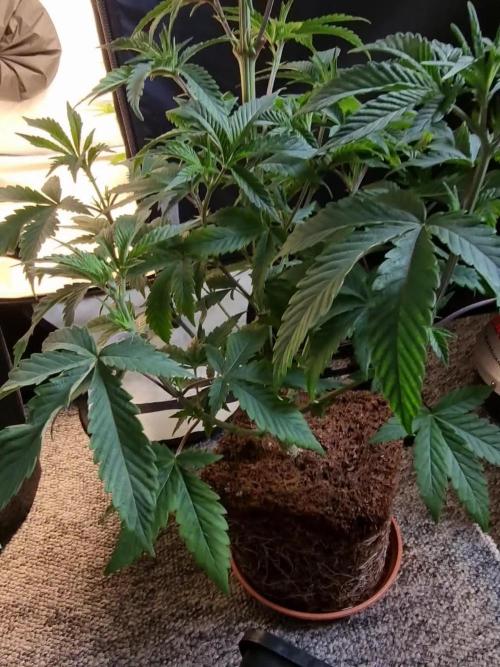
They are 8 weeks old now, I repotted them into 16l fabric bags ready to flower.
I took some cuttings incase it's worth growing again.
Put some direct into a pot of coir and others in a cup of tap water (refreshed every couple of days)
Let's see which if any roots first.




shorts_status_processing


@MELs_Garden
Follow
Semana 5
Del 30 de noviembre al 6 de diciembre
Seguimos con el mismo sistema que hemos utilizando hasta ahora.
3 de diciembre
Realizamos transplantes a macetas de 7l. Como podeis ver en las fotos las raices son una locura y tienen todo el sutrato colonizado.
Utilizaremos cocogen de la marca progen (que es el que hemos utilizado en todo el cultivo hasta hora) para el transplante a maceta definitiva, 100% coco, previamente humedecido con agua + ryzofuel.
Aprovechamos para quitar algunas hojas de la parte de abajo y eliminar algun nudo.
5 de diciembre
Cambiamos el periodo a 15 h y 30 min para que vayan sexando.
Realizamos riego, esta vez le metemos agua + 1gr•10l de vegetative growth de grotek porque es algo que me gusta mucho como funciona, le da mucha fuerza de cara a floracion a la planta. Regamos con 0.5l por planta
PH: 6.2
EC: 0.4ms
Sera el ultimo riego antes de pasar a floracion que sera el 7 de diciembre.


@KambleFrost
Follow
Growing nicely!
Second set of true leaves are forming, still only giving RO+Tap water to 160-180ppm
Watering a bit more thoroughly instead of just the top inch.
Got my sponsored setup too! Loving every bit of it!
Thanks MarsHydro & AC Infinity ❤️❤️


@sunshinegroww
Follow
It looks like this one is mutant I don’t know the other seed i popped looks the same



@osmrducks
Follow
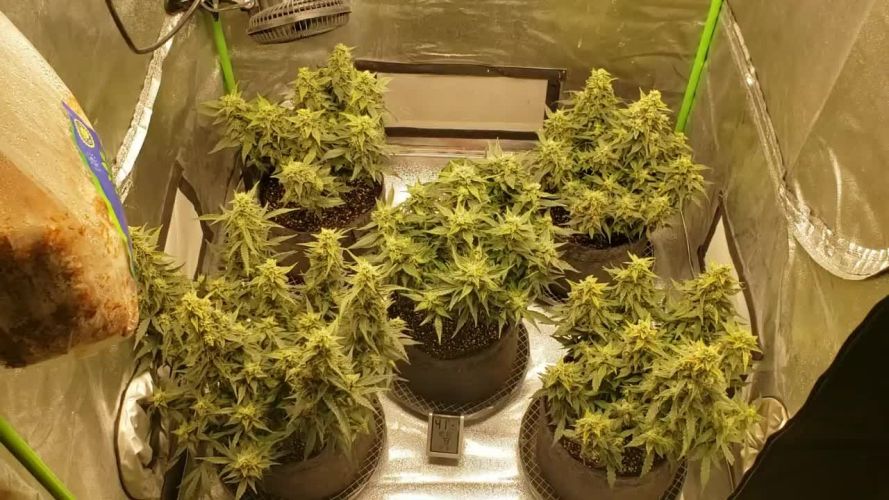
Day 57: Girls looking good and healthy. Got the HLG turned up 100% pumping 500 watt to em! We shall see. Still only given around 500ppm nutes.
Day 58: Got mostly cloudy with just a couple amber it looks like. I'm thinking I need to start flushing. Albeit, only on one plant. I will wait a few days more until I make a decision.
Day 59: Still looking beautiful! Buds are getting thicker! Decided I will give MOAB till week 10 and check the tric's at that time. Prob start flushing at that time. Only time will tell.
Day 60: Girls looking good. 👊 Not gonna lie, getting nervous as I do not want to cut em too soon or too late. This is a tough spot. The one has a ton of red hairs. It looked as if there was just a couple of amber that I found the other day. I was looking on the outside of the buds, also. So I know the inside is where I need to look. Just not wanting to jack with them too much. I will check again at end of week.
Day 61: Busy. No updates.
Day 62: These girls are starting to smell amazing!! I don't see any noticeable growth here lately. I'm hoping they start to bulk even more though as I think I am still seeing some clear trichomes.
Day 63: Welp, all is well and no new updates. I been feeding pretty heavy so I will back off and just water tomorrow.


@thenotillwizard
Follow
Harvested at day 76, after 72h of darkness.
Very good yield!
3.3 pounds of dry buds + 1 pound of trim
The 2 keepers yielded 366 and 342g of premium quality smoke.
Very uplifting and energizing high :) Love it!


@Elysian_gardens710
Follow
This is week 10 for our AK-47 Auto Goxuak by Genehtik. She is finishing out great! For the most part she yellowed out but some sugar leaves and caylxs have purple in them.
Her buds just keep stacking! Ashoka is already way past her estimated period and still showing white pistils(stoma?) And clear Trichomes.i tried to get some shots.failed mainly lol. When that changes we will chop her.
Taking advantage of the longer flower I decided to pull a few of her branches back down to expose the buds to more light. Thicken them up I hope!
I flushed her again. This time just in the sink with running tap water(our water is horrible too!) I didn't pH the water or add any Kleanse this week. I also stopped giving her Real Growers recharge.
She smells great! Like Pepper and a little skunk.


@BLAZED
Follow
Week 12 (17-4 to 23-4)
17-4
Temperature: 23.1 degrees (lights on) 19,1 degrees (lights off)
Humidity: 62% (highest) 50% (lowest)
18-4
Temperature: 22.5 degrees (lights on) 17.9 degrees (lights off)
Humidity: 61% (highest) 52% (lowest)
Opened the reservoir for a couple of minutes.
19-4
Temperature: 22.5 degrees (lights on) 18.4 degrees (lights off)
Humidity: 64% (highest) 54% (lowest)
No pictures.
20-4
Temperature: 24.1 degrees (lights on) 19.1 degrees (lights off)
Humidity: 65% (highest) 54% (lowest)
Light increased from 50% to 60% strength.
I also made a new 10L feed, and added it to the reservoir, there was still 2850 ml in the reservoir, so i can calculate how much they get per watering.
Opened the reservoir for a couple of minutes.
21-4
Temperature: 24.4 degrees (lights on) 19.3 degrees (lights off)
Humidity: 66% (highest) 54% (lowest)
No pictures.
22-4
Temperature: 23.7 degrees (lights on) 19.7 degrees (lights off)
Humidity: 67% (highest) 42% (lowest)
Opened the reservoir for a couple of minutes.
23-4
Temperature: 23.6 degrees (lights on) 17.7 degrees (lights off)
Humidity: 64% (highest) 50% (lowest)




@AsNoriu
Follow
Day 78. Humidity keeps very high, all fans on max, extraction exhaust is on 70%.
Day 83. Found maybe WPM on one plant, so now all air movement on max of all maxes ;))))
Happy Growing !!!


@CanadianFillmore
Follow
Thanks for stopping by growfessors, week 4 begins. Not much to report other than I'm happy with the bud development.


@CheeRz
Follow
We started LST but the the lady in the back of the left side is round about 8 cm higher than the lady in the front. It looks like they r different pheno types. I hope that she'll grow faster now. If not I've to put her on a shoe box to match the height of the other plants.


@Ieiogrow94
Follow
Eccoci qui...
Siamo quasi alla fine del cultivo, odore, resina e colore ci sono. Attendiamo solo la maturazione delle cime che richiederà 1 settimana....
NON VEDO L'ORAAAA...
Seguiranno aggiornamenti, grazie a tutti per il supporto🔥🌲❤️
