




Likes
5
Share


@MadeInGermany
Follow
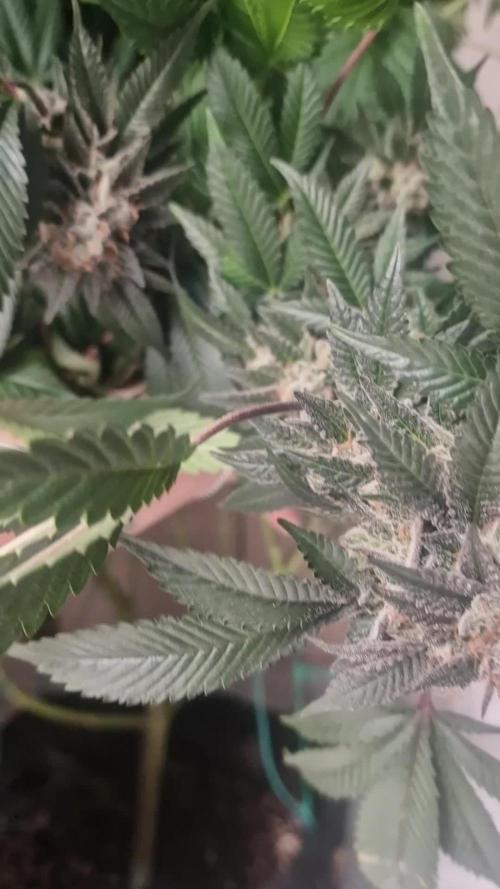
Harvest day 68
since time switch
to 12 / 12 h
Hey guys :-)
Finally it's time 💚
The lady is done the large leaves have been removed and hung upside down to dry in the dark drying room.
You can now stay there for 13-15 days at a temperature of 18-20 degrees and 55-62% humidity.
After 13-15 days it is neatly trimmed by hand and placed in jars with boveda packs 62.
After 4 weeks Boveda 58% come in and are ready for testing ;-).
After everything has been cut cleanly, the last update comes with the smoke report and the finished pictures.
Let's get to the plant 💚.
First of all I would like to compliment Green House for this genetics.
Unfortunately, the rating system at Growdiaries is a bit strange because I have to give the stars before the Smoke Report and in the end it might have led to more stars in terms of taste.
The growth was great from start to finish.
She had no problems at all and also had no problems with animals 👍.
I'm amazed at the great smell the beautiful buds give off😀.
Of course I cut cuttings and if the taste is as good as the smell it will be grown again ☺️.
A final report comes with the Smoke Report.
Until then, I would like to say thank you to the whole Green House team and wish you all the best fun with the diary 💚🙏🏻
Have fun and stay healthy 💚🙏🏻
👇🏼👇🏼👇🏼👇🏼👇🏼👇🏼👇🏼👇🏼👇🏼👇🏼👇🏼👇🏼
‘Powered by GreenHouse Feeding’
Copy the link for 10% off all Nutrients 👇🏼
http://shop.greenhousefeeding.com/
affiliate/madelngermany_passiongrower/
👇🏼👇🏼👇🏼👇🏼👇🏼👇🏼👇🏼👇🏼👇🏼👇🏼👇🏼👇🏼
Water 💧 💧💧
Osmosis water mixed with normal water (24 hours stale that the chlorine evaporates) to 0.2 EC. Add Cal / Mag to 0.4 Ec Ph with Organic Ph - to 5.8 - 6.5
MadeInGermany

Likes
26
Share


@D33jW
Follow
📅 Week 10 – Day 69 / FLO35
🌞 Temp: 26–28°C
💦 RH: 60%
💥 PPFD: 720 µmol/m²/s
🌬️ VPD: ~1.3
Nothing major this week – the flowers are stacking up nicely considering the conditions we have during this summer run.
It's warm during the day and warm at night, so metabolism isn’t running at its best.
A lot depends on the weather now, so I'm keeping my fingers crossed for cooler nights to help things along.
Stay wild – and keep growing 🌱







Likes
18
Share


@smoker420
Follow
Some really nice cherry here rosing runs are great on this strain good returns and the rosin has a slight wax texture to it glad i had chance to grow this will be deffinatly growing again

Likes
12
Share


@FlavoursUk
Follow
Last day of week 4 and the girls are looking well, growing and thickening up well. No problems so far. If you're following along make sure you follow my Instagram and YouTube for more in depth details on my grows. Both links can be found on my profile. Instagram.com/flavoursuk_v3

Likes
2
Share


@CalGonJim
Follow
5/5 MONDAY Took out the AC Infinity lights and just went with the 2 cheap blue and red lights. Samsung 301B.. H?....great lights but so powerful and no blue red combo. I noticed the plant grow towards the red spectrum LED than the whiter ones on the AC system. There are 2 on each bar. I use the AC lights as auxiliary when I get need it for taller plants with lots of vegetation. 2pm looking great.
'"Sir, I have seen nae deerskin treaty, nor have I seen fairies or water sprites. But what I do have are Malay coins, enough to bury you. Prayer beads, not enough to get you to heaven. And hashish, enough to ease my grieving when the East India Company slit your throat, which, of course, they will."
― Brace in a conversation with James.
5/5 11pm Monday night, MORNING for me.....WHAT IS THIS?????
CONKEY IS ALIVE!!!!!!
CONKEY IS ALIVE!!!!!!
CONKEY IS ALIVE!!!!!!
CONKEY IS ALIVE!!!!!!
CONKEY IS ALIVE!!!!!! HOLDY SHILT I CANT BELIVE IT, NOW WHAT THE FUCK DO I DO???? I GOT OUTSMARTED BY A SEED!!!!!! A-FUCKING-GAIN!!!! HOW CAN I NOT BE SMARTER THAN A SEED....??????🚨
5/6 1230am..... ALL OF THIS IS SOMEONE ELSE FAULT....... Now I have a freakshow Siamese twin plant, PERFECT.
When Im not flying off in a rage about things I break....it's a fucking comet of disaster.... I typed comedy you stupid ficler.... Maybe I keep them in the same pot and call them Cory & Trevor!!!
2am They are getting a little humid so I have to open the top for a while. The cheaper lights work better. and are less than 15w
5/7👍🚨Looks like Cory & Trevor are fighting 😂😂
5/8 looks good. 8am getting great photos on small iPhone by pulling back a little bit so it doesn’t focus too far behind.
5/10 2am. I was able to empty my disgusting body of toxic shit...these plants are rebuilding by digestive tract and systems. A multi-year painful endeavor I have achieved through weed. so fuck you if you dont like it. I will defend my rights with overwhelming force. if you try and take it. you know exactly what I mean and yes this means you badgey mc fafo.
5/11 12 pm
Likes
4
Share


@ChitownCannaChica
Follow
Pictures would be better if I took her out, but I’ll wait another week for some glamour shots. Just chugging along. 1-2 more weeks!
Stacked colas

Likes
18
Share


@Ironblimp
Follow
End of Week 13, marks the end of Week 9(63days) of Flowering. Trichomes are less clear, more cloudy-milky, and frosty, but all I'm waiting on is anywhere between 10-30% of the trichomes to change its color to amber to decide when to harvest. After the gradual down shift in nutrient feeding and flushing transition, the buds still grew almost 1/2'' or so since last week, with slow signs of deficiencies(nitrogen only), but instead could be the natural plant cannibalizing process in action. I will continue to flush with water only until harvest, to effectively drain away the extra nutrients and salts, which should be enough to keep it's natural flavor and smell before harvest.


Likes
12
Share


@Mule420
Follow
Added the epsom salt and calcium supplement to fix my yellowing problem and so far it’s turning it for the better!!! 😂

Likes
1
Share

@DannyGNYC
Follow
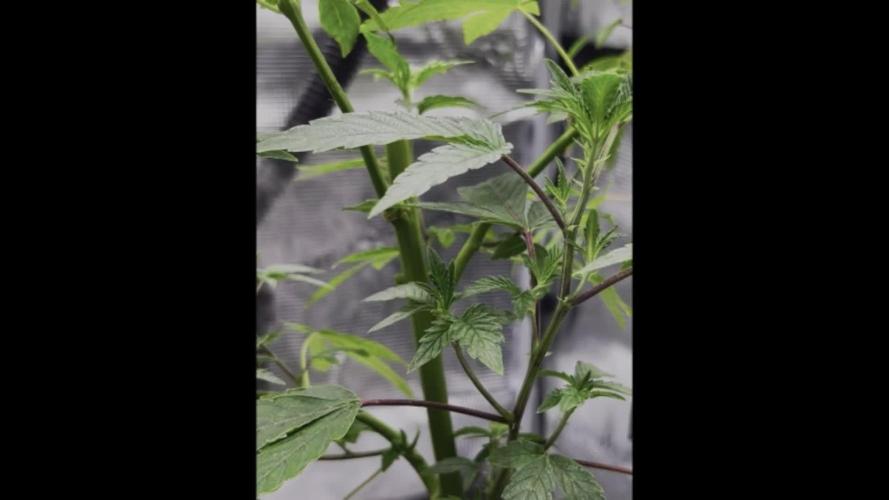
Oh boy, what a week have they got Sick PH was very high. Didn’t know what to do so the last week and a half. I’ve been flushing them bringing the pH down little by little trying to go gentle eventually the last flash show PH at 6.8. Which is OK anything between six and seven is considered optimal range for cannabis plant.
Likes
23
Share


@Zuppler
Follow
**Grow Report by Zuppler - Week 7 Flowering Phase**
Yo, what’s good fam? Zuppler checkin’ in with that Week 7 flowering update, fresh from the Florida heat. We’re gettin’ real close to the finish line now, and these girls are stackin’ up thick! Buds are solid, and the trichs are lookin’ like a snowstorm hit ‘em – straight frosty.
After dialin’ back the nutes last week due to that light leaf burn, things are lookin' smooth again. They bounced back nice, and the Overdrive is really kickin’ in now. I can see that final push as the buds swell up, and the resin production is off the charts.
The smell in here? Wild. You walk in, and it hits you right in the face. Real loud, like you can’t hide it no more. But no worries, we got it all under control. Temps and humidity are locked in, and the girls are drinkin' up the lighter nute mix just fine.
At this point, it’s all about lettin’ ‘em ripen up proper. Leaves are startin’ to fade, and I’m keepin' a close eye on them trichomes – they’re just about to hit that perfect amber/cloudy mix.
Zuppler signin’ off. The end’s almost here, fam!
Likes
16
Share


@DonKrika
Follow
I still have problems with high levels of humidity, usually around 65% during the night and 55% during the day, I ended up removing more leaves to try to reduce the amount of humidity in the air.
I can see that the buds grew since last week, I was expecting the buds to be a bit bigger this week, but I'm happy with the current size, but I'm happy with the amount of trichomes present.
DAY 96
PH - 5.93
Solution Temp - 19
PPM-2000
Watering Volume per plant - 4L
DAY 103 - Water
PH - 6
Solution Temp - 18
PPM-690
Watering Volume per plant - 4L

Likes
24
Share


@DeepRootsGrowTrees
Follow
SWISS DREAM ROSE 🌹 CBD AUTO
KANNABIA SEEDS
WEEK #8 Overall
Week #6 Flower
This week she's looking beautiful dense purple buds that have trichomes along with the white and orange colored hairs. Great Genetics 👍 from Kannabia Seeds of your looking to grow some CBD!! Stay Growing!!
Kannabia.com
SWISS DREAM ROSE 🌹 CBD AUTO
Likes
2
Share


@Ultraviolet_
Follow
We become aware at such times of man's wonderful ability to bring seemingly unrelated elements into harmonic balance, and receive a glimpse into a world where everything exists in conscious sympathetic attunement to everything else. When we listen to a piece of music that seems to strike a beautiful chord somewhere inside us, or view a painting that simply glows with harmonic awareness well executed, we probably do not spare much time to contemplate the wonderfully intricate combination of vibrations that our sensors make it possible for us to perceive. We tend to appreciate the relationship between the parts of something by an awareness of the harmony or dissonance of the whole. This ability enables us to say "what a beautiful house!" instead of "analysis has proven that this collection of building materials exhibits certain elements of harmonic proportion." While this ability to instinctively appreciate the beauty of true harmony has an important role to play in evolution, a more analytical understanding of the laws involved can be most useful. This is especially so if we wish to create works of art where each part exists in true harmony, not only with the other part of that particular whole, but with the universe within which the creator and the created exist.
Everything vibrates. From the most dense matter to the most subtle cosmic rays, everything which our senses allow our thoughts to become aware of, can be specified in terms of wavelength or frequency of vibration. These two terms define the same thing, but from different points of view.
The following are the approximate wavelengths of various energy carriers:
Cosmic rays 0.000,000,001 mm
Gamma rays 0.000,000,1 mm
X rays 0.000,500 mm
Ultraviolet rays 0.003 mm
Visible light 0.006 mm
Infrared 0.01 mm
Sound waves 1 meter
Radio waves 300 meters
Violet light 400 nm to 450 nm
Blue light 450 nm to 500 nm
Green light 500 nm to 570 nm
Yellow light 570 nm to 590 nm
Orange light 590 nm to 610 nm
Red light 610 to 700 nm
1 nanometer (nm) = 0.000,000,1 cm = 1/10,000,000 cm
If a guitar string is plucked and we hear a sound, it is not too difficult for the human mind to associate this sound with the vibration of the guitar string. With color it is quite different. It is difficult for us to conceive that the color of a substance is not an inherent property of the substance itself, but an indication picked up by our senses of that substance's ability to absorb or reflect the light which happens to be shining on it at that moment. Neither the matter nor the light is colored. What happens is that the brain learns to differentiate between the frequencies reflected or transmitted by the substance the eyes are focused on. The same thing happens with sound. When we say "Oh! Listen, they're playing my favorite song," what we really mean is: "My brain has stored within it a particular pattern of frequencies. I have compared the new information being received with this stored pattern and have deduced the answer that the two patterns are similar within certain specified tolerances." The 'pleasure' involved could have something to do with our running the pre-recorded pattern at the same time, in 'sympathy' with the new pattern as it is received.
The word sympathy describes very well our ability to appreciate color and sound. It also describes the reason behind certain elements of harmony. For instance, if a substance vibrating at 100 cycles per second (tone 1) is in the proximity of another substance vibrating at 200 cycles per second (tone 2), we could perceive, if we had the right equipment, a certain sympathetic relationship between the two.
We will see from this that there is a uniform doubling of the first tone seen in the second. At various points along the waves, the two are the same in amplitude. At other points, they are at opposite poles to each other. This doubled frequency has more points of similarity to the original than any other frequency except the original itself. If the equipment we had available for measuring these two frequencies was a soundboard amplifier and a pair of ears, then we would hear what would sound to us like one tone. If we had the opportunity to hear one at a time, we would hear that although they sound the same, one is higher in pitch than the other. This characteristic of 'the same but different in pitch', musicians have called the octave. Any two tones produced where one has exactly doubled the frequency of the other is called an octave. Speaking in ratios, an octave would appear then as the ratio 2:1 or 1:2, depending on whether we are talking of an octave up or down.
A single note produced by almost any instrument will contain more than one wavelength or frequency. It will have a dominant frequency, the wavelength of which we would call the note's 'fundamental' or 1st harmonic. It will also have a varying number of upper harmonics, gradually fading in intensity into infinity or silence.
Natural harmonics always have the same pattern of intervals between them. The interval between the 1st and 2nd harmonic is a perfect octave; between the 2nd and 3rd a perfect fifth; between the 3rd and 4th a perfect 4th; and so on, the intervals becoming smaller and smaller until they lose any relationship with the western 12 tone scale as it exists at the moment. Just as an octave has certain elements of sympathy with its fundamental, so some intervals have been noted to be more perfectly in sympathy with the fundamental than others. The ratio of the 'perfect 5th' or interval of 7 semitones, as it occurs in the harmonic series, is 3:2 or 2:3, while that of the 'perfect fourth" is 4:3 or 3:4. All the tones in the western 12 tone scale can be expressed in terms of the ratio between the upper tone and its fundamental. This would seem to be an ideal way of generating a scale from any given fundamental and several attempts have been made to do this, the Pythagorean system being probably the most well known. Although when working with a single tone instrument playing on its own, the Pythagorean formula works wonderfully well, if we had several instruments tuned this way together and asked them to play almost any western music, we would find that at times they sounded quite out of tune to each other.
The lack of flexibility of the various scale systems based on the harmonic series has led to what is known as the 'tempered' scale. This uses as its primary unit of interval the ratio of the octave or 2:1. It then proceeds to divide the interval between any fundamental and its upper octave into 12 smaller intervals by applying the ratio: two to the one-twelfth power, to one (21/12:1). This equals 1.059463094, so by multiplying any frequency by this number, we will obtain the tempered semitone next up from our fundamental. We will also find that any tone twelve semitones up from any other tone, in a scale generated in this way, will have exactly double the frequency.
If we took the note middle C on a piano and halved the wavelength, we would have the note C one octave above. If we halved this, we would have the C above, and so on. However, within about 6 octaves, we would find that although a 'sound' was being produced, no human ear could perceive it. If we kept on going, halving and producing upper octaves of our fundamental C, we would proceed through the infrared band, into the visible light spectrum. If we happened to be outside during the day, we would, for one octave only, see the note C with our eyes. The next octave above would already be in the ultraviolet band, and outside the eye's sensitivity range. If we can think of color as being an indication of a substance's vibratory rate or wavelength, we may begin to see a relationship that could exist between the color and sound spectrums.
The logical extension of what has so far been said is that there exists a scale in the color spectrum that corresponds exactly to the scale in the sound spectrum, each color tone being an octave of the equivalent note in the sound range.
This is not the end of the story but only the beginning. If we can for the moment accept that any wavelength in one band has upper and lower octave stretching out to infinity, then the next question is 'fine, but what shall we use as our fundamental? A particular color? A particular sound frequency?' The musicians among us will probably say 'A 440'. This means that the note A should vibrate at 440 Hertz, or 440 times per second. They would tell us that this is standard pitch has been adopted by most orchestras around the world; pianos are tuned to it, instruments are constructed to formulas based on it, and so to them it would probably seem the most appropriate place to begin. Some of these musicians may know of the battle that is still raging with regards to this being the standard, but few would know why A = 440 Hz was chosen except that it worked when it was set to be a suitable compromise between the many different pitches in use at the time.
432 Hz is said to be mathematically consistent with the patterns of the universe. Studies reveal that 432 Hz tuning vibrates with the universe’s golden mean PHI and unifies the properties of light, time, space, matter, gravity, and magnetism with biology, the DNA code, and consciousness. When our atoms and DNA start to resonate in harmony with the spiraling pattern of nature, our sense of connection to nature is said to be magnified.
Another interesting factor to consider is that the A=432 Hz tuning correlates with the color spectrum, while the A=440 Hz is off. Audiophiles have also stated that A = 432 Hz music seems to be non-local and can fill an entire room, whereas A=440 Hz can be perceived as directional or linear in sound propagation.
Once you adopt the idea that sound (or vibration in general) can have an equalizing and harmonizing effect (as well as a disturbing effect), the science of harmony can be applied to bring greater harmony into one's life or tune to specific energies. There is a form of absolute and relative harmony. Absolute harmony can, for example, be determined by the tuning of an instrument. The ancients tuned their instruments at an A of 432 Hz instead of 440 Hz - and for a good reason. There are plenty of music examples on the internet that you can listen to in order to establish the difference for yourself.
Attuning the instrument to 432 Hz results in a more relaxing sound, while 440 Hz slightly tenses up the body. This is because 440 Hz is out of tune with both macro and micro cosmos. On the contrary, 432 Hz is in tune. To give an example of how this is manifested microcosmically: our breath (0,3 Hz) and our pulse (1,2 Hz) relate to the frequency of the lower octave of an A of 432 Hz (108 Hz) as 1:360 and 1:90.
It is interesting to note that 432 Hz was the standard pitch of many old instruments and that it was only recently (19th and 20th century) the standard pitch was increased. This was done in order to be able to play for bigger audiences. Bigger audiences (more bodies) absorb more of the lower frequencies, so the higher pitch was more likely to “cut through”. One of the oldest instruments of the world is the bell ensemble of Yi Zeng (dated 423 BC), tuned to a standard F4 of 345 Hz, which gives an A= 432 Hz. The frequency of 345 Hz is that of the platonic year! Similarly, many old organs are tuned in A=432 as well; for example, St. Peter’s Capella Gregoriana, St. Peter’s Capella Giulia, S. Maria Maggiore in Rome.
Maria Renold’s book “Intervals Scales Tones and the Concert Pitch C=128 Hz” claims conclusive evidence that 440 Hz and raising concert pitch above scientific “C” Prime=128 Hz (Concert A=432 Hz) disassociates the connection of consciousness to the body and creates anti-social conditions in humanity.
The difference between concert pitch A=440 Hz and Concert A=432 Hz is only 8 cycles per second, but it is a perceptible difference of awareness in the human consciousness experience of the dream we share called existence.
Likes
57
Share


@PEAKYPLANTERS
Follow
good evening to all, my friends
God only know what I spent to keep these gems up, but in cure a thing I swallowed another!
The too much warmth in tent has arisen a reaction of strong stress in the plant by transforming their peaks from the shape of fox's tail.
This happens in some cases when the temperature is very high in a tent and makes it believe the plant that is still full summer making it bloom and vegetate at the same time
Processing
Likes
1
Share


@Lifted
Follow
Hooked up my carbon filter today. I'm only using it to scrub the air on a timer. Decided to poke a few holes in the ducting to help move scrubbed air around my plant. Added the other fan back in to keep air circulating. Since I don't have fresh air coming in I plan on using a supplement for co2. What are you guys using? It's only a small 2×2×6 tent with one plant and running a 150w HP's light.

Likes
11
Share


@DixTheReal
Follow
Giorno 36 - ho sistemato meglio l’apicale rinforzando con nastro di carta e mettendo il sostegno di gomma sotto. Vedremo nei prossimi giorni come si evolve la situazione. Ho dato 1 lt di acqua a testa in irrigazione
Giorno 37 - L’apicale sembra stare decisamente meglio, ogni volta si stacca dal sostegno e cerca di andare verso la luce.
Giorno 38 - ho dato 1litro di acqua a testa in irrigazione, domani alzerò i dosaggi di fertilizzanti a 1ml/lt per ognuno
Giorno 39 - ho dato 1litro (0,5 l a testa) di fertilizzanti in quantità (1ml/L di bio grow, bio bloom e top max), vediamo come reagiscono le piante
Giorno 40 - il terreno é ancora umido, irrigherò domani, sembra abbiano reagito bene alla dose in più di fertilizzanti che ho dato ieri
Giorno 41 - ho dato 1litro di acqua a testa perché una delle due aveva le foglie totalmente abbassate, verificherò tra qualche ora se si é ripresa
Giorno 42 - stanotte alle 3 le foglie di una erano completamente abbassate di nuovo, il terreno é umido quindi non ho irrigato, credo che annaffierò domani