Likes
Comments
Share
Welcome to Flower week 10 and harvest of Zamnesia Kalini Asia For this Project , I’ve chosen the Feminized Photo Strain Kalini Asia : Here’s what I’m working with: • 🌱 Tent: 225x150x150 • 🧑‍🌾 Breeder Company: Zamnesia • 💧 Humidity Range: 35 • ⏳ Flowering Time: 7-8weeks • Strain Info: 22%THC • 🌡️ Temperature: 26 • 🍵 Pot Size: 16 • Nutrient Brand: Narcos • ⚡ Lights : 600W x 2 I would truly appreciate every bit of feedback, help, questions, or discussions – and of course, your likes and interactions mean the world to me as I try to stand out in this exciting competition! Let’s grow together – and don’t forget to stop by again to see the latest updates! Happy growing! Stay lifted and stay curious! Peace & Buds!
Likes
28
Share
No fertilizer this week. I harvested the Apricot and the Pound Cake. I will wait one more week for the Orange Sherbet because it doesn't seem ready even if it's in the Fast Buds harvest range. This week should be the last "flowering" week, next ones will be the harvests. I don't want to add another flowering week just for the Orange Sherbet, there will be nothing to see that will not be included in the harvest. During half of the grow, the weather was really bad, especially for the summer period. The worst weather was during the vegetative phase. The plants didn't receive enough light which resulted in poor roots and leaves development. Because of that, the plants didn't have the chance to grow nice buds even if the sun was there during most of the flowering phase. Last summer, I grew a Tropicana Cookies (also from Fast Buds) in a tiny pot at the exact same spot and had better results despite the smaller pot. I didn't record the sun for that year but the weather was better from what I remember. I'm disapointed by the weather but cannot blame the plants. You cannot expect beautiful plants and buds if they don't have light 😞 In the end, my summer grows are more like bonus grows (my main grows are under a light in the winter) and I make them just for fun and to be able to taste new weeds without too much investment. So, mission accomplished 😎 Parameters : ------------------------------------------- Humidity range : 30-70% depending on the sun Temperature range : 22-30°C depending on the sun SUN Average : sunny
Likes
1
Share
There is a timelapse of this week, Blueberry is in the background. This entry covers days 30 - 38. This week has seen violent acts. I've topped the blueberry. She's doing well! I've started to give this plant less light so I can give more energy to the flowering GSC auto. I'm not sure how much this will stunt my plant. Lately my feeding schedules for both this plant and my GSC auto are obtained by following the GH Flora Series recirculating feed chart on the General Hydroponics website. I put the amounts they suggest for 1 gallon, but I use 3 gallons of water. So, I give the plants 1/3 of what the feed chart recommends. It's worked well so far. My plants are thriving, and I haven't seen signs of nutrient burn. The only deficiencies I encounter are Cal Mag. I remedy this by mixing in some tap water with my RO water.
Likes
21
Share
What is 1st week has gone pretty well after the germination it's got a little bite taken out of it from a tiny bug but other than that it settled in in the soil nicely had its 1st feed with 0.5 mil of expert nutrients grow A 0.5 of grow B 0.5 mil per litre of exponents master root with a ph of 6.5. As I said in the germination update I'm planning to grow this one throughout the whole year until October .
Likes
125
Share
@Regenwurm
Follow
Die 10 Blütewoche ist erfolgreich abgeschlossen! Tage der Wachstumsphase = 32 Tage. Tage der Blütephase = 70 Tage Wachstum h in Blütewoche 9= 0 cm Blütenbildung: Hoch Die Blütenkelche beginnen mit der Produktion Der Wasserbedarf der Pflanze reduziert sich etwas. Diese Woche 3 Tage die Pflanze austrocknen lassen. Mutation 1= strähnige Blüten (wie bei der Dr. Greenspoon öfter mal vorkommt) Mutation 2 = Gigantismus (doppelt so viele DNA Ketten wie regulär) 2 mal in dieser Woche mit Purolyt Mischung 1:25 besprüht Lichtstärke: 90 % Lichtabstand: 36 cm Std Tag/Nacht: 12/12 Temperatur Tag: 25-26,5 Grad RLF Tag: 55-61% Temperatur Nacht: 20-21 grad RLF Nacht: 50-55 % VPD Wert: ca. 0,90-1,1 PH Wert Wasser/Düngelösung: 6,3 EC Wert: 1,5 Ventilator Oszillation: Stufe 2 Befeuchter: aus Entfeuchter: mit Steuerung an Zusätzlicher Entfeuchter: 1 Stk außerhalb vom Zelt im Raum Bewässerung: 1* Wasser PH 6,6 EC 0,1/ 2 * bewässert mit Dünger mit den o.g. Mengen Purolyt Besprühung: 2 mal Controlling: Grow Control Dünger: Greenbuzz Nutrients Licht: Pro Emit Vollspektrum Abluft: EC Carbon Active 750 m3 gesteuert/PrimaKlima 480m3 https://greenbuzznutrients.com/de/ Danke an Greenbuzz Ihr bekommt 25 % Rabatt bei der Nutzung des Codes auf der GB Homepage https://greenbuzzliquids.com/de/shop/ Code: GD42025 (Mindestbestellwert 75€)
Likes
3
Share
Todo llego a su fin, aun no se cuanto es el peso final pero tieme muy buena pinta. En unos dias actualizamos con fotos del secado y resultado final
Likes
91
Share
Week 1 Day 5 Flower Hi Everyone 🖐️🏻 Thanks for looking in! I switched to flower 5 days ago and the girls are filling out well each day. I just today drilled a hole in the floor and inserted an iron rod into it which now pulls the net in a lot tighter and has allowed me to start tucking and guiding branches where they can get the best light and fill the net. I have supported this with a bit of defoliation to get light to those lower branches and get them pushing growth towards the canopy. As the next two weeks progress I will continue to defoliate and even remove some lower branches which aren't likely to benefit the canopy and in fact deprive the canopy of some energy. The roots are looking good rapidly colonizing the tubs, I've had to return them to the trays from the reservoir below several times which is a headache I'm happy to have😂 I may have flipped too early and aren't likely to fill the area but it should still be a heavy crop and if rather have a manageable grow than a jungle. If it proves way off then next time I grow the same strain using the same method I'll add another week to the veg. Thanks for looking in GDCommunity and thanks in advance for any help, advice and general support ✌️🏻Peace 🔥Fire 👨‍🌾Farmer
Likes
Comments
Share
@Lolasola
Follow
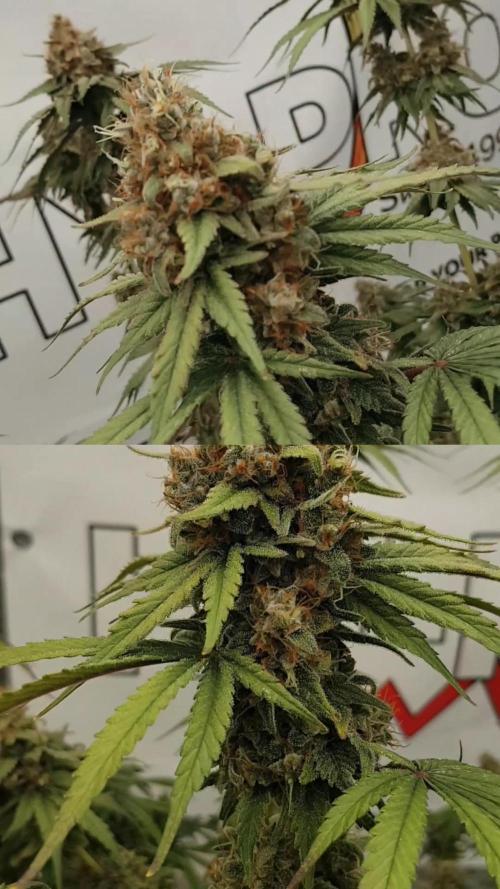
We start to see the purple ☘️🤩 2.5ec 47day flowering
Likes
20
Share
@UDAAC
Follow
Well welcome to week one flower ! I am so grateful she seems happy starting to get the system balanced I’m running rdwc two five gallon buckets with a 3” flex line connecting the base to base With ball valves to control the water height in grow bucket 320gph sub pump in the Reservoir bucket then to water chiller back to grow bucket large enough dependable oxygen pump for grow and reservoir water oxygenation I also alternate Southern Ag GFF and Hydro guard let’s go!
Likes
27
Share
Esos fumetillas, que ya ando por aquí, que las mudanzas son mu largas, pero todo acaba y ya al 100%. Germine en que estuve estable 4 do sweet dos de sweetseeds, un híbrido que bien cultivado es increíble, tanto de sabor como de colocón, no os quiero adelantar mucho os dejo por aquí la información de la primera semana. . El ph lo tenemos en 5.8 la humedad ronda los 70/80% y la temperatura está entre 22/24 grados. Bien controlado en su primera semana de vida. . La alimentación de la gama agrobeta. 0,5 ml x L Piramid , vía radicular. 0,5 ml x L Growth black line , vía radicular. 0,1 gr x L Cancerbero , vía radicular. 0,1 ml x L Tucán , vía radicular. 0.1 ml x L Flash Root , vía radicular. 0,4 ml x L Great Green , vía foliar. Son las cantidades exactas las cuales aplico 1 vez por semana. . Soy el primero que está deseando ver cómo florece, y se que todavía queda unas semanas, pero poco a poco lograremos el objetivo, buenos humos fumetillas 💨💨💨
Likes
3
Share
Likes
17
Share
Likes
11
Share
Likes
17
Share
Lightly defoliated her for better air circulation and removed a few bud sites below ScrOG net that will never make it to the top. New light fixture has been added this week; Mars hydro FC3000, this is the EVO version with the latest Samsung chips. Overkill or killing it? We will see.
Likes
5
Share
@Ninjabuds
Follow
My Rainbow Saltz plant is a medium-sized beauty in the tent. It's got really nice, healthy leaves and an incredibly strong aroma already. I'm excited to see how it develops! Okay, This past week has been absolutely fantastic! The weather has been incredible, and I've been able to keep the windows open almost the entire time. My plants are thriving in the humidity, and the VPD has been perfect. Everything just feels so balanced and in check.
Likes
45
Share
2nd net is up. Early bud formations are promising. holding up to the extremes pretty well, some leaves taking minor damage, but overall, she is holding up, gave her 1 night at 50F see how she would react, stressful. Not advised as it messes with her metabolism, but I want to see if it triggers any anthocyanin response. Love to see her purp up but no signs yet. Remember, For every molecule of glucose produced during photosynthesis, a plant needs to split six molecules of water. This process provides the hydrogen needed for synthesizing glucose and other organic compounds, while oxygen is released as a byproduct. Homework. If Rubisco activity is impaired and it cannot properly function or regenerate its substrate, the plant's leaves are likely to turn a pale green or lime green, a condition known as chlorosis. Essentially, Rubisco activity is highly regulated and susceptible to various environmental and metabolic factors that can cause it to become inhibited, leading to an apparent failure in RuBP regeneration due to a lack of consumption. Rubisco regeneration is intrinsically linked to nitrogen supply because Rubisco is a major sink for nitrogen in plants, typically accounting for 15% to over 25% of total leaf nitrogen. The regeneration phase itself consumes nitrogen through the synthesis of the Rubisco enzyme and associated proteins (like Rubisco activase), and overall nitrogen status heavily influences the efficiency of RuBP regeneration. RuBisCO is a very large enzyme that constitutes a significant proportion (up to 50%) of leaf soluble protein and requires large investments in nitrogen. Insufficient nitrogen supply limits the plant's ability to produce adequate amounts of RuBisCO, thereby limiting the overall capacity for photosynthesis and carbon fixation. Maintaining the optimal, slightly alkaline pH is crucial for the proper function and regeneration of Rubisco. Deviations in either direction (too high or too low) disrupt the enzyme's structure, activation state, and interaction with its substrates, leading to decreased activity and impaired RuBP regeneration. (Lime/yellowing) Structural Component: Nitrogen is an essential building block for all proteins, and the sheer abundance of the Rubisco protein makes it the single largest storage of nitrogen in the leaf. Synthesis and Activity: Adequate nitrogen supply is crucial for the synthesis and maintenance of sufficient Rubisco enzyme and Rubisco activase (Rca), the regulatory protein responsible for maintaining Rubisco's active state. Nitrogen deficiency leads to a decrease in the content and activity of both Rubisco and Rca, which in turn limits the maximum carboxylation rate, Vmax, and the rate of RuBP regeneration Jmax, thus reducing overall photosynthetic capacity. Nitrogen Storage and Remobilization: Rubisco can act as a temporary nitrogen storage protein, which is degraded to remobilize nitrogen to other growing parts of the plant, especially under conditions of nitrogen deficiency or senescence. Nitrogen Use Efficiency (NUE): The allocation of nitrogen to Rubisco is a key determinant of a plant's photosynthetic nitrogen use efficiency (PNUE). In high-nitrogen conditions, plants may accumulate a surplus of Rubisco, which may not be fully activated, leading to a lower PNUE. Optimizing the amount and activity of Rubisco relative to nitrogen availability is a target for improving crop NUE. Photorespiration and Nitrogen Metabolism: Nitrogen metabolism is also linked to the photorespiration pathway (which competes with carboxylation at the Rubisco active site), particularly in the reassimilation of ammonia released during the process. To increase RuBisCO regeneration, which refers to the process of forming the CO2 acceptor molecule Ribulose-1,5-bisphosphate (RuBP) during photosynthesis, the primary methods involve optimizing the levels and activity of Rubisco activase (Rca) and enhancing the performance of other Calvin-Benson-Bassham (CBB) cycle enzymes. Biochemical and Environmental Approaches: Optimize Rubisco Activase (Rca) activity: Rca is a crucial chaperone protein that removes inhibitory sugar phosphates, such as CA1P (2-carboxy-D-arabinitol 1-phosphate), from the Rubisco active site, thus maintaining its catalytic competence. •Ensure optimal light conditions: Rca is light-activated via the chloroplast's redox status. Adequate light intensity ensures Rca can effectively maintain Rubisco in its active, carbamylated state. •Maintain optimal temperature: Rca is highly temperature-sensitive and can become unstable at moderately high temperatures (e.g., above 35°C/95F° in many C3 plants), which decreases its ability to activate Rubisco. Maintaining temperatures within the optimal range for a specific plant species is important. •Optimize Mg2+ concentration: Mg2+ is a key cofactor for both Rubisco carbamylation and Rca activity. In the light, Mg2+ concentration in the chloroplast stroma increases, promoting activation. •Manage ATP/ADP ratio: Rca activity depends on ATP hydrolysis and is inhibited by ADP. Conditions that maintain a high ATP/ADP ratio in the chloroplast stroma favor Rca activity. Enhance Calvin-Benson-Bassham (CBB) cycle enzyme activity: The overall rate of RuBP regeneration can be limited by other enzymes in the cycle. •Increase SBPase activity: Sedoheptulose-1,7-bisphosphatase (SBPase) is a key regulatory enzyme in the regeneration pathway, and increasing its activity can enhance RuBP regeneration and overall photosynthesis. •Optimize other enzymes: Overexpression of other CBB cycle enzymes such as fructose-1,6-bisphosphate aldolase (FBA) and triose phosphate isomerase (TPI) can also help to balance the metabolic flux and improve RuBP regeneration capacity. Magnesium ions, Mg2+, are specifically required for Rubisco activation because the cation plays a critical structural and chemical role in forming the active site: A specific lysine residue in the active site must be carbamylated by a CO2 molecule to activate the enzyme. The resulting negatively charged carbamyl group then facilitates the binding of the positively charged Mg2+ion. While other divalent metal ions like Mn2+ can bind to Rubisco, they alter the enzyme's substrate specificity and lead to dramatically lower activity or a higher rate of the non-productive oxygenation reaction compared to Mg2+, making them biologically unfavorable in the context of efficient carbon fixation. The concentration of Mg2+ in the chloroplast stroma naturally increases in the light due to ion potential balancing during ATP synthesis, providing a physiological mechanism to ensure the enzyme is activated when photosynthesis is possible. At the center of the porphyrin ring, nestled within its nitrogen atoms, is a Magnesium ion (Mg2+). This magnesium ion is crucial for the function of chlorophyll, and without it, the pigment cannot effectively capture and transfer light energy. Mg acts as a cofactor: Mg2+ binds to Rubisco after an activator CO2 molecule, forming a catalytically competent complex (Enzyme-CO2-Mg2+). High light + CO2) increases demand: Under high light (60 DLI is a very high intensity, potentially saturating) and high CO2, the plant's capacity for photosynthesis is high, and thus the demand for activated Rubisco and the necessary Mg2+ cofactor increases. Mg deficiency becomes limiting: If Mg2+ is deficient under these conditions, the higher levels of Rubisco and Rubisco activase produced cannot be fully activated, leading to lower photosynthetic rates and potential photo-oxidative damage. Optimal range: Studies show that adequate Mg2+ application can enhance Rubisco activation and stabilize net photosynthetic rates under stress conditions, but the required concentration is specific to the experimental setup. Monitoring is key: The most effective approach in a controlled environment is to monitor the plant's physiological responses e.g., leaf Mg2+ concentration, photosynthetic rate, Rubisco activation state, and adjust the nutrient solution/fertilizer to maintain adequate levels, rather than supplementing a fixed "extra" amount. In practice, this means ensuring that Mg2+ is not a limiting factor in the plant's standard nutrient solution when pushing the limits with high light and CO2. Applying Mg2+ through foliar spray is beneficial to Rubisco regeneration, particularly in alleviating the negative effects of magnesium (Mg) deficiency and high-temperature stress (HTS). While Mg can be leached from soil, within the plant it is considered a mobile nutrient, particularly in the phloem. Foliar-applied Mg is quickly absorbed by the leaves and can be translocate to other plant parts, including new growth and sink organs. Foliar application of: NATURES VERY OWN MgSO4 @ 15.0g L-1 in a spray bottle. For those high-intensity workouts when 1 meal a day is just not enough! Foliar sprays are often recommended as a rapid rescue measure for existing deficiencies or as a supplement during critical growth stages, when demand for Mg is high. Application in the early morning or late evening can improve absorption and prevent leaf burn. The plant was getting a little limey yellow in the centre. Shortly thereafter, she was back in business, green mostly regenerated. The starting point [of creativity] is curiosity: pondering why the default exists in the first place. We’re driven to question defaults when we experience vuja de, the opposite of déjà vu. Déjà vu occurs when we encounter something new, but it feels as if we’ve seen it before. Vuja de is the reverse—we face something familiar, but we see it with a fresh perspective that enables us to gain new insights into old problems. Confidence is evidence... nothing more. You are confident because you have driven 10,000 times, you are confident because you have spoken 10,000 times. People think confidence is a feeling, but it's not. If you want more confidence, then you need to create evidence, take more shots, collect more data, build more experiences, take more risks; fail, confidence doesn't come first; it is the reward you get for doing the work. no one else wants to do.
Processing
Likes
11
Share
It’s bern roughly two months these guys have been growing! Lst’d Both but untied the gg because I wasn’t sure she was benefiting from it so I’m going to do it over. These ladies (I hope) will start their flower journey next week when I revive my new flower tent 😎..stay tuned for some epic buds..I hope!!
Likes
22
Share
Just getting a jump start on this week's pics. Wow they are so nice!! Fastbuds always make me so happy!! They are taking 1/2 gallon every 2 days. Love watching them grow!!!
Likes
4
Share
🇩🇪 10.12. neue Drähte eingezogen um die kleine weiter in Form zu halten und etwas gerader auszurichten. Happy growing💛✌️ 9.12. gestern den Draht unten am Stamm gelöst, und neue Drähte gesetzt. Heute das Video aufgenommen. Einmal eine rundum Ansicht. 7.12. einen weiteren Draht diesmal mit Gummi Stück eingebaut um den Trieb auf Höhe zu halten und keine Druckstelle zu hinterlassen. 🇬🇧 12.10. New wires were installed to keep the little one in shape and straighten it out a bit. Happy growing! 💛✌️ 12.9. Yesterday I loosened the wire at the bottom of the trunk and attached new wires. I recorded the video today. It's a 360-degree view. 12.7. I installed another wire, this time with a piece of rubber, to keep the shoot at the correct height and avoid leaving a pressure mark.