


Likes
Comments
Share

@Catawbiense
Follow
Die 4. Blütewoche neigt sich ihrem Ende zu. Den Pflanzen geht es soweit gut . Nächste Woche beginne ich mit dem PK 13/14. Vermutlich 2 Giessgänge. Allmählich beginnt es auch sehr lecker zu duften. Hoffe das jetzt nichts rumzickt. Ziel ist es Temperatur und RLF konstant zu halten. Die Pflanze welche am nächsten zur Zuluftsöffnung steht purpelt schon leicht.

Likes
8
Share


@Budhunter
Follow
As I stated before this is my mutant plant hehehhe.. looks like buds are fattening up a bit and more light penetrating in the colas.. she seems to be growing.. happy days

Likes
7
Share


@XoticGROW666
Follow
( RUNTZ X F1DURB X GUSHERS )🍬🌈🍨🍧
PURP KICKIN INN END #WEEK4
CANT WAIT TILL THE BUDS SWELL UPP!!
SUPA INTENSE CANDY TERPS THIS ROUND
NOT BIG BUDS BUT SUPA HIGH IN BRIXX LEVEL WITH ALL THE ORGANIC CARBON INPUTS!! PPM 900/1200 1.2 max
(Face Off OG x Watermelon Zkittlez) X (Runtz x F1 Durb x Gushers) 🍉🍬🌈🍧🍨🍦
LIL PRUPLE TINT WIT MOUTH WATERING SUGARY TERPS KICK INN END #WEEK4 BY WEEK 7/8 SHE WILL BE PURPLE PURPLE WIT SUPER INTENSE CANDY MOUTH WATERING TERPS CANT WAIT TILL SEE THEM BUDS SWELL UPP!! PHENO A/B
NOT BIG BUDS BUT SUPA HIGH IN BRIXX LEVEL WITH ALL THE ORGANIC CARBON INPUTS!! PPM 900/1200 1.2 max

Likes
8
Share


@all_about_420
Follow
Die zweite Blütewoche der Tropicanna Poison F1 Fast Version verläuft absolut nach Lehrbuch. Die Blütenentwicklung ist mittlerweile im vollen Gange: An sämtlichen Triebspitzen formieren sich dichte, vitale Blütenansätze (Budsites) mit einer stetig zunehmenden Anzahl an schneeweißen Pistillen. Der vertikale Stretch verhält sich dabei mustergültig und hält sich erfreulich in Grenzen. Dank der schnellen F1-Fast-Genetik von Sweet Seeds hat die Pflanze den Übergang vom Längenwachstum zur reinen Blütenproduktion extrem zügig vollzogen. Das Kronendach bleibt dadurch kompakt, homogen und perfekt auf einer Höhe. Die Nährstoffaufnahme ist stabil, die Blattgesundheit makellos – beste Voraussetzungen für die anstehende Masse- und Harzbildungsphase!

Likes
102
Share


@Hashy
Follow
Week 9 5th week of flower.
Light settings
12/12 on at 9.00am off 9.00pm
Light power= 75% 184w
Radiator settings
LIghts on
Turn on if temp drops below 23c
Turn off if temp goes above 23c
Lights off
Turn on if temp drops below 18.5c
Turn off if temp goes above 18.5c
Dehumidifier settings
LIghts on
Turn off if humidity drops below 60%
Turn on if humidity goes above 60%
LIghts off
Turn off if humidity drops below 62%
Turn on if humidity goes above 62%
Extractor settings
temperature 25c with 1c steps
Humidity 50% with 2% steps
Max speed 10
Min speed 7
VPD aim 0.8-1.2
DLI aim 30
Wednesday 22/3/23 Day 57 (Day 29 flower)
Nothing
Thursday 23/3/23 Day 58 (Day 30 flower)
Autofeed 4 20 minute runs
(last weeks nute schedule)
Feed 12L Ec=1.93 Ph=6.6/6.5
4.5L left
Roughly 2.5L each.
#3 run 0.1L Ec= Ph=
Pump wasn't submerge properly.
Friday 24/3/23 Day 59 (Day 31 flower)
Moved light more over towards the cheesecake.
Big defoliation
Saturday 25/3/23 Day 60 (Day 32 flower)
Autofeed 4 20 minute runs
Slightly less powerful pump
Calmag 0.5ml/L
4 drops ph d
Feed 10L Ec=0.4 Ph=6.1/6.2
1.5L left
Roughly 2.2L each.
#3 run 0.32L Ec=2.6 Ph=6.1
#3 Height= 63CM Dist= 30CM DLI= 35
Sunday 26/3/23 Day 61 (Day 33 flower)
Nothing
Monday 27/3/23 Day 62 (Day 34 flower)
1.00pm alter heater settings to 22.5c
6.00pm
Extractor settings
temperature 24c with 1c steps
Humidity 50% with 0% steps
Max speed 10
Min speed 4
Tuesday 28/3/23 Day 63 (Day 35 flower)
Feed
(This weeks schedule)
Autofeed 4 15 minute runs
Normal pump
4 drops ph d
Feed 15L Ec=1.75 Ph=6.4
8.75L left
Roughly 2.08L each.
#3 run L Ec= Ph=
#3 Height= 63CM Dist= 30CM DLI= 36
Another week done for the grow. Things are going great.
#3 Gorilla Cookies FF aka the outa control monster, gota luv this plant she has dominated most of the tent.
Power used for week
Light
(2.22+2.21+2.21+2.21+2.22+2.21+2.22)=15.5Kw
Extractor
(0.57+0.57+0.57+0.54+0.57+0.53+0.54)=3.89Kw
Fans
(0.5+0.53+0.52+0.69+0.9+1.08+1.06)=5.28Kw
Dehumidifier
(1.49+0.34+0.71+1.48+0.0+0.0+0.0)=4.02Kw
Radiator
(2.42+2.47+2.74+3.62+5.24+2.1+1.45)=20.04Kw
Water pump.
(0.0+0.01+0.0+0.01+0.0+0.0+0.01)=0.03Kw
Total for the week=48.76Kw
Back in a week.
Thanks for stopping by.
Likes
91
Share


@Salokin
Follow
Hi Growmies,
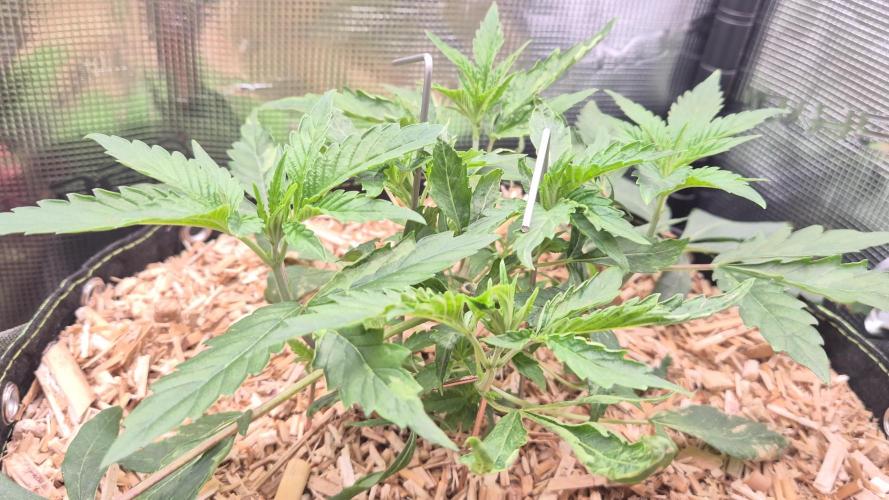
I changed the cutting in the tank to one I still had in my other tent, as these were showing a lot more signs of a revegging plant compared to the one I had in the tank previously. I will top her very soon to stimulate a more lateral growth, before I will move her into the small box in roughly two weeks, once the Afghan is harvested and dried. I have also added a dripper as I suspected the lack of topwatering caused the old one to fail.



Likes
10
Share


@Growbody
Follow
Hallo und herzlich Willkommen zu einem etwas anderen Gropwbericht. Die Blueberry Zkittlez Automatic von Sensi Seeds (der Strain heißt jetzt Blueberry Candiez Automatic) hatte ich letztes Jahr bereits angebaut und war vom Geschmack total begeistert. Deshalb baue ich den jetzt wieder an und dazu die Blueberry Automatic von Zamnesia Seeds, die schon einige Zeit in meiner Samenbank liegt. Mal sehen, wie sich die Pflanzen unterscheiden.
Die URL der Blueberry Automatic von Zamnesia Seeds:
https://www.zamnesia.com/de/3323-zamnesia-seeds-blueberry-automatic-feminisiert.html
Die URL der Blueberry Zkittlez Automatic von Sensi Seeds:
https://sensiseeds.com/de/research/blueberry-candiez-automatic
Beide Strains erhalten die gleichen Bedingungen. Beide stehen in einem 9 Liter doppellagigen Stofftopf von ROOTIES (ChillWelten war der Vorgänger der Firma, heute heissen alle ROOTIES), beide haben die Sonnenerde Bio Hanferde und bekommen und später gibt's noch eine Mulchschicht mit Sonnenerde Bio Faser. Beide haben am Anfang eine Bioledex mit 10W im gleichen Abstand.
Tag 70: Die Blueberry Auto von Zamnesia Seeds hat Spinnmilben bekommen und wird sicherheitshalber separiert. Da waren wohl nicht genügend Raubmilben in den 2 Packungen und die Florfliegenlarven hätten das eigentlich auch verhindern müssen.
Tag 70: Die Blueberry Zkittlez Automatic von Sensi Seeds hat Blattläuse bekommen und wird sicherheitshalber separiert.
Schau mal wieder rein, wenn es dir gefallen hat. Schönes Adventwochenende und bleibt friedlich und humorvoll. ✋😎

Likes
2
Share


@CannaIGrow
Follow
Plant is growing well. Probably the prettiest one outta the bunch so far.
Likes
5
Share


@BenChasinBigBudz
Follow
Initiated flower with a 48 hour period of darkness on the 35th day from seed.
#SFgrow

Likes
12
Share


@Pedro_88
Follow
Estoy muy satisfecho con el crecimiento de mi chemical bride, ayer hubo un fuerte viento y tumbo a mí watermelon skittlez no la pude encontrar, pero ya tenemos otra en proceso que verán en estos días

Likes
4
Share


@stolen_cheese
Follow
What happened to the Purple Kosher? It grew several bananas and since I don't want to throw it away, I tried to cut off every banana I could find. For two days now it didn't grow more bananas, but it feels like the booster dosis was wasted on banana growth :(
The Lemon Mandarin is going really strong with thick buds for this flowerday and it smells really strong like mandarins. Almost like you peeled one inside the tent.
The Bruised Banana has a soft, fruity smell and the Papaya Sherbert probably takes 1 - 2 weeks more than the other 3 plants.
Fertilizers were 1 g of Pflanzengeflüster on 10 L
Plant Booster 3g on 10 L
Weedtamine 10g on 10 Liters

Likes
22
Share


@Rap_a_cap
Follow
Perfect weather.
This girl is a monster, she has gained more than 40 centimetres in 1 week and now (without LTS) will be 6 fts tall.
Strong smell of burned cookies and caramel, very uncommon at this stage.
My first consideration is that Fast Version strains are far behind respect to standard feminized ones.

Likes
10
Share


@RivenWaters
Follow
Starting 7 seeds, only six made it to the solo cups. ETHOS genetics seeds are ; Planet of the Grapes 55ind/45sat, Cotton Candy Grapes 70/30, Grape Diamonds 50/50, Apex Kush 90/10, and Skunk Hero x Afghgan Kush 100/0 ; DNA Genetics seed, Cataract Kush 99/1 Ind. dom.


Processing
Likes
65
Share


@Wicked_Stix
Follow
I did her first water change on day 10 upped the nutrient dose and increased the reservior to 12 gallons. Gave her the first dose of armor si and humic acid. I topped her on day 12 to start 4 main branches. Will most likely top again and start training in about a week depending on how she wants to grow. The goal is a maximum of 5 weeks veg if they cooperate. Of the 6 strains she is a little faster than the rest so far. They are under 240w qb and a galaxyhydro pulling about 140w for now. Will be adding more qb when I spread the buckets out.

Likes
15
Share

@Bncgrower
Follow
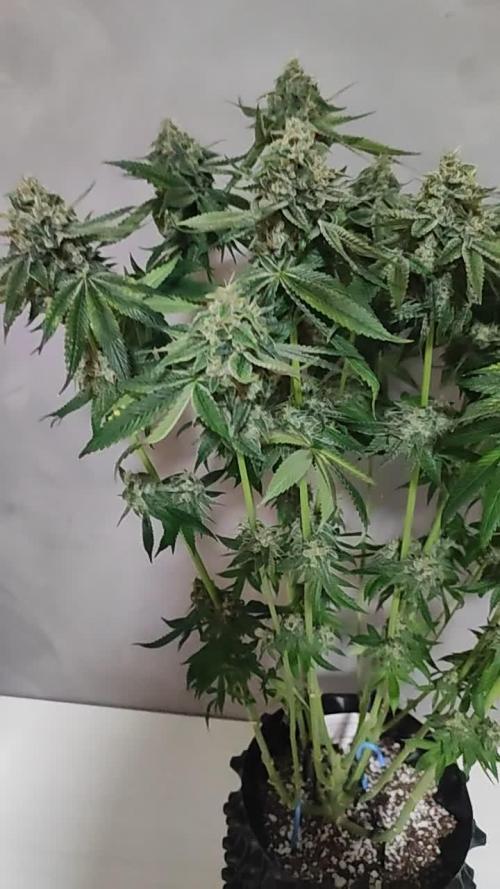
Another week is coming to an end, and we're getting closer and closer to harvest, and with it, those great results. 💪🍁
In these 15 days before harvest, I start watering only with RO water and a pH of 6.2. At the beginning of the last week, and about 3 days before harvest, I'll flush with RO + Cleanse 10mL.

Likes
62
Share


@OwlGang_Uk
Follow
I’ll updats my comment tomorrow
Height Chart:
Girls Scout Cookies: 31 inches (3gal)
Stardawg: 35 inches
Girls Scout Cookies: 40 1/4 inches (5gal)
Gorilla Glue: 33 1/4 inches
Lemon OG: 41 1/2 Inches


Likes
115
Share


@DogDoctorOfficial
Follow
Harvesting the Bounty of Cherry Cola Auto
Dear fellow cultivators, we've reached the triumphant culmination of Cherry Cola's journey as we delve into Week 13 – Harvest Time! Join me in celebrating the fruition of our labor and the bountiful rewards awaiting us as we harvest the radiant buds of Cherry Cola Auto.
As the sun sets on Week 13, the air is filled with anticipation and excitement. Harvest season has dawned upon us, marking the culmination of Cherry Cola's remarkable journey from seed to harvest-ready beauty.
In the heart of the garden, Cherry Cola stands tall, her branches heavy with the weight of abundant buds. Each bud is a testament to her resilience, her vigor, and the care and dedication invested in her growth.
With meticulous care and precision, the time has come to harvest Cherry Cola's radiant buds. Each cut is made with reverence, ensuring that only the finest, most pristine flowers make their way into our stash.
As the buds are trimmed and cured, an aromatic symphony is unleashed, filling the air with the tantalizing scent of Cherry Cola's terpene-rich profile. It's a sensory experience like no other, a celebration of nature's bounty.
As we gather the fruits of our labor, let us take a moment to reflect on the journey that has brought us here. It's been a labor of love, a testament to patience, perseverance, and the boundless wonders of nature.
In conclusion, let us raise a toast to Cherry Cola Auto – a true champion of the garden, a symbol of resilience, and a source of boundless joy. May her harvest be plentiful, her flavors unforgettable, and her legacy enduring. Until next time, happy harvesting, fellow enthusiasts! #CherryColaHarvest #BountifulBuds #GrowersPride
Nutrition: @aptusholland @aptus_world @aptus_
Love, Care, and Attention: @dogdoctorofficial
As always, thank you all for joining me on this journey, for your love, and for it all. My horticultural odyssey would never be the same without you. Your love and support are cherished, and I feel both honored and blessed to have you in my life
Friendly reminder all you see here is pure research and for educational purposes only
Growers Love To you All 💚 💚 💚
Likes
30
Share


@ktkoi
Follow
Day 60: Using LST and FIM Lemon's canopy looks great all the sites exposed to light. Orange is getting taller.. so we'll see how it'll end up. The yellowing leaves might actually be light burn they're pretty close to the light, but the sugar leaves are a bit more protected. I might go back to 20:4 in terms of light schedule or lower the shelf. Smell wise even Lemon's non sugar leaves have a very lovely scent. I'll get back to the scent profile another day.
Likes
15
Share


@DoDhLo
Follow
Finally managed to get some money & bought some real lights (Added a 500W Hps lamp). Also bought aluminum and made a tent .
I Lost track of the plants names . The plants seems to be growing for the first time when i added the extra lamp.
