Likes
Comments
Share
@CannDy420
Follow
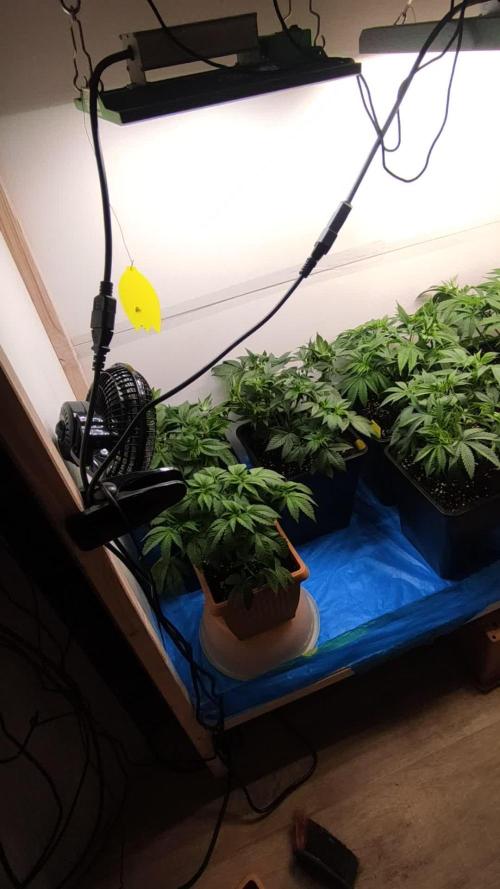
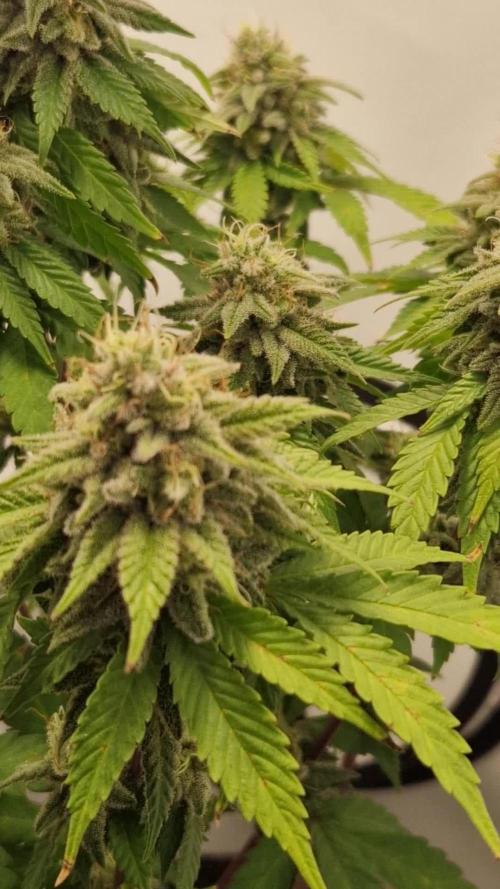
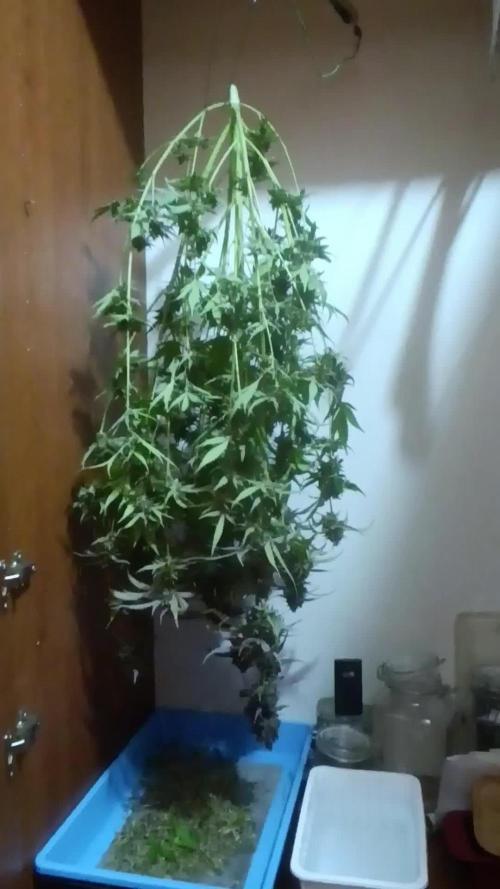
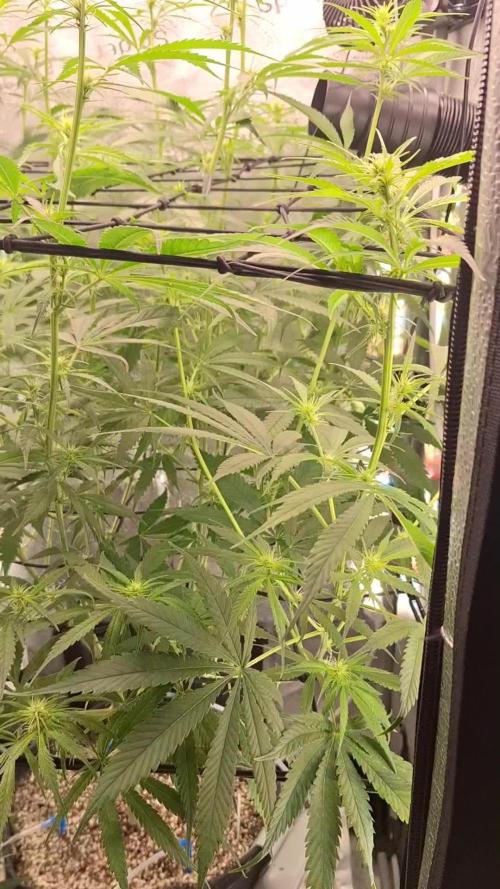
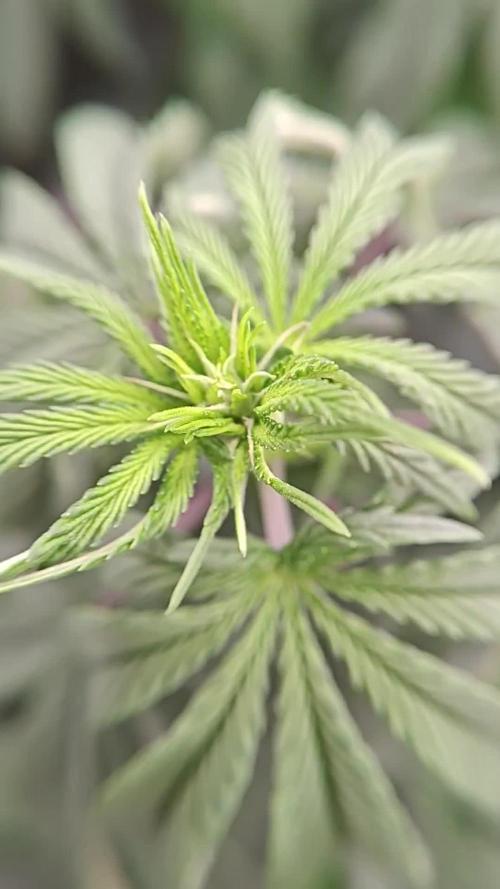
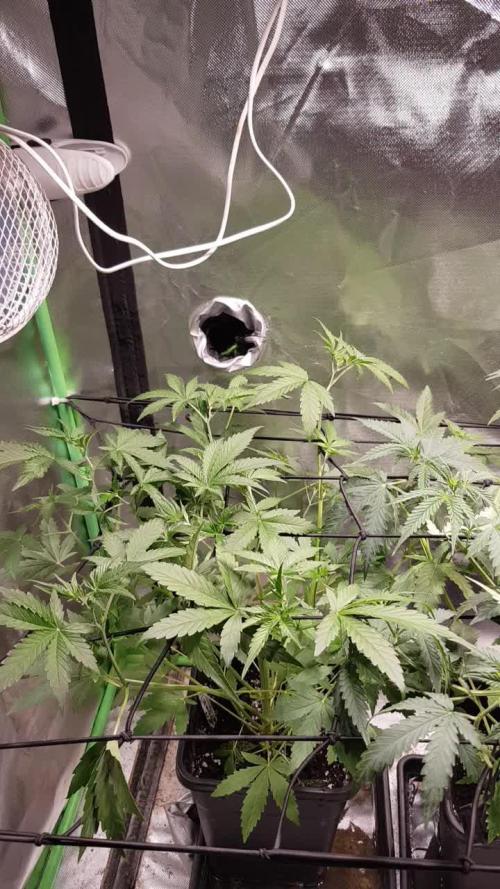
Das frühzeitige umtopfen in die finalen töpfe haben die pflanzen gut überstanden und stehen jetzt in ihrer neuen grossen growbox .
Likes
17
Share
@Hoodoo
Follow
2020-08-17 Beginning of Week 9 of flowering! Wow! The buds in the middle are getting super frosty now and I noticed that I had some colas that had dipped below the light canopy. They're now back up on top! I am still giving nutrients as I don't see many amber trichomes yet but I am going into the tent without the LEDs on to take some more updated pics. Don't wanna miss my window as I prefer to be stimulated instead of sedated by cannabis. Hoping this strain delivers. IF anyone wants to comment on the 'readiness' of my buds for flushing (or not flushing) please leave a comment or message me! 2020-08-23 Updated with this week's entire set of pics! Trying to take more with the lights off and just the flash to capture the trichomes. Looks like the sugar leaves have more amber trichomes. I've been advised by at least one person that it's time to harvest. Still looking for more opinions! Cheers.
Likes
9
Share
day 28 from seed No flower... day 29 from seed No flower... Day 30 from seed Finally signs of flower. First pistils came trough. Around 550-600 ppfd
Likes
27
Share
Do sweet dos será la variedad más tardía de todo pero no por ello va a ser lo peor. Al contrario esta variedad tan reconocida de sweet seeds es una bomba y que si se tiene paciencia suficiente se logran flores muy ricas tanto en sabor como en potencia. . La humedad esta al 45% la temperatura está entre 21/25 grados , y como siempre el ph , ya que es de lo más importante,está en 5,8/6,0. . AgroBeta: Ya tenemos el lavado de raíces realizado, y hemos retirado los nutrientes para aplicar un estrés hídrico. . Hasta aquí todo familia 🕸️ , un saludo y buenos humos fumetillas💨💨💨.
Likes
37
Share
Week 9 - Day 2 - YES, we got it! The flowering is fully in progress now. Not that much to say at this moment, everything is okay. Take a look at the Video to get a better dimension. - Plant heights: BBCC 1 - 43 (+5) cm / BBCC 2 - 35,5 (+2,5) cm | ICED'G 1 - 30 ,5 (+2,5) cm / ICED'G 2 - 35 (+8) cm. - ■ Timeline ■ Germination start [ 04.11.2017 - 17:15] Germinated / into Coir Pellets [ 06.11.2017 ] PreVegetative start [ 07.11.2017 ] Transplanted into 1L Airpots [ 19.11.2017 ] Vegetative start [ 26.11.2017 ] Transplanted into 7L TeKu [ 06.12.2017 ] PreFlowering start [ 20.12.2017 ] Transplanted into 11 L Teku [01.01.2018 - BBCC 1 and ICED'G 2] - Flowering start [ 07.01.2018 ] - Harvesting Part 1 [ xx.xx.2018 ] Harvesting Part 2 [ xx.xx.2018 ] - ■ Growroom ■ Size » 90x90x170 ~ 0,8 m² - PreVegetative Lightning » 24 ▪️ LED ~ 33W - daylight - 3700lm Vegetative Lightning » 24 - 20/4 ▪️ HID ~ 250W - 5600K - 18.000lm Flowering Lightning » 12/12 ▪️ HID ~ 400W - 2100K - 56.500lm - Supply air ▪️ mesh window - negative pressure Exhaust air fan ~ max.420m³/h ] Circulating air fans ~ 3x16W max.2250 rpm - Pots ▪️ Coir Pellets --> 1 L Airpots --> 7 Liter TeKu. Medium ▪️ Organic Soils! Composition ▪️ bark humus,wood fibers,coconut fibers,coconut husks,compost,guano,hornmeal,clay minerals,trace elements,calcium carbonate,perlite. - ■ Supported by ■ » Female Seeds - so easy ! » Cellmax - Organic Growing. ////////////////////////////////////////////////////////////////// 👋 Greetings your organically » tried and true, since simple is the best! 👍
Likes
24
Share
The girls have survived another week ❤️ I did a light defoliation and have been monitoring the RH closely. We have had a very damp week here, and the RH kept climbing and had my fan working hard. They are starting to plump up and fill in 😋. They have also started to slow their drinking habits, instead of watering every three days, it has moved to every 4 now. Just a couple of weeks left, I think I will be harvesting these over Christmas 🎄, and will have some great bud ready for the new year! 🎉🎊🍾
Likes
21
Share
@gr3g4l
Follow
Esta semana tocó un par de podas de bajos y sus hojas y mas adelante un último repaso y poda de hojas abanico si lo fuera necesario y a seguir floreciendo tranquilas, sin más estreses.
Likes
47
Share
Day 8 - Color improving, but not at the rate I'd expect or like, so I went ahead and gave her more food. I am feeling so hesitant in doing so, just because I've never had such a hungry baby, but I'm adding slowly over the course of the past few days to try my best to avoid nutrient burn. Day 9 - This girl is getting greener and stronger, but she's still on the pale side. I added 2 more mls of both Veg A, B, and Coco Cal - slow and steady. I'm hoping I can find her sweet spot soon. I'm starting to get that "I don't know wtf I'm doing" feeling lol 😂 Her environment is pristine - Ph is great, temp in the tent and water is perfect, I brought up the humidity to 48%, air circulation is on point... I'm not sure what else I could offer this princess.🤷‍♀️ C'mon little FF3, show me what you got! Day 10 - continued improvement in color, but not seeing what I want. I'm watching myself as to try to avoid nutrient burn, but she just seems hungry.... So far the more she eats the greener she's getting so, fingers crossed! 🤞added 5ml Coco Cal Day 11 - I think we've found our happy place. Her color looks much better, and she's growing happily. Her little mutated leaf has grown so fat you can barely appreciate its uniqueness anymore. Day 12 - added another half gallon of water along with 2mls of Veg A and B, as well as 4ml Coco Cal. Day 13 - I continue to keep feeding with hesitation, only because I've. Never experienced an eater like this before. Still. No signs of nute burn, but I do have continued improvement of color and gusto. 💪 Day 14 - Closing out a happily uneventful week. She's fat and happy, and that's all I can hope for at this stage. She really enjoys story time! 💜🤣
Likes
6
Share
@Simba732
Follow
Ms purple is doing very well 💪🏾 This week new branche kept popping out so I hat to go for some LST to level up everything nicely. Once that was done I defoliated to let the light be even throughout. So far so good she’s building up like a champ. Happy growing to you all. Take care
Likes
6
Share
@Greenline
Follow
Smell kind of strawberry champagne And sorbet. Super sweet And fruity.definitely 9 week. In week 5-7 start to put some weight on it but in 7-9 still put more and more 3 layer of trellis and they didn’t make it :))) all of them start to fall down. A little problems in veg cuz I was using organic guanokalong than I switched to mills (the best I think in the European market at least) they to great results. I was using them before, I was growing zkittlez than and same shit fucking great results,I definitely recommended mills full line. Try it and see for your self.I hope that post help you in a way other and you make an idea how that strain develops in flower. Oh yah she stretched till week 4-5 so be aware when you put them in flower. For ipm program I use atlantica full line all of them bio extracts and they make it. I was fighting with trips and you all know how hard is to fight with them. Not even 1 sign of trips after a few weeks of atlantica ipm. Anyway I definitely recommend this strain and I will grow again and again alongside with others for sure.
Likes
8
Share
@GorkedOut
Follow
Plant 1: 2.40 Oz dry (chopped day 84) Plant 2: 4.85 Oz dry (chopped day 88) Happy with them so far. Will update post cure and smoke report.
Likes
11
Share
03.11: they’re doing great will update trough out the week. 05.11: got you some Updates. They‘re doing their thing 08.11: taking Off some Leafs every now and Then so they won’t touch any budsites, still doing great. 10.11: they‘re clearly starting to Stack, co2 is about to run out this week so I'll get them a little EC boost now. Lamp is hanging on max height possible now. Temps from 23 - 28C in the tent night/daytime and about 56 - 64% rh, will be lowered soon to 52-60% soon.
Likes
62
Share
@nonick123
Follow
Día 78 (06/01) CBD Auto 20:1 #1 - El amarilleo continua... esperando que haga efecto el SILICIUM FLASH 💥 OG Kush Auto - Empieza la ventana de cosecha: Reviso los tricomas y solo hay algunos nublados (el resto trasparentes), pero creo que acabará en una semana más como máximo! Día 79 (07/01) CBD Auto 20:1 #1 - Parece que el amarilleo se frena un poco. ¿Será suficiente y formará unas buenas porras? OG Kush Auto - Riego 750 ml. Está consumiendo mucha agua en este tramo final! 😍 Día 80 (08/01) CBD Auto 20:1 #1 - Está recuperando el verdor! El SILICIUM FLASH está haciendo efecto! OG Kush Auto - La planta no para de beber y las ramas se doblan por el peso de los cogollos! 😍💥 Día 81 (09/01) CBD Auto 20:1 #1 - Los cogollos empiezan a coger mayor densidad. Según mis cálculos, le faltan 17 - 24 días OG Kush Auto - La senescencia sigue avanzando pero los tricomas aun no están listos (50% nublados). Espero cosechar en el día 84 aproximadamente Día 82 (10/01) Busy day Día 83 (11/01) CBD Auto 20:1 #1 - El SILICIUM FLASH ha hecho efecto y empieza a retomarse el verdor en las hojas! Que maravilla! OG Kush Auto - Los tricomas están mayoritariamente nublados y algo ámbar. Mañana la cosecha! 😁 Día 84 (12/01) CBD Auto 20:1 #1 - Los cogollos empiezan a apilarse y a engordar 😁 OG Kush Auto - Día de cosecha! 😍💥💨😁 FastBuds 15% DISCOUNT code "NONICK" 2fast4buds.com @fast_buds_official_ @fastbuds.official 💦 BioTabs 15% DISCOUNT code "GDBT420" biotabs.nl/en/shop/ @biotabs_official 🌱Substrate PRO-MIX HP BACILLUS + MYCORRHIZAE @promixmitch @promixgrowers_unfiltered 💡2 x Mars Hydro FC1500 EVO Led Grow Light (2024 NEW FC 1500-EVO Samsung LM301H 150W LED) - https://marshydro.eu/products/fc1500-evo-led-grow-lights/ - https://www.amazon.de/dp/B0CSSGN5D8?ref=myi_title_dp
Likes
2
Share
We become aware at such times of man's wonderful ability to bring seemingly unrelated elements into harmonic balance, and receive a glimpse into a world where everything exists in conscious sympathetic attunement to everything else. When we listen to a piece of music that seems to strike a beautiful chord somewhere inside us, or view a painting that simply glows with harmonic awareness well executed, we probably do not spare much time to contemplate the wonderfully intricate combination of vibrations that our sensors make it possible for us to perceive. We tend to appreciate the relationship between the parts of something by an awareness of the harmony or dissonance of the whole. This ability enables us to say "what a beautiful house!" instead of "analysis has proven that this collection of building materials exhibits certain elements of harmonic proportion." While this ability to instinctively appreciate the beauty of true harmony has an important role to play in evolution, a more analytical understanding of the laws involved can be most useful. This is especially so if we wish to create works of art where each part exists in true harmony, not only with the other part of that particular whole, but with the universe within which the creator and the created exist. Everything vibrates. From the most dense matter to the most subtle cosmic rays, everything which our senses allow our thoughts to become aware of, can be specified in terms of wavelength or frequency of vibration. These two terms define the same thing, but from different points of view. The following are the approximate wavelengths of various energy carriers: Cosmic rays 0.000,000,001 mm Gamma rays 0.000,000,1 mm X rays 0.000,500 mm Ultraviolet rays 0.003 mm Visible light 0.006 mm Infrared 0.01 mm Sound waves 1 meter Radio waves 300 meters Violet light 400 nm to 450 nm Blue light 450 nm to 500 nm Green light 500 nm to 570 nm Yellow light 570 nm to 590 nm Orange light 590 nm to 610 nm Red light 610 to 700 nm 1 nanometer (nm) = 0.000,000,1 cm = 1/10,000,000 cm If a guitar string is plucked and we hear a sound, it is not too difficult for the human mind to associate this sound with the vibration of the guitar string. With color it is quite different. It is difficult for us to conceive that the color of a substance is not an inherent property of the substance itself, but an indication picked up by our senses of that substance's ability to absorb or reflect the light which happens to be shining on it at that moment. Neither the matter nor the light is colored. What happens is that the brain learns to differentiate between the frequencies reflected or transmitted by the substance the eyes are focused on. The same thing happens with sound. When we say "Oh! Listen, they're playing my favorite song," what we really mean is: "My brain has stored within it a particular pattern of frequencies. I have compared the new information being received with this stored pattern and have deduced the answer that the two patterns are similar within certain specified tolerances." The 'pleasure' involved could have something to do with our running the pre-recorded pattern at the same time, in 'sympathy' with the new pattern as it is received. The word sympathy describes very well our ability to appreciate color and sound. It also describes the reason behind certain elements of harmony. For instance, if a substance vibrating at 100 cycles per second (tone 1) is in the proximity of another substance vibrating at 200 cycles per second (tone 2), we could perceive, if we had the right equipment, a certain sympathetic relationship between the two. We will see from this that there is a uniform doubling of the first tone seen in the second. At various points along the waves, the two are the same in amplitude. At other points, they are at opposite poles to each other. This doubled frequency has more points of similarity to the original than any other frequency except the original itself. If the equipment we had available for measuring these two frequencies was a soundboard amplifier and a pair of ears, then we would hear what would sound to us like one tone. If we had the opportunity to hear one at a time, we would hear that although they sound the same, one is higher in pitch than the other. This characteristic of 'the same but different in pitch', musicians have called the octave. Any two tones produced where one has exactly doubled the frequency of the other is called an octave. Speaking in ratios, an octave would appear then as the ratio 2:1 or 1:2, depending on whether we are talking of an octave up or down. A single note produced by almost any instrument will contain more than one wavelength or frequency. It will have a dominant frequency, the wavelength of which we would call the note's 'fundamental' or 1st harmonic. It will also have a varying number of upper harmonics, gradually fading in intensity into infinity or silence. Natural harmonics always have the same pattern of intervals between them. The interval between the 1st and 2nd harmonic is a perfect octave; between the 2nd and 3rd a perfect fifth; between the 3rd and 4th a perfect 4th; and so on, the intervals becoming smaller and smaller until they lose any relationship with the western 12 tone scale as it exists at the moment. Just as an octave has certain elements of sympathy with its fundamental, so some intervals have been noted to be more perfectly in sympathy with the fundamental than others. The ratio of the 'perfect 5th' or interval of 7 semitones, as it occurs in the harmonic series, is 3:2 or 2:3, while that of the 'perfect fourth" is 4:3 or 3:4. All the tones in the western 12 tone scale can be expressed in terms of the ratio between the upper tone and its fundamental. This would seem to be an ideal way of generating a scale from any given fundamental and several attempts have been made to do this, the Pythagorean system being probably the most well known. Although when working with a single tone instrument playing on its own, the Pythagorean formula works wonderfully well, if we had several instruments tuned this way together and asked them to play almost any western music, we would find that at times they sounded quite out of tune to each other. The lack of flexibility of the various scale systems based on the harmonic series has led to what is known as the 'tempered' scale. This uses as its primary unit of interval the ratio of the octave or 2:1. It then proceeds to divide the interval between any fundamental and its upper octave into 12 smaller intervals by applying the ratio: two to the one-twelfth power, to one (21/12:1). This equals 1.059463094, so by multiplying any frequency by this number, we will obtain the tempered semitone next up from our fundamental. We will also find that any tone twelve semitones up from any other tone, in a scale generated in this way, will have exactly double the frequency. If we took the note middle C on a piano and halved the wavelength, we would have the note C one octave above. If we halved this, we would have the C above, and so on. However, within about 6 octaves, we would find that although a 'sound' was being produced, no human ear could perceive it. If we kept on going, halving and producing upper octaves of our fundamental C, we would proceed through the infrared band, into the visible light spectrum. If we happened to be outside during the day, we would, for one octave only, see the note C with our eyes. The next octave above would already be in the ultraviolet band, and outside the eye's sensitivity range. If we can think of color as being an indication of a substance's vibratory rate or wavelength, we may begin to see a relationship that could exist between the color and sound spectrums. The logical extension of what has so far been said is that there exists a scale in the color spectrum that corresponds exactly to the scale in the sound spectrum, each color tone being an octave of the equivalent note in the sound range. This is not the end of the story but only the beginning. If we can for the moment accept that any wavelength in one band has upper and lower octave stretching out to infinity, then the next question is 'fine, but what shall we use as our fundamental? A particular color? A particular sound frequency?' The musicians among us will probably say 'A 440'. This means that the note A should vibrate at 440 Hertz, or 440 times per second. They would tell us that this is standard pitch has been adopted by most orchestras around the world; pianos are tuned to it, instruments are constructed to formulas based on it, and so to them it would probably seem the most appropriate place to begin. Some of these musicians may know of the battle that is still raging with regards to this being the standard, but few would know why A = 440 Hz was chosen except that it worked when it was set to be a suitable compromise between the many different pitches in use at the time. 432 Hz is said to be mathematically consistent with the patterns of the universe. Studies reveal that 432 Hz tuning vibrates with the universe’s golden mean PHI and unifies the properties of light, time, space, matter, gravity, and magnetism with biology, the DNA code, and consciousness. When our atoms and DNA start to resonate in harmony with the spiraling pattern of nature, our sense of connection to nature is said to be magnified. Another interesting factor to consider is that the A=432 Hz tuning correlates with the color spectrum, while the A=440 Hz is off. Audiophiles have also stated that A = 432 Hz music seems to be non-local and can fill an entire room, whereas A=440 Hz can be perceived as directional or linear in sound propagation. Once you adopt the idea that sound (or vibration in general) can have an equalizing and harmonizing effect (as well as a disturbing effect), the science of harmony can be applied to bring greater harmony into one's life or tune to specific energies. There is a form of absolute and relative harmony. Absolute harmony can, for example, be determined by the tuning of an instrument. The ancients tuned their instruments at an A of 432 Hz instead of 440 Hz - and for a good reason. There are plenty of music examples on the internet that you can listen to in order to establish the difference for yourself. Attuning the instrument to 432 Hz results in a more relaxing sound, while 440 Hz slightly tenses up the body. This is because 440 Hz is out of tune with both macro and micro cosmos. On the contrary, 432 Hz is in tune. To give an example of how this is manifested microcosmically: our breath (0,3 Hz) and our pulse (1,2 Hz) relate to the frequency of the lower octave of an A of 432 Hz (108 Hz) as 1:360 and 1:90. It is interesting to note that 432 Hz was the standard pitch of many old instruments and that it was only recently (19th and 20th century) the standard pitch was increased. This was done in order to be able to play for bigger audiences. Bigger audiences (more bodies) absorb more of the lower frequencies, so the higher pitch was more likely to “cut through”. One of the oldest instruments of the world is the bell ensemble of Yi Zeng (dated 423 BC), tuned to a standard F4 of 345 Hz, which gives an A= 432 Hz. The frequency of 345 Hz is that of the platonic year! Similarly, many old organs are tuned in A=432 as well; for example, St. Peter’s Capella Gregoriana, St. Peter’s Capella Giulia, S. Maria Maggiore in Rome. Maria Renold’s book “Intervals Scales Tones and the Concert Pitch C=128 Hz” claims conclusive evidence that 440 Hz and raising concert pitch above scientific “C” Prime=128 Hz (Concert A=432 Hz) disassociates the connection of consciousness to the body and creates anti-social conditions in humanity. The difference between concert pitch A=440 Hz and Concert A=432 Hz is only 8 cycles per second, but it is a perceptible difference of awareness in the human consciousness experience of the dream we share called existence.
Likes
91
Share
WEEK 2 FLOWER SUPER LEMON HAZE ⭐️NUTRIENTS USED ⭐️ 1st time using this lineup. All nutrients are added to the reservoir as follows Front Row AG Si .5ml per gallon Front Row AG Part A 3.3g per gallon Front Row AG Part B 2.2g per gallon Front Row AG Phoszyme .4g per gallon Front Row AG Bloom 2.6g per gallon Front Row AG Triologic 1ml per gallon Front Row AG CleanUp .2g per gallon This week the whole slate of Front Row AG nutrients are used. For my first experience using salt type nutrient, everything seems to be going well. No deficiencies and no signs of stress. Mixing is super easy and everything dissolves 100%. One of my first times seeing no purple streaked stems in the last 5 years. My lights were gradually raised by 5-10% every day until 100%. Beginning the week PPFD was almost 1000, now it is almost 1500 PPFD. To supplement all of the light these plants will get, high doses of CO2 are given during daylight hours. The room stays at 1500ppm at a minimum. By weeks end everything under the net will be stripped and the canopy thinned of all large fan leaves. One big stressful event, so the rest of flower the plants can be left alone to bloom. It’s best to do it once IMO. I believe things are right on track. Calyxes are already starting to form on all of the plants and things will only get better from here. Thanks for stopping by and I’ll see you next week.
Likes
5
Share
Youtube staff first for growing community Soon my girls wake up for hard working day
Likes
101
Share
@Ferenc
Follow
Day 73, 25th of November 2020: Hi! Well they are getting nice maturing buds getting bigger and all good. I love the red colour of the Red Hot Cookies. Unfortunately, Tropicanna Poison and Red Mandarnine does not show any signs of purple or red colour. Kalini Asia neither albeit, the bonsai version gets purple. Gelato is little beauty. So yes, basically not much to say. Fertilization is still the same every second day with the ratio and mixture above stated. The lamp is on 11.15 min and off 12.45 min. Last week was 15 min longer light cycle.... So every week 15 min shorter light cycle until the 5th week. So far -45 min. It switches on at 6 am and off at 17.15 pm.
Likes
44
Share
@RakonGrow
Follow
Note : + jegliches Zubehör wird in der GermniationsWoche aufgelistet . Zeitraffer Videos folgen immer nachträglich. + videos werden so geschnitten das nur ein geschlossenes Zelt erscheint , ergo Fehlen paar reale Minuten (ca 1 Std) . Day 57: + 2.0 Liter Flaschenwasser + + Dünger für Blühte + + + Canna Terrar Flores (Achtung wirkt wie PH-) + + + Canna Boost + + + Cannazym + + + Canna PH+ + + PH 5.91 Da es heute heiss ist , wird wie Gestern laufen . Bis 19:00 Uhr wird das Licht reduziert und dann DLI nachgeholt. Day 58: Da es immer noch heiss ist , wird wie Gestern laufen . Bis 19:00 Uhr wird das Licht reduziert und dann DLI nachgeholt. Day 59: + 2.0 Liter Flaschenwasser + + Dünger für Blühte + + + Canna Terrar Flores (Achtung wirkt wie PH-) + + + Canna Boost + + + Cannazym + + + Canna Rhizotonic + + + Canna PH+ + + PH 5.91 16h jetzt mit 1000 PPFD und jeweils 1 Stunde Sonnenaufgang und Sonnenuntergang. Day 60: Mal ein bissel Größenvergleiche gemacht .Das Clipper Feuerzeug ist 7.5 cm hoch . Day 61: + 1.75 Liter Flaschenwasser + + Dünger für Blühte + + + Canna Terrar Flores (Achtung wirkt wie PH-) + + + Canna Boost + + + Cannazym + + + Canna Rhizotonic + + + Canna PH+ + + PH 6.01 Day 62: Das Wetter bleibt stabil, damit bleiben die Growwerte auch stabil. Bisher Läuft das 1000 PPFD Spitze und 750 PPFD Sekundätriebe ganz gut . Ihre Freundin die leider ein Wasserschaden erlitten hat (tja da war wohl irgendwas im Wasser was ein Regenbogenfilm erzeugt hat , im schlimmsten Fall Waschmittel) nimmt der einen Seite zwar licht, aber geht halt nicht anderes bei nur einer Lichtquelle . Ich fahr halt gleich ein doppel Experiement mit dem Licht. Bisher aber holt sie ganz gut nach mit 900-1000 PPFD auf die ziemlich gleich hohe Krone . Day 63: + 1.75 Liter Flaschenwasser + + Dünger für Blühte + + + Canna Terrar Flores (Achtung wirkt wie PH-) + + + Canna Boost + + + Cannazym + + + Canna Rhizotonic + + + Greenhouse Feeding BioEnhancer + + + Canna PH+ + + PH 6.01
Likes
6
Share
@Chubbs
Follow
FBA2507-week 1 of Veg This week has been wild. Once the roots made a foundation the upper growth has been explosive the last few days. Really cool to watch and see the daily growth. I introduce calmag and grow nutrients this week starting at a 1/4 strength. All in all they've responded well showing no burn what so ever. Happy Growing