


Likes
Comments
Share

@PEAKYPLANTERS
Follow
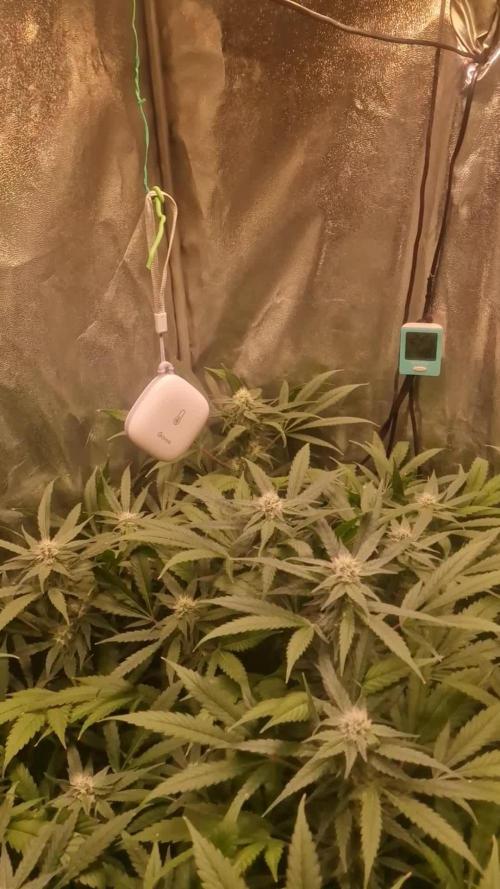
💣 Booom 💥
It literally exploded with shoots and its structure is phenomenal

Likes
8
Share


@PepitaVerde
Follow
Puse variedades con distintos tiempos, por lo que a unas las dejare de fertilizar antes que a otras, al igual que con los lavados de raíces


Likes
12
Share


@Bread_n_Buds
Follow
This week, you'll find the HARVEST of Chocolope Autoflowering #2. This plant has a different phenotype and will be available next week.
** This is plant and trichomes running AWC
The plant is a beautiful plant, around 100 cm tall, with beautiful, full, dense, and resinous flowers, despite growing in less than ideal temperatures.
Pot and Soil - This plant was grown in an 11-liter pot with Plagron's BioLight Mix organic soil.
Lighting/PPFD - A Zamnesia Phytonaut 480W LED lamp was used from mid-flowering until fruiting. We achieved a PPFD (photosynthetically active photon flux density) between 800 and 1200 μmol/m²/s, with a cycle of 24 hours, then 23 hours, then 20 hours, and finally 18 hours.
Z https://www.zamnesia.io/it/14526-lampada-led-per-coltivazione-phytonaut-480.html (National link if Google doesn't work)
Growing system: Zamnesia Ecosystem, fan, extractor, and grow box, all made by Zamnesia.
Trichomes: We harvested the plant at the beginning of the harvest window because we had to send the samples to the Autoflower World Cup. We still have a good amount of amber, 15% to 20%. 30-40% cloudy and transparent are still abundant, but in any case, with a sativa, you harvest early. Remember, amber is a sign of oxidation and means the plant is moving towards indica effects, so sativas should not be harvested too late to preserve their day-use effects.
Nutrients: Grown with Plagron Official, a 100% organic base fertilizer, and all recommended additives.
Visit www.plagron.com for grow cycle calculations, product selection, and general information.
All nutrients are available on the Zamnesia website. Also check out the live substrate and the fantastic new Zammi product line.
You can find this excellent strain here:
https://www.zamnesia.io/en/11102-blueberry-crumble-auto-zamnesia-seeds-feminized.html
(Google if the link doesn't work; it's a national link)
You can find this excellent strain here:
https://www.zamnesia.io/it/11113-chocolope-auto-zamnesia-seeds-femminizzata.html
(Google if the link doesn't work; it's a national link)
Zamnesia Description -
Chocolope Auto brings the beloved flavor and uplifting energy of the original Chocolope to a fast, compact, and easy-to-grow autoflowering strain. By blending OG Chocolate Thai, Cannalope Haze, and ruderalis, Zamnesia Seeds has created a 90% sativa hybrid designed for those seeking old-school aromas with all the convenience of modern genetics.
From seed to harvest in just 11–12 weeks, Chocolope Auto maintains a manageable height of 120–180 cm. In optimal conditions, it can yield up to 300 g/m² indoors or 200 g/plant outdoors. Despite its slightly compact structure, the buds are extremely resinous and bursting with sweet, chocolate, and fruity aromas.
With 21% THC, Chocolope Auto offers an uplifting, cerebral high that promotes creativity and focus. It's the ideal companion for daytime use, lively social gatherings, or for finding motivation without a heavy physical effect. Expect a clean, euphoric boost followed by a gently relaxing finish.
For growers looking for a quick and reliable way to enjoy one of the most iconic flavor profiles around, Chocolope Auto is a must-try. Fragrant, fast, and full of retro charm, it proves that practicality doesn't have to come at the expense of character.
Music - Frequencies 432 Hz and 528 Hz and black musc from www.radionula.com
"The best that nature has to offer"
www.zamnesia.com
Likes
4
Share


@Willy_Balls
Follow
Runoff ph is a bit high this time. Don’t know why. Around 6.8. Average ph going in is 6.0.
Also the big fan leaves on ice cream cakes are kind of strange shaped. Will see how they are going to look later.


Likes
3
Share

@MaxWax
Follow
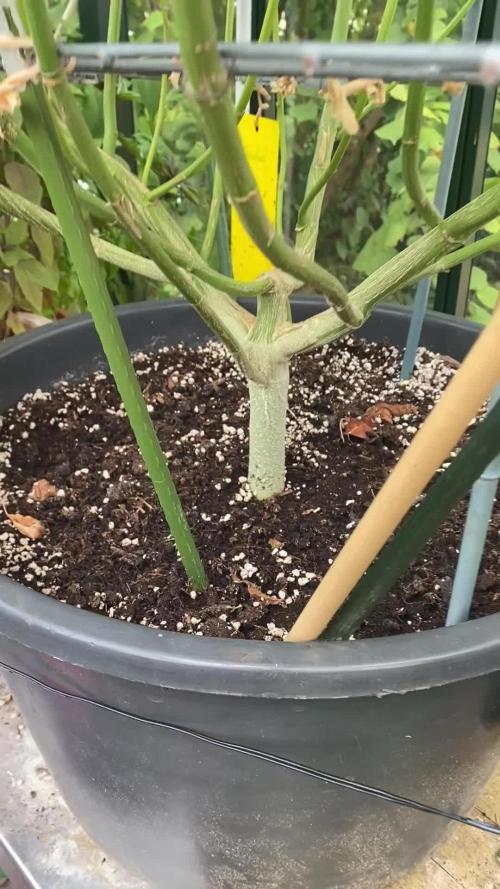
Unfortunately, the plant didn't handle my absence very well. It got way too hot inside the greenhouse, and my neighbor was a bit too generous with the nutrients while not allowing enough runoff (drain). I flushed the plant today—the initial runoff was at a critical 2200 PPM, but I managed to flush it down to a stable 800 PPM. I really hope she recovers quickly now. I have to leave for another two-week work trip this coming Monday, so I'm hoping she bounces back by then so I can leave with peace of mind🙈😀

Likes
5
Share


@Eljardindemargarita_grower
Follow
Buenas
Aquí en la 5 semana de flora
Las peques , van tirando y poco a poco vamos viendo cómo finalizan
No le cogí bien el punto a esta gama de nutrientes , van llegando algo justas a esta etapa
Ya tan solo iremos viendo , que amarillean bastante , pero bueno , no pasa nada , tendremos ,si todo acaba bien , buena cosecha ...
Mil gracias un saludo
Hoy os dejo un vídeo , que por cierto ,está también en mi perfil de YouTube...no dudéis en hecharles el vistazo
Mil gracias

Likes
5
Share


@Mr_Puff_N_Stuff
Follow
Getting chubby! They are almost there. The buds are begging to fatten up and they are beginning to smell. They are just rolling alone…
Likes
6
Share


@Jbreezy
Follow
Still taking about 2-3L of water each day, feeding ucann bloom every two weeks with worm castings. A little bleaching on the gelato but I just raised the light a few more inches, hoping it’s enough to prevent more. The Coco Melon is short but the buds are looking very compact.

Likes
15
Share

@trelopoulos
Follow
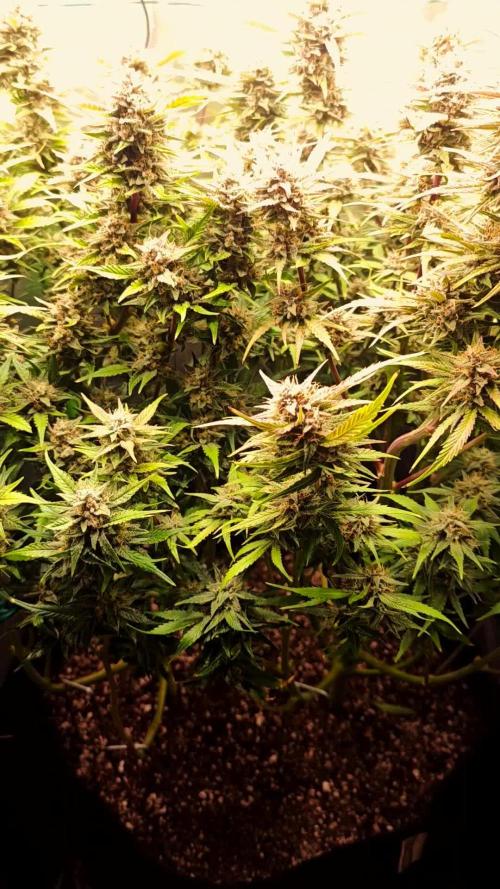
Beautiful buds! Great aroma. and they packed great.. what else can you ask. Next week they will be harvested🤤
Likes
9
Share

@Bread_n_Buds
Follow
Our Blue Dream by Zamnesia is a truly exceptional beauty, now in advanced flowering it is showing all its beauty.
** Remember that we are growing a plant worked with the techniques indicated and another left to grow without pruning to preserve its speed; in the previous/next diary you will find the other plant of the same variety.
Here the plant has let itself go straight and free and is thanking us very well by giving us some very very beautiful flowers.
We are in a 100% organic configuration, the soil is recycled Promix + 1/3 fresh soil + 10% Perlite + RQS Mycorrhizae Mix (4 g in the mix, 1 g under the small fiber pot).
We switched to the advanced flowering program a couple of days ago but last week we still did not give green sensation. We fertilize with: // 1 ml/l Sugar Royal - 2 ml/l Alga Bloom - 1 ml/l Power Buds - 1ml/l Green Sensation
We sprayed 5 ml/l Vita Race Foliare once a week.
For all the info https://plagron.com/
All nutrients are available from Zamnesia: https://www.zamnesia.io/it/531-growshop/476-fertilizers
We always have the excellent mycorrhizae from RQS that run in the soil. https://www.zamnesia.io/5778-mix-micorrhiza-easy-roots.html
Try this strain it promises more than good ---- // https://www.zamnesia.io/en/3271-zamnesia-seeds-blue-dream-feminized.html
Short Description Zamnesia // Exceptionally tasty and potent, Blue Dream by Zamnesia Seeds is a hybrid with a distinctive and sophisticated character. A blend of Haze and Blueberry strains that manages to bring out the best of both worlds. Its short flowering time of just 9 weeks far surpasses other Haze strains!
The whole world of growing and much more is at Zamnesia: just take a look at the site and you will find "all the best that nature has to offer" in various shapes and colors.
The new strains are fantastic and the old ones are no exception...
-- // www.zamnesia.com

Likes
39
Share


@CURATI_DA_SOLO
Follow
In realtà ho coltivato 2 semi di questa pianta una l'ho raccolta e seccata mentre un altra è ancora in flush e verrà raccolta tra 5-6 giorni. I fenotipi sono quasi identici e predilige un odore di gas e og! L'effetto è devastante molto narcotica e a breve pubblichero qualche foto di qualche estrazione a freddo! Spero che piacciano a qualcuno i miei lavori e che qualcuno di voi si possa ispirare a tutto questo.
Ringrazio ogni singola persona che è passata di qui a lasciare il suo like o commento e ricordo a tutti voi che potete trovarmi anche su Instagram 😘


Likes
12
Share


@BudMunchies
Follow
09/17: Started flowering already! I am confused By this as i have never had an auto start flowing so soon. Admittedly i have only grown like 3 other autos. But they were well into week 4 before i started showing signs of flower. I think these are going to be tiny little plants.
Likes
21
Share


@NSABND
Follow
Start of Week 9 🙌
I plan to use fertilizer for bud growth from day 64 to day 70+... depending on when the harvest time occurs 😉😄👍
Started working with fertilizer today, every 2 days a mixture of 10ml per liter as long as the buds have not properly developed trichomes 😵 I hope this works 😵😲😱
Day 68 with fertilizer again
Likes
6
Share


@RhodiesGrow
Follow
Sweet Seeds Speed + Auto Germinated in rapid rooters and AC Infinity propagator. Temp 75º RH 85% +
3rd Generation autoflowering strain. This hybrid is the result of crossing an autoflowering Critical Mass genetic line from the Sweet Seeds®️ R&D Department, chosen for its fast flowering and pleasant intense aroma, with a selected strain of very fast flowering, our Speed Devil #2 Auto®️ (SWS25).
This autoflowering strain has been developed through the search for the genetic traits responsible for very fast flowering. The final result is a strain that is ready to harvest only 7 weeks after germination.
It produces thick buds covered with aromatic resin. Sweet and fruity aromas with hints of yeast and cheese.
Awards
1st Prize - Best Autoflowering Strain - 1st Grow Diaries POTY - Spannabis - Barcelona - 2022

Likes
16
Share


@TooQuiikk
Follow
Let me start by saying, I'M SO GLAD I DIDN'T CHOP! THESE BABIES ARE GAINING SOME SERIOUS BULK!
I can not wait to see them finish out, It's really testing my patience, but I notice more bulk every single day!
It's about time to get the chop, they are maturing really quick and I love it. The smells are absolutely insane!!!


Likes
4
Share

@The_Doctor_Green
Follow
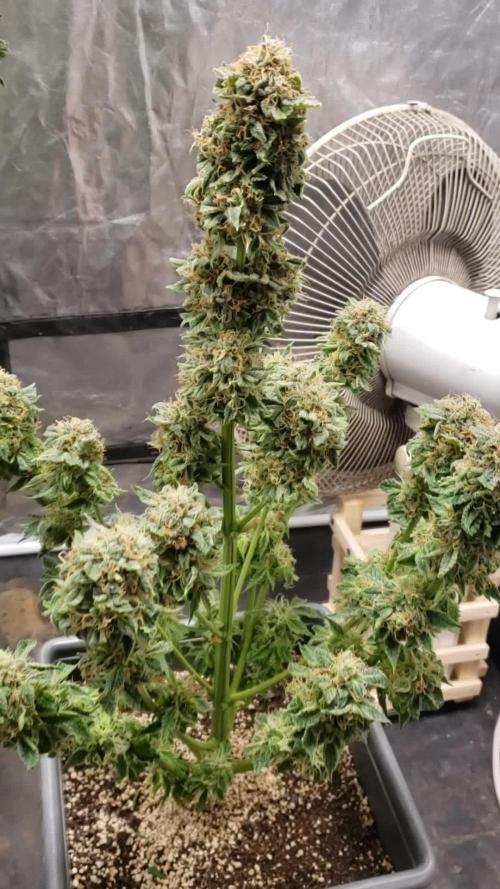
Hola a todos! Bueno llego el corte, dia 84.
La planta ha quedado baja, pero con unos buenos cogollos, bien compactos. Así que ahora a secar y esperar para catar esa delicia.🤪🤪🤪🙌🙌🙌🤩🤩🤩🤩

Likes
8
Share


@Santica_Garden
Follow
My Ayahuasca Purple are looking absolutely beautiful 😁 not much to update on, I have uploaded a video for you guys with all the information you need 👍🏾 Happy Growing
Likes
48
Share


@DogDoctorOfficial
Follow
this one is just great, she is growing amazingly beautiful with some of the most perfect leafs ever seen in an auto, and she and they all in fact, are growing so amazing that the time to defoliate them hard as came, curious to see how aill they all react <3<3<3
and they are naked and with them legs shaved hihihihi now lets see
Man she love it , a few days in to it and she is praying like no stress happens what so ever , tuff girl , they all are in did tuff girls
and with the week coming to an end , she keeps happy af and showing her love to me , thank you my Girl <3 <3 <3
added a defoliation edit video hope you guys have fun and that is not moving to fast hehehe trying to make them videos fun and not to long <3<3<3
oh almost forgot, stopped CaMag, she does not need it any more i believe
As always thank you all for stopping by and for supporting me on this journey, i am super passion about growing and fell blessed to have you all with me on this new journey <3 <3 <3
Genetics - Fast Buds Tester 2310
Ligth - LUMATEK ZEUS 465 COMPACT PRO
Food - APTUS HOLLAND
#aptus #aptusplanttech #aptusgang #aptusfamily #aptustrueplantscience #inbalancewithnature #trueplantscience #fastbuds #dogdoctorofficial #growerslove
With true love comes happiness <3 <3 <3 Always believe in your self and always do things expecting nothing and with an open heart , be a giver and the universe will give back to you in ways you could not even imagine so <3 <3 <3
All info and full product details can be find in can find @
https://2fast4buds.com/ wen released
https://aptus-holland.com/
https://autopot.co.uk/
https://lumatek-lighting.com/
<3 <3 <3 Growers love to you all <3 <3 <3
Likes
7
Share


@Greenislandfr
Follow
Coupe de lapex après la fausse floraison et oui cetais la surprise elle est repasser en croissance 😂 peut être a cause du stress du climat et de la coupe d'apex tardive bon on va en profiter pour defolier et attacher tout ça