Likes
Comments
Share
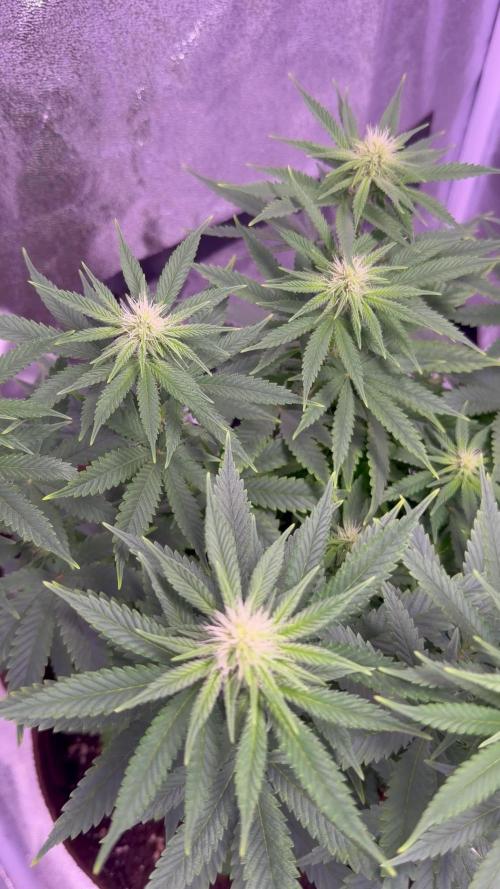
Start der 7. Blütewoche. Junge junge, die calypso sunrocks ist wirklich der Wahnsinn! War ein bonus seed von linda seeds, besten Dank nochma👌😜 Habe beide Damen vorgestern nochmal mit bio bloom von greenhouse nachgedüngt. Jetzt sollte nix mehr schiefgehen.. Bin sehr gespannt aufs letzte drittel. Bei der banana punch geht's auch in die richtige Richtung. Weniger Stretch wegen der 50/50 Genetik und der doppelten Anzahl an Haupttrieben. Aber s'läuft👌 14.02. Ende der 7. Blütewoche. Die calypso sunrocks ist schon weiter als die banana punch. Aber 2 bis 3 Wochen werden es bestommt noch sein. Ich hab Zeit, die regeln das schon😉 seid gespannt wie ich..
Likes
72
Share
Likes
18
Share
@cannasaxx
Follow
Alles im grünen Bereich 👍🏻💚🍉🌈🎄 Ja, viel gibt es nicht zu sagen außer das ich sehr zufrieden bin mit dem Grow. Adlite IR, UV, Deep Red sind mit angeschlossen, sie sind nämlich jetzt in der Pre-Bloom Phase das heißt 16std. Licht eine Woche und dann 12/12 Umstellung. Euch eine fröhliche Weihnacht 🎄😇
Likes
14
Share
D71/F27 - 10/06/23 - Added Nutes and water, EC 1 and pH 5.0 D72/F28 - 11/06/23 - Nothing to report D73/F29 - 12/06/23 - Added Nutes and water, EC 0.8 and pH 5.3 D74/F30 - 13/06/23 - Nothing to report D75/F31 - 14/06/23 - Added Nutes and water, EC 0.9 and pH 5.3 D76/F32 - 15/06/23 - 👉Changed Water. Some signals on the leafes. I think it is because of heat but I0m going to ask to the community. D77/F33 - 16/06/23 - I've asked to the community and is heat stress, so I'm going to change the light hours to 12/24 (4 only red ligh and 8 red-white)
Likes
6
Share
@Moss420
Follow
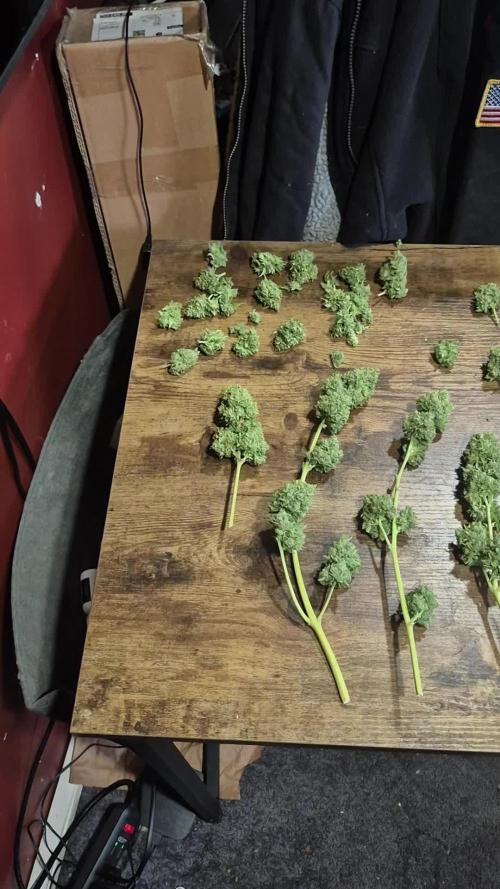
Ended up flushing Mumma for about 10 days - got her ppm down real low. Night before harvest I set the timer so the light would not come back on in the morning before I harvested (I've seen people who swear by this and other who say it doesn't do anything but figured it couldn't hurt). At this point the other plants are pretty disappointing compared to Mumma so they aren't getting as much "love" lol.
Likes
226
Share
@HighTV
Follow
| 📅 Week 7 | Days 43 - 49 | 💡 750w 📏36' | | ☔ 23%-34% | | 🌡️️🌞 74 - 81 | | 🌡️️🌑 66 - 74 | 12/21 I did a reservoir swap with the fresh nutrient levels as planned! Without PH testing fluid I had to adjust the tap+nutrients by memory, but i'm fairly accurate and only off the target(5.8) by .2 most of the time. 12/22 Did another reservoir swap again this time unplanned, because i'm still unable to PH until tomorrow. The things we do for dank buds lol! Adjusted some of the Low stress training a little more severe LST to prepare for a late 'SCROG' i'm putting in tomorrow. 12/23 A late 'SCROG' was applied to the plants today to make the lateral dormant buds grow vertical as best as possible. With a Late "screen of green" like this its mainly used to LST and get better airflow. If you are looking to weave tops and get an even canopy then you will want to SCROG while at the end of Veg. PH fluid arrived today so the reservoirs were adjusted to 5.8 after being topped off. 12/24 PH was really low so there is a possible 'acid rain' effect. I adjusted the PHs to 6.0 to compensate and I will reservoir swap the buckets if the PH drops this low again tomorrow. I did some adjustments to the LST using the scrog. 12/25 Reservoirs had a really low PH again so I did a Res swap on all 3 plants to avoid a possible acid rain effect. Essentially that's when C02 dissolves into your water forming CarbonicAcid before dropping 2 H+ protons and causing the PH to lower and turn acidic. I PHed the fresh reservoir to 5.8 and cleaned the tent out. I didn't do any training today. 12/26 I extended the intake duct to deliver the cold outside air directly underneath the focus plants canopy to lower temperatures and force purpling. I adjusted all 3 plants to 5.8 PH and topped of the reservoir on 2 of them. The focus plant has been growing fantastically. 12/27 All of the reservoirs needed topped off and of course they had their PHs adjusted to 5.8. I moved the plants apart a slight bit and did some adjustments to the SCROG for better training and airflow. Temperatures might be getting low at night, but unless it gets worse I will be fine and just consider this an attempt to get more purple. 😋 ______________________________________________________________________________ Week 7 is complete and in the Books. These Girls are thriving on low levels of Bloom + Calmag. It's as if these genetics have replaced all Nitrogen needs with an insatiable desire for CalMag. I really cant seem to give them enough Magnesium to satisfy them at this stage. Overall in this week I have trained the focus plant down into a SCROG and spread out her reach so the colas individually grow vertical. She took a day to recover totally, but she rebounded just fine and spent the rest of the week pumping out pistils. Around day 5 on the week the focus plant started to show just a little bit of color between her pistils so it looks like we have some nice color to look forward to in the coming weeks. APOLOGIES FOR THE LINES IN THE TIME LAPSE - They are interference lines being caused by the HPS and my current camera does not have the appropriate shutter-speed settings to eliminate this 😪 Feel free to leave comments/questions below or give me any feedback to improve my diaries. If you like this Diary follow along and check out my others as well 😎
Likes
4
Share
@Mo_Powers
Follow
spring in germany is really something to be proud of. the sun has been shining beautifully for weeks. the plant like it too. (at least the ones with watering assistance) she is now a good 20cm high. she is stretching a bit but that's ok. it's a bit complicated to specify the exact fertilization scheme. i have a tank with 40 liters to which i have added the following HESI fertilizers. 150ml Hydro Grow, 150ml Root Complex, 80ml Powerzyme and 8 drops Super Vit. the 40 liters will last a very long time. i think i will only have to top up again in 4 weeks.
Likes
7
Share
Strawberry Gorilla is my little plant. I'm going to run this one again. I believe it didn't take transplant well, it's been a smaller plant but healthy. It's growing good, leaves look good, in every way it looks healthy, it's just smaller. I have no complaints about the strain, it's looking very good.
Likes
126
Share
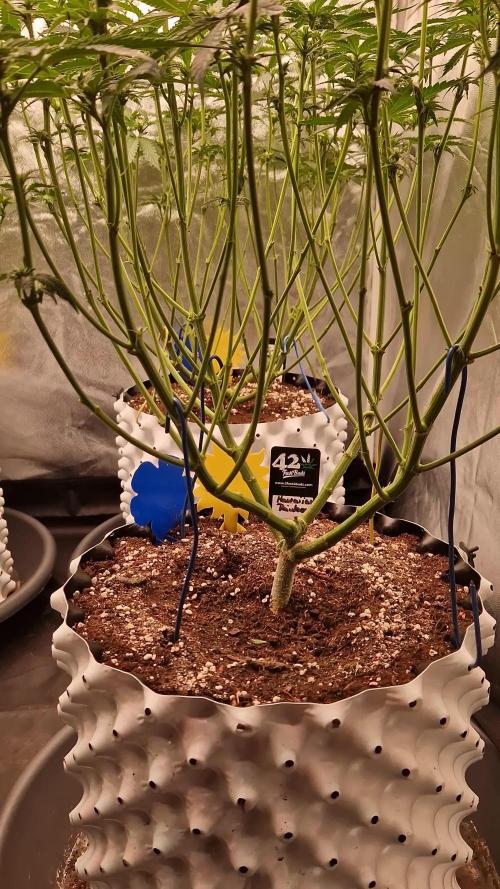
Guten Tag zusammen, Wir sind in Woche 4 der Blütephase angekommen. Bisher läuft es ganz gut. Die Blütenbildung ist voll im gange und so sollte es auch sein, denn nach dem Entlauben letzter Woche galt ihre ganze Konzentration nämlich darauf. Makro und Mikronährstoffe sind sehr gefragt. Wir versuchen einmal am Tag, ca.1 Liter Nährstofflösung in den Topf zu geben. Aber es gibt auch Tage bzw. eher Wochenenden, wo sie mal etwas auf Diät sind da wir nicht Vorort sind xD Bisher haben wir dort aber trotz allem, zusammen eine super gute Chemie entwickelt. Ansonsten zur re vege, die obigen Blätter sind schon dreiblattfinger. Jüngere Blätter beginnen sich zu Rollen was ein gutes Zeichen ist. Farblich gesehen und gesundheitlich passt es bei ihr aber auch. Dennoch haben wir den Haupttrieb getoppt, da es zu viel Masse für das kleine 60x 60x 120 cm Zelt gab. Somit auch nochmal ein wenig Schimmel gefahr vermieden. Ja ansonsten wünschen wir allen Growmies eine mega und erfolgreiche Woche! Genießt das des letztigen warmen Wetters und vielen Dank fürs vorbeischauen! VG 😎✌️
Likes
21
Share
German version below: The Critical Neville Haze Auto has really picked up the pace this week and continues to develop very quickly. She seems to be loving the combination of humidity, light and temperature and is making the most of the conditions right now. After just 10 days, we already topped her, which is a new personal record for us and definitely qualifies her as a fast starter. Our previous plants only reached that stage around day 12. She is also very easygoing when it comes to water and nutrients. She takes both very well and is clearly putting those nutrients straight into growth. Overall, she looks strong and healthy, and it’s genuinely fun watching her grow. If she keeps up this pace, we may soon have to start wondering who is actually training whom here. _______________________________________________________________________________ Die Critical Neville Haze Auto hat diese Woche ordentlich zugelegt und entwickelt sich weiterhin richtig flott. Die Kombination aus Luftfeuchtigkeit, Licht und Temperatur scheint ihr ausgesprochen gut zu gefallen und sie nutzt die Bedingungen aktuell ziemlich konsequent aus. Nach gerade einmal 10 Tagen haben wir sie bereits getoppt, was für uns tatsächlich ein neuer persönlicher Rekord ist, eine echte Schnellstartgenetik. Unsere bisherigen Pflanzen waren erst an Tag 12 so weit. Auch beim Wasser und Dünger zeigt sie sich unkompliziert. Sie nimmt beides gut auf und setzt die Nährstoffe sichtbar in Wachstum um. Insgesamt macht sie einen kräftigen und gesunden Eindruck und es macht gerade richtig Spaß, ihr beim Wachsen zuzusehen. Wenn sie dieses Tempo beibehält, müssen wir uns wohl langsam überlegen, wer hier eigentlich wen trainiert. 😂
Likes
4
Share
Likes
21
Share
crazy week its colddddd forsure had some lil neats in my soil put about half-inch sand didnt feed going to next week broke a few heads im just let do there thing hit rm with a big bloom feed next week if i keep the temps upp should bee very nice buds sure is smelling good
Likes
47
Share
The cannabis strain Grape Guava can be a purple strain, depending on its specific phenotype and genetic makeup. While not all phenotypes of Grape Guava are purple, some variations, such as the Zatix Grape Guava, are noted for their striking purple appearance due to the genetic expression of anthocyanin pigments. https://www.youtube.com/watch?v=cKdVmdoKJ5k In a garden of green, Grape Guava gleams, With its fruity aroma, enchanting dreams. Clusters of grapes, guava's sweetness ignite, A strain so divine, in purple and white. Euphoria whispers, a lush fruity haze, Grape Guava's embrace, a tranquil daze. Off and away.@1400ppm. The increased CO2 allows plants to thrive at higher temperatures, which in turn necessitates higher humidity to maintain the ideal VPD for healthy growth and transpiration. 80F -5F = 75F LST with 70% RH = 0.72 kPa. Higher temperatures and humidity promote rapid growth, nutrient uptake, and photosynthesis while maintaining a lower stress level. Temperature influences the rate of enzymatic reactions involved in aerobic respiration. Enzymes, such as those involved in glycolysis, the Krebs cycle, and the electron transport chain, work most efficiently at an optimal temperature range. In low temperatures, enzymatic activity will slow down, thus reducing the rate of aerobic respiration. In high temperatures, enzymes can become denatured, thus impairing their function and stopping the process of aerobic respiration. Glucose is the primary fuel for aerobic respiration. The rate of aerobic respiration increases with the availability of glucose, as it is the starting point for glycolysis. If glucose levels are low, cells may rely on alternative energy sources such as fatty acids or amino acids , but these processes may yield less ATP or be less efficient. To determine this effect, carbon dioxide volume was measured (as carbon dioxide is an output of aerobic respiration) 18/6 with the 6 being IR. The near infrared (IR-a) borders around 700nm up to 1400nm @ photon par flux density of 1.8 instead of darkness, keeping temps overnight a neat 77F-80F. Think of my tent as a lung. What goes in must come out. When the rate of air going out exceeds the amount of air coming in, it creates a negative pressure. Tent concaves (bends in). If set up correctly, your RH will begin to drop slowly to the desired level you set, and the extraction turns off when it reaches desired% RH. The plant, as it performs cellular respiration, will always be releasing more water into the air, so the RH% of the tent overnight will always increase, so long as oxidative phosphorylation is occurring. As soon as the RH% creeps back up to 55%, the extraction turns back on, over and over. This creates a strong pressure differential which will work wonders on your grow. Replicating high and low-pressure fronts in nature. Critical for oxygen diffusion at the critical time of peak cellular respiratory function.. Moisture will not transfer from a saturated atmosphere to another if that air is already at or above its saturation point, meaning the air can't hold any more water vapor. Once I understood that water is produced as a by product during cellular respiration, specifically at the very end of the electron transport chain (ETC) where electrons are finally transferred to molecular oxygen, the higher the RH of the air, the more resistance there is for more moisture to be added to that environment, and effects the ease with which it does so. But none of that water comes from the pot; it's pulled from the air. If you run high daytime RH, your medium/pot is 100% reliant on transpirational root pull to move water. ZERO evaporation happens across the atmosphere if the tent air has high RH%, the medium cannot release its water through evaporation. Once a canopy develops, light no longer slowly wicks and evaporates from the topsoil. The Soil-Plant-Atmosphere Continuum (SPAC) describes the continuous pathway and process of water movement, driven by a gradient in water potential, from the soil, through the plant's roots, stem, and leaves, and finally evaporating into the atmosphere through transpiration. There is evaporation, there is transpiration, and then there is evapotranspiration; Evapotranspiration (ET) is the combined total of two processes: evaporation (water lost directly from soil and surface water into the atmosphere) and transpiration (water released from plants to the atmosphere through their leaves). Evapotranspiration represents the total amount of water that moves from the medium into the air. There is no such thing as a medium with too much water, only a medium that retains too much for too long. The water must always flow efficiently from one atmosphere(Medium) to another(Air) in a timely manner. Moisture is a critical factor for bacterial growth and decay. Dictating how long it's allowed to sit in any one location for any given period is a key preferred control. To ensure a net reduction in a bacterial population, the rate of removal (ET) must exceed the rate of bacterial growth (decay rate), which is often modeled as a growth rate for the specific bacterium under the given conditions. By optimizing daytime VPD, we also optimize conditions for bacterial growth to explode exponentially above 77°F.. If water is allowed to sit in a medium without an escape within a timeframe, nothing good will happen. IF High RH is maintained overnight as well as during the day, placing 100% of water movement at the behest of daytime transpiration, roots can only pull where they can reach, and if soil is compressed above a certain point, moisture will become trapped in a medium with no way of moving day or night. This will begin the countdown for decay to take hold. When water stagnates in a medium, it loses oxygen, creating anaerobic conditions that foster the growth of harmful microorganisms like bacteria and fungi, which can produce toxins and disease vectors. Thigmomorphogenesis, the process by which plants respond to mechanical stimuli like touch by altering their growth and development, results in significant morphological changes to improve survival against mechanical perturbations. This complex response involves sensing touch and initiating physiological and genetic responses, leading to changes in form and structure over days or weeks. The process is triggered by physical forces such as wind, rain, or touch. Plants adapt to these stimuli by changing their shape and structure, which may include slower growth, thickened stems, or altered leaf development. Plants possess sophisticated mechanisms to detect even subtle mechanical stimuli and initiate responses. A variety of molecules, including calcium ions, jasmonates, ethylene, and nitric oxide, are involved in signaling these mechanical inputs. Touch can induce the expression of genes that encode proteins for calcium sensing, cell wall modification, and defense mechanisms. A plant exposed to constant wind may become shorter and sturdier. A plant that is touched frequently might grow more slowly to conserve energy and develop thicker cell walls. These changes increase a plant's resilience and ability to survive in harsh environments. Let's get Thiggy with it.
Likes
114
Share
@Natrona
Follow
This week, my Titans are sleeping in a cooler dark room until harvest. So for your viewing pleasure, I've loaded some videos made of the Titans during there time with me. I'm wondering what to serve at my Queens Tea Party... I made some butterscotch pistachio bars and modified the recipe for less sugar. 😋 We experimented with topping the bars with black cherry spread, orange marmalade and a mango jelly. All are very tasty as the bit of sour/tart enhances the butterscotch sweet. A few solar eclipse pics.
Likes
12
Share
She prefers the purple bulb over the white spectrum. I love growing plants, they can't cheat on you. Lol
Likes
24
Share
This plant is in the far back corner so it's hard to get good pics of it. Its the most stretchy plant this run but it looks like its putting on some nice frosty buds. I spread the plants out a little this week so they get better light and air flow. Other than that I haven't done anything besides keep the reservoir full. Still pumping nutrients 1 minute on 20 minutes off. They are getting .5 tsp maxibloom per gallon. Not going to run any boosters this round. They dont look like they want or need it.
Likes
11
Share
@Drgreen13
Follow
Just so you know, this was my first ever grow, i had help and did tons of research. It wasnt all me on this one
Likes
Comments
Share
@Nillenium
Follow
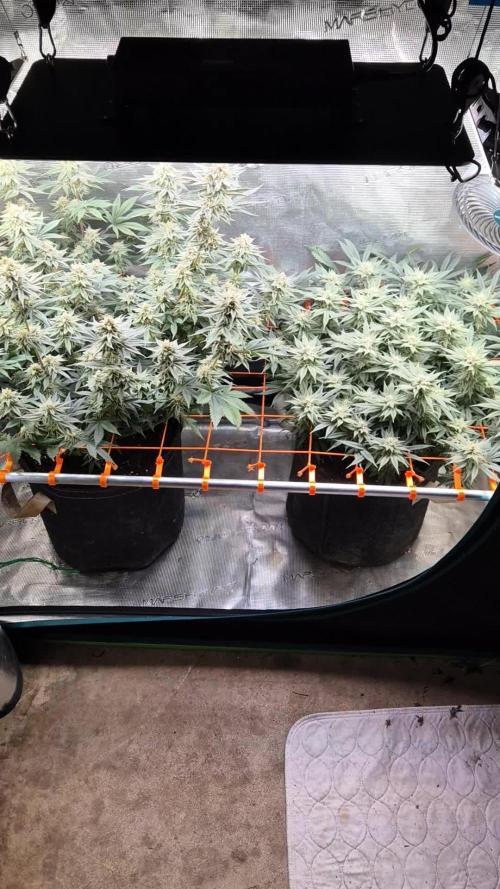
Am 16. Tag wurde die Dame getoppt und am Ende der Woche habe ich mit dem 1. LST begonnen.