Likes
Comments
Share

@Growfather1
Follow
Hello everyone.
A week has passed and the 2 plants in the front are going into the second week of 12/12 while the amnesia in the back is going into the third week.
Everything is going to plan temperature and humidity is good for now.
Thanks for stopping by and have a nice week.


Likes
5
Share


@GrowLegend
Follow
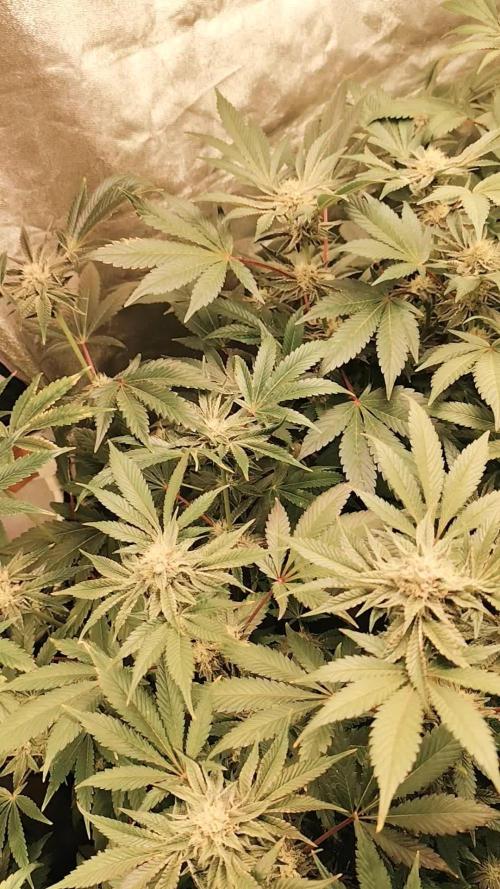
Hola a todos, En esta semana 3 de floración la planta sigue engordando sus cogollos purpuras. Ha dejado de crecer para centrar su energía de producir sus flores, que presentan buenos tricomas.

Likes
10
Share


@wheedtobeus420
Follow
For the life of me I can’t remember what days she on😂 She’s coming a lot so nicely. I’m very happy to have her. Excited to watch her bulkin up day 49!!

Likes
6
Share


@griffy
Follow
week 8 in the books lemon is still swelling up but has slowed kinda thinking just packing on some weight now im hoping . Trichs are starting to get cloudy but alot still clear so going to wait until i see mostly cloudy and few amber and start a week or 2 flush on her depending on what her leaves are showing me . smells delish and stickyyyy . amnesia on the other hand is either just taking her sweet time to flower i beleive it say 9 week max to flower which im there or she reverted to a photo or something . If she still hasnt flowered by the time i harvest def gonna switch lights for a lil while and see if that can trigger her . Thats all for this week .


Likes
9
Share


@LittleBigTrees
Follow
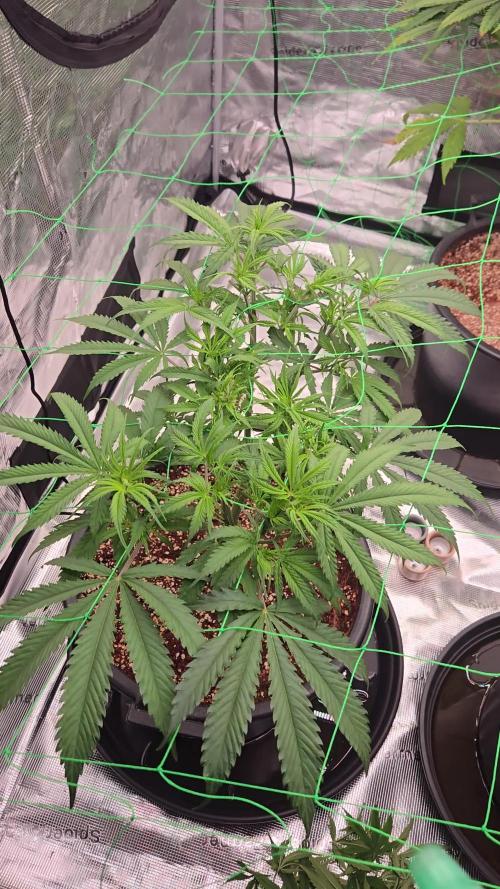
Looking nice and compact with strong growth 🙂
Still only fed her water so far.
Likes
17
Share


@RDWCGrowing
Follow
7/27/2023- Prep
Tent and system are cleaned and ready to go from my last grow. I have submitted my Journa for the Diary of the Month Competition here is to hopeing for good resutls.
7/28/2023- Germination Day 0- Seed initiation
Well lets get this new Grow started.. So My Dad Sent me a custom Strain that he wanted me to grow out and Breed for him. The Strain is Called Red Rhino:
Red Rhino is an amazing strain coming from Israel and boasts a 60% Sativa and a 40% Indica. This strian comes from crossing double gum and master kush. Effects are an increased appetite, as well as giving you ephoric feelings throughout the whole day.
RO Water Used
Added Hydrogen Peroxided
8/1/2023- Germination Achieved G-Day 1
Popped her head above the root riot today to say hello.. Woot first challenge when dealing with an unknown seed and a new Strain is getting the seed to pop and the lady to show life.
8/2/2023- Germination Day 2
Took the root riot out today and it was soaked not good plant drowing again. I am still having a hard time finding the right blance for where the water should be to keep the root riot moist and not soaked. I had to drain some of the water out of the root riot plug to help give a little oxygen. I also removed some of the water.
8/3/2023- Germination Day 3
Looking good stretching her leaves out to let in the lights
8/4/2023- Germination Day 4
Looking good a few days until I put them into the RDWC System and get this thing rocking and rolling.
8/5/2023- Germinaiton Day 5
Looking good will probably plant tomorrow if the roots are still looking good.
8/6/2023- Plant Day- Germination Day 6
Planted into the RDWC System today. Joy when they go into the system as long as we dial that in right this will now be a great grow.. Survived the hard part..
8/7/2023- Germination Day 7
Fell over today I am worried.., she is showing some damage on the lower leaves from the over watering in the cloning machine but right now I don't see any new damage.
Supported the Stems with little improvised pole to help her stand up.
8/8/2023- Germination Day 8
Added the first Nutes today, to help support root growth and to help give there first jump to growth.
TPS SILICA GOLD-.5mil/Gal
Root Drip- 1mil/Gal
GH FLoraMicro-1mil/Gal
GH FlroaGro-1mil/Gal
GH FLroaBloom-1Mil/Gal
ORCA-.5mil/Gal
8/9/2023 - Germination Day 9
Everything is looking good new growth looks like it is praying and they are looking happy. I will take off the damage leaves probably tomorrow.
8/10/2023- Germination Day 10
Everything is looking good looks like she is recoving well, with just a little bit of a delay. Cleaned up the dead leaves... Day 1 VEG tomorrow.. Water Change Day and first real meal...
Likes
6
Share


@Staffedition
Follow
Привет друзья.
Наше знакомства продолжается с новым сортом автоцветущих растений от Smail_Seeds сорт TROPICANNA POISONZKITTLEZ XL AUTO F1 reg.
Сегодня растению 73 дня.
Растение очень хорошо развилось, ни каких сбоев в генетике не наблюдалось за весь цикл.
Шишки наливаются очень хорошо😀
Так же стрессую, что бы получить пыльцу.
Скоро будут феминизированные растения.
Сорт выводим сами.
Смотри мой профиль, у нас всегда есть что то интересное.
Не забудь поставить лайк❤️, если понравилась как прошла неделя
И читайте наш TELEGRAM: https://t.me/smail_seeds
#Smail_Seeds 😀


Likes
21
Share


@HillCountryHempCo
Follow
28 days and it started flowering. Saw my first pistol hairs today.


Likes
24
Share


@Stinkfox
Follow
Getting into the final week and a half. I’m looking for all cloudy trichomes, with no amber on this one. So it might be day 56 on the dot. I’ll take a look later in the week. I’m getting excited. I’ve never had White Widow.
Processing
Likes
5
Share


@Chile_groweed
Follow
Cabe decir que lleva 30 días desde el cambio 12/12 .
21 días de floración
Se ha comenzado a formar la flor densa

Likes
41
Share


@TerpTurtle
Follow
xxxxxxx Clone update xxxxxxx
Check out those trichomes 😎
Be art | Composition

Likes
18
Share


@Ultraviolet
Follow
Green light is radiation with wavelengths between 520 and 560 nm and it affects photosynthesis, plant height, and flowering. Plants reflect green light and this is why they appear green to our eyes. As a result, some growers think that plants don’t use green wavelengths, but they actually do!
In fact, only around 5 – 10% of green light is reflected from leaves and the rest (90 – 95 %) is absorbed or transmitted to lower leaves [1].
Green wavelengths get used in photosynthesis. Chlorophyll pigments absorb small amounts of green wavelengths. Light that doesn’t get absorbed is transmitted to leaves that are shaded out from direct light. This means that leaves at the bottom of the canopy get more green light than leaves at the top. A high proportion of green wavelengths compared to other colors tells lower leaves that they are being shaded out, so they are able to react accordingly. Lower leaves may react by opening or closing their stomata or growing longer stems that help the leaves reach brighter light [1, 2, 3].
When it comes to growing cannabis, many cultivators are interested in the quality of light used for the flowering stage. In many plants, flowering is regulated by two main photoreceptors: cryptochrome and phytochrome. Both photoreceptors primarily respond to blue light but can also respond to green, although to a lesser extent. Green can accelerate the start of flowering in several species (although cannabis has yet to be tested) [1, 4, 5]. However, once flowering has begun, it’s important to provide plants with a “full spectrum” light that has high amounts of blue and red light, and moderate amounts of green, in order for photosynthesis to be optimized.
Green light mediates seed germination in some species. Seeds use green wavelengths to decide whether the environment is good for germination. Shade environments are enriched in green relative to red and blue light, so a plant can tell if it is shady or sunny. A seed that senses a shaded environment may stay dormant to avoid poor growing conditions [1]. Some examples of plant species where researchers have documented this response are: ryegrass (a grass that grows in tufts) and Chondrilla (a plant related to dandelion) [1, 6].
Although green wavelengths generally tell plants NOT to germinate, there are some exceptions! Surprisingly, green wavelengths can stimulate seed germination in some species like Aeschynomene, Tephrosia, Solidago, Cyrtopodium, and Atriplex [1, 6, 7].
Of course, light is not the only factor affecting seed germination – it’s a combination of many factors, such as soil moisture, soil type, temperature, photoperiod, and light quality.
When combined with red and blue light, green can really enhance plant growth [1, 8]. However, too much green light (more than 50% of the total light) can actually reduce plant growth [8]. Based on the most current research, the ideal ratio of green, red, and blue light is thought to be around 1:2:1 for green:blue:red [9]. When choosing a horticultural light, choose one that has high amounts of blue and red light and moderate amounts of green and other colors of light.
Not many studies can be found about the effect of green light on cannabis growth or metabolism. However, if one reads carefully, there are clues and data available even from the very early papers.
Mahlberg and Hemphill (1983) used colored filters in their study to alter the sunlight spectrum and study green light among others. They concluded that the green filter, which makes the environment green by cutting other wavelengths out, reduced the THC concentration significantly compared to the daylight control treatment. It has been demonstrated that green color can reduce secondary metabolite activity with other species as well. For example, the addition of green to a light spectrum decreases anthocyanin concentration in lettuce (Zhang and Folta 2012).
If green light only reverses the biosynthesis of some secondary metabolites, then why put green light into a growth spectrum at all? Well, there are a couple of good reasons. One is that green penetrates leaf layers effectively. Conversely red and blue light is almost completely absorbed by the first leaf layer.
Green travels through the first, second, and even third layers effectively (Figure 2). Lower leaf layers can utilize green light in photosynthesis and therefore produce yields as well.
Even though a green light-specific photoreceptor has not yet been found, it is known that green light has effects independent from the cryptochrome but then again, also cryptochrome-dependent ones, just like blue light. It is known that green light in low light intensity conditions can enhance far red stimulating secondary metabolite production in microgreens and then again, counteracts the production of these compounds in high-intensity light conditions (Kim et al. 2004). In many cases, green light promoted physiological changes in plants that are opposite to the actions of blue light. In the study by Kim et al. blue light-induced anthocyanin accumulation was inhibited by green light. In another study it has been found that blue light promotes stomatal opening whereas green light promotes stomatal closure (Frechilla et al. 2000). Blue light inhibits the early stem elongation in the seedling stage whereas green light promotes it (Folta 2004). Also, blue light results in flowering induction, and green light inhibits it (Banerjee et al., 2007). As you can see, green light works very closely with blue light, and therefore not only the amount of these two wavelengths separately is important but also the ratio (Blue: Green) between these two in the designed spectrum. Furthermore, green light has been found to affect the elongation of petioles and upward leaf reorientation with the model plant Arabidopsis thaliana both of which are a sign of shade avoidance symptoms (Zhang et al. 2011) and also gene expression in the same plant (Dhingra et al. 2006).
As mentioned before, green light produces shade avoidance symptoms which are quite intuitive if you consider the natural conditions where the plants grow. Not all the green light is reflected from the highest canopy leaves in nature but a lot of it (50-90%) has been estimated to penetrate the upper leaves at the plant level ((Terashima et al., 2009; Nishio, 2000). For the plant growing in the understory of the forest green light is a signal for the plant of being in the shade of a bigger plant. Then again, the plants growing under unobstructed sunlight can take advantage of the green photons that can more easily penetrate the upper leaves than the red and blue photons. From the photosynthetic pigments in higher plants, chlorophyll is crucial for plant growth. Dissolved chlorophyll and absorb maximally in the red (λ600–700 nm) and blue (λ400–500 nm) regions of the spectrum and not as easily in the green (λ500–600 nm) regions. Up to 80% of all green light is thought to be transmitted through the chloroplast (Terashima et al., 2009) and this allows more green photons to pass deeper into the leaf mesophyll layer than red and blue photons. When the green light is scattered in the vertical leaf profile its journey is lengthened and therefore photons have a higher chance of hitting and being absorbed by chloroplasts on their passage through the leaf to the lower leaves of the plant.
Photons of PPFD (photosynthetic photon flux density) are captured by chlorophyll causing an excitation of an electron to enter a higher energy state in which the energy is immediately passed on to the neighboring chlorophyll molecule by resonance transfer or released to the electron transport chain (PSII and PSI). Despite the low extinction coefficient of chlorophyll in the green 500–600 nm region it needs to be noted that the absorbance can be significant if the pigment (chlorophyll) concentration in the leaf is high enough.
The research available clearly shows that plants use green wavelengths to promote higher biomass and yield (photosynthetic activity), and that it is a crucial signal for long-term developmental and short-term dynamic acclimation (Blue:Green ratio) to the environment. It should not be dismissed but studied more because it brings more opportunities to control plant gene expression and physiology in plant production.
REFERENCES
Banerjee R., Schleicher E., Meier S. Viana R. M., Pokorny R., Ahmad M., Bittl R., Batschauer. 2007. The signaling state of Arabidopsis cryptochrome 2 contains flavin semiquinone. The Journal of Biological Chemistry 282, 14916–14922.
Dhingra, A., Bies, D. H., Lehner, K. R., and Folta, K. M. 2006. Green light adjusts the plastic transcriptome during early photomorphogenic development. Plant Physiol. 142, 1256-1266.
Folta, K. M. 2004. Green light stimulates early stem elongation, antagonizing light-mediated growth inhibition. Plant Physiol. 135, 1407-1416.
Frechilla, S., Talbott, L. D., Bogomolmi, R. A., and Zeiger, E. 2000. Reversal of blue light -stimulated stomatal opening by green light. Plant Cell Physiol. 41, 171-176.
Kim, H.H., Goins, G. D., Wheeler, R. M., and Sager, J. C. 2004.Green-light supplementation for enhanced lettuce growth under red- and blue-light emitting diodes. HortScience 39, 1617-1622.
Nishio, J.N. 2000. Why are higher plants green? Evolution of the higher plant photosynthetic pigment complement. Plant Cell and Environment 23, 539–548.
Terashima I., Fujita T., Inoue T., Chow W.S., Oguchi R. 2009. Green light drives leaf photosynthesis more efficiently than red light in strong white light: revisiting the enigmatic question of why leaves are green. Plant & Cell Physiology 50, 684–697.
Zhang, T., Maruhnich, S. A., and Folta, K. M. 2011. Green light induces shade avoidance symptoms. Plant Physiol. 157, 1528-156.
Wang, Y. & Folta, K. M. Contributions of green light to plant growth and development. Am. J. Bot. 100, 70–78 (2013).
Zhang, T. & Folta, K. M. Green light signaling and adaptive response. Plant Signal. Behav. 7, 75–78 (2012).
Johkan, M. et al. Blue light-emitting diode light irradiation of seedlings improves seedling quality and growth after transplanting in red leaf lettuce. HortScience 45, 1809–1814 (2010).
Kasajima, S., et al. Effect of Light Quality on Developmental Rate of Wheat under Continuous Light at a Constant Temperature. Plant Prod. Sci. 10, 286–291 (2007).
Banerjee, R. et al. The signaling state of Arabidopsis cryptochrome 2 contains flavin semiquinone. J. Biol. Chem. 282, 14916–14922 (2007).
Goggin, D. E. & Steadman, K. J. Blue and green are frequently seen: responses of seeds to short- and mid-wavelength light. Seed Sci. Res. 22, 27–35 (2012).
Mandák, B. & Pyšek, P. The effects of light quality, nitrate concentration and presence of bracteoles on germination of different fruit types in the heterocarpous Atriplex sagittata. J. Ecol. 89, 149–158 (2001).
Darko, E. et al. Photosynthesis under artificial light: the shift in primary and secondary metabolism. Philos. Trans. R. Soc. B Biol. Sci. 369 (2014).
Lu, N. et al. Effects of Supplemental Lighting with Light-Emitting Diodes (LEDs) on Tomato Yield and Quality of Single-Truss Tomato Plants Grown at High Planting Density. Environ. Control Biol. 50, 63–74 (2012).

Likes
4
Share


@SamDo
Follow
Hey growers, welcome back to the Pineapple Upside Down grow journal — week 17 of veg.
The plant keeps showing solid, consistent growth week after week.
Her structure is getting stronger, and the canopy’s really starting to fill out nicely.
Leaves are broad, green, and vibrant — a sign that she’s fully balanced and comfortable in her environment.
Nutrient uptake looks perfect; the roots are clearly doing their job.
I decided to raise the EC slightly, moving up to 1.8, since she’s been drinking more and showing signs of higher demand.
pH remains stable, and the overall system is clean, well oxygenated, and running smoothly.
For now, there’s no sign of deficiencies or stress. Everything’s running exactly as planned.
I’m still unsure whether I’ll top her before moving to flower.
That decision will depend on the final height and how much space she takes once she’s ready to transition into the flowering box.
At this point, I prefer to let her develop naturally, focusing on strength and branch structure rather than manipulation.
This phase is all about preparing her for a smooth transition into bloom, with maximum vigor and balanced nutrition.
So for now, patience and observation.
Next week should mark the last phase before flowering, and from there, things are going to get a lot more interesting.
See you next week, growers — keep it clean, keep it green, and stay consistent. Peace

Likes
178
Share


@NuggetPawn
Follow
Tried my best to hold on but had to abort a week earlier than planned. Rot continued to grow and I wasn’t sure how bad it had spread in areas I couldn’t see. Luckily I think I only lost another 6 ounces dry, maybe more, not sure really as I binned immediately if I came across any abnormalities. Trimming took around 10 hours with 2.5 people.
She will now be hung up for 5 days to dry, hash will be made from trim tomorrow.
Harvest figures with some better photos will follow in a weeks time.
I am going to move back down to 4 plants this time, 6 was a bit too much for a space I struggle to access. I’ll take more care to trim lower growth tips next time to increase airflow, as I was chopping I realised just how dense the undercarriages were. I am also changing my lights to a lower wattage as I think I blasted them a bit too much during this grow.
Have already vaped a couple bowls and am really impressed with the flavour profile, she hits more like an indica vs the last grow and the stone is certainly heavier.
Hopefully I will be popping some Orange Sherbet seeds before the week is out, stay safe peeps 😷

Likes
12
Share


@Ieiogrow94
Follow
Eccoci qui...
Questa varietà mi lascia a bocca aperta è gigante!!! Sono rimasto molto colpito da come pur avendola messa giù da seme sia avanti in fioritura come i cloni con 53 giorni alle spalle!!!!!
Sono curioso di questa bellezza, e come in tutti i diari SI INIZIA CON I VIDEO.
Grazie a @KhalifaGenetics per la collab e a tutti per il supporto🔥🌲❤️