


Processing
Likes
Comments
Share


@Patillac31
Follow
•Morning of day 19, ¾ through week 3.
Did a light defol on both ladies. I gotta say I'm a big fan of Big Bud by Seedstockers! This girl is going to be exactly what her name is. I know its early with roughly 40 days to go, but I will for sure be growing this girl again. Any suggestions drop me a line. Happy gardening and stay safe Gromies! 🔥🌱🙏🖖✌️😷
•Morning of day 15, start of week 3.
°Big bud is 32" in diameter after more LST. And 37"tall (soil to top). Less stretching and more compacting of nodes. Very pleased! She's feeding at full strength and looking like she might want more. Very vigorous growth.
°Agent Orange. 30" in diameter after LST. plant did NOT respond well to LST. AND IS 36½" tall (soil to top). Also showed signs of nutrient burn. Will only feed half strength every 3rd watering.
Any suggestions drop me a line! Happy Gardening!


Likes
25
Share


@Borberad
Follow
Woche 13 ging nur zwei Tage. Für meinen Geschmack war die Pflanzen an Tag 58 ausreichend reif. Zuvor wurden ja schon die Headbuds geerntet, da es kleine Opfer an den Pilz gab. Die letzten Tage verbrachten die Pflanzen bei 48h dauerhafter Beleuchtung und abschließenden 12h Dunkelheit. Ob eines von beiden einen positiven Effekt hatte lässt sich nicht klären aber kaputt gehen, kann davon nicht viel und ich kann Argumente für beides nachvollziehen, von daher kombinieren wir mal beide Varianten. Alles in allem war es jeden Tag eine Freude das Zelt zu öffnen, zu sehen wie die Blümchen sich entwickeln und sich von ihrem Duft betören zu lassen.
Da die Gesetzeslage es so möchte, werden nur 250g für den Konsum im Cannatrol getrocknet und gecured. Somit sollten wir rechnerisch bei 50g Trockengewicht auskommen. Der Rest landet in einem Wurmkomposter, um zumindest die aufgebrachte Energie nicht ganz zu verlieren. Bleibt Sauber! 💚🍀🌍

Likes
21
Share


@Bakeryguy420
Follow
really easy to grow. Had some issues in the begging being underfed and low ph issues. But still grew through all the struggles. Wasnt the biggest yield but wasn't the biggest plant. So wasn't expecting truly much. The purple pheno gave me a zip and half about. The other green one gave me a zip dry. Both smell lovely and can't wait. Will come back next week or so to update smoke report. Also fixing to make cannabutter from some of this can not wait ^_^ . Will grow it again but in a bigger pot maybe.

Likes
5
Share

@BLAZED
Follow
Week 3 (27-11 to 3-12)
What's good everyone?
We started this week off with removing the 2 bottom shoots.
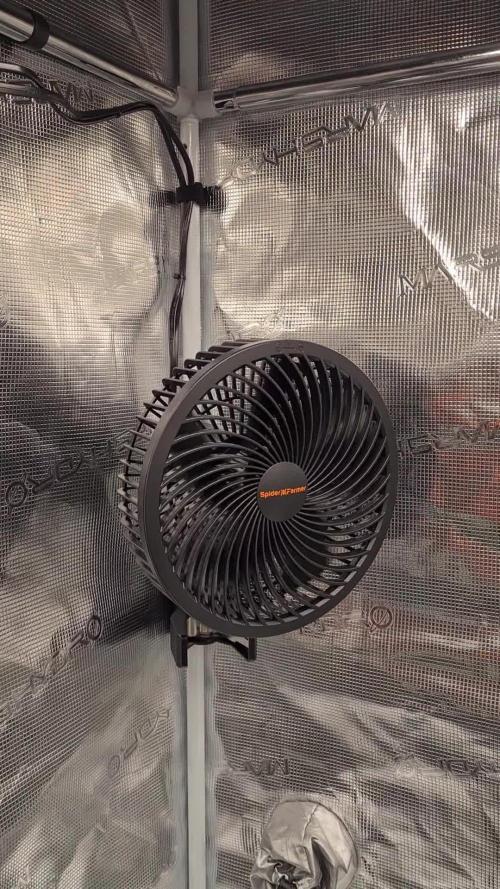
The next day Santa came early 😁 Got 2 new clip fans and the AC5 Power strip from Spider Farmer.
The power strip has 5 outlets you can control in the app, they can be turned on based on a time cycle, humidity or temps.
It comes with a sensor that monitors light, temperature, and humidity.
And a soil sensor that monitors soil moisture (VWC), temperature, and electrical conductivity (EC).
It also has a light adapter to connect 2 lights, that can be controlled in the app aswell.
The app shows the current VPD, i try to keep this around 1.0.
In the middle of the week we topped her aswell.
The next day we increased the light intensity from 30% to 35%.
LUX: 13.000/13.500 to LUX: 15.000/15.500
This week's growing conditions were 17.9°C to 22.4°C with a humidity of 55.5% to 67.6% and watered 2 times with 0.5L.
See you next week!

Likes
10
Share


@Waveydavey420
Follow
Plants are responding well with the gold leaf at 4ml per gallon. The reservoir is starting to have a strong bad smell on day 3. May switch back to ph'd water at 6.5, then add gold leaf at 10ml gallon every 3 days. They're drinking water like crazy. Iowered the light to about 20", running on 580 watt.

Likes
5
Share


@GREENPHOENIX6262
Follow
* Critical+2.0 Week 1 Veg - 10/08*
Thus far all is moving accordingly - Light nute feeds have begun - Moved into 4x4 tent with C02 Exhale bag.

Likes
11
Share


@tripa_grower
Follow
Hey mates, I'm happy with my first grow. I'm learning so much.
Day 29: I'm looking like a hypochondriac, but for the plants, all I see I think it's a disease. Now I'm seem the older leaves getting yellowing, and gotting some brown/dark spots and saw little flies walking at the soil, I've googled it and can be fungus gnats, what I'm supposed to do?
About the pH: I never measured the pH cause I'm using the pH Perfect products of Advanced Nutrients and they say you dont know care about this. But I've started to use mineral water, to see if have some difference. Obvious the mineral water is more puriest and clear than the tap water. Lets see.
Day 30: I've did the defoliation on all seeds, but on Seed 2 and 3 I've just removed dead or yellow/brown leaves, and at the Seed 1 I've removed the most of fan leaves, leaving two or three at max.
Day 34: I'm happy with these girls, Seed 3 I've did not LST and she have 49cm, Seed 2 I've did a soft LST and she have 45cm and 3 main colas, Seed 3 I've did a more little harder LST and she has only 33cm and I think has 4 or 5 main colas, I really dont know the exact number cause one of them is a little lower than the 4 others.
Likes
4
Share

@CannaWolf420
Follow
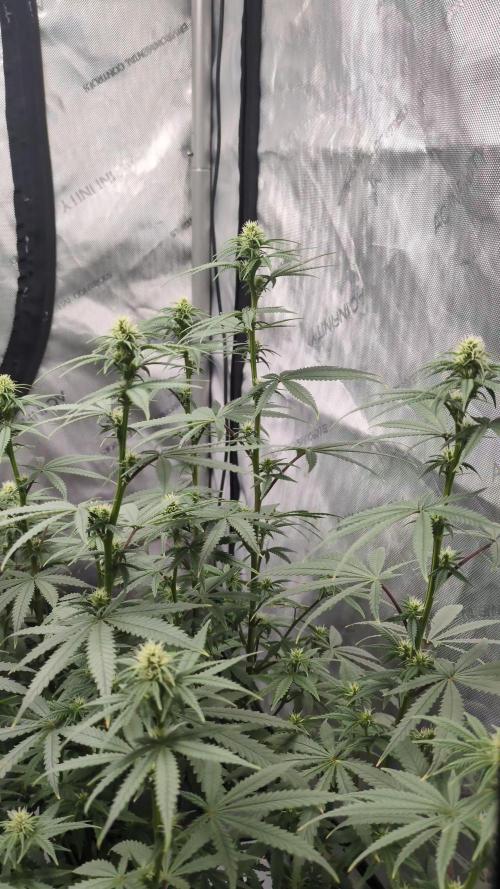
The end of another fine week of flowering has come. These ladies are working hard and seem to be in very good condition.
I've seen a lot of production in bud shape and mass over the last week with no sign of issues. Last Thursday I gave them a good heavy feeding then fallowed up with light non feeding waterings through the week, because they are bottom feeding, the non feed watering insures the plants root system doesn't get salt buildup.
As for plant structure and trichome production, these lady's have a very nice structure not to tall with a tight node stack
I've noticed some good frost production so far being early into mid flower.

Likes
2
Share


Likes
8
Share


@CanadianFillmore
Follow
Let the flushing begin! Week 8 went well, this girl packed on the last of her weight and density. She's showing more red hairs, more color in her leaves and she's got a 60/40 mix of cloudy/clear trichomes.

Likes
13
Share


@420DeepGrow
Follow
📆 Semana 0
🍁💐💐Mimosa Auto:
Ya está la semilla en servilleta de papel, vamos a ver qué tal responde esta Mimosa Auto de RQS.
Dicen que tira cogollos resinosos y con aroma a cítricos, así que hay ganas de ver cómo se comporta la germinación.
De momento a dejarla tranquila, que se pille bien al sustrato, luz suave y agua cuando lo pida, nada de fliparse que no queremos estresarla demasiado. Esta semana es todo paciencia y mimo para que se asiente bien; en cuanto coja ritmo, vamos metiendo caña.
💡 Para darle un empujón en estas primeras etapas, he añadido el Seed Booster de RQS, perfecto para fortalecer raíces y asegurar una germinación rápida y segura.
Seguimos creciendo fuerte! 💪
CUPON RQSCREW: 15% DESCUENTO en Royal Queen Seeds
Likes
Comments
Share


Likes
12
Share


@iLoveGoodWeed
Follow
The plant have nuts lock I did flush her bud maybe a bit late and it's not looking good for this one buds hope fully she will recover a bit


Likes
29
Share

@Natrona
Follow
Fat Bastard Auto by MSNL
👉Sponsored Grow👈
W2 V2
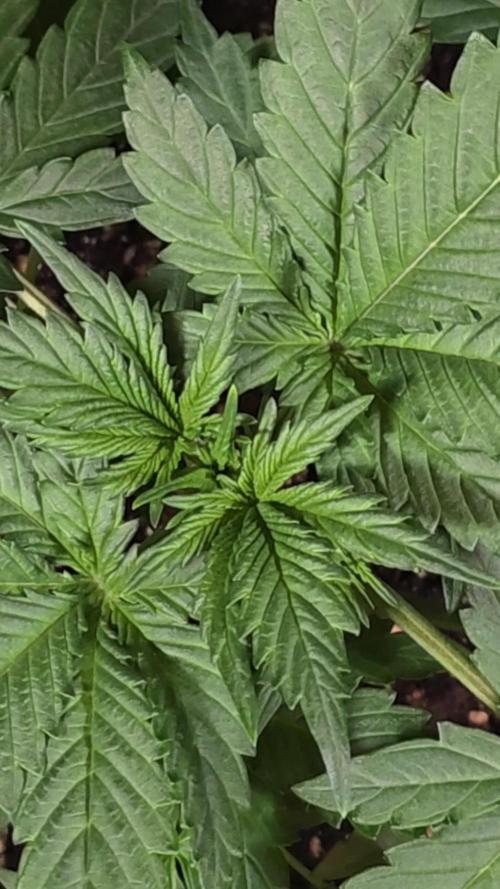
Fat Bastard shot up 4 inches this week and is now 6 inches tall now. Because I have iridium and copper in the water, the ph meter fluctuates due to breaking bonds between the hydrogen and oxygen. The fluctuation range I see is between 6.4 and 6.9 so I’m reporting 6.6. So far, I don’t see any negative effects of the iridium & copper on the plant.
The soil base is Happy frog, Coast of Maine, Mushroom Compost and super soil. I’m giving only ph water to her for this grow. I gave 1 liter of ph 6.6 PPM 376 at 66.7f twice this week
As always, thank you all for stopping by, for the likes and most of all growers’ love and support.
Stay green, growers love 💚🌿
💫Natrona💫

Likes
13
Share


@Leanback
Follow
Still waiting… the flowers are growing and some tricomes getting cloudy.


Likes
6
Share

@La_VecinaCannabica
Follow
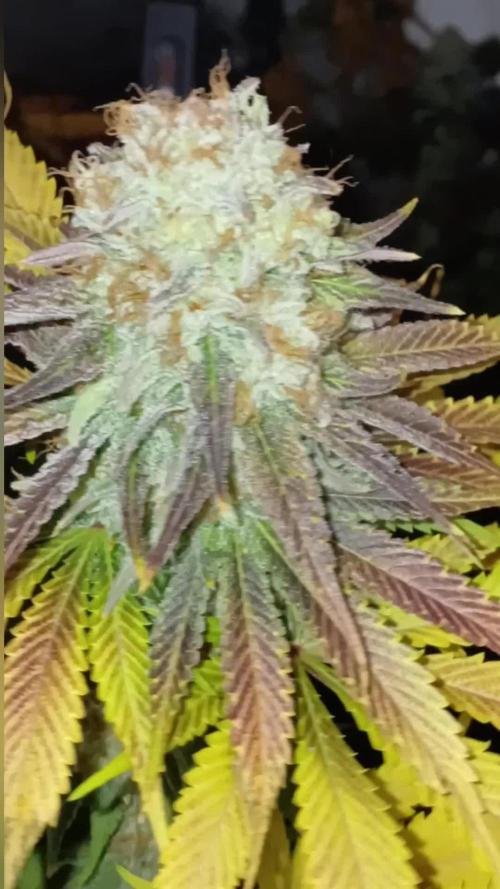
La variedad Pink Truffle de lujo ,unas de las mejores cepas que he cultivado.
Likes
10
Share


@BEACHBUDZ757
Follow
Growing very quick super healthy . This is my first Auto run. CO2 setup is 3 cups sugar 1 table air stone, tubing hooked to fan to disperse co2

Likes
32
Share


@PEAKYPLANTERS
Follow
Respect for all of you, brother farmers! masters and beginners! thank you again for gathering on the pages of my diaries! we carry out our work with dedication and live on ambition! Come on guys!🙌👽🙌
WE WANTED TO CELEBRATE WITH YOU
OUR 3 YEARS OF AGRICULTURE ON THE PLATFORM.
GREETINGS TO THE FRIENDS OF @GROWDIARIES WHO MADE THIS POSSIBLE!


