


Likes
Comments
Share

@LegacyGrow
Follow
Tag 84 Grow:
Tag 29 Blüte:
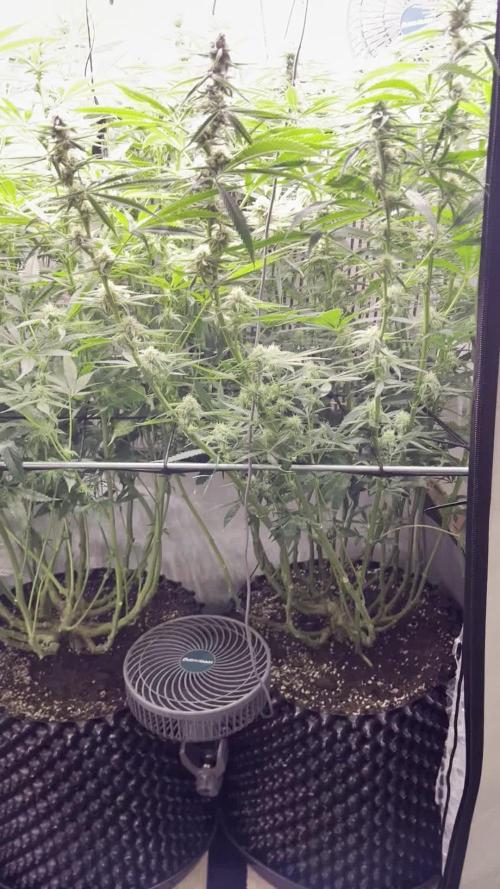
Die Trauermücken sind deutlich im Rückgang.
Der Luftentfeuchter tut sein Bestes unter 62% schafft er es leider nicht. Was mir etwas zu feucht für die Blüte ist - daher habe ich die Umluft nochmals erhöht und auch im Bereich der erde 2 Ventilatoren installiert.
Jedes zweite Wässerung ist ein 24h gebrühter Compost-Tea.
der Geruch ist sehr süß-fruchtig leichte spuren Gasig.
Die Trichombildung ist recht ansehnlich
Ich versuche jeden - jeden zweiten Tag ein paar Blätter zu entfernen die Schatten auf Top-Buds werfen. Nie mehr als 5-10 Stk.
Tag 89 Grow:
Tag 34 Blüte:
Heute habe ich mehrere Blätter entfernt um mehr licht an die unteren Buds zu bringen. Es riecht extrem süßlich nach Erdbeerkuchen XD.
Zusätzlich gab es wie alle 3-5 Tage ca. 25L 6,4 PH Wasser mit 1,2ml/L Canna Magnesium und Calcium für extra starke Blüten.
--------------------------------------------------------------------------------------------------------------------------------------------
Day 84 – Grow
Day 29 – Flowering Phase:
Fungus gnats have decreased significantly. The dehumidifier is doing its best, but unfortunately it cannot reduce relative humidity below 62%, which is slightly too high for the flowering stage. Therefore, air circulation has been increased further, and two additional fans have been installed at soil level.
Every second watering consists of a compost tea brewed for 24 hours. The aroma is very sweet and fruity, with slight gassy notes. Trichome production is quite impressive.
Every one to two days, a few leaves are selectively removed that cast shade on the top buds — never more than 5–10 leaves at a time.

Likes
37
Share


@LaGrassaFarm
Follow
Esta es la última semana que le damos riego con nutrientes, a las plantas con flora avanzada, (recordad que tenemos tres más retrasadas, que entraron a florar más tarde)
Además hemos igualado la altura de toda la canopia.

Likes
2
Share


@CannaIGrow
Follow
Plant seems to be growing well, she’s has some nice fans. I’ll be transplanting some time next week. Topped her this week too.
Likes
5
Share


@Prempavee
Follow
This plant during her life have passed trough many issues but she overcame them all and she express an incredible vigor.
This week I just added some straw on the ground and I have watered with a solution of EM that I made, also a light solution of molassa have been added to the foliage
OMG is not even possible to make a diary longer than 30 weeks here lol 555555

Likes
6
Share


@geo098765
Follow
I’m trying to figure out what color these tricomes are so I know when to flush, I’m using salt based chemicals so I know I want to flush before harvest

Processing
Likes
10
Share


@YAKDADDYDWC
Follow
Had major problems with temps rising this week was forced to pull out the aircon..... gona cost a fortune!!! To top it off i got gnats but 8 think im on top of it geez i have had some troubles from enviroment because its summer and i would have better results in winter

Likes
4
Share

@CannaIGrow
Follow
This plant was the first of the 4 to come up, it also basically exploded out of the shell in the germination process. While she was still in water I could already see green leaves lol. She’s really plugging along. This is a cross made by a friend of mine and is the first time it’s being grown.
Likes
116
Share


@bioaccessory
Follow
Три четверти пути позади.
Растение стало сильно липким, в остальном все хорошо.
22/04 PH6,0 PPM850
24/04 PH6,1 PPM930
👉Планирую сделать интересный досвет низов по периметру, оставайтесь на связи.
Спасибо, что заглянули, и будьте здоровы! 🙏
Продолжение следует ...😶
Likes
119
Share


@DogDoctorOfficial
Follow
I love growing and i love the GD community, we are like a big canna family and its a pleasure and an honor to be part of this all. Thank you all for being here , for growing and believing in this beautiful healing plant . Growers love to you all

Likes
23
Share


@WolverineGreens
Follow
They r still stretchin they asses off.😁 2 maybe 3 more feedings wit grow nutes.
Other then the mutant alaskan purp, everything looks good. They look loke they r still in the middle of strectching, so im guessin ill average a height of round 5'5"-6ft for the 30 inground.😁😁😁 the short ones r big around tho so im happy.
Gave up trying to figure out the problem with my mutant ap. I cut it way down on nutes and didnt see a change. Will just treat it like the others til harvest n see what happens.

Likes
14
Share


@Weedywade89
Follow
Had a little heat issue it was hitting 110 degrees outside for four days straight and about 130 degrees in the GrowRoom didn’t have the funds to get a ac for the room but working on it so my lady’s suffered for a few days
Likes
28
Share


@BB_UK
Follow
So let’s start by saying I was Mis sold original bloom with the hydro coco version and me being me expecting what I asked for and as I bought soil 2 bags with it you’d expect to have indefinitely what I asked for but sadly not, I can say it hasn’t caused a problem on my autos and I now have the correct nutrient but the first feed was with it! Results would apparently be not as good as the soil version but I imagine being the first feeds it’s not as important as if it was through 2-4th week of bloom, but again this is the start! Here we grow


Likes
15
Share


@Hashy
Follow
********************************************
Week 9 mid flower (week 5 flower)
********************************************
Light cycle=12/12
Light Power=140w 59%
Extractor controller settings (during lights on).
High temp= 26c
Temp step=0c
High Rh= 48%
Rh step=0%
Speed max=10
Speed min=3
Extractor controller settings (during lights off).
High temp= 20c
Temp step=0c
High Rh= 53%
Rh step=0%
Speed max=10
Speed min=3
Smart controller settings (during lights on).
Lights on=9.00am
Radiator on= -19.0c
Radiator off=+19.5c
Smart controller settings (during lights off).
Lights off=9.00pm
Radiator on=-18.0c
Radiator off=+18.5c
VPD aim=0.9-1.4
DLI aim=30-35
EC aim=0.8-1.5
PH aim=6.0-6.5
💧💧💧💧💧💧💧💧💧💧💧💧💧💧💧💧
NPK= 8-17-26
Method= Automatic
Feed=Flower nutes
Neutralise=0.1ml/L
Plagron bloom=4ml/L
Plagron Power buds=1ml/L
Green Sensation=1ml/L
Easy Ph down=0ml/L
(1ml=24 drops, 1 drop=0.04ml)
Easy Ph Up=0.021ml/L
(1ml=24 drops, each drop is 0.04ml)
Ec=1.55 PH=6.2/6.0
Runs=10
Run times=3mins (0.75L/0.375L each)
Gap times= 17mins
Total runtime=30mins(7.5L/3.75L each)
Total flowrate= 0.25L/min(0.125L/min each)
Auto start time=10.00am
Auto stop time=1.03pm
💧💧💧💧💧💧💧💧💧💧💧💧💧💧💧💧
********************************************
********************************************
📅5/4/25 Saturday(Day 57)
📋
📅6/4/25 Sunday(Day 58)
📋Small defoliation
📅7/4/25 Monday(Day 59)
📋
💧
Automatic Flower nutes
Ec=1.5 PH=6.1/5.6
Volume=10L
Volume left=2.5L
Volume used=7.5L(0.25L/min)
Volume each=3.75L(0.125L/min)
Runoff.
Total runoff=1.5L
Ec=1.6 PH=6.5/6.1
💧
📅8/4/25 Tuesday(Day 60)
📋
📅9/4/25 Wednesday(Day 61)
📋
📅10/4/25 Thursday(Day 62)
📋
💧
Automatic Flower nutes
Ec=1.5 PH=6.3/6.0
Volume=10L
Volume left=2.5L
Volume used=7.5L(0.25L/min)
Volume each=3.75L(0.125L/min)
Runoff.
Total runoff=1.6L
Ec=1.8 PH=6.4/6 1
💧
📅11/4/25 Friday(Day 63)
📋H=70cm D=41cm Dli=28.2 PPFD=653
********************************************
Weekly roundup.
📋 She's looking good, nice height, good amount of flower sites.
Take it easy.
Back soon.
********************************************
Likes
16
Share


@OrganicBuds030
Follow
Die erste Woche der Blütephase wurde eingeleitet. Im nächsten Schritt werden wir schon bei Woche 3 weiter machen. Woche 2 hab ich leider keine Aufnahmen gemacht. Aber jetzt wird es spannend.

Likes
4
Share

@Trinidad
Follow
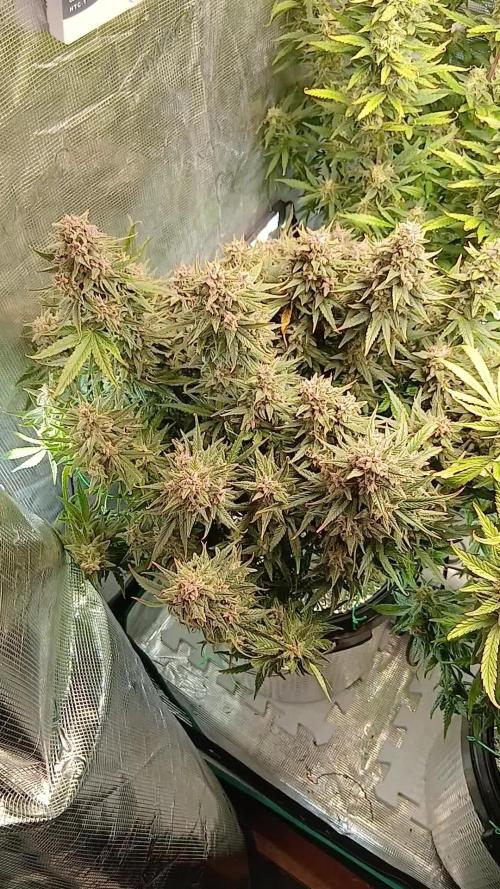
15th.05.2025 Day 70. Left these girls for a couple of days, came back to see them explode. All milky trichomes. Still some white pistil hairs. Strong 💪 smell. Tropicana cookies 🍪 strong cirtus smell. Banana 🍌 purple punch has sweet and fruity smell, so lovely. Lemon 🍋 cherry🍒 has bubble gum smell with hint of citrus. They have definitely put on some weight in past week. We will see how far we can take them until we start seeing amber trichomes.
17th.05.2025 day 72
Today I harvested the tropicana cookies. I still could have waited a bit longer, however i am dying for a smoke. Hung whole plant in small grow tent, maybe 1ft x 1ft. I am trying to slow down drying as much as possible because on last run (wurlz f1) I dry too quickly without keeping an eye on temperature and humidity. Buds were crispy. In dry tent now the buds are touching the wall. I don't know if this will affect the dry. We will find out. Placed dehumidifier in tent as humidity keeps going up as plant drys. Set at 60%. I can't get temperature down to 60f or 15.5c as recommended. My temperature is around 20c or 68f. As for the others i will try to push them as much as possible. We'll see how things progress.
18th.05.2025 Day 73
Today was chop day for banana 🍌 purple punch 👊🏼. She is frosty as f**k. On this plant fimming was applied. She came out short as I wanted. It's difficult to see with jewelers loop but I see some amber. I need to get better scope.
Also today I gave chemdawg a reservoir change out with final part solution. Also because there is more room in grow tent I spread some of the branches and trimmed off some of the lower popcorn buds. Topped up lemon cherry with nutrient solution. Soon lemon 🍋 cherry 🍒 will be chopped🔪
For the dry tent I removed dehumidifier as it was creating heat on the buds directly about. I am using an inline fan now . Once the humidity gets too high it comes on and sucks dry air in. This also removes stagnant or stale air, which is better for buds and will help prevent mold.
21th.05.2025 Day 76
Today lemon 🍋 cheery was harvested. Looking at trichomes they seem milky woth little amber, however the pistil hairs on her were all brown and she was starting to lose her bubble smell. I placed her in dry tent with tropicana cookies and banana purple punch. I had to install carbon filter because these girls were stanking up the house.


Likes
31
Share


@TheHighentist
Follow
30/7
-Temp 23-27day/21-24night
-45%RH (2+-)
31/7
-Temp 23-26day/21-24night
-44%RH (2+-)
1/8* Water day / flush
-Temp 23-27day/22-24night
-43.5%RH (2+-)
2/8 Slowly getting ready for harvest.
-Temp 23-26day/21-24night
-43.5%RH (2+-)
3/8
-Temp 23-26day/21-24night
-43.5%RH (2+-)
4/8 Day before harvest, shut the lights off till tomorrow.
Trichomes, smell and looks are just like i want it. Very satisfied.
5/8 Harvest day - Converting grow tent to dry tent.
Likes
35
Share


@Rap_a_cap
Follow
This is exactly the 🇲🇦 morroccan 🇲🇦 way of sifting resin from kief. Traditionally, apart the hand rubbing method, dry sifting through a mesh is the most used way to obtain resin, from 🇦🇫 Afghanistan 🇦🇫 or 🇳🇵Nepalese 🇳🇵 Mountains to 🇲🇦 Morocc 🇲🇦 Rif passing through Bekaa valley in 🇱🇧Lebanon 🇱🇧. The average size of meshes used vary from 90 to 180 microns and are mostly made by silk and for this reason uneven.
I think the most productive ways to sift are Dry Ice and rotating pollinator + CO2, I've tried a DIY pollinator built by a friend and it can reach up to 20/25% of resin extracted at 120 microns and 15% at 90 microns. But smell and taste don't reach that traditionally extracted but this is another story.
Morroccan way is good compromise between a stashbox or more evolute methods.
It requires less than 10 dollar of expenses.
You need:
a basin or pot without handles
a heavy-duty plastic bag that contains the basin
a pair of chopsticks
a good 120 microns net
an elastic band
tape
Kif or trim q.s.
Here is the link where I buy my meshes. Very high quality, customable size and material (steel or nylon) and length and very kind vendor on AliExpress
https://a.aliexpress.com/_uwfQzq
Drum for 3 minutes.
.....perhaps you will find that you have an innate talent as a drummer, throw the shit away and put your head right......


