


Likes
Comments
Share

@Bunterbiber
Follow
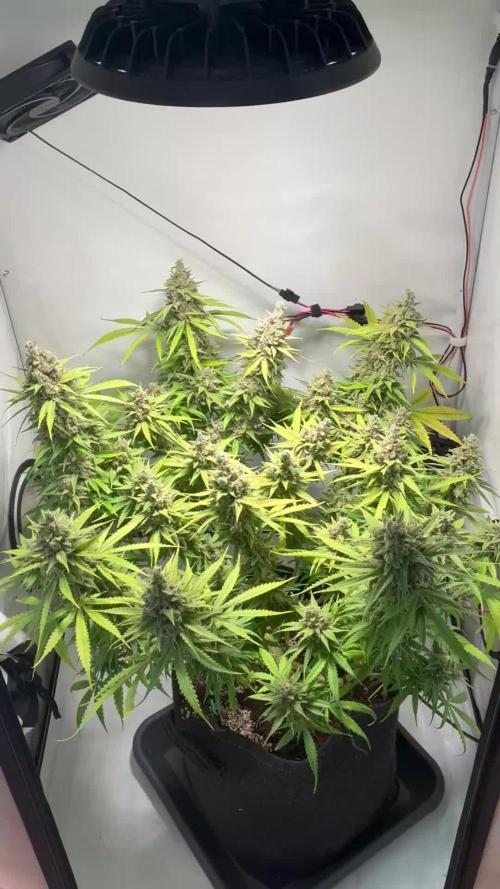
Chop day is officially here! By the end of Week 16, I decided to pull the trigger. The trichomes were mostly cloudy with a few ambers popping up here and there. While I could have let her go another week, my personal schedule made this the perfect time to harvest.
I also had a new toy in the garden today: a Vevor bowl trimmer. I used it for the small and medium-sized buds while hand-trimming the 'top shelf' colas. Honestly? I’m blown away. It’s not as surgical as a manual trim, but the time-saving is a total game-changer.
The Stats:
- Wet weight: 544g
Next step: Into the Dryfermbags for about a week until the limited amount (due to German law) is ready for the jar.
Overall, I couldn't be happier with this grow. No issues, no drama—this strain was an absolute breeze to grow and performed like a champ. Now, I just need to nail the drying and curing phase!
P.S. Need some cleaning advice! Cleaning the Vevor trimmer (especially the grate) is a nightmare. I’ve been using ISO and a cloth, but it’s still a struggle to get all that resin off. If anyone has a pro-tip or a better method for cleaning these machines, please let me know in the comments!"




Likes
7
Share

@DogDoctorOfficial
Follow
Week 9 From Seed
Sour Diesel — 12/12 From Seed
(≈ Week 4 Flower)
First, a quick recap for anyone joining the journey now.
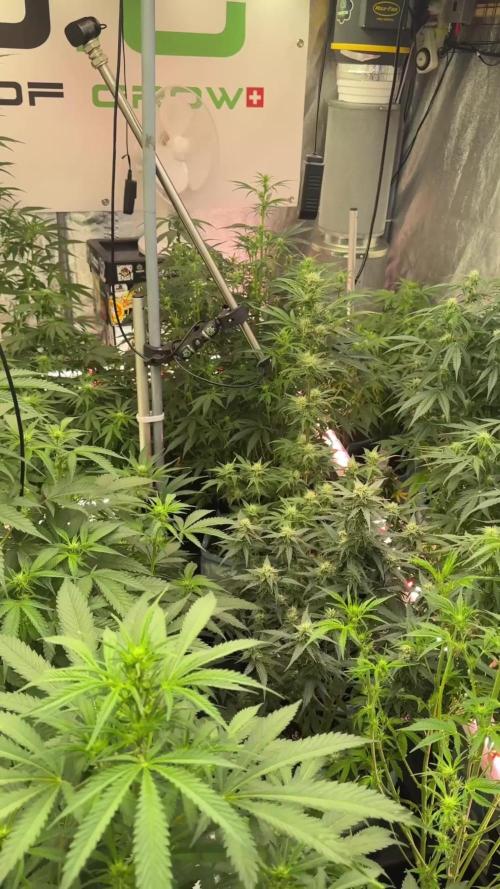
This Sour Diesel had a rougher start compared to the rest of the room. Earlier in the run she experienced stress that slowed her development, which is why she remains smaller than the other plants in the room.
That said, plants have an incredible ability to recover when given the right environment and a little patience.
And despite her size, she is now building beautiful flower structure and starting to frost up nicely.
Sometimes the smaller plants still carry the biggest character.
⸻
Current Room Conditions
The room is currently running slightly on the warm and humid side, but this is intentional and carefully controlled.
Environment
• Canopy temperature: ~28°C (gradually tapering toward ~26°C)
• Relative humidity: ~70% (slowly being reduced toward ~60%)
• CO₂: 1000+ ppm through passive enrichment
• PPFD across canopy: 800 → 1300 µmol
This might look risky on paper, but the room has very strong airflow and constant air exchange, including inner-canopy movement.
Good airflow changes everything.
Without proper air movement these numbers would be dangerous, but with healthy circulation and CO₂ availability, the plants are able to metabolize efficiently.
⸻
Nutrient Program (Current Week)
Feed EC: ~2.4
Soil EC: ~0.9
Current weekly top feed includes:
• CalMag Pro
• Terra Bloom (base nutrient)
• Power Buds
• Green Sensation
• Pure Zym
• Sugar Royal
• Vita Race (foliar where applicable)
⸻
Why Power Buds and Green Sensation Now
At this stage the plant has fully entered generative growth.
The stretch phase is finishing and the plant is shifting energy toward flower development and resin production.
Power Buds
Power Buds helps signal the plant to transition more strongly into flower formation. At this stage we want the plant focusing on bud site development and structure, and this additive helps push that direction.
Green Sensation
Green Sensation comes in as a flower booster, supporting:
• bud weight
• terpene production
• resin development
• potassium and phosphorus availability during peak demand
Around week 4 of flower, plants start increasing nutrient demand for flower building, which is why this product becomes relevant now.
⸻
Why Power Roots Was Removed
Early in the run the focus is on root system establishment.
Power Roots is excellent during:
• seedling stage
• early vegetative growth
• transplant stress
But once the root system is already developed and the plant has entered full flowering mode, the focus shifts from root expansion to flower production.
At this point it becomes more beneficial to direct the feeding program toward generative growth rather than root stimulation.
⸻
A Quick Note on Leaf VPD
Leaf VPD is always something to keep in mind, but we won’t go too deep here since we’ve covered it in previous reports.
What matters most is that:
• temperature
• humidity
• airflow
• light intensity
are all working together.
Even though humidity is currently around 70%, the strong airflow and active transpiration keep the plants functioning properly.
The leaves are still able to transpire and regulate themselves efficiently.
⸻
Plant Development
Despite the smaller plant size, the flower formation is looking excellent.
Bud sites are stacking well and trichome production is already beginning to show.
She is starting to frost up nicely, almost like a light snowfall on the sugar leaves.
The structure is surprisingly elegant for a plant that had a slower start.
Sometimes the plants that struggle early end up showing the most personality later in flower.
⸻
What to Expect Next Week
Over the coming week we should begin to see:
• increased bud stacking
• calyx swelling beginning
• more visible trichome development
• stronger aroma production
The plant should now start focusing more energy on resin production and flower density.
If conditions remain stable, the next weeks will likely show the true character of this Sour Diesel.
⸻
Final Words
To everyone following this journey:
Thank you.
To the OG growers, the new followers, the people quietly watching, the ones leaving comments, the ones sharing knowledge, and yes — even the haters.
Energy is energy, and every voice contributes to the ecosystem of this community.
Shoutout as well to the GrowDiaries platform, the broader growing community across platforms, and everyone who continues to support, question, discuss, and share knowledge.
We grow together.
And sometimes even the plants we think we messed up still remind us why we love doing this.
See you next week. 🌱
📡 Please stay tuned they can try and take us down but we never quit https://www.youtube.com/@DOGDOGTHEDOCTOR NEW
🙏 Thank you for your patience and continued support.
FOR DISCOUNT CODES AND MORE JUST FOLLOW THE LINK https://website.beacons.ai/dogdoctorofficial
📲 Don’t forget to Subscribe and follow me on Instagram and YouTube @DogDoctorOfficial for exclusive content, real-time updates, and behind-the-scenes magic. We’ve got so much more coming, including transplanting and all the amazing techniques that go along with it. You won’t want to miss it.
GrowDiaries Journal: https://growdiaries.com/grower/dogdoctorofficial
Instagram: https://www.instagram.com/dogdoctorofficial/
YouTube: https://www.youtube.com/@dogdoctorofficial Deleted by Youtube
Vimeo : https://vimeo.com/dogdoctorofficial Under construction stay tuned ⸻
Explore the Gear that Powers My Grow
If you’re curious about the tech I’m using, check out these links:
🔆 Lighting & Environmental Control
• Future of Grow — Advanced LED lighting technology
https://www.futureofgrow.com/
DISCOUNT CODE: DOG20
• Lumiflora — Under-canopy LED lighting
https://lumiflorade.com/
• TrollMaster — Environmental controllers and automation gear (past collaboration)
⸻
Genetics
• Zamnesia Seeds — Genetics used in this project
https://www.zamnesia.com/
⸻
🌱 Soil, Substrates, Boosters & Root Support
• Plagron — Substrates, bio mixes, and supportive products
https://plagron.com/en/
⸻
🎒 Storage, Curing & Preservation
• Grove Bags — Curing and storage solutions
https://grovebags.com/
⸻
📸 Photography Equipment & Tools
(Not sponsors, but part of my creative toolkit)
• Sony A6700
• Sony full-frame macro lens + few more
• Stacking photography workflow - learning
• iPhone (for behind-the-scenes shots)
We’ve got much more coming as we move through the grow cycles. Trust me, you won’t want to miss the next steps, let’s push the boundaries of indoor horticulture together!
As always, this is shared for educational purposes, aiming to spread understanding and appreciation for this plant. Let’s celebrate it responsibly and continue to learn and grow together.
With true love comes happiness. Always believe in yourself, and always do things expecting nothing and with an open heart. Be a giver, and the universe will give back in ways you could never imagine.
💚 Growers love to all 💚
📸 P.S. – The Eye Behind the Lens
All photos in this diary (for now — except for the ones showing the camera, which I took with an iPhone) are taken with a Sony A6700 paired with a Sony full-frame macro lens and a few more.
Photography is part of the story — it’s how we share the fine textures, the glow, and the quiet details that words can’t always capture.
I’ve also started experimenting with photo stacking — a technique where multiple images, each taken at a slightly different focus point, are layered together to create one perfectly sharp image from front to back.
It’s not digital enhancement or AI; it’s pure photography — a way to reveal the plant’s beauty in microscopic depth, from trichome to petal.
You’ll even see a few shots of "ghost me" capturing the shots — camera, lens, setup — because every grow deserves not just to be cultivated, but documented like art.
FOR DISCOUNT CODES AND MORE JUST FOLLOW THE LINK https://website.beacons.ai/dogdoctorofficial
NEW DISCORD - Official Server Invite Link : https://discord.gg/ksjAkA5T74

Likes
129
Share


@DreamIT
Follow
🎲➕ VLC Critical Plus + by PEV Grow➕🎲
➕13.6 Speak for itself. is almost ready to start mainlining 😆
➕14.6 Nothing interesting at the moment, it grows well
➕15.6 even today nothing special to say, yeah
➕16.6 All very nice. It will look so soft in the picture
➕17.6 Yesterday I discovered 3D photographs. What do you think about it? if you are not just a serial commentator, please leave me your opinion, i would appreciate it very much 🙏🦄
➕18.6 with these photos I caught a little cursed insect that goes around the leaves, as a precaution I give two sprays of neem oil in the box. I live behind closed doors with mosquito nets and bug catching cat, I really want to know where they came from. In one year of Indoor cultivation I have never had any problems 😤
➕19.6 Week ended without problems, very fast this plant. Great job PEV Grow 🤘🦄
__________________________________________
❓ Are you new to the world of cultivation and don't know where to safely buy your seeds?
😮On the Pevgrow site, you can find the best-feminized seeds indoors and outdoors. Achieved through totally natural stress methods and with guaranteed superior quality.
✅http://bit.ly/PevGrow
ℹ️Check out the marijuana dictionary
✅http://bit.ly/CannabisDictionaryPEVGrow
__________________________________________
👀 Are you looking for a good lamp to start with? 👀
🌞Viparspectra has something more than the others, take a look at their site.
⏩ Use "GDVIP" for an extra discount or "ViparDreamIT" for an extra 5 %% discount
👀 Search for it on Amazon
✅Amazon US: https://amzn.to/30xSTVq
✅Amazon Canada: https://amzn.to/38udUVe
✅Viparspectra UE: bit.ly/ViparspectraUE
👀 Watch my ViparSpectra XS1000 unboxing on YouTube, leave a like and write to the channel 🦄
✅http://bit.ly/UnboxingViparSpectraDreamIT
______________________________________________
📷🥇 Follow the best photos on Instagram 🥇📷
https://www.instagram.com/dreamit420/
🔻🔻Leave a comment with your opinion if you pass by here🔻🔻
🤟🦄💚 Thank you and enjoy the growth 💚🦄🤟


Likes
127
Share


@DutchFarmer
Follow
Weekly Update on the Runtz 🌱
Hey everyone! Just wanted to share how the Runtz is coming along. She's thriving under the care of the Plagron nutrients 🌿, reacting beautifully to every feed. Since my last update, she’s sprouted several new nodes and is showing incredible growth!
https://plagron.com/en/tools/grow-schedule-calculator
She’s definitely growing like a sativa 🌳, with those long, stretchy branches. To manage that, I’m planning to enforce some solid training techniques to keep her short and wide, just the way I like it 💪✨.
I’m loving the whole experience so far, it’s been such a rewarding journey 💚. I’ve attached plenty of pictures for you all to check out 📸. Please drop a like, leave a comment, and share any feedback or tips you’ve got! 🌟🙌
Processing
Likes
10
Share


@StarletBud21
Follow
The week has been going very well plants are reacting good to nutrients and seem to be happily growing , haven’t fiddled around too much this week as starting to get the hang of things slowly ! The grow so far has been quite smooth And haven’t run into any Major problems all plants have been topped and will continue lst throughout I believe they look quite healthy haha ?
First timers luck 😉🤨 we hope so
Good end to the week next week I shall trim and see how that goes
Happy growing 💎


Likes
15
Share


@Lazuli
Follow
Final 2 weeks, the buds are hard full of frost i switched the feeding to finalpart now

Processing
Likes
10
Share


@simps
Follow
This plant has a growth spurt this week she’s doing just fine growing as I am training her to do not a whole lot to report just lotta growth everything’s going good
Day 4 of week 6 she is showing signs of preflower stretches we will see how it goes but it definitely looked like she wants to go into flower hoping to have a few more weeks of good veg time but I’ll take what ever she wants to do 👍😊

Likes
27
Share


@eldruida_lamota
Follow
Esos fumetillas, ya traigo de nuevo estás do sweet dos del banco sweetseeds, y es que vaya puntas, va salir chicha de cojones, con ver el porte y los laterales que tiene ya vemos que van a salir una flores grandes, y si no me creéis lo veréis en unas semanas.
Hasta el momento todo va bien es esperar la recta final para finalizar este proyecto y empezar con muchos más.
.
La humedad esta al 45% la temperatura está entre 21/25 grados , y como siempre el ph , ya que es de lo más importante,está en 5,8/6,0.
.
AgroBeta:
1 ml x L Flowering black line , vía radicular.
0,2 ml x L Beta shark, vía radicular.
0.5 gr x L mega PK , vía radicular.
0,8 ml x L Terminator, vía radicular.
0,5 gr x L Engordacogollos, vía radicular.
0,3 ml x L Tucán , vía radicular.
0,1 ml x L Betazyme, vía radicular.
0,3 ml x L Tricoma, vía radicular.
0,05 ml x L Gold Joker, vía radicular.
0,2 ml x L Silver, vía radicular.
.
Hasta aquí todo familia 🕸️ , un saludo y buenos humos fumetillas💨💨💨.
Likes
17
Share

@Generalbudz
Follow
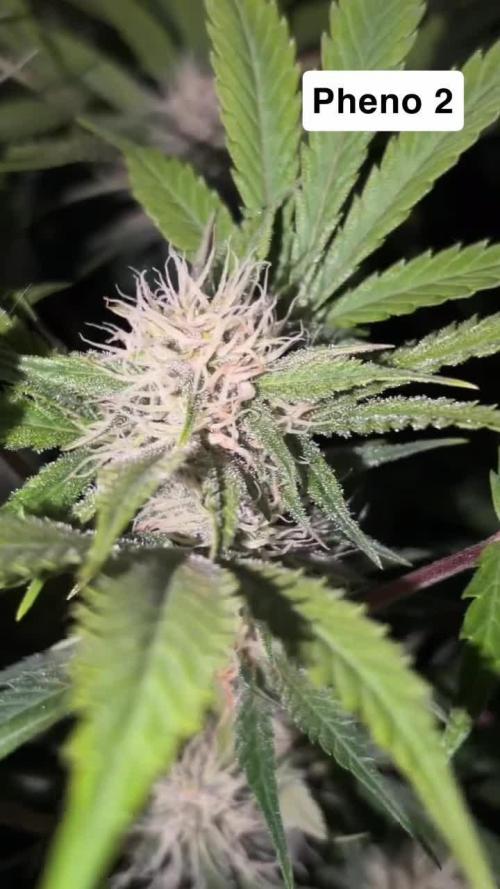
Seems like the 75-85 day lifetime suggestion from fastbuds is on point and not a overstatement, (KEEP IN MIND THEY ARE FEED BY A DRIP SYSTEM FROM SAME WATER TANK / SAME NUTES) - pheno 1 chewed more nitrogen than her siblings since early on, she got a topleafs fade earlier than expected but she is forgiven because she is finishing crazy fast and feels like shes 2 weeks ahead of everyone else bonus point to her she smells strong and full of ice no matter the top fade, pheno 2 is doing avarage smells 100% same as pheno 1 but seems slower (no early fade full of trichomes too)
- Pheno 3 🏅words cannot summon her up, she looks purple already and she smells like a elite photoperoid pheno hunt result, honestly id suggest fastbuds to ask me to cut a stem put it in a glass tube with gel and send it to them via mail to study or replicate her genetics if that is possible, i have never seen such absurdly 10/10 auto in my life, her smell is a John Jones punch in the nose, and not just me saying this ive shown it to my friends and they are shocked (keep in mind im a Berliner who is in toch with some of world LOUD hunter legends if yk yk) something was up with this pheno since sporut we dont know what that is but we want more of this one, she also loved the nute dose we gave her with zero problems .
Pheno 4 is simmalar in smell with pheno 1 and 2 but her growth seems to be noticably slower she seems to be a bit behind id say 1 week, maybe because shes under the 6inch osculating fan and shes getting a bit less light she has 0 metabolism problems though so thats fine.
Dont get me wrong pheno 1 2 and 4 smell strong and amazing too but miles away from pheno 3 and NO pheno 3 isnt a different strain put in the seed bag by mistake if you toch the stem 4 of the phenos have the exact same cherry cola smell pheno 3 is just the CHOSEN ONE.
Likes
8
Share


@Canna_Enthusiast
Follow
So far so good,
Plant2 is one week behind in size on Plant1 but no reason to panic.
Each seed has his own growing speed.
Started some LST techniques to keep the plant low and let the side branches reach their full potential.
The plants are looking happy and healthy.
Because it are auto’s I’m expexting them to start flowering in a week or 2 but it’s hard to tell as I usually only grow non-auto’s
I’ll switch to bloom nutrition as soon as I see the first pistils appear.

Likes
38
Share


@Green_Mountains
Follow
A lot going on this week!! Feeding 3 quarts every Sunday and Wednesday at this point. I did a light defoliation on Monday and did a more thorough defoliation on Friday! I opened up a lot of bud sights and it shows in the pics from late in the week!!
I just turned the fan and carbon filter on. Temps are currently holding at 73-74F and the humidity is between 43-45%. I'm very happy with that!
I hope to keep them both happy!!
Enjoy!
Likes
18
Share


@Wilstang
Follow
Growing Strawberry was a gentle walk in the garden, all she wanted to do was eat and grow. Very bushy plant and amazing structure and resistance. 100% recommended for that sativa perfection 🔥🚀

Likes
4
Share


@Dendegrow
Follow
Radical Juice Auto – Two Phenotypes 🌱🍉🍊
This run gave me two completely different phenos!
One is short and stocky – classic indica vibes 💪🌿
The other one is taller and more slender – definitely leaning toward sativa 🌾
The tall pheno reminds me a bit of Tangie 🍊
The short one? Straight-up watermelon 🍉 – super juicy and fresh!
Both are smelling 🔥 already and I can’t wait to see how they look and taste in the end 😍👃
Follow me to see how this story ends! 🌟✌️
Radical Juice Auto – Zwei Phänotypen 🌱🍉🍊
Dieser Grow hat zwei komplett unterschiedliche Phänotypen hervorgebracht!
Einer ist klein, kompakt und wirkt richtig indica-lastig 💪🌿
Der andere ist lang und schlank – eher in die sativa-Richtung 🌾
Der hohe Phäno erinnert mich etwas an Tangie 🍊
Der kleine? Riecht wie Wassermelone 🍉 – richtig saftig und frisch!
Beide duften jetzt schon 🔥 und ich bin mega gespannt, wie sie am Ende aussehen und vor allem schmecken 😍👃
Folgt mir, um nichts zu verpassen! 🌟✌️

Likes
5
Share


@Do_it_Dan
Follow
Nice week for the lady runtz, many many bud sights, the smell is getting there, had to give a little extra pk warrior but other than that she's doing well 😀 👍 happy growing and stay green ✌️ 💚 👌 peace

Likes
4
Share


@UrbanBoer
Follow
Talk about a mission accomplished, dam you Lamby… you had me excited at one point when I thought you were an auto, but to my shock, you are a regular, you just have a long ass flowering window… at least unlike her sisters within the 4th cycle, she did not reveg she just focused on flower, the buds are bulky and firm, scent is amazing, you would mistake her for a cheese strain. I should not be disappointed by the plant’s size! Because I planted her during winter, and all outdoor or greenhouse(unless you have a GH that is climate controlled), do not grow as big as the would during spring or summer season, and due to this factor, I only got 59g of wet bud. But I have faith the other ladies will produce a higher yields.
Last I smoke this strain was earlier late summer or early Autumn, and from smoking to growing now harvest, I wish I am blown out the water with this strain, it’s time to conduct that questionnaire. Or even better go to an established cannabis club, and get them to samples bud, and ask for a review.
Likes
8
Share


@Da-weed
Follow
Čau Growers 💚 Tak je to tady, končí poslední týden VEGETACE a přepínám na květ. Holky jsou celkem cítit, povyskočily zase o kousek do výšky, snad to zvládnou. Jsou zdravé a mají se k světu. První týden v květu nechám ještě GROW krmení, po té BLOOM, Power Roots do třetího týdne a Green Sensation od třetího týdne. Zábava začíná 💚Ať se daří, ať to roste, konec hlášení.
Likes
3
Share


@Squaregrouper
Follow
it's been a pleasure growing this plant outdoors as usual.. great results every year same clone off mother produces heavier than usual buds.. with minimal fertilizers.. 25% the amount of indoors chemicals

Likes
39
Share


@eldruidamx
Follow
Day 92. Watering with fertilizers.
Day 93. Watering with clean water.
Day 94. Watering with fertilizers.
Day 95. Watering with clean water.
Day 96. Watering with fertilizers.
Day 97. Watering with clean water.
Day 98. Watering with fertilizers.

Likes
5
Share


@Strangelet
Follow
Day 67. Will give her a couple more days.
Flushed middle of the week and removed all fan leaves.