





Likes
19
Share

@German_GrowLab
Follow
Einen wunderschönen guten Tag, liebe Grow-Community, und herzlich willkommen zur dreizehntenWoche meines kleinen Outdoorprojekts!
Diese Woche halte ich es mal wieder etwas kürzer😄.
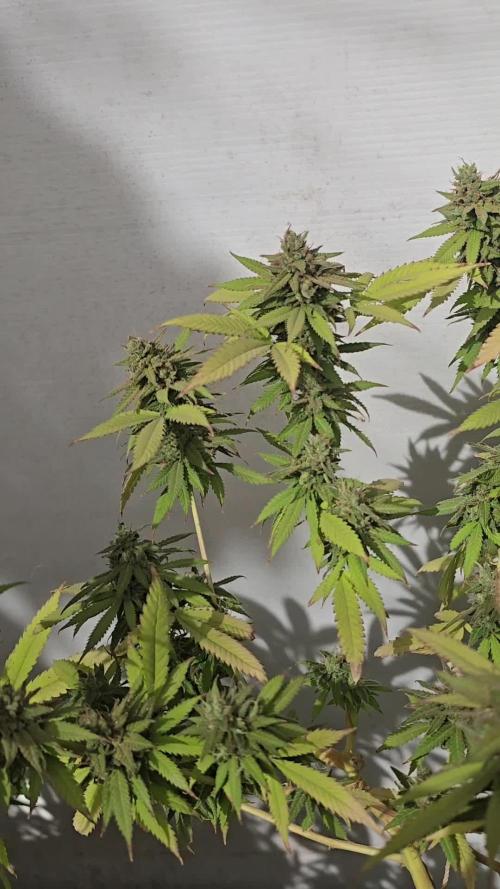
Ich will mich hier ja nicht die ganz die ganze zeit beschweren aber das Wetter könnte echt n bisschen mehr mitspielen 😅. Die letzten Tage hatten wir. Von Niesel regen bis zu Monsun artigen Verhältnissen alles gehabt. Die Damen haben diese wiedersagen Verhältnisse gut weggesteckt und stehen in voller Pracht. Allerdings haben sie nicht übermäßig an höhe zugelegt was ich ihnen angesichts der Wetterlage auch nicht übel nehmen kann.
Aber was ist die Woche geschehen?
Ich habe den Pflanzen eine kleine Hormonkur in Form der im letzten Bericht angesetzten Jauche gegönnt. Dies besteht aus:
5l Wasser (in meinem Fall habe ich destilliertes verwendet ist aber eigentlich egal)
75g Alfalfa
75g Seegras
20g Melasse/Lab Mischung
Das ganze in einen Behalte gegeben und dann mit offen vergären lassen. Da die verwendeten Milchsäurebakterien sich anaerob vermehren, also ohne zugäbe von Sauerstoff wie beim AACT, werdende sich keinen sprudelstein. Die Jauche wird einmal am Tag mit geschlossenem Deckel geschüttelt.Wichtig ist zu erwähnen das die Jauche über die zeit immer mehr an Potenz gewinnt da die Milchsäurebakterien immer mehr Material zersetzen. Dies ist zu bedenken wenn man die Jauche verdünnt.
Die fertige Jauche ist eine absolutes Monster im garten und bringt eine reihe an benefits für die Pflanzen. Unter anderem:
+verbesserung der Bodenbeschaffenheit
+Erhöhung de Stresstoleranz
+förderung des Wachstums durch phytohormone
+erhöhen die diversität an Mikroorganismen
+Verbessern die Phosphoraufnahme durch die bessere aufspaltung im Boden
+untedrückung von Schadorganismen
eine gute und bereits Pflanzenverfügbare Silikatquelle
Und und und …
Die Jauche habe ich einerseits im Verhältnis 1:20 gespritzt hierbei ist darauf zu achten das man dies eine Stunde vor Sonnenaufgang erledigt um Verbrennungen Vorzubeugen und den Bakterien zeit zu geben einen film auf den Blättern zu bilden welcher auch die Ansiedlung von Pilzen erschwert (Mehltau etc.). Am nächsten Tag habe ich die Jauche dann noch im Verhältnis 1:10 gegossen um wirklich alle bennefits mitzunehmen . Die Pflanzen haben das Treatment gut aufgenommen und wirken bereits etwas vitaler.
Es gibt auch einen neuen Liebling im Garten:
Die bitter Orange hat sich wirklich gemacht und ein robb ein an den Stängeln (nicht dass das immer aussagekräftig wäre) ist wirklich vielversprechend.
Mit dem im letzten Bericht angekündigten lollipoppen warte ich doch noch etwas das ich mit bei dem eine oder anderen unteren trieb nicht sicher bin ob er sich nicht doch noch macht . Das alles wird sich dann in den nächsten ein bis zwei Wochen entscheiden.
Und zu guter letzt..
Habe ich den Bio Bloom in Form eines Top-dress eingearbeitet, da wir uns doch langsam aber sicher in Richtung Blüte bewegen und das Bodenlöeben diesen erst Pflanzenverfügbar machen muss. Durch das aufstreuen hat sich ein leichter Pilzfilm gebildet. Dies ist aber kein schlechtes Zeichen und wurde auch son in der akungsbeilage beschrieben.
Alles in allem sind wir gut auf Kurs 😊
Das war’s für diese Woche. Euch noch einen schönen Restmontag und einen guten start in die Woche.
Peace


Likes
2
Share


@OldSchoolT
Follow
Can anyone shed any light on this mutation? Just 3 top leaves no nodes or sites other then the lower first set?

Likes
13
Share


@ChachoGreenCrown
Follow
Buena producción dió Rainbows pese a que el clima es algo complicado en esta zona de España en la que vivo. Las lluvias llegan rápido en Octubre! Aún así tenemos unos veranos magníficos para cultivar en outdoor.. con un clima en las que las horas de Sol no faltan. La planta se portó fenomenal al ponerla en tierra, asimilando con facilidad toda la comida que le dimos. Sin signos de excesos y con ganas de comer más!!!
Cogollos duros como piedras bailando al son de los chunguitos. Dale mariano que ya tenemos rainbows para rato.

Likes
5
Share


@RastaRick
Follow
Tok off large fan leaves on day 24. Seeing preflower starting. Decided to try out a natural shape instead of doing LST. I hope this doesn't backfire... The blackberry gum on the right is getting big. I like how autopotamus has natural shape... But he also has much more light haha

Likes
8
Share

@RakonGrow
Follow
+
Tag 65:
starting 30-70% watering rule
2.0L bottle water EC 0.35 + 0.35ml/L CalMag + Terra Flores 5.25ml/L Final PH 6.16
Tag 64:
starting 30-70% watering rule
2.25L bottle water EC 0.35 + 0.4ml/L CalMag + Terra Flores 5.25ml/L Final PH 6.20
Tag 63:
starting 30-70% watering rule
2.0L bottle water EC 0.35 + 0.4ml/L CalMag + Terra Flores 5.25ml/L Final PH 6.20
Tag 62:
starting 30-70% watering rule
1.9L bottle water EC 0.35 + 0.4ml/L CalMag + Terra Flores 5.25ml/L Final PH 6.20
Tag 61:
starting 30-70% watering rule
2.25L bottle water EC 0.35 + 0.4ml/L CalMag + Terra Flores 5.25ml/L Final PH 6.20
Tag 60
:starting 30-70% watering rule
1.0L bottle water EC 0.35 + 0.4ml/L CalMag + Terra Flores 5.25ml/L Final PH 6.20
Tag 59:
3.0L bottle water EC 0.35 + 0.4ml/L CalMag + Terra Flores 5ml/L Final PH 6.15
Tag 58: add a "enter growroom and tent" video
---------------------- all values are weight in grams ( assumption : 1000g = 1000ml.) -------------
Day......State...Date Time..................Seed......messure..change...watering.....surplus.....DayLight.....Night.....within 24h
...57...bloom...13.11.2025 07:00.....Runtz...........8099.......3092..........3092...........-402
...57...bloom...13.11.2025 11:00.....Runtz...........8599.........500.............500
...57...bloom...13.11.2025 11:01.....Runtz...........8227.......-372
...57...bloom...13.11.2025 13:00.....Runtz...........8477.........250............250
...57...bloom...13.11.2025 18:00.....Runtz...........7755.......-722
...57...bloom...13.11.2025 23:45.....Runtz...........7363.......-392..................................................-1486
...58...bloom...14.11.2025 06:00.....Runtz...........7111.......-252......................................................................-252...............-1738
...58...bloom...14.11.2025 23:45.....Runtz...........5261.....-1851.................................................-1851
...59...bloom...15.11.2025 06:00.....Runtz...........5064.......-196.......................................................................-196..............-2047
...59...bloom...15.11.2025 07:00.....Runtz...........8080.......3016...........3016..........-769
...59...bloom...15.11.2025 23:45.....Runtz...........6518.....-1562.................................................-1562
...60...bloom...16.11.2025 06:00.....Runtz...........6219.......-299.......................................................................-299..............-1861
...60...bloom...16.11.2025 07:00.....Runtz...........7253.......1034...........1034..........-827
...60...bloom...16.11.2025 23:45.....Runtz...........6067.....-1427.................................................-1427
...61...bloom...17.11.2025 06:00.....Runtz...........5820.......-247.......................................................................-247..............-1674
...61...bloom...17.11.2025 07:00.....Runtz...........7618.......1798...........1798............124
...61...bloom...17.11.2025 23:45.....Runtz...........5911.....-1594.................................................-1432
...62...bloom...18.11.2025 06:00.....Runtz...........5645.......-266.......................................................................-247..............-1674
...62...bloom...18.11.2025 07:00.....Runtz...........7532.......1887...........1887.............27
...62...bloom...18.11.2025 23:45.....Runtz...........5866.....-1666................................................-1666
...63...bloom...19.11.2025 06:00.....Runtz...........5581.......-285.......................................................................-285..............-1951
...63...bloom...19.11.2025 07:00.....Runtz...........7895.......2314...........2314...........363
...63...bloom...19.11.2025 23:45.....Runtz...........6148.....-1711................................................-1711
...64...bloom...20.11.2025 06:00.....Runtz...........5868.......-316.......................................................................-316..............-2027
...64...bloom...20.11.2025 07:00.....Runtz...........7850.......1982...........1982...........-45
...64...bloom...19.11.2025 23:45.....Runtz...........6126.....-1724................................................-1724
...65...bloom...20.11.2025 06:00.....Runtz...........5826.......-300.......................................................................-300..............-2024
...65...bloom...20.11.2025 07:00.....Runtz...........7842.......2016...........2016.............-8
+

Likes
118
Share


@SwissKush
Follow
Day 50 - she is a monster!
a. this plant is very large, and is producing many bud sites
b. she is drinking 4L of water a day, the most ive ever had a plant drink
c. the stem on her is the largest ive grown, already larger than Bruce Banner trunk
d. DWC is at 6.1-6.3 PH. Very good conditions, the flowers are exploding
Day 51 - HUGE
a. I cannot believe how large this plant actually is
b. flowering all over the place, many locations
c. i start to notice a little leaf tip burn, time to change out DWC totally, and put 1/2 strength full flower blend
d. water from DWC was blood red/brown, the root system is very healthy
e. I tied back all the large branches, making room for everything
Day 52 - she enjoyed the LST
a. Her flowers are growing so fast
b. She is drinking 4-5L a day of nutrients, at full flower blend during feeding @ 6.2 PH
c. I like to gradually increase the nutrients after a mineral water flush mid way through the grow.
Day 53 - drank 5L - 700ppm
a. she is eating very well, and growing all over
b. the buds are becoming fatter and fatter
c. she has been increased up to full flower blend, looking great!
Day 53 - drank 5L again
a. she is growing so fast, and huge
b. the buds are becoming very long and getting thick
Day 55 - buds are growing
a. her buds are so hard, becoming larger every day
b. she is drinking 5L a day
Day 56 - buds everywhere
a. this plant is growing towers for buds
b. have to use constant LST tying back everything
Likes
8
Share


@Tweak
Follow
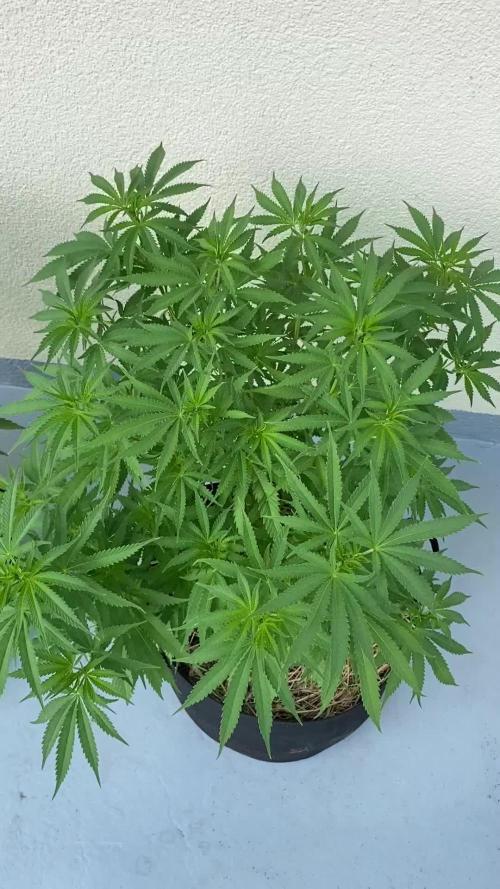
Went away for 3 days and came home to an explosion of growth. GG 12 is already starting to bud even though it’s by far the smallest. The other 3 girls are just stretching.


Likes
2
Share


@Altitonans_Fulmen
Follow
Α,α (alpha) and Ω,ω(omega)
Here we grow again.
LAST GROW.
344g+280g+445g+255g=1324g dry bud.
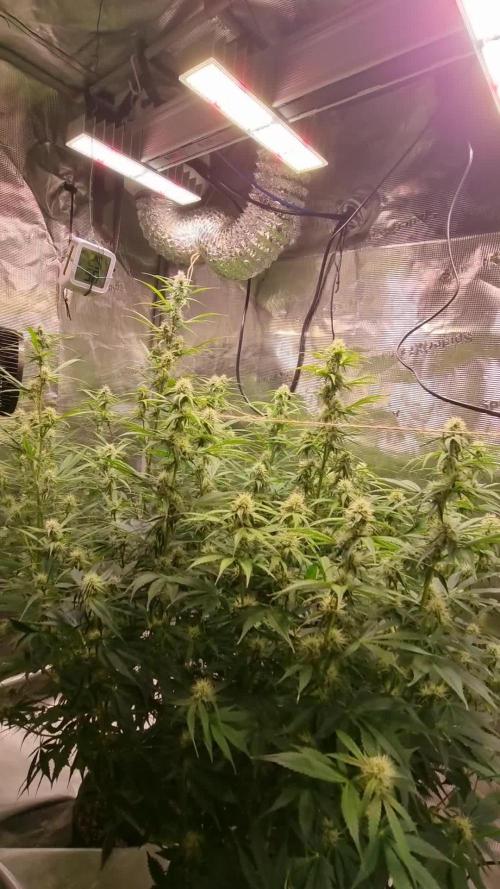
Yielding 1,324 grams of dry cannabis using a 600W light in a 4x4 tent is exceptionally efficient. This breaks down to roughly 2.21 grams per watt, far exceeding the standard indoor benchmark of 1.0 g/W and outperforming elite professional targets (1.5–2.0 g/W). For carbon and energy efficiency, this output drastically lowers the carbon cost per gram compared to typical indoor grows. Achieving 1,324 grams (47.2 ounces) of dry cannabis from a 600W light in a 4x4 tent is exceptional, yielding roughly 2.21 grams per watt. This is an elite-tier result that reflects world-class photosynthetic conversion, highly optimized canopy light distribution, dialled-in CO2 supplementation, and precise environmental control.
Growing 1.3kg of dry in a 2x2 with 1 plant is just being silly and not understanding how carbon and energy conversion works towards mass.
Took 6 years and 10,000+ Hours to break the 2 grams-per-watt barrier not exactly 600W, in honesty, though—even with modern, high-efficiency LEDs—is an incredible feat that requires hitting the absolute genetic ceiling of the cultivar and maintaining flawless environmental parameters for the space.
Photosynthesis is the literal conversion of light energy (photons) into chemical energy (carbohydrates). Leaf temperature, driven by radiation from fixtures and mitigated by latent heat of vaporization (transpiration), dictates metabolic rates. If your room's thermal dynamics are off, enzyme activity inside the plant stalls, grinding growth to a halt. Anyone else pretending to have done so with nothing but Plagron nutrients at 75F is telling porkie pies *cough*, otherwise known as a liar, liar with a bum that's on fire, but it seems that's the new norm these days on GD. *cough cough*.
Using copper and zinc plates in the plant medium to form a natural earth battery to assist with Electrochemical Reactance. The moist soil acts as an electrolyte, while zinc serves as the anode and copper as the cathode. Zinc is a highly reactive metal and oxidizes, losing electrons into the soil. These electrons travel through an external wire to the copper plate. The moisture and dissolved salts in your plant medium allow charged ions to move freely between the plates, completing the circuit and generating a small direct current (usually between 0.8 and 1.1 volts). This micro-current subtly alters/the Electrical Conductivity (EC), allowing more effective breaking apart of chemical bonds in the soil (electrolysis), making soil nutrients like phosphorus, calcium, and potassium more accessible to roots. Buried the zinc plates around the sides of the plant pot's root zone and the copper plate in the middle. Ran an insulated copper wire above ground to connect the zinc plate to the copper plate, creating a closed loop. Making sure the soil remains perfectly moist and contains everything it needs; entirely distilled water or bone-dry medium will prevent ion exchange and block the current. Leave that up to the rhizosphere.
Currently testing new parameters for a couple of weeks. Seeing what she can do with a new and upgraded ducting closed loop and double the water capacity. Also added 6kg of inoculated biochar along with a slew of small improvements. Keeping an eye on. Zinc toxicity vs. consumption, given how sacrificial zinc is. Want to make sure the biochar stabilizes first.
A Synganic closed-loop bioengineering-logic grow room merges synthetic inputs (precision minerals/chelated nutrients) with an organic living soil matrix (microbial life/bio-stimulants), managed via automated, data-driven automation. Master Operating Procedure (MOP): The system balances a sterile environment with a thriving, dynamic rhizosphere, merging the biological resilience of living organic soil with the high-precision chemical control of modern Controlled Environment Agriculture (CEA).
Synganic blends a biologically active living soil or microbe-rich substrate with targeted, low-dose mineral or synthetic fertigation to optimize both metabolic yield and secondary metabolite expression (terpenes/flavonoids).
What else is alive!
Eisenia fetida (Red Wigglers) will continuously process organic matter into plant-available nutrients and aerate the media.
Stratiolaelaps scimitus (Hypoaspis mites) provides excellent biological control against fungus gnats and pupating thrips.
Armadillidium vulgare (Pillbugs) excel at breaking down tough, woody organic matter and toxic heavy metals.
New "Closed-Loop Sealing" Isolates the internal microclimate from external weather, vectors, and pests. Air is scrubbed 264nm UV-C, recirculated, and enriched rather than openly exhausted.
Operational Parameters (MOP Framework). Microbes act as biological buffers for the mineral inputs, preventing salt toxicity and ensuring continuous nutrient availability.
Precise management of Vapour Pressure Deficit (VPD) day and night to force optimal stomatal conductance without stressing the biological media.
Strict clean-room protocols prevent pathogen intrusion while maintaining non-sterile, highly active beneficial bacteria and fungi populations in the root zone.
Looking at a grow room as a closed-loop system changes everything. You aren't "growing a plant"; you are managing a mass and energy balance equation where the plant is a biological transducer. Every watt of light introduces sensible heat. Every drop of water turns into latent heat via transpiration. When a deficiency appears, a grower flushes or adds a bottle of "magic" additive. A master looks at the HVAC duty cycle, realizes the dew point spiked, the stomata closed, and calcium transport stalled due to lack of transpiration, not lack of nutrients.
Protocol-driven logic can be automated, replicated, and optimized. Legacy growing and anecdotal habits fail the moment the room moisture volume changes. ADD CALMAG!
Comprehensive Substrate Composition: Because why not.
1. Substrate Base & Aeration Media
Expanded Clay Aggregates (Hydroton Pebbles)
Coir Chunks & Horticultural Coco Coir
Sphagnum Peat Moss
Horticultural Perlite
Horticultural Vermiculite
Horticultural Pumice
Volcanic Basalt Rock
2. Mineral Amendments & Soil Conditioners
Agricultural Gypsum (Calcium Sulfate)
Wollastonite (Calcium Silicate)
Dolomitic Limestone (Calcium Magnesium Carbonate)
Basalt Rock Dust (Trace Mineralizer)
Azomite (Micronutrient-Rich Volcanic Ash)
Glauconite (Greensand)
Crushed Seashells (Calcium Carbonate Source)
Pyrolyzed Carbon Feedstocks (Biochar & Horticultural Charcoal)
Shungite (Carbonaceous Mineraloid)
3. Organic Nutrient Amendments
Steamed Bone Meal (High Phosphorus)
Dehydrated Blood Meal (High Nitrogen)
Fish Bone Meal (Phosphorus & Trace Calcium)
Cold-Processed Kelp Meal (Ascophyllum nodosum)
Dehydrated Moringa Oleifera Powder (Botanical Nutrient)
Spirulina Powder (Arthrospira platensis / Cyanobacteria Nutrient)
Marine Crustacean Biomass (Shrimp & Crab Chitin)
4. Biological Inoculants & Organic Acids
Mycorrhizal Fungi Inoculant (Endomycorrhizae / Ectomycorrhizae)
Vermicompost (Premium Worm Castings)
Humic & Fulvic Acids (Concentrated Humates)
Soil-Plant-Atmosphere Continuum (SPAC): An ecological concept referring to the pathway of water moving from the soil, through the plant, and into the atmosphere.
Humidity of the air dictates the moisture in the medium, which dictates the rate of pull from the terracotta stakes 15 in total.
Terracotta (unglazed, low-fired clay) is highly porous, acting as a breathable, permeable membrane that transports water based on the moisture gradient between the potting medium (soil) and the surrounding air. White terracotta and brown terracotta often have different pore sizes and overall porosity, primarily driven by differences in clay composition, impurities, and firing temperatures. While both are considered porous, brown terracotta often has higher iron content and impurities that behave as fluxes, affecting how the pores form during firing, while white terracotta is generally derived from more refined clays, with smaller pores making it more suited to pure water.
This mechanism is driven by capillary action and evaporation. When the surrounding soil is dry, the terracotta acts as a wick, pulling water out of the pot and into the soil. If the soil is very saturated, the terracotta absorbs water from the soil and allows it to evaporate from its outer surface, increasing the drying rate of the soil. Terracotta tends to keep the potting mix at an optimal saturation point, wicking up more water when the outside surface evaporates water into the air. The greater the difference in moisture between the soil and the outside air, the faster the water transfers through the ceramic. In low humidity and hot weather, the evaporation rate from the terracotta surface is high, creating a rapid drying effect. Newer terracotta pots often have a denser, lighter-toned structure that is less porous than traditional, red-orange terracotta, slowing down the moisture transfer rate. Over time, dissolved salts from fertilizer or tap water build up and block the pores, reducing the permeability of the clay. Water is all that is used or needed, thanks to the biochar and the massive storage bank of nutrients. Just waiting until something creeps up.
Clay pot irrigation (Ollas), an ancient farming practice, utilizes this property by burying unglazed jars in the soil, allowing water to slowly seep into the surrounding soil only when the soil dries out. Remember to clean terracotta stakes in mild acid after each grow. Submerge the stakes in a solution of 1 part distilled white vinegar to 3 or 4 parts water. Let the stakes soak for 20 to 30 minutes. You will hear a fizzing sound as the acid reacts with and dissolves the mineral salts. Use a stiff-bristled brush or an old toothbrush to scrub away the loosened residue. Rinse the stake thoroughly in clean water to wash away any leftover vinegar. BOOM good for next grow!
Indigenous Amazonians created, or at least significantly enhanced, the fertile, dark soil known as Terra Preta de Índio (Portuguese for "Indian Black Earth") by incorporating biochar and other organic materials into the soil. This anthropogenic (human-made) soil technique, which dates back roughly 2,500 to 8,000 years, allowed ancient civilizations to flourish in regions with naturally poor, acidic, and nutrient-poor tropical soils.
Electrical Conductivity refers to how easily a material or solution allows electrons or ions to flow continuously when an electrical potential is applied.
Electrochemical Reactance is the opposition to alternating current (AC) caused specifically by the temporary storage of energy in electric or magnetic fields, rather than energy being lost as heat. Reactance does not directly alter a material's intrinsic electrical conductivity. Instead, it dictates how the system stores and releases energy over time, which creates a temporary barrier to current flow in AC circuits. Together with resistance, reactance makes up total impedance. Electrical impedance (the combination of resistance and reactance) in the rhizosphere dictates how easily ions and water move into plant roots, directly impacting the Electron Transport Rate (ETR). High impedance restricts ion mobility, leading to nutrient deficiencies that decrease ETR and stunt overall plant growth.
Electrolysis in the rhizosphere can reduce the direct ATP energy cost for a plant by electrochemically altering soil chemistry, changing pH gradients, and splitting or reducing compounds so that nutrients become easier to absorb or break down.
Electrolysis uses an external electrical voltage to drive chemical reactions (like splitting water or reducing ions). This external electricity performs thermodynamic work on the soil solution. Rather than directly fueling plant enzymatic machinery or lowering biological ATP synthesis costs inside root cells, electrochemical reactions alter surrounding nutrient forms (e.g., changing pH, altering redox states, or breaking tight mineral bonds). By electrochemically making mineral ions more mobile or bioavailable, the plant may spend less root exudate carbon or membrane-transport ATP trying to scavenge locked nutrients, though the plant's baseline respiration and ATP costs for active uptake still apply.
Laws of math are conceptual, laws of math are universal, the laws of math are invariant, and the laws of math are exceptionless.
The laws of mathematics are the foundational rules that govern structure, quantity, space, and change. Unlike the laws of physics, which describe how our specific universe behaves, mathematical laws are absolute truths independent of physical reality.
Think of electricity like highway traffic to easily understand the difference between the movement, the road, and the speed.
•Electron Flow is the traffic (the cars moving).
•Electrical Conductivity is the highway (how wide and smooth the road is).
•Electron Transport Rate (ETR) is the speedometer (how many cars pass by per second).
ETR stands for Electron Transport Rate. It measures the speed at which electrons are moved through the thylakoid membranes in a plant's chloroplasts during the light-dependent reactions of photosynthesis.
Mass is effectively "congealed" energy. Energy is just numbers. Energy isn't a physical "substance" you can hold or touch. It is essentially an abstract, calculated number that we assign to a system to predict how it will change, interact, or move. A numerical label we attach to matter to track how it behaves.
ATP (adenosine triphosphate) is the primary energy carrier in cells, including plant cells. It powers various cellular activities like nutrient uptake, protein synthesis, and cell division. Without ATP, the plant's metabolic machinery would grind to a halt, regardless of the presence of nutrients, oxygen, or carbon. Nutrients, like nitrogen, phosphorus, and potassium, are essential for building plant tissues and various molecules. They are incorporated into proteins, nucleic acids, and other vital compounds. While crucial, their uptake and utilization rely on ATP-driven processes. Oxygen is vital for cellular respiration, a process that generates ATP. While plants can produce ATP through photosynthesis, oxygen is essential for maximizing ATP production in mitochondria through oxidative phosphorylation. Carbon is the backbone of all organic molecules, including carbohydrates synthesized during photosynthesis. It's the fundamental building block of plant structures and fuels. However, its incorporation into organic molecules is also ATP-dependent. We don't grow we facilitate energy conversion.
Everything is energy. Energy is represented by numbers. Numbers are frozen music. Music is moving sacred geometry of the Uni-verse.
Likes
2
Share

@Growbody
Follow
Herzlich Willkommen zu meinem Growbericht der Purple Haze F3 Feminized Polyhybrid Autoflower von 2Fast4Buds. Ob Jimmy an dieser Auto Version seine Freude gehabt hätte, werden wir nie erfahren. Ich bin mir allerdings sicher, er hätte sie auch angebaut. Die Genetiker von FastBuds schufen diese 55%ige Sativa durch die Kreuzung zweier Automatiks, Purple Lemonade Auto F6 und Amnesia Haze Auto F5. Mit 23% THC dürfte sie allerdings um einiges stärker sein als die Purple Haze, die Jimmy in den 60ern, also vor mehr als 60 Jahren, genoss. Ob das High auch higher ist, muss sich noch zeigen. Lassen wir uns überraschen.
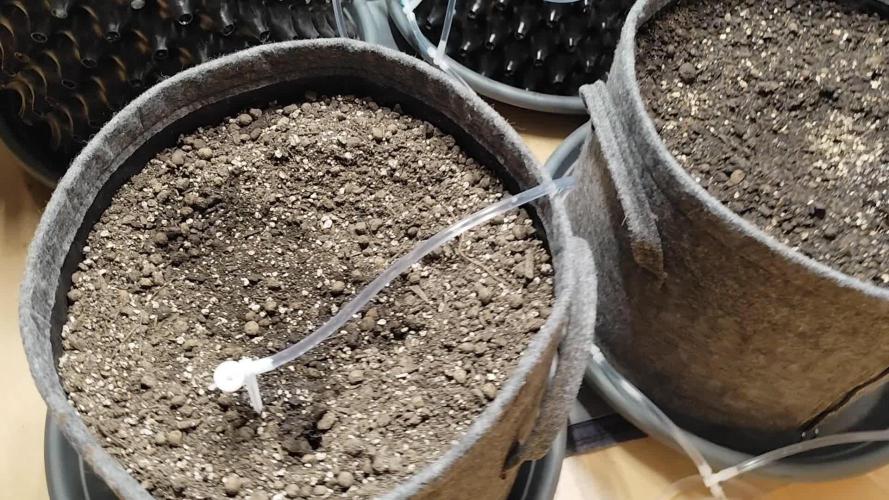
Tag -6: Die neuen Air Pots 7th Gen. sind da. Zeit, den Growroom vorzubereiten. Im "Erdlager" reift die Sonnenerde vom letzten Indoorgrow schon einige Monate. Ich hatte sie mit Monster Bud Mix Living Soil und Hornspänen gefüttert, jetzt kommt noch aktivierte Pflanzenkohle von Jungle Vibes aus Freiburg dazu, Dann kommt die Erde in die Pötte. Nächstes Mal werde ich das wieder draussen machen und die Töpfe reintragen, gab 'ne ganz schöne Sauerei und ich konnte den Growroom nochmal putzen...
Tag -3: Zeit, das automatische Bewässerungssystem zu testen. Ich erhoffe mir dadurch eine gleichmässigere Bewässerung, sowohl von der Menge als auch von der Temperatur des Giesswassers. Der Wasserkanister mit Brunnenwasser steht auf einer kleinen Heizmatte, Wie auch alle Töpfe auf einer Heizmatte stehen. Die passenden Tropfer sind schon bestellt.
Tag 0: Endlich ist es soweit, die Samen kommen in SmartStart Plugs von Zamnesia, die sich in Seedbooster Plus editiertem Wasser vollgesaugt hatten.
Tag 3: Der Keim ist da, die Blätter sind noch nicht zu sehen, die Schale klebt noch dran. 🌱
Tag 4: 4 cm am ersten Tag, die Kleine legt ganz schön los.
Tag 6: 8 cm am zweiten Tag, morgen kann sie schon angehäufelt werden.
Es freut mich, dass du dir meinen Grow ansiehst. Schön, wenn du dranbleibst 👍😎


Likes
5
Share


@Tafari
Follow
Aquí vemos el momento de la felicidad plena, donde la genética y el banco cumplen su palabra y sugerencias, una genética super independiente, con poco cuidado se llevo el premio de la mejor entre las otras plantas que he cultivado este año, aguanto mucho las plagas, con excepción de la ultima semana que entre la humedad y las lluvias, los trips aprovecharon el lavado de los preventivos para atacarla, pero no llegaron a ser un problema, la planta tuvo un crecimiento continuo y parejo, desarrollo muy buena estructura y producción impresionante!!!!!, 820 gramos de cogollos húmedos, muchísima resina, cogollos super compactos y duros, en el día de mañana estaré generando una extracción para probar retorno, color y sabor, muy contento de haber cultivado esta magnifica joya del banco BSF Seeds, mega recomendado.
Processing
Likes
3
Share


@Kushizlez
Follow
Day 42-49
(Day 43) I was at the dollar store today and I found the best little plant risers. And they all link together in perfect 12” squares. Fits in my tent perfectly and only spent 15 bucks. That should help the dry downs quite a bit.
I’m going to transplant the euro genetics into 1.7g pots with amended sunshine mix #4 for their final containers.
I moved all of the non-marijuana seedlings into a small greenhouse out of my tent so I have some more space and light per plant.
I also set up an exhaust fan to keep the humidity at a perfect 65-70% night and day.
(Day 44) Everything is looking a little nute burned and droopy. The garlics are showing signs of overwatering and nitrogen toxicity. They look like they want to flower so badly. Node spacing is weirdly short too. I picked up the American genetics to look for roots and they were busting out of the bottom. They’re definitely not rootbound as they’re not even a foot tall yet. This is likely from having soil that is too compact (from using too much rock dust and not enough drainage) causing my waterings to not even reach the bottom of the pot. This was also happening to my other grow. I will make sure to very lightly pack soil into pots for now on because you can always add more later. I’m going to fluff up the pots and see if I can loosen the soil a bit. If that doesn’t work I’m going to look at transplanting into 3g fabric pots and lightly shaking off most of the old soil. Luckily I added a shit ton of drainage for the euro genetics when I amended the sunshine mix so they won’t need a transplant.
(Day 46) The fluffing didn’t do much. In fact it might have made it worse lol. I just went to the store and bought some Destiny Organics soil and have decided to transplant.
I dusted off 90% of the old soil down to root ball which will cause an insane amount of stress to the plants. The plants started in the aero garden were being choked out by the shitty sponge plug it was germinated in. I took a razor blade and carefully cut them down the middle so the stem can expand. I might have cut a few major roots one or two plants. Other than that everything is transplanted. I cut all my amendments in half and I packed the soil very loosely this time.
The situation is not ideal by any means but I’m hoping they will bounce back in the next week. This should at least set them up for a more successful flower. I can’t really expect much quality from botched run but who knows. I might come out with some fire. Since this is my last grow here I don’t even have to pay the power bill for the next few months! (I have a very generous landlord as he’s letting me finish my grow until mid September now 😂)
(Day 47) I’m going to give them their first good watering and test my fluffy soil. I watered in approximately 700mls each making sure it soaks to the bottom of the pot.
(Day 49) All the plants have bounced back except for the ones with root damage. They are still looking droopy and sad. The black garlic #1 has recovered really nicely and is looking happier than ever. The apical growth tip is so tight it has like 4 nodes within an inch somehow. I recently learned that hormones contained in kelp and seaweed extracts can act as plant growth inhibitors and shorten node spacing drastically. I only added a very small amount of kelp meal to the soil so it must be leftover from the previous foliar sprays Velokelp. I’m going to pinch the top off bg1 and see if the lowers can catch up. Sucks to do that so close to flip but oh well.
The euros are looking fully recovered from their burn a little while ago. The sunshine mix is quite thick and water retentive as well but at least it has some extra drainage. They’re all looking quite healthy.


Processing
Likes
37
Share


@RickJames_Mcdank
Follow
She is growing really good and healthy. The trichomes are so much I can;t imagine how much it will be later in stage.
I stopped giving Algo grow and reduced the Nitrogen. As you can see its going fine and all good.
She takes allot of water though. I had to water her on days she normaly doesn't get watered.
But so far so fine so good.😎🙏

Likes
3
Share


@stonedkoala
Follow
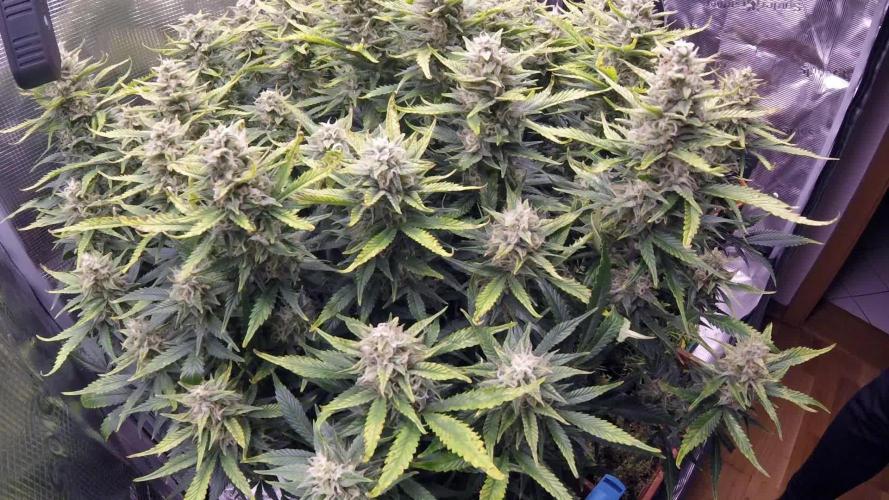
- Raised cal mag from 3 to 5 because I thought plant was lacking cal mag
- Upped nutes but it may have led to nute burn in the next few weeks (see pics)
- ~350-400 ppm for half nutes
- buds starting to form nicely



Likes
6
Share


@603grower
Follow
These girls didn’t give me any issues at all. They just screw themselves. I planted one seed and when I did the mainline, I cloned the top, which is how I ended up with two plants. I can’t believe how big the buds got all this girl trimming it was a nightmare. There was so many leaves, some of the buds are so big that I did a small amount rot in one of them It’s so happened to be the biggest bud. I was running the humidity kinda high about 60% the whole time. About this plant doesn’t have much of a nose on it but she looks great and Got over these two.

