Likes
Comments
Share
@Growbody
Follow
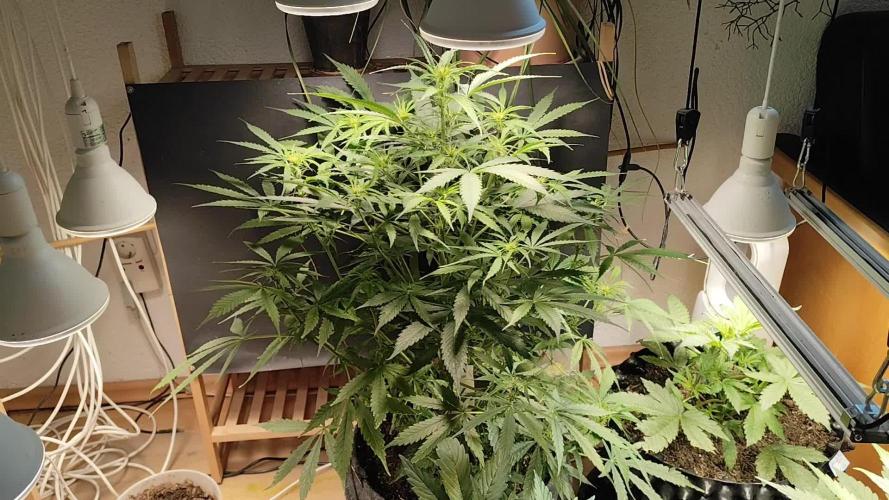
Hallo und herzlich willkommen zu meinem neuen Grow mit der Auto Jack, Jacky White 6th Gen. von Paradise Seeds. Die "Eltern" sind Jacky White x Ruderalis, die "Großeltern" sind Jack Herer und White Widow. Sie ist dadurch eine 75% Sativa mit zitronig-fruchtigen Aromen, genau mein Ding. Es freut mich sehr, das mir die Samen in einer sehr schönen Verpackung freundlicherweise von Paradise Seeds zur Verfügung gestellt wurden. Das ist für mich der Ansporn, eine möglichst genaue Beschreibung des Growverlaufs aufzuzeichnen. Die URL des Strains findet ihr hier: https://www.paradise-seeds.com/de/product/auto-jack/ Für diesen Grow verwende ich den 15Liter WideVersion Stofftopf von ROOTiES, die Sonnenerde Bio Hanferde, den BioBizz Wurmhumus, Sonnenerdes Bio Faser, BIONOVA + zamnesias MonsterBud Mix Living Soil, zamnesias Smast Start und Plagrons Seedbooster Plus. Hat sich alles prima bewähert. Tag 58: 2,0 Liter Wasser. Tag 58: Die Auto Jack von Paradise Seeds steht da wie ein Schirm. Nur die Hauptcola streckt sich ein bisschen weiter 'raus. Sie geht so geschwungen ans Licht, da ist kein 'runterbiegen nötig. 0,5 Liter Wasser. Schön, dass du reingeschaut hast. Nächste Woche gehts weiter und ich freue mich, wenn du dabei bist 👋😎
Likes
18
Share
Now we've reached day 25. We are in the transition phase, pre-flowering if you want, when the seedlings reveal their sex by showing the white fluff or the boyish balls. Here and in all F1 Hybrids you can be SURE, SURE as death that you will never see any balls. If you have underestimated this aspect of the F1 Hybrid, go back and think about how many times you found the balls on the paint, full of pollen that fertilized your ladies. Do you like having young ladies impregnate you? Absolutely not for me and this is a very valid reason why you can choose the F1 Hybrid. Really guys the seeds suck and the genetics of the various breeders if they don't do a job like this it means that they are super hybrid poles with genetic traces scattered here and there. Inglourious bastards. Here we don't want to be Aryan but to cultivate healthy plants with safe results. Our Watermalon Candy F1 per mea culpa mea culèa mea grandissima culpa shows some signs of overfeeding, the famous yellow tips of the leaves. Let's be clear, this is minor and is due to the fact that these genetics are so good that they need very little or no fertilizer in the vegetative phase. Then if you already have fertilized soil, forget about growing guys, another pro! I gave the recommended doses even a little less to tell the truth of both Aptus and Plagron and the plants more or less all have these small signs of over. LITTLE guys, wait until the end to save if you feel like it, or at least I recommend it. To fix this little thing we go to flush with pH 6.2 and only give Aptus Regulator which should rebalance the plant and soil before delicately moving on to fertilizers for flowering. Site Description ZAMNESIA SEEDS - WATERMELON CANDY F1 HYBRID AUTOMATIC: BUDS BURSTING WITH FLAVOR If you've been looking for a flavorful strain with superb genetics that's effortless to cultivate, the hunt is over. Thanks to reliable F1 hybrid genetics, Watermelon Candy F1 Automatic showcases the highest degree of productivity and efficiency. This strain takes everything you know and love about the original, and packages it in a plant with even greater potential. GROWING WATERMELON CANDY F1 HYBRID AUTOMATIC Derived from Watermelon, Candy Kush, and ruderalis, Watermelon Candy F1 Automatic is a finely tuned medley of genetics. This cultivar is fast to flourish and reliable to grow, no matter where you choose to grow. Taking just 9–10 weeks from germination to harvest, she provides a uniform growing experience culminating in a huge haul of buds for her size. Reaching heights of 65–80cm, Watermelon Candy F1 Automatic stays pretty grounded, making her perfect for smaller growing areas where space is a commodity. It also means you can fit more plants in if you have the room! Once ready to yield, growers will see a return of 400–450g/m² indoors and up to 100g/plant outdoors. Moreover, Watermelon Candy F1 Automatic is highly resistant to pests and disease, making it an ideal strain for newcomers and fans of low-maintenance cultivation. AROMAS, FLAVORS, AND EFFECTS OF WATERMELON CANDY F1 HYBRID AUTOMATIC If we haven't already sold you on the power of F1 hybrid genetics, the proof is in the pudding. Watermelon Candy F1 Automatic is teaming with terpenes and cannabinoids, making for a lively high coupled with huge flavors. Just one hit is all it takes to sample rich fruitiness mixed with sweet candies and a slight earthiness to back it up. And with an average THC content of 23%, the effects are euphoric at the start but settle into deep relaxation soon after. Whether you're chilling alone or with friends, Watermelon Candy F1 Automatic will see you right. As for fertilizers, I'm doing a small comparison experiment to finish off the fertilizers I had at home, it's not 100% indicative, it's only on two specimens but given the stable genetics I decided to try to compare the results of Plagron Vs Aptus , both excellent brands which they will certainly produce beautiful plants which are already of excellent stable genetics. In the next few weeks the comparison will be more evident now the seedlings are still very small and just potted. So seeds of all brands, in addition to these great F1 Hybrids and the entire Zamnesia line, fertilizers and everything related to the world of cannabis, you should buy them from the best online store in the sector www.zamnesia.io
Likes
19
Share
Legend Timestamp: 📅 Measures: 🛠️ Water: 🌊 Actions: 💼 Thoughts: 🧠 Events: 🚀 ________________________________ 📅 D50/F11 - 12/10/23 🛠️ EC 1.3 (stable) pH 5.5 (raised) -- pure water 🌊 RES Changed 💦💦💦 💼 Made some LST on the little one. No more work on the bigger 🧠 I'm going to change the water within today and run it for 12-24h and then put only bloom nutes 🚀 ________________________________ 📅 D51/F12 - 13/10/23 🛠️ EC 1.3 (by set up) pH 5.5 🌊 New water, calmag, bloom A and B and B52 💼 Removed all LST constraints on the big one. Some spouts removed from the little one. Some defolation 🧠 All training was removed now I will let her grow normally 🚀 ________________________________ 📅 D52/F13 - 14/10/23 🛠️ EC 1.0 (falling) pH 6 (rising) -- EC 1.3 pH 6.1 🌊 No water added. Added Big Bud and Bud candy to raise EC until 1.3 💼 LST and defolation on the little one. Made Timelapse video. 🧠 She's eating a lot: very good 🚀 The little one is sprouting out the first petals ________________________________ 📅 D53/F14 - 15/10/23 🛠️ EC 1.1 (falling) pH 5.2 (falling) -- EC 1.45 pH 5.4 🌊 Water decresed a lot. Added 4L and Bloom A-B - Calmag and a little of Rhino Skin (silica) 💼 LST on the little one, some defolation on the big 🧠 I would like to have only nice big fat buds, so I need to work on this goal 🚀 ________________________________ 📅 D54/F15 - 16/10/23 🛠️ EC 1.5 (rising) pH 4.7 (falling) -- EC 1.4 pH 5.4 🌊 Water decresed a lot. Added 6L Bloom A-B and lot of Calmag 💼 Only a little defolation 🧠 Next time, no calmag at all 🚀 By mistake I added a lot of calmag so to balance I have to add lot of water and now the pot is completly full. Keep in mind there is a lot of Calmag in it ________________________________ 📅 D55/F16 - 17/10/23 🛠️ EC 1.5 (stable) pH 5.2 (rising) -- EC 1.2 pH 5.4 🌊 Added pure water and a little of silica (Rhino skin) 💼 🧠 🚀 Some leafes tips are burning, so I'm going to go back to 1,2, trying to have a good pH range ________________________________ 📅 D56/F17 - 18/10/23 🛠️ EC 1.2 (stable) pH 5.7 (rising) 🌊 No water neither nutes added 💼 Little defolation 🧠 Maybe the Thrips from Granada come out and infected Marlene. I will spray also her tonigh 🚀 Some symptoms of insects like leaves bitten
Likes
57
Share
Hey everyone ☺️. This week they have made great progress 👍. So that next week they can be put in their 11 liter pots and get their Green House Company Powder Feeding 😋. Otherwise there is nothing more to say for this week, except have fun with the update 😛 stay healthy 🙏🏻 and let it grow 🌱👌 You can buy this Strain at : https://sweetseeds.es/de/red-mandarine-f1-fast-version/ Type: Red Mandarine F1 Fast Version ☝️🏼 Genetics: Red Poison Auto®️ (SWS39) X Tangie (California Orange x Hybrid Skunk) 👍 Vega lamp: 2 x Todogrow Led Quantum Board 100 W 💡 Bloom Lamp : 2 x Todogrow Led Cxb 3590 COB 3500 K 205W 💡💡☝️🏼 Soil : Canna Coco Professional + ☝️🏼 Fertilizer: Green House Powder Feeding ☝️🏼🌱 Water: Osmosis water mixed with normal water (24 hours stale that the chlorine evaporates) to 0.2 EC. Add Cal / Mag to 0.4 Ec Ph with Organic Ph - to 5.5 - 5.8 .
Likes
14
Share
Great week put them on bloom food at around 40% strength, calmag at 25% strength and pk boost at 50% they had 1 feeding of formula at 1litre per plant the bud sights are exposed too light after the defoiliation at around day 29 plant was fed just water with the transition too bloom feed at Day 34 lights are at full spectrum so red light has been introduced at Day 29 . All plants are a nice size 1 still slacking but catching up hear we go full on flower mode :)oh PH in range 6.2-6.5 threw out the 5weeKs grow.
Likes
21
Share
🌌 Cosmic Noodles — Week 9 From Seed (≈ Week 5 Flower | 12/12 From Seed) Divided Report — Growth vs Stress ⸻ Quick Recap — How We Got Here This run continues under 12/12 from seed, now entering: • 🌱 Week 9 from seed • 🌸 ≈ Week 5 of flowering At this stage, plants are expected to be: • Fully transitioned into flower • Actively stacking buds • Stabilizing structure after stretch However, this week became something more than a standard update… 👉 It became a controlled contrast experiment We now have three distinct expressions in the same environment: • Plant A → Stretch-driven structure • Plant B → Open, balanced, high-performance plant • Overwatered Plant → Intentionally stressed (root zone) Same room. Same feed. Same conditions. Different outcomes. ⸻ 🌊 The Overwatered Plant — Controlled Stress What was done This plant was intentionally overwatered to observe: • Root response • Recovery potential • Impact on flowering progression ⸻ 🔬 What overwatering actually does • Saturated medium → oxygen depletion in root zone • Roots lose function → nutrient uptake collapses • Plant shows deficiency symptoms without deficiency • Metabolism slows → flower development stalls ⸻ 👁️ Current Observations (Week 9 / Flower Week 5) From the visual timeline: • Heavy, swollen leaf droop (not thirst-related) • Necrotic/burnt leaf edges • Weak flower formation • Overall loss of vigor • No strong signs of recovery yet 👉 This is consistent with root hypoxia stress ⸻ 🛠️ Corrective Actions Taken • ✅ Full drainage of excess water • ✅ Substrate allowed to dry • ✅ Feeding paused (critical decision) • ✅ No additional stress applied This approach respects one key principle: 🌱 “Recovery is biological, not forced.” ⸻ ⚖️ Current Status — Honest Assessment At this moment: 👉 The plant is not showing a strong rebound And that’s important to state clearly. ⸻ 🔮 Possible Outcomes 🌱 Scenario 1 — Late Recovery (possible, but limited probability) • New growth improves • Leaf degradation slows • Buds continue developing (reduced yield expected) ⸻ ☠️ Scenario 2 — Progressive Decline (more likely) • Continued leaf death • Minimal metabolic recovery • Poor flower development ⸻ 👉 Either way, this plant has already fulfilled its purpose: It became a living demonstration of root zone importance ⸻ 🌿 Plant A — Stretch Expression Structure • Taller, more vertical growth • Longer internodal spacing • More “reaching” behavior Current State (Week 5 Flower) • Healthy foliage overall • Bud sites forming consistently • No stress signals 👉 This phenotype leans toward: 🌱 Structure over density ⸻ 🌿 Plant B — The Balanced Beast This one stands out immediately. Structure • Open architecture • Excellent light penetration • Strong lateral branching Response to Defoliation • Fast recovery • No visible stress • Continued aggressive development Flowering Progress • Clean bud stacking • Strong formation across canopy • Uniform development 👉 This is: 🌿 A plant fully aligned with its environment ⸻ ✂️ Defoliation — Outcome Analysis Defoliation was applied to the healthy plants. Results: • No slowdown • No shock response • Improved light distribution • Strong continuation of flowering 👉 This confirms: • Timing ✅ • Intensity ✅ • Plant health baseline ✅ ⸻ 🌡️ Environment & Feeding — Stability Check • 🌡️ Temperature → unchanged from previous week • 💧 Feeding → same regimen maintained • ⚖️ No variable changes introduced 👉 Critical insight: Differences observed are not environmental They are root-driven and plant-specific ⸻ 🧠 Key Lesson of Week 9 🌱 “In flower, roots dictate everything.” Even under identical conditions: • Healthy roots → explosive growth • Stressed roots → systemic collapse This week shows clearly: 👉 The plant is not just what you feed… 👉 It is what it can absorb and process ⸻ 🎥 Mr. Baggy — Introduction This week also marks: 🎬 The arrival of Mr. Baggy Even if limited visually in this update, his presence is now part of the journey. And honestly… perfect timing. Because this week represents: Real growing Not just pretty plants ⸻ 🔮 What to Expect — Moving Forward 🌿 Plant A & B • Continued bud stacking • Increased density over next 1–2 weeks • Gradual nutrient demand peak • Structure already defined → now focusing on weight ⸻ 🌊 Overwatered Plant Two paths remain: • 🌱 Slow stabilization (best case) • ☠️ Continued decline (most likely) No intervention planned beyond: Observation + stability ⸻ 🙏 Closing Words — From Grower to Growers To everyone following this journey: • The supporters • The silent watchers • The experienced growers • The beginners • The sponsors • The platform • The community 👉 Thank you. Not every week is perfect. Not every plant is beautiful. But every moment teaches something. And that’s the point. 📡 DELETED @ 1K Please stay tuned.we never quit https://www.youtube.com/@thedogdoctorofficial NEW 🙏 Thank you for your patience and continued support. FOR DISCOUNT CODES AND MORE JUST FOLLOW THE LINK https://website.beacons.ai/dogdoctorofficial 📲 Don’t forget to Subscribe and follow me on Instagram and YouTube @DogDoctorOfficial for exclusive content, real-time updates, and behind-the-scenes magic. We’ve got so much more coming, including transplanting and all the amazing techniques that go along with it. You won’t want to miss it. GrowDiaries Journal: https://growdiaries.com/grower/dogdoctorofficial Instagram: https://www.instagram.com/dogdoctorofficial/ YouTube: https://www.youtube.com/@dogdoctorofficial Deleted by Youtube Vimeo : https://vimeo.com/dogdoctorofficial Under construction stay tuned ⸻ Explore the Gear that Powers My Grow If you’re curious about the tech I’m using, check out these links: 🔆 Lighting & Environmental Control • Future of Grow — Advanced LED lighting technology https://www.futureofgrow.com/ DISCOUNT CODE: DOG20 • Lumiflora — Under-canopy LED lighting https://lumiflorade.com/ • TrollMaster — Environmental controllers and automation gear (past collaboration) ⸻ Genetics • Zamnesia Seeds — Genetics used in this project https://www.zamnesia.com/ ⸻ 🌱 Soil, Substrates, Boosters & Root Support • Plagron — Substrates, bio mixes, and supportive products https://plagron.com/en/ ⸻ 🎒 Storage, Curing & Preservation • Grove Bags — Curing and storage solutions https://grovebags.com/ ⸻ 📸 Photography Equipment & Tools (Not sponsors, but part of my creative toolkit) • Sony A6700 • Sony full-frame macro lens + few more • Stacking photography workflow - learning • iPhone (for behind-the-scenes shots) We’ve got much more coming as we move through the grow cycles. Trust me, you won’t want to miss the next steps, let’s push the boundaries of indoor horticulture together! As always, this is shared for educational purposes, aiming to spread understanding and appreciation for this plant. Let’s celebrate it responsibly and continue to learn and grow together. With true love comes happiness. Always believe in yourself, and always do things expecting nothing and with an open heart. Be a giver, and the universe will give back in ways you could never imagine. 💚 Growers love to all 💚 📸 P.S. – The Eye Behind the Lens All photos in this diary (for now — except for the ones showing the camera, which I took with an iPhone) are taken with a Sony A6700 paired with a Sony full-frame macro lens and a few more. Photography is part of the story — it’s how we share the fine textures, the glow, and the quiet details that words can’t always capture. I’ve also started experimenting with photo stacking — a technique where multiple images, each taken at a slightly different focus point, are layered together to create one perfectly sharp image from front to back. It’s not digital enhancement or AI; it’s pure photography — a way to reveal the plant’s beauty in microscopic depth, from trichome to petal. You’ll even see a few shots of "ghost me" capturing the shots — camera, lens, setup — because every grow deserves not just to be cultivated, but documented like art. FOR DISCOUNT CODES AND MORE JUST FOLLOW THE LINK https://website.beacons.ai/dogdoctorofficial NEW DISCORD - Official Server Invite Link : https://discord.gg/ksjAkA5T74
Likes
5
Share
@4ako4ako
Follow
Got better at week 8 end. Finally lots of trichomes, buds are gettin denser last couple days. Made a couple of pure water waterings between nutrition. Defoliated hard and seems like this is last time before harvest. Please share any thoughts/tips on better growing this baby👇 Peace🙏
Likes
12
Share
@LSchnabel
Follow
A great run! Had a ton of fun filling this whole tent in with one plant! I think I way do this again with an overgrown mother.
Likes
10
Share
Eccoci qui... Ormai manca davvero poco ci siamo quasi.... Ora niente più fertilizzanti solo acqua ed attendiamo la maturazione.. Questa genetica viene da un altro pianeta, davvero SPAZIALE.. Seguiranno aggiornamenti, grazie a tutti per il supporto🔥🌲❤️
Likes
2
Share
@OS_Farmz
Follow
Well, that seems to the last vegetation week fot this beauties. Now the got quite huge and the genetic diffirence between two strains can be seen. Today will switch the lights to 12/12 and let's go;)
Likes
2
Share
I have also lowered the light a bit, increased the nutrients to 2ml per 1000ml and watered about 4/500ml. I have also changed the light schedule to 20 hours again. Also I don't know why I have done the LST the way I have, i saw something similar on YouTube and the stem was bending in that direction one day so I thought I would give it a go. It might not have been the smartest move on my first grow but who knows, we will see. I am thinking about getting Advanced Nutrients BigBud and was wondering if anyone thinks it is worth it or to stick with what I am using the whole way through before flush?
Likes
6
Share
I Topped Dressed 5 Tbs of 2-8-4 & 2.5 Tbs of 4-4-4 & Feed 1 Tbs of Molasses in 1 Gallon water Feed
Likes
5
Share
This plant seems to have grown much denser and better than my first plant. I just got the ac infinity ventilation setup with controller 69 for my 2x2, still trying to learn, hopefully grow #3 goes even better. Stay tuned
Likes
16
Share
@Mrg7667
Follow
Just about up to normal feeding, some leaves are starting to get green back some not so much! tricombs are start to turn milky in allot of the chocolate marhsmellow and actually a couple of the DD i might me able to harvest both at the same time Smell is absolutely insane i can smell it around the corner from my apartment 😅
Likes
30
Share
Will definitely update this as I finish trimming and curing!
Likes
10
Share
Voltage, also known as electric pressure, electric tension, or (electric) potential difference, is the difference in electric potential between two points. In a static electric field, it corresponds to the work needed per unit of charge to move a test charge between the two points. In the International System of Units (SI), the derived unit for voltage is named volt. The voltage between points can be caused by the build-up of electric charge (e.g., a capacitor), and from an electromotive force (e.g., electromagnetic induction in generators, inductors, and transformers). On a macroscopic scale, a potential difference can be caused by electrochemical processes (e.g., cells and batteries), the pressure-induced piezoelectric effect, and the thermoelectric effect. Since it is the difference in electric potential, it is a physical scalar quantity. A voltmeter can be used to measure the voltage between two points in a system. Often a common reference potential such as the ground of the system is used as one of the points. A voltage can represent either a source of energy or the loss, dissipation, or storage of energy. Dropping the temps will slightly raise the humidity, air holds less % water the colder it is. Lights on 25-35rh% the same water content will spike to 50rh% + at night just by dropping the temps. At night all the juice photosynthesis has been storing up is mashed and mixed up to make all the goodies we need for bud, water is used to transport all these things everywhere, like little solvent transport devices, once a nutrient/protein has been delivered to destination the plant needs to get rid of all this excess water molecules it was using to transport. The only solution at night is to spit it back out into the air at night. During the peak of flower, this can catch a grower unaware, with a 4x4 full tent it can be a challenge to control all that moisture exhaust overnight especially if you're really pushing the limits. We live in a water world, above or below, our misconception is we live on dry land, we don't live in less watery conditions than above or below. We fit into a very narrow band of moisture that just so happens to be full of lots of air and everything else required for life. Got my first full whiff of the smell of purple lemonade, always surprises me how accurately the smell fits names, the dominant terpenes in the Purple Lemonade weed strain are carene, linalool, limonene, and myrcene. Carene gives this strain its sweet, citrus flavor and some woody notes, whereas the linalool I recognize so well from Granddaddy Purp. Myrcene has been shown to have sedative qualities while bringing musky, earthy elements to the flavor profile. Trichome production started to ramp up, and the plant that grew taller/closer to UV showed noticeably thicker coatings. The taller plant shows slight yellowing of lower leaves, and the smaller plant is green and lush but the buds are slightly less progressed, interesting. I super-cropped the main stem of the tall one just over a week ago (clean). I expected it to be the one slightly behind in development. The plant has roughly 10-15% "Total resources" that it keeps in case emergencies arise. Reserves if you will. My rationale behind breaking anything goes hand in hand with slowing things down as production is lost due to the time it takes to repair damage. I recall watching a YouTube video, where a curly hair gentleman would super crop in a manner to damage but not disrupt using a twisting method, using fingers and thumbs placing them close together one goes clockwise other counter clock this varies a lot depending on the thickness of stem but what you wait for is a tiny snap, it may take several rolls to weaken if walls are tough I found. No snapping or bending of the stem, you want just to fracture it but not puncture this way the xylem and phloem channels remain flowing,the damage is repaired almost instantly and the 10-15% is dispatched with very little repair time. Everything in the general vicinity of the stress will now grow stronger so as to prevent further similar damage. This is why I had expected the tall one to lag behind in development once I had cropped it but low and behold it worked and the tall one has slightly more developed buds. The effects of birdsong on plant life may at first glance be far-fetched. Nigh on ten years ago an article appeared in Nexus Magazine on the discovery or invention of a method of growing plants using bird sounds. Christopher Bird and Peter Tompkins describe the development of Dan Carlson’s Sonic Bloom in their book The Secret Life of Plants. Many others have, it seems, recognized the role of birdsong in the growth of plants, and influenced or directly helped Carlson to develop his invention. Dan Carlson’s desire to see that no one need be hungry through shortage of food sought to understand the optimum growth of plants. He discovered that plants also feed from ‘the top down’ as well as the roots. Underneath all leaves are pores called stomata which open to take in nutrients and moisture from the air. Carlson’s observation that the more bird life there is on the farm, the more abundant is plant life, has been echoed by farmers throughout history, except in modern times. Where there is little bird life, plants are stunted, and dwarfed. Nature has the birds sing at dawn and dusk, which dilates the stomata, and so feeds the plants. One can immediately see the importance of trees. The development of Sonic Bloom was to create birdsong, which is played to the plants, while a foliar nutrient is sprayed onto the plants at the same time as they are being stimulated by the sound, to enhance their growth. This method produced fantastic results in the amount of abundantly nutritious produce from one plant, often in poor soils and in drought conditions. Carlson showed that the breathing leaves of plants are the source of the nutrient intake for growth. This of course is also true for humans—the breath is food. We shall discourse on this on another occasion. Plants transfer nutrients to the soil via this breathing, and Carlson showed that his plants improved the soil and helped earthworms proliferate. The secret of Sonic Bloom was the development of the music of the same frequency as the dawn chorus of the birds. With the help of a Minneapolis music teacher, Michael Holtz, a cassette was prepared. It seems that both birds and plants found Indian melodies called ragas delightfully suitable. This is actually quite profound, although the American farmers, especially women, who had to endure this music whilst it was played to the plants, found it irritating. Holtz found the “Spring” movement of Vivaldi’s The Four Seasons appropriate and concludes: “I realized that Vivaldi, in his day, must have known all about birdsong, which he tried to imitate in his long violin passages. Holtz, it is related by the authors Bird and Tompkins, also realized that the violin music dominant in “Spring” reflected Johann Sebastian Bach’s violin sonatas broadcast by the Ottawa University researchers to a wheat field, which had obtained remarkable crops with 66 percent greater yield than average, with larger and heavier seeds. Accordingly, Holtz selected Bach’s E-major concerto for violin for inclusion on the tape. “I chose that particular concerto,” explained Holtz, “because it has many repetitions but varying notes. Bach was such a musical genius he could change his harmonic rhythm at nearly every other beat, with his chords going from E to B to G-sharp and so on, whereas Vivaldi would frequently keep to one chord for as long as four measures. That is why Bach is considered the greatest composer that ever lived. I chose Bach’s string concerto, rather than his more popular organ music, because the timbre of the violin, and its harmonic structure, is far richer than that of the organ. Birdsong has long been loved but also studied with reference to the musical scale and harmonics. As Holtz deepened his study he said, “I began to feel that God had created the birds for more than just freely flying about and warbling. Their very singing must somehow be intimately linked to the mysteries of seed germination and plant growth. The spring season down on the farms is much more silent than ever before. DDT killed off many birds and others never seem to have taken their place. Who knows what magical effect a bird like the wood thrush might have on its environment, singing three separate notes all at the same time, warbling two of them and sustaining the others. Tree and bird life are essential to Earth's existence, which Carlson, Holtz, and others have shown, but indeed others see and feel. “Plants”, says Steiner, “can only be understood when considered in connection with all that is circling, weaving, and living around them. In spring and autumn, when swallows produce vibrations as they flock in a body of air, causing currents with their wing beats, these and birdsong, have a powerful effect on the flowering and fruiting of plants. Remove the winged creatures, Steiner warns, and there would be stunting of vegetation. Nothing more needs to be added here. It has been said that you cannot hurt the humblest creature or disturb the smallest pebble without your action having a reaction upon something else...You cannot think of an evil thought, no matter how private, without it having an effect upon somebody else. Whatsoever you do in life sets up some form of resonance. When I say the morning chorus of the birds awakens the earth I mean that the characteristic song of the birds sets in motion a series of vibrations which react upon other forms of life. Remember, the soil of the earth is full of living microorganisms. The plants are also living organisms. You, yourselves, are living organisms. Now, this is the beauty and wonder of it all—when one aspect of nature has been moved into a state of resonance it immediately relays its vibrational motion to something else. So when I say the dawn chorus awakens the earth I literally mean what I say. I do not suggest that the earth would come to a standstill without the bird song, but I do mean that life on earth would be sluggish and ineffectual without that first instigating outburst of vibrational power poured forth at just the right pitch and tone to set off a chain effect. I know some of you will say, what happens in those parts of the world where there are no birds? Well, what does happen? Very little, I assure you. The hot deserts and the polar regions where there are few, if any, birds are not renowned for their wonders of nature. It is as though they are asleep. Nothing grows, few things live. Little resonates and there is a great stillness over everything. You see, that outburst of sound just before dawn is like the little lever that works the bigger lever which turns the wheel which moves the machine…and so on. Never underestimate small things. Animals are blessed with instantaneous and unthought-out wisdom. They are in direct contact with God and they act and live as though they are fully aware of it. Men are also in contact with God, but most of them act as though they have never heard of God because they are largely veiled from their divine center by their own thinking minds of which they are so proud.
Likes
19
Share
*english version below* Blütewoche 3 – Das kontrollierte Chaos im Citrus-Labor Diese Woche hatte im Zelt etwas von einem wissenschaftlichen Versuch, der langsam beginnt, außer Kontrolle zu geraten – aber genau so, wie wir es wollen. Wachstum & Struktur Der Stretch hat sich nun offiziell beruhigt. Die Pflanzen tun jetzt so, als wären sie die ganze Zeit vollkommen zivilisiert gewesen. Statt Höhenrausch gibt’s nun fokussiertes Kraftbündeln in die Blüten. Das Dach ist mittlerweile eine homogene, grüne Welle, sauber ausgerichtet wie ein geordnetes Blatt-Array. Oben wurde schon etwas entlaubt – so viel, dass man es inzwischen kaum noch sieht, weil die Damen schneller nachlegen als man schneiden kann. Der große Eingriff steht aber noch aus: Lollipopping Phase II – die chirurgische Endrunde. Wenn der untere Bereich fertig freigestellt ist, bleibt nur noch pure Effizienzmaschine übrig: Stamm, Weg, Bud. Blütenentwicklung Die Blütenstände haben diese Woche einen riesigen Sprung gemacht. Von „Wir probieren mal was aus“ zu „Okay, jetzt legen wir richtig los“. Die Cluster sind gut verteilt, dicht, voller frischer, weißer Pistillen und alles schreit danach, dass die nächsten Wochen interessant werden. Und das Beste: Reib mal an einem Zuckerblatt – da kommt dir schon jetzt dieses knackige Zitronenterpen-Profil entgegen. So klar und frisch, dass es fast im Auge brennt… im positiven Sinne. Systemstatus – läuft wie ein Uhrwerk EC: stabil bei 1.5 Wassertemperatur: 19°C – Chiller arbeitet wie ein Kühlschrank auf Red Bull Raumtemperatur: 25°C RLF: 58–60% → perfekte VPD für frühe Blüte pH: brav stabil, keine wilden Ausreißer Technik-Showcase Die Under-Canopy-Beleuchtung sorgt jetzt für diesen „UFO-Unterboden-Glow“, der aussieht, als würden die Pflanzen gleich abheben. Das RDWC läuft absolut glasklar, O₂-Sättigung im Premiumbereich und die Mars Hydro oben drüber macht fleißig Druck. Und dann noch das neue Gadget: Dein Mikroskop. Ein Spielzeug, das vermutlich gefährlicher ist als jedes Add-On im Zelt, denn man will plötzlich ALLES analysieren: Harzköpfchen, Blattzellen, PPSI-Strukturen… und wahrscheinlich irgendwann auch, ob die Pflanzen heimlich zurückwinken. Fazit der Woche Blütewoche 3 bringt Stabilität, Aroma, Spannung und Vorfreude. Der Stretch ist vorbei, die Bühne gehört jetzt den Blüten – und die liefern. Mit der kommenden Lollipop-Operation und weiterem Lichtdruck dürfte die Anlage jetzt in die Phase kommen, in der man sich fragt: „Wie voll kann ein 120er Zelt eigentlich werden, bevor es rechtlich als Landwirtschaft gilt?“ -------------------------------------------------- Flowering Week 3 – Controlled Chaos in the Citrus Laboratory This week inside the tent felt like watching a scientific experiment slowly slip out of control — but exactly in the way we hoped for. Growth & Structure The stretch has officially calmed down. The plants are now pretending they were perfectly civilized all along. Instead of reaching for the sky, they’re now channeling all energy into bud production. The canopy has turned into a uniform green wave, aligned like a carefully arranged leaf array. Some defoliation was done earlier, though the girls have grown so fast that it’s barely noticeable anymore. But the big procedure is still ahead: Lollipopping Phase II – the surgical finale. Once the lower section is fully cleaned, only pure efficiency remains: stem, pathway, bud. Bud Development The flowers made a huge jump this week. They went from “We’re experimenting…” to “Alright, now we’re getting serious.” The clusters are evenly distributed, dense, and bursting with fresh white pistils — everything is signaling that the next weeks are going to be fun. And the highlight: Rub one of the sugar leaves… that crisp lemon terpene profile already hits you. Sharp, fresh, and almost stinging the eyes — in the best possible way. System Status – Running Like a Machine EC: steady at 1.5 Water Temp: 19°C – chiller performing like a fridge on energy drinks Room Temp: 25°C RH: 58–60% → ideal VPD for early bloom pH: stable and obedient Tech Showcase The under-canopy lighting now creates this “UFO glow” underneath the plants — looking like the whole root zone is preparing for lift-off. RDWC is crystal clear, O₂ levels are premium, and the Mars Hydro above is pushing photons like it means it. And then… the new gadget: Your microscope. A toy more dangerous than any nutrient bottle — because suddenly you want to analyze EVERYTHING: trichomes, leaf cells, stomata, probably even if the plants secretly wave back. Weekly Verdict Flower Week 3 brings stability, aroma, excitement, and anticipation. The stretch is done, the stage belongs to the buds — and they’re delivering. With the upcoming lollipopping operation and increasing light intensity, the setup is entering that phase where you start to wonder: “How full can a 120×120 tent get before it legally counts as agriculture?”
Processing
Likes
6
Share
@dank604
Follow
Starting to really take off in length since her 2nd feeding. I've been so far alternating between plain ph'd water and feeding every 3-4 days, moving on to week 5 feeding schedule in the coming days. This girl definitely smells a bit more than my first grow (great white auto) and I like that 😍 I'm wondering when I should start to defoliate a bit....
Processing
Likes
4
Share