




@Ghost2022
Follow
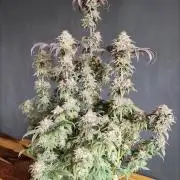
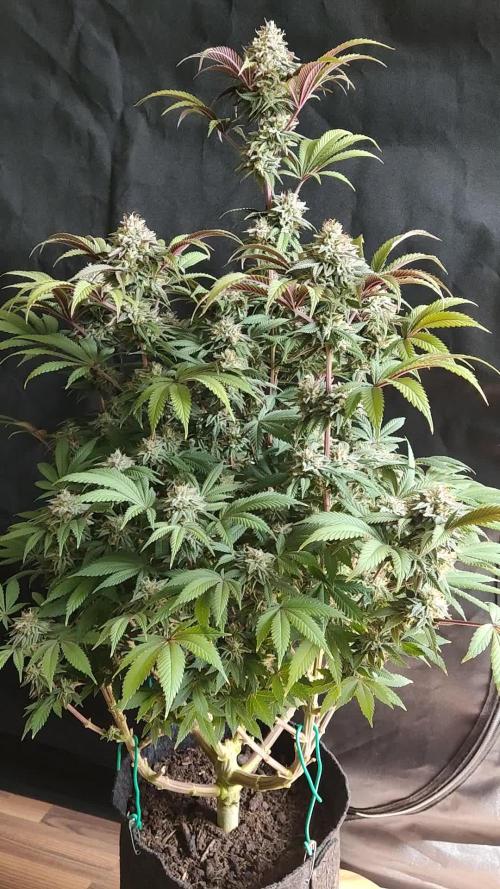
Day 45. Plants have grown huge in last week. Tallest one about 65cm. At its closest point the light is 6 inch. The bud sites furthest away are about 18 inch. Trying g to even out the canopy with some success. Just using the string method of LST and also moving the pot around to get an even amount of strong light.

shorts_status_processing


@Dunk_Junk
Follow
Flowering stretch almost done!!
She is a good sized plant for a tiny 1 litre airpot.


@MadeInGermany
Follow
Hey everyone ☺️.
It gets more beautiful from week to week 😍👍.
I have them all this week Sprayed again properly with neem oil in the veggie phase ☺️.
There have been no trips for 2 weeks, but prevention is better 😀.
Because of the neem oil, the plants look very dark and shiny, which I really like when they shimmer like that 😝.
I didn't do any training these days, that will be done again the next few days 👌.
it was watered twice this week with around 0.6 l per plant.
The Ph / Ec measuring device was also recalibrated.
Otherwise there is nothing to report for this week and we'll see you again with the next update ☺️👍.
I wish you and your families a Merry Christmas 😊.
Stay healthy and let it grow 🍀
You can buy this Strain at
https://www.amsterdamgenetics.com/product/kosher-tangie-kush/
Type:
Kosher Tangie Kush
☝️🏼
Genetics:
Kosher Kush
X
Tangie
👍
Vega lamp:
2 x Todogrow Led
Quantum Board 100 W
💡
Bloom Lamp :
2 x Todogrow Led
Cxb 3590 COB 3500 K 205W
💡💡☝️🏼
Soil :
Canna Coco Professional +
☝️🏼
Fertilizer:
Green House Powder Feeding
☝️🏼🌱
Water:
Osmosis water mixed with normal water (24 hours stale that the chlorine evaporates) to 0.2 EC. Add Cal / Mag to 0.4 Ec Ph with Organic Ph - to 5.5 - 5.8 .


@Lovemabud
Follow
All set for another shed grow now the temps a dropping. This is another tin shed grow and they certainly have there challenges.
I thought I would waterproof my shed, unfortunately I sealed the outside not realising that run off channels run down the panel, I effectively stopped all drainage and due to a shipload of rain the last few days it's wet inside. Lucky I have my tent raised. A problem that will certainly need to be fixed prior to flowering, for now I'll just make sure I'm wearing my gumboots.


@Smokwiri
Follow
Welcome to week 8 of my Northern Lights XL Auto diary
Did some LST, and she seems to like it very much.
Development did slow down a bit as it seems, but the plant is taking the training very well
the lower branches did grow quite a bit and are moving upwards to the light
overall performance is very good, no insects problems, also no problems with rain (yet)
Waiting for more bud development, let the plant take it's time


@HUMO_Cultiva
Follow
We are happy of the results, but in the next batch we will be put 8 plantas and AC





@Comfrey
Follow
23.-30.07.
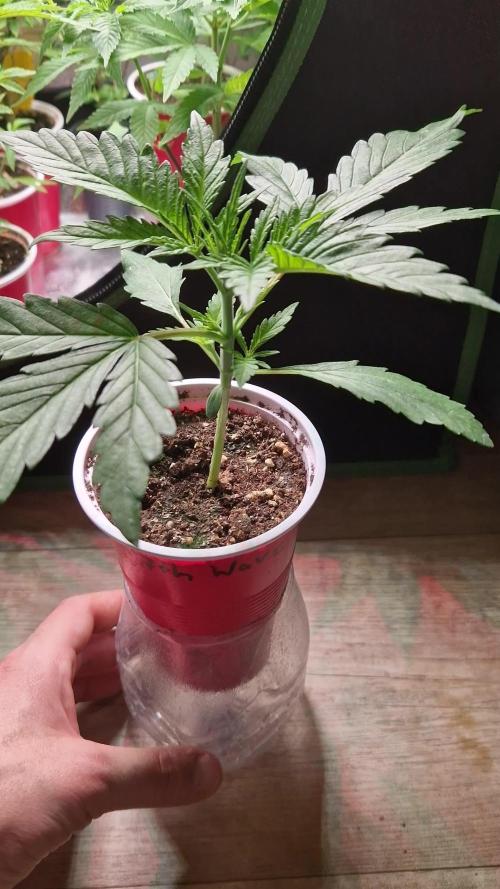
Die Woche verging wie im Fluge. Strawberry Haze Auto duftet mittlerweile sehr fruchtig mit Zitrusnoten.
Die Blüten schwellen nach einem krassen Stretch an. Das intensive LST und das Entfernen störender Blätter hat dazu geführt, dass die Blüten sehr gleichmäßig Sonnenlicht bekommen und später in der Blüte die Luft gut zirkulieren kann.
Zwei Tage der Woche standen die Pflanzen unter der Markise, es hat über Stunden heftig geregnet.
Das Gießen läuft wie gewohnt nach Gefühl. An heißen Sonnentagen bis zu 1,5 Liter.


@Ultraviolet
Follow
0.23v tuned to 7.83Hz Plants exposed to the Schumann resonance often show greater resistance to stress factors such as drought, diseases, and pests. It is possible that these natural electromagnetic waves strengthen plants' immune systems and increase their ability to resist disease.
Pretty neat, in the afternoon when the tent hovers around 84F the plants are 🙏, can visually see in time around 10 minutes after I opened the tent the temp had dropped to 76 pressure was lost, she is still chilling but she doesn't quite have that perk anymore.
*Salinity3.5% - 100ml H2O=100g The concentration of salt in a solution 3.5%= 3.5g in 100ml.
Growing well. Not going to top or do any training, I'll let the plant do its own thing, she is constructing foundations now for what she senses ahead. Smart girl. ✨️ Let her, do her thing, let me do mine.
The voltage that is needed for electrolysis to occur is called the decomposition potential. The word "lysis" means to separate or break, so in terms, electrolysis would mean "breakdown via electricity. Green hydrogen is hydrogen produced by the electrolysis of water, using renewable electricity. The production of green hydrogen causes significantly lower greenhouse gas emissions than the production of grey hydrogen, which is derived from fossil fuels without carbon capture.
Electrolysis of pure water requires excess energy in the form of overpotential to overcome various activation barriers. Without the excess energy, electrolysis occurs slowly or not at all. This is in part due to the limited self-ionization of water. Pure water has an electrical conductivity of about one hundred thousandths that of seawater. Efficiency is increased through the addition of an electrolyte (such as a salt, acid or base).
Photoelectrolysis of water, also known as photoelectrochemical water splitting, occurs in a photoelectrochemical cell when light is used as the energy source for the electrolysis of water, producing dihydrogen . Photoelectrolysis is sometimes known colloquially as the hydrogen holy grail for its potential to yield a viable alternative to petroleum as a source of energy. The PEC cell primarily consists of three components: the photoelectrode the electrolyte and a counter electrode. The semiconductor crucial to this process, absorbs sunlight, initiating electron excitation and subsequent water molecule splitting into hydrogen and oxygen.
Water electrolysis requires a minimum potential difference of 1.23 volts, although at that voltage external heat is also required. Typically 1.5 volts is required.
Biochar, a by-product of biomass pyrolysis, is typically characterized by high carbon content, aromaticity, porosity, cation exchange capacity, stability, and reactivity. The coupling of biochar oxidation reaction (BOR) with water electrolysis constitutes biochar-assisted water electrolysis (BAWE) for hydrogen production, which has been demonstrated to reduce the electricity consumption of conventional water electrolysis from 1.23v to 0.21v.
Biochar particles added to the electrolyte form a two-phase solution, in which the biochar oxidation reaction (BOR) has a lower potential (0.21 V vs. RHE) than OER (1.23 V vs. RHE), reducing the energy consumption for hydrogen production via biochar-assisted water electrolysis (BAWE).
BAWE produces H2 under 1 V while eliminating O2 formation: key word "eliminating". Air with a normal oxygen concentration of around 21% is not considered explosive on its own; however, if a flammable gas or vapor is present, increasing the oxygen percentage above 23.5% can significantly increase the risk of ignition and explosion due to the enriched oxygen environment.
The addition of ion mediators (Fe3+/Fe2+) significantly increases BOR kinetics.
Air:
Nitrogen -- N2 -- 78.084%
Carbon Dioxide -- CO2 -- 0.04%
Hydrogen in homosphere H -- 0.00005%
Hydrogen "GAS" H2 in homosphere - 0%
"Nitrogen, oxygen, and argon are the three main components of Earth's atmosphere. Water concentration varies but averages around 0.25% of the atmosphere by mass. Carbon dioxide and all of the other elements and compounds are trace gases. Trace gases include the greenhouse gases carbon dioxide, methane, nitrous oxide, and ozone. Except for argon, other noble gases are trace elements (these include neon, helium, krypton, and xenon). Industrial pollutants include chlorine and its compounds, fluorine and its compounds, elemental mercury vapor, sulfur dioxide, and hydrogen sulfide. Other components of Earth's atmosphere include spores, pollen, volcanic ash, and salt from sea spray."
Although the CRC table does not list water vapor (H2O), air can contain as much as 5% water vapor, more commonly ranging from 1-3%. The 1-5% range places water vapor as the third most common gas (which alters the other percentages accordingly). Water content varies according to air temperature. Dry air is denser than humid air. However, sometimes humid air contains actual water droplets, which can make it more dense than humid air that only contains water vapor.
The homosphere(where you live) is the portion of the atmosphere with a fairly uniform composition due to atmospheric turbulence. In contrast, the heterosphere is the part of the atmosphere where chemical composition varies mainly according to altitude. The lower portion of the heterosphere contains oxygen and nitrogen, but these heavier elements do not occur higher up. The upper heterosphere consists almost entirely of hydrogen, cool.
78%nitrogen as N2, a far too stable bond to be used by organisms.
20%oxygen
0.04%co2
0.00005% hydrogen
When lightning strikes, it tears apart the bond in airborne nitrogen molecules. Those free nitrogen atoms N2 nitrites then have the chance to combine with oxygen molecules to form a compound called nitrates N3. Once formed, the nitrates are carried down to the ground becoming usable by organisms. Will it react with the oxygen in the air spontaneously, the answer is no. The mixture is chemically stable indefinitely. A mixture with air near the release point can be ignited, but if this does not happen then when its concentration gets below 4% it will be unable to carry a flame. Taking a small detour into chemistry here, a key concept to understanding the health impact of nitrogen-based compounds is knowing the difference between nitrates and nitrites.
What Are Nitrates and Nitrites?
A nitrite (NO2) is a nitrogen atom bonded to only two nitrogen atoms. Very strong bond
A nitrate (NO3) is a nitrogen atom bonded to three oxygen atoms. Weaker bond The optimal pH for nitrate (NO3-) depends on the process and the type of bacteria involved.
Nitrification
The optimal pH for nitrification is between 7.5 and 8.6
Nitrification is the process of oxidizing ammonia to nitrate and nitrite
Nitrosomonas has an optimal pH between 7.0 and 8.0
Nitrobacter has an optimal pH between 7.5 and 8.0
Nitrification ceases at pH


@The_outdoor_guy
Follow
15th of October
Sry for the delayed update, but was quite busy with my work lately.
Anyway, on the 15th of October, it was the big day of harvesting this beauty. 6 1/2 months ago in April it germinated. And now after 9 weeks of flower finally it’s harvest time.
The past 2 weeks the weather was nasty af. But this steadfast soldier was bravly withstanding this ass sucking conditions. Only few buds I had cut out because of mold. The rest has beautiful shiny milky trichomes that makes me happy😊. I think they would have needed 2 more weeks to really thicken up, but the weather is gonna be worst in the next weeks :(. So better chopped now.
In the last weeks I was super worried to loose my whole harvest to the every day high humidity. I even wanted to chop it earlier. But got good recommendation from the community to be still patiened.
That hint was very rewarding,
Thanks guys.
I will also make another week for the harvest, don’t worry 😊


@Madman2020
Follow
Day 12
Starting to show preflowers. Seems a bit late.
I will take clones today from top 3 plants
81f/76%.
1100ppm.
1000co2 37-53kluxx
4 very sickly and ugly plants
Plant stems are all pretty stiff by now.
Looks like i could have fit 2 more plants
Day 14
Plants are doing well with height control.
I did a second Topping of the main 4 branches for each plant the week before flower flip.
Most plants are 22-25inches tall
3 of my White Weddings are looking very weird. Not a clue as to what is wrong.
Flowers are developing well on each plant
No more LST from here in out. I will let them grow how they are(minimal stress)
Started Defoliating


@Gonjuk
Follow
Fin'ora tutto bene a un mese di fioritura ho cambiato l'acqua, c'è un problema l'acqua è a 25/26° ogni tanto ci metto delle bottiglie congelate e aumento il perossido d'idrogeno


@BelgianBudtender
Follow
Heyo,
This is my Diary for the 2022 Dutch Passion Master Grower contest!
The first weed plant I ever grew was Auto Ultimate by Dutch Passion, So I am very excited to grow another Autoflower from this seedbank!
so far everything is smooth sailing, my germination took less than 2 days, and only 2 days later untill I had roots poking out, excited to see where she goes!


@ukterpdoc
Follow
Sorry for late update friends been in Jamaica for 10 days 😀
So plants look amaizin gonna flip them tomorrow i think its time any opinions guys.


@ButterfliesLittleFarm
Follow
Hello Diary,
The first week of vegetation on my small farm has ended and so far everything is going well.
In order to better remember the arrangement of the plants, they are arranged alphabetically from left to right.
On the left is Apollo, in the middle is the Milky Way and on the right is Titan.
Milky Way F1 is developing and growing nicely. It grew 7 cm and I am generally satisfied.
What worries me a little is discoloration, i.e. light spots on the leaves. I'm not sure about the cause, but maybe it's genetics.
I will see and follow what happens.
Watering was not frequent, considering the size of the pots, there is a lot of moisture in the ground, so I watered it every 5 days with a liter and a half of water.
In the first week, I didn't add any supplements, considering that I mixed a lot of supplements into the soil.
Conditions on the farm are satisfactory. The humidity is slightly higher than 50% and the temperature is around 25 degrees.
The light is set to 18/6 from the first day of vegetation.
I took pictures on the first and last day of the first week, just to see the difference in a week.
Here's a quick recap of the week.
30/04/2023 - Day 1.
Watering and photography. Officially, the first day of the growing season.
Prepared 5 liters of water, lowered the pH. at 6.0 and with that amount watered the Milky Way F1 and its two roommates with about the same amount of water.
Milky Way F1 - 4 cm
05/05/2023 - Day 6.
Watering. The procedure is the same as 5 days earlier.
06/05/2023 - Day 7.
Photography. End of the first week of vegetation.
Milky Way F1 - 7 cm
That's all for this week, see you soon and thank you all for your support.
