


@Creme_De_La_Creme
Follow
day 70 was harvest day !!
really fast strain, 24h light ON really played a big role as well
frosty buds and amazing strawberry smell, now lets dry it !!




@DogDoctorOfficial
Follow
🌿 8×8 Adventure – Week 14
Amnesia Haze Auto by Zamnesia – Pheno A
👑 The Queen of the Yo-Yo World Is Still Reigning… And She's Moving FAST! 😂🌸🔥
Hello everyone, and welcome back to another chapter of the 8×8 Adventure! 🌱💚
Well...
As expected.
Absolutely as expected.
😂😂😂
OUR QUEEN IS STILL THE QUEEN OF THE YO-YO WORLD!
👑🌿⚖️😂
Seriously, my friends...
This girl is HEAVY.
Not a little heavy.
Not "maybe we should support that branch" heavy.
We're talking about the kind of heavy where you look at the plant, look at the supports, look at the plant again, and start wondering whether the entire yoyo department needs to be put on permanent standby.
😂😂😂👑
And the answer is...
YES.
YES, IT DOES.
Because our Amnesia Haze Auto Pheno A is still carrying a serious amount of flower throughout her structure.
The branches are loaded.
The flowers are substantial.
The plant is evolving quickly.
And when I look at her this week, I get the feeling that we're moving into an increasingly important part of her journey.
She's changing.
She's developing.
She's looking increasingly mature.
But is she ready to finish?
That's a different question.
And one we're not going to answer just because the calendar says Week 14.
😂🌸
For now, she's staying right where she is.
We're going to keep watching her, supporting her, documenting her, and allowing the next chapter to reveal itself.
Because this Queen isn't going anywhere just yet.
👑💚
So let's give her the individual report she deserves!
────────────────────────
👑 WEEK 14 — LONG LIVE THE QUEEN OF YOYOS!
Let's start with the obvious.
She's still incredibly heavy.
😂⚖️🌸
Last week, we were already talking about the ridiculous amount of support this girl needed.
And this week?
The title remains firmly hers.
The Queen of the Yo-Yo World.
No competition.
No challengers.
No appeals.
😂👑
Looking at her structure, it's easy to understand why those supports are such an important part of her story.
She's carrying substantial flowers throughout the plant, not just in one single location.
The weight is distributed across her branches, and the overall structure needs support to help everything remain where it should.
And honestly, I love that this has become part of her individual personality.
Some plants make an impression through height.
Others through colour.
Others through the shape of their flowers.
This girl?
She makes an impression through sheer weight.
😂🌿🌸⚖️
She's compact in certain parts of her architecture, but don't let that fool you.
There is a lot happening throughout this plant.
And the yoyo department is still very much open for business.
────────────────────────
😂 THE YOYO DEPARTMENT IS NOT CLOSING ANYTIME SOON
I think we need to make this official.
😂
At this point, the yoyos deserve their own diary.
Maybe we should call it:
"The 8×8 Adventure — Supporting the Support System."
😂😂😂👑
One branch needs help.
Another branch is carrying serious weight.
And suddenly, we're looking around the room to see whether there's another support available.
Because when a plant becomes this heavy, support is no longer some decorative extra.
It's part of managing the structure we've got.
And with Amnesia Haze Pheno A, that structure has become one of the defining features of the entire grow.
The important thing is that we're not trying to reshape her into something she's not.
We're simply helping her carry what she's produced.
She built the flowers.
She created the weight.
She developed those branches.
We're here to support the result.
That's it.
😂🌿👑
So, no...
the yoyo department isn't going anywhere.
And neither is the Queen.
At least, not for now.
────────────────────────
🌸 SHE'S EVOLVING FAST — AND THAT'S WHAT HAS MY ATTENTION
Beyond the weight, the other thing catching my attention this week is how quickly she's changing.
She's still developing.
The flowers continue to evolve.
And the overall appearance of the plant is changing as we move deeper into this stage of the run.
That's what makes this moment so interesting.
We have a plant that has already built a substantial structure, and now we're watching how that structure develops as the flowering cycle progresses.
When I compare the way she looks now with the earlier chapters, I can see why she's becoming such an interesting plant to follow.
She's not standing still.
She's not simply repeating the same week.
She's changing.
And she's doing it quickly enough to make me wonder what the next set of photographs will show us.
😂📸🌸
But here's the important part.
Fast development doesn't automatically tell us the exact amount of time remaining.
The plant can look increasingly mature while still having changes left to make.
So I'm not going to declare a finish date.
I'm going to keep observing her.
Keep documenting her.
And let the next week tell us more.
For now, she's evolving fast, carrying serious weight, and keeping the Queen title firmly in place.
👑🌿🔥
────────────────────────
🔍 THE FINAL CHAPTERS MAY BE APPROACHING… BUT WE'RE NOT WRITING THE ENDING YET
I have to admit, when I look at this girl now, I start thinking about the final stages of her journey.
She's looking increasingly mature.
She's carrying substantial flowers.
And the changes are becoming more noticeable from one update to the next.
But I want to keep one thing clear.
Looking close to the end and actually being ready are not necessarily the same thing.
The photographs help us document appearance and progression, but they cannot tell us everything about maturity on their own.
That's why we're going to keep watching rather than making assumptions.
Next week is next week.
😂🌿
For now, she stays where she is, and we continue following her story.
No premature farewell.
No harvest announcement.
No guessing just to put a date on the calendar.
We'll see what time tells us.
And honestly?
That's part of the fun.
────────────────────────
🌸 A PLANT THAT HAS EARNED HER SUPPORT
Let's take a moment to appreciate what all those supports represent.
They're not the main attraction.
The flowers are.
But the supports tell us something about the structure of this particular plant.
She's carrying enough weight that we need to pay attention to the branches and help them remain supported.
And that's another reason I enjoy keeping individual diaries.
If I simply wrote, "Amnesia Haze Auto is doing well," we'd miss so much of what makes this particular phenotype interesting.
We'd miss her unusual leaf presentation.
We'd miss the substantial flower development.
We'd miss the sheer number of supports.
And we'd miss the little details that have made her the Queen of the Yo-Yo World.
😂👑⚖️
This is her story.
Not every Amnesia Haze Auto will look exactly like this.
Not every plant will develop the same architecture.
And that's precisely why we document the individual plants rather than pretending one description represents every phenotype.
────────────────────────
📸 THE PHOTOGRAPHS — ANOTHER CHAPTER IN HER STORY
This week's photographs continue the visual record of our Queen.
The wider shots help show the plant's overall architecture and how much space she occupies.
The closer shots let us appreciate the individual flowers and their developing structure.
And the support details?
Well...
those deserve a little attention too.
😂📸👑
Because they're part of the reality of this plant.
It's easy to focus exclusively on beautiful flower portraits, but the full-plant photographs help tell the larger story.
They show us how the plant is developing as a whole.
They provide context for the branches.
They show where the flowers sit within the canopy.
And they help us compare this week's appearance with the previous updates.
That's the value of keeping a proper diary.
We don't have to rely on memory alone.
We can look back and follow the progression.
And with this girl, that progression has been fascinating.
────────────────────────
💎 THE FLOWERS ARE STILL THE STARS
Let's not allow the yo-yos to steal the entire show.
😂🌸
They're important, certainly.
But they're supporting the plant, not replacing the flowers as the main attraction.
The flowers are what make this girl so substantial.
The distribution of those flowers throughout the plant is part of what makes her structure so impressive.
And the way the plant continues to evolve is what keeps me interested in the next update.
She's not just a plant with a lot of supports.
She's a plant that has developed a structure substantial enough to make those supports necessary.
That's a very different story.
And it's one I want to keep documenting honestly.
So yes...
the Queen of the Yo-Yo World remains on her throne.
But the flowers are the reason she got there.
👑🌸💚
────────────────────────
🌿 OBSERVATION OVER UNNECESSARY INTERVENTION
At this point in the adventure, I'm increasingly focused on observing rather than constantly trying to change the plants.
Earlier in the run, there were plenty of moments for structural work, positioning, and other interventions.
Now, the plants have established their individual architectures.
The flowers are developing.
And the priorities are different.
We're observing the plants.
Monitoring the room.
Keeping an eye on the support system.
Documenting the changes.
And responding when something actually needs attention.
With this girl, support is clearly part of the story.
But we don't need to manufacture extra work just because we're in the grow room.
Sometimes the best thing you can do is recognize what the plant needs and leave the rest alone.
The Queen is doing her thing.
We're here to help her carry the results.
😂👑🌿
────────────────────────
☀️ SAME ROOM — SAME PHOTONS — HER OWN RESPONSE
The 8×8 lighting setup remains part of the same shared environment.
The two additional Future of Grow Black Series 600W fixtures are still part of the expanded setup, giving us more lighting capability and flexibility.
Our established reference has been approximately:
🔌 59% power from the plug.
☀️ Around 1,500 PPFD across the upper canopy.
Those figures describe our previous room reference, not a newly verified measurement at every point of this plant.
The canopy is three-dimensional.
Different branches and flowers sit at different heights and positions, so light exposure naturally varies throughout the structure.
And that's one of the interesting parts of this experiment.
Amnesia Haze Auto Pheno A has developed her own architecture under the same general environment as the other plants.
She's substantial.
She's heavy.
She's developing quickly.
And she's requiring plenty of support.
The lighting is one part of the shared environment, but we're not going to attribute every characteristic of this phenotype to one factor alone.
We're documenting what we see and comparing it with the other plants.
Same room.
Same artificial sun.
Different genetic expressions.
That's the 8×8 Adventure.
💡🌿☀️
────────────────────────
💡 MORE CAPABILITY, MORE CONTROL
The additional Future of Grow fixtures have given us more available lighting capability, but the point isn't to run everything at maximum simply because we can.
It's about having more flexibility and control over the lighting setup.
We're observing the plants within that expanded environment and documenting how differently they express themselves.
And that has been one of the most interesting parts of this project.
A huge thank you to Future of Grow for supplying the two additional Black Series 600W fixtures for us to test.
Having that extra capacity while controlling the output has given us another important part of the 8×8 experiment.
More capability.
More control.
More photons.
And twelve different plants responding in their own ways.
💚☀️🌿
────────────────────────
🔴 THE RED-LIGHT ROUTINE — KEEPING THE SCIENCE HONEST
We're also continuing to document the additional 15-minute red-light period after the main lighting period.
Red and far-red wavelengths interact with the plant's phytochrome system, which helps plants interpret their light environment.
The response depends on the wavelength, intensity, timing, duration, and the rest of the conditions.
So we're treating this as a documented part of our lighting routine, not as a guaranteed way to accelerate flowering or produce a particular result.
With Amnesia Haze Auto Pheno A, we're watching the plant's overall progression.
She's developing quickly.
She's carrying substantial flower.
And her appearance is changing as the run progresses.
But we cannot conclude from those observations alone that the red-light routine caused the changes.
That's why we keep documenting the whole environment and avoid turning correlation into proof.
We're here to learn, compare, and share the journey honestly.
🔴🌿🔬
────────────────────────
🔬 A LITTLE LIGHT SCIENCE — THE EMERSON EFFECT
Since we're discussing red light, let's revisit the Emerson effect.
The Emerson effect describes how photosynthesis can respond more efficiently when suitable red and far-red wavelengths are supplied together under particular experimental conditions.
It involves the cooperation between two major components of the light-dependent reactions of photosynthesis:
🌿 Photosystem II (PSII)
🌿 Photosystem I (PSI)
These photosystems have different light-absorption characteristics. Under suitable conditions, combining light that supports both can produce a greater photosynthetic response than would be expected from the individual wavelengths alone.
It's a fascinating example of how plant responses to light involve more than simply increasing brightness.
But there is an important distinction.
The Emerson effect does not mean every red-light treatment produces the same response, nor does it prove that a particular 15-minute red-light routine will increase yield, accelerate flowering, or determine harvest timing.
Spectrum, intensity, timing, and experimental conditions matter.
Our additional red-light period is part of the routine we're documenting in this grow.
We're not claiming that it automatically reproduces the Emerson effect.
We're recording what we do, observing the plants, and keeping our conclusions grounded in the evidence we have.
That's how we keep learning without turning an interesting scientific concept into an unsupported promise.
💡🔬🌱
────────────────────────
⚗️ NUTRITION — THE ROOM'S SHARED APPROACH
The room continues under the same general flowering nutrition approach, with the nutritional programme being adjusted progressively as the plants move through the later stages.
The established foundation includes the relevant Plagron Terra flowering products and additives used for this run.
Our previous room references were approximately:
⚗️ pH — around 6.0.
⚡ EC — around 2.05 mS/cm during the previous stage.
These are continuity references, not fresh readings confirmed specifically for this update.
The important part is that we're looking at the plant alongside the wider room conditions, rather than trying to explain her entire development through a single number.
And with this Queen, the story remains clear.
She's developing.
She's carrying weight.
She's changing quickly.
And we're continuing to observe her rather than assuming every plant will follow the same timeline.
────────────────────────
🌡️ THE 8×8 ROOM — SHARED CONDITIONS
Our previously established room references were approximately:
🌸 Flowering — Week 14.
💡 Light schedule — 12/12.
☀️ Upper-canopy PPFD reference — around 1,500.
🔌 Future of Grow output — around 59% from the plug.
🌡️ Day temperature — around 26.5–27°C.
🌙 Night temperature — around 25–26°C.
💧 Relative humidity — around 60–61%.
🌱 Substrate temperature — around 25–26°C.
💦 Nutrient solution temperature — around 25°C.
⚗️ pH — around 6.0.
⚡ EC — previously around 2.05 mS/cm.
💨 CO₂ — around 693 ppm.
💧 Previous irrigation reference — around 1.4–1.45 L per plant per 24 hours.
🌱 Pot size — 15 L.
These are the established room references from earlier reports, not a claim that every reading was retaken this week.
The room provides the shared background.
Each plant gives us her own response.
And Amnesia Haze Auto Pheno A continues to give us plenty to talk about.
👑🌿🌸
────────────────────────
🔬 SAME ROOM — DIFFERENT PLANTS, DIFFERENT TIMELINES
This remains the heart of the 8×8 Adventure.
Twelve plants.
One room.
The same general environmental approach.
The same lighting philosophy.
The same overall nutritional strategy.
And twelve individual expressions.
Some plants are compact.
Some are tall.
Some take their time.
Some seem to change before our eyes.
Some produce different flower structures.
And some make us install enough supports to start considering a career in the yoyo industry.
😂😂😂👑
Amnesia Haze Auto Pheno A is one of those plants that makes her personality impossible to miss.
She's substantial.
She's heavy.
She's developing quickly.
And she's moving through her own timeline.
That's what makes this experiment worthwhile.
We're not trying to make every plant behave identically.
We're documenting what each one actually does.
────────────────────────
💬 JOIN THE DOG DOCTOR COMMUNITY!
Want to talk about the 8×8 Adventure, share your own experiences, ask questions, or hang out with other growers?
Come and join us on Discord! 💚🌱
🔗 https://discord.gg/dogdoctorofficial
Different genetics, different environments, different experiences, and plenty to learn from one another.
Come say hello and join the conversation!
────────────────────────
🔮 WHAT HAPPENS NEXT? NEXT WEEK IS NEXT WEEK!
And this is where I'm happy to leave the story for now.
😂🌿👑
She's evolving quickly.
She's carrying a serious amount of weight.
She's looking increasingly mature.
And I have the feeling we're approaching an important part of her journey.
But we're not going to rush the conclusion.
She's not going anywhere for now.
We'll keep watching her.
We'll keep documenting her.
We'll keep paying attention to the flowers and the overall plant.
And next week?
We'll see what next week brings.
😂🌸
No premature finish line.
No promises about a date.
Just the Queen, her ridiculous support network, and another chapter of the 8×8 Adventure.
────────────────────────
❤️ FINAL THOUGHTS — THE QUEEN IS STILL REIGNING
Week 14.
And our Amnesia Haze Auto Pheno A is still doing what she does best.
👑🌿🔥
She's heavy.
She's beautiful.
She's evolving quickly.
She's carrying substantial flowers throughout her structure.
And she's still the undisputed Queen of the Yo-Yo World.
😂😂😂⚖️
The support system remains an important part of her story, and we're continuing to keep an eye on her as she moves through this stage.
She's looking increasingly mature, and it's tempting to start thinking about the final chapter.
But we're going to let time tell us when that chapter actually arrives.
For now, she's staying where she is.
We're observing.
We're documenting.
We're supporting what needs support.
And we're enjoying the show.
Because this is what the 8×8 Adventure is about.
Not forcing every plant into the same schedule.
Not pretending we know the ending before it happens.
But paying attention to the individual plant in front of us.
And this girl?
She's giving us a hell of a story.
👑🌿🌸💎
Keep doing your thing, Queen.
Keep showing us what you're capable of.
Keep carrying those flowers.
And please...
try not to make me expand the yoyo department again next week.
😂😂😂👑
Although, let's be honest...
if you need another one, you'll get another one.
That's what the department is here for.
💚🌱
Let's keep the photons flying.
Let's keep documenting.
Let's keep learning.
And most importantly...
let's let this beautiful Queen shine.
────────────────────────
🙏 THANK YOU
A massive thank you to everyone following the 8×8 Adventure here on GrowDiaries. 💚🌱
Thank you to Zamnesia for the Amnesia Haze Auto genetics and for giving us the opportunity to follow this individual phenotype throughout the journey.
Thank you to Plagron for supporting the garden with the growing media and nutrition.
A huge thank you to Future of Grow for supplying the additional Black Series 600W fixtures and allowing us to test the expanded lighting setup inside the 8×8.
Thank you to Lumiflora for helping bring additional light deeper into the canopy and allowing us to explore the garden as the three-dimensional environment it really is.
And thank you to TrolMaster for helping monitor and manage the room behind the scenes.
Finally, thank you to everyone who follows these diaries, leaves a comment, asks a question, or simply stops by to see how the girls are doing.
Every bit of support means a lot. 💚
Twelve plants.
One room.
Twelve individual stories.
And our Amnesia Haze Auto Pheno A?
She's still the Queen.
Still heavy.
Still evolving.
Still surrounded by enough yoyos to keep an entire department employed.
😂👑⚖️🌸
We're not rushing her.
We're not writing her ending.
We're simply watching, documenting, and letting her show us what comes next.
Growers Love, my friends! 💚🌱
Happy growing, take care everyone...
and don't forget to join the Dog Doctor community on Discord:
https://discord.gg/dogdoctorofficial
See you next week in the 8×8 jungle!
👑🌿🌸💎☀️🔥



shorts_status_processing


@UrbanFog
Follow
This week again had some challenges with power and humidity but we push on.
The ladies are getting seriously frosty and start to fatten up.
They all looking good but the Lemon Zkittles is most impressive. Also the one pheno of Gorrila Cookies is frosty frosty frosty.
But all the plants are looking good and stacking on buds nicely. Looking forward to harvesting in a couple of weeks. Here to hoping no more power or humidity issues, only fat and tasty buds ahead


@Rap_a_cap
Follow
Outdoors........time passes slowly....
Tropical weather here, this week. Hot morning, evening storms , cooler nights, high humidity, wind. What else?
No problems to report, fantastic grow, girls full of life. Lots of work to bend and rearrange plant's shape every day, sometimes twice a day. Defoliation. Plant is responding fantastically.
Special Kush #1 is now in the last days of crazy-stretch phase, is a big plant so I had to move the main top forward again to the opposite point of the perimeter in order to lower the line and give light in the middle.


@Bigbankbossshit
Follow
“The Thrown” which is my tallest plant gave me some issues this week due to the fact that I had to suppress the plant because of the height.
Broke a few branches that I had to tape up which is not a problem. I break branches on the regular around here purposely for growth 😈.
Heavy rain this week, so I had to watch out for humidity issues, which I took care of. On top of that my basement flooded, had to break out the water pump.
This transition week i’m glad I was able to have more time at home to monitor my plants.
Hey guys sorry I’m not on here all the time if you like more pictures follow me on my Instagram a bigbankbossshit. I believe the link is at the top. They are about to be some really awesome pictures I’m hoping in the near future. With the six strains I’m sure to Jane some awesome pictures. So follow me on Instagram.


@la_piper
Follow
Гров прошёл не без проблем.
На самом старте мой кот решил откусить один листочек, но это не остановило этот сорт✌️👍
Гров прошёл приятно, очень много трихом на шишках.
Рекомендую всем👍👌
Чуть чуть не додержал до янатрных трихом,время поджимало.

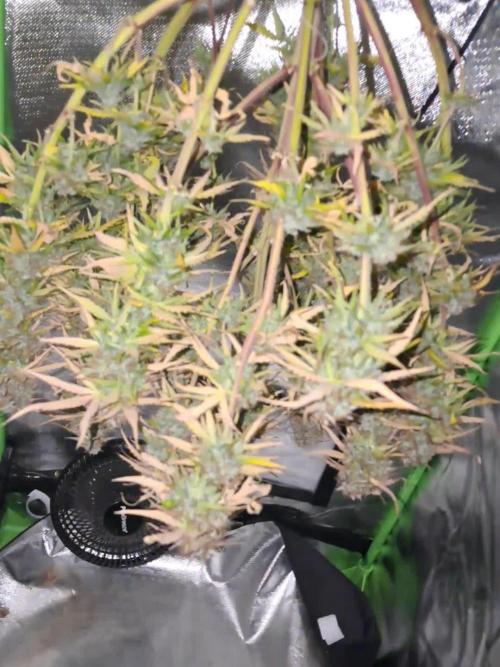

@Grow4ever
Follow
Ernte nach dem Trichomkopf Check-UP.
Schokoladige Noten erahne ich bisher nicht.
Sehr zitronig, sauer bisher. Bin auf das curen gespannt.


@Ultraviolet
Follow
Once again she passes my expectations, late to the show with trichome production. I'm surprised there is purple on the bud, maybe Purpinator does work. I thought I could see hints under the grow lights and thought my eyes were deceiving me, I was just being hopeful. But nah 2 of the 3(under the UV) have developed a beautiful tone of purple. I was never going to bother with a deep freeze but maybe the whole bud will change given conditions, that would be something, fingers crossed. 🤔 was a little skeptical that reducing temps humidity would change density, but it does, buds are solid something I've not been able to achieve before.
Rule of thumb is never to surpass 60% RH in the flowering phase and try to progressively reduce it down to 40% in the last 2–3 weeks before harvest. The plant will react as it seeks to protect its flowers, responding by producing denser buds and a higher concentration of resin. Cannabis plants are sensitive to sudden temperature changes, especially in the flowering stage. Extreme heat or cold can impact bud density and overall yields. In nature as a defense mechanism from cold, the plant sensing sudden dips in temperature will attempt to remove the pockets of air within the bud, it achieves this by compacting itself in doing so to better protect itself from cold snaps which are normally indicators in nature that worse weather is on the way.
Terpene levels are the highest just before the sun comes out. Ideally, you want as many terpenes present in your plants as possible when you harvest. Cannabis plants soak up the sun during the day and produce resin and other goodies at night. The plant is at its emptiest from "harvest undesirables" so to speak right before the lights on. Boiling cannabis roots during harvesting slows down the drying process. When you boil cannabis roots, it shocks the plant, closing the stomata on the leaves. This prevents massive moisture loss through the leaves, leaving only the floral clusters actively losing moisture at a reduced pace. I've always run a strict 60/60 and it took almost twice as long to dry to a snap than previous grows where I didn't boil for what it's worth.
Chlorophyll is good for the plant but not for you. When you harvest the buds, even after you flush them, if you flush them, they’re still filled with chlorophyll. Freshly cut buds are greener than dried buds because they still contain loads of chlorophyll. However, when rushed through the drying process, the buds dry but retain some chlorophyll, and when you smoke it, you will taste it. Chlorophyll-filled buds are smokable, but they aren’t clean. Slow drying gives the buds enough time and favorable conditions to lose the chlorophyll and sugars, giving you a smoother smoke. How the plant disposes of the chlorophyll and sugars by a process of chemically breaking them down and attaching the decomposed matter once small enough to water molecules which then evaporate back into the ether. Time must be given to the process to break down the chlorophyll and sugars. Think of it like optimizing the environment for decay.
All the nutrients it could ever need are in abundance, it eats nutrients based on its demand for growth, which is dictated primarily by available light.
Plant growth and geographic distribution (where the plant can grow) are greatly affected by the environment. If any environmental factor is less than ideal, it limits a plant's growth and/or distribution. For example, only plants adapted to limited amounts of water can live in deserts. Either directly or indirectly, most plant problems are caused by environmental stress. In some cases, poor environmental conditions (e.g., too little water) damage a plant directly. In other cases, environmental stress weakens a plant and makes it more susceptible to disease or insect attack. Environmental factors that affect plant growth include light, temperature, water, humidity, and nutrition. It's important to understand how these factors affect plant growth and development. With a basic understanding of these factors, you may be able to manipulate plants to meet your needs, whether for increased leaf, flower, or fruit production. By recognizing the roles of these factors, you'll also be better able to diagnose plant problems caused by environmental stress.
Water and humidity
*Most growing plants contain about 90 percent water. Water plays many roles in plants. It is:*
A primary component in photosynthesis and respiration
Responsible for turgor pressure in cells (Like the air in an inflated balloon, water is responsible for the fullness and firmness of plant tissue. Turgor is needed to maintain cell shape and ensure cell growth.)
A solvent for minerals and carbohydrates moving through the plant
Responsible for cooling leaves as it evaporates from leaf tissue during transpiration
A regulator of stomatal opening and closing, thus controlling transpiration and, to some degree, photosynthesis
The source of pressure to move roots through the soil
The medium in which most biochemical reactions take place
Relative humidity is the ratio of water vapor in the air to the amount of water the air could hold at the current temperature and pressure. Warm air can hold more water vapor than cold air. Relative humidity (RH) is expressed by the following equation:
RH = water in air ÷ water air could hold (at constant temperature and pressure)
The relative humidity is given as a percent. For example, if a pound of air at 75°F could hold 4 grams of water vapor, and there are only 3 grams of water in the air, then the relative humidity (RH) is:
3 ÷ 4 = 0.75 = 75%
Water vapor moves from an area of high relative humidity to one of low relative humidity. The greater the difference in humidity, the faster water moves. This factor is important because the rate of water movement directly affects a plant's transpiration rate.
The relative humidity in the air spaces between leaf cells approaches 100 percent. When a stoma opens, water vapor inside the leaf rushes out into the surrounding air (Figure 2), and a bubble of high humidity forms around the stoma. By saturating this small area of air, the bubble reduces the difference in relative humidity between the air spaces within the leaf and the air adjacent to the leaf. As a result, transpiration slows down.
If the wind blows the humidity bubble away, however, transpiration increases. Thus, transpiration usually is at its peak on hot, dry, windy days. On the other hand, transpiration generally is quite slow when temperatures are cool, humidity is high, and there is no wind.
Hot, dry conditions generally occur during the summer, which partially explains why plants wilt quickly in the summer. If a constant supply of water is not available to be absorbed by the roots and moved to the leaves, turgor pressure is lost and leaves go limp.
Plant Nutrition
Plant nutrition often is confused with fertilization. Plant nutrition refers to a plant's need for and use of basic chemical elements. Fertilization is the term used when these materials are added to the environment around a plant. A lot must happen before a chemical element in a fertilizer can be used by a plant.
Plants need 17 elements for normal growth. Three of them--carbon, hydrogen, and oxygen--are found in air and water. The rest are found in the soil.
Six soil elements are called macronutrients because they are used in relatively large amounts by plants. They are nitrogen, potassium, magnesium, calcium, phosphorus, and sulfur.
Eight other soil elements are used in much smaller amounts and are called micronutrients or trace elements. They are iron, zinc, molybdenum, manganese, boron, copper, cobalt, and chlorine. They make up less than 1% of total but are none the less vital.
Most of the nutrients a plant needs are dissolved in water and then absorbed by its roots. In fact, 98 percent are absorbed from the soil-water solution, and only about 2 percent are actually extracted from soil particles.
Fertilizers
Fertilizers are materials containing plant nutrients that are added to the environment around a plant. Generally, they are added to the water or soil, but some can be sprayed on leaves. This method is called foliar fertilization. It should be done carefully with a dilute solution because a high fertilizer concentration can injure leaf cells. The nutrient, however, does need to pass through the thin layer of wax (cutin) on the leaf surface.
It is to be noted applying a immobile nutrient via foliar application it will remain immobile within the leaf it was absorbed through.
Fertilizers are not plant food! Plants produce their own food from water, carbon dioxide, and solar energy through photosynthesis. This food (sugars and carbohydrates) is combined with plant nutrients to produce proteins, enzymes, vitamins, and other elements essential to growth.
Nutrient absorption
Anything that reduces or stops sugar production in leaves can lower nutrient absorption. Thus, if a plant is under stress because of low light or extreme temperatures, nutrient deficiency may develop.
A plant's developmental stage or rate of growth also may affect the amount of nutrients absorbed. Many plants have a rest (dormant) period during part of the year. During this time, few nutrients are absorbed. Plants also may absorb different nutrients as flower buds begin to develop than they do during periods of rapid vegetative growth.
432 Hz is said to be mathematically consistent with the patterns of the universe. Studies reveal that 432 Hz tuning vibrates with the universe’s golden mean PHI and unifies the properties of light, time, space, matter, gravity and magnetism with biology, the DNA code and consciousness. When our atoms and DNA start to resonate in harmony with the spiraling pattern of nature, our sense of connection to nature is said to be magnified.
Another interesting factor to consider is that the A=432 Hz tuning correlates with the color spectrum while the A=440 Hz is off.
Audiophiles have also stated that A = 432 Hz music seems to be non-local and can fill an entire room, whereas A=440 Hz can be perceived as directional or linear in sound propagation.
Once you adopt the idea that sound (or vibration in general) can have an equalizing and harmonizing effect (as well as a disturbing effect), the science of harmony can be applied to bring greater harmony into ones life or a tune to specific energies. There is a form of absolute and of relative harmony. Absolute harmony can for example be determined by the tuning of an instrument. The ancients tuned their instruments at an A of 432 Hz instead of 440 Hz - and for a good reason. There are plenty of music examples on the internet that you can listen to in order to establish the difference for yourself. Attuning the instrument to 432 Hz results in a more relaxing sound, while 440 Hz slightly tenses up to body. This is because 440 Hz is out of tune with both macro and micro cosmos. On the contrary, 432 Hz is in tune. To give an example of how this is manifested micro cosmically: our breath (0,3 Hz) and our pulse (1,2 Hz) relate to the frequency of the lower octave of an A of 432 Hz (108 Hz) as 1:360 and 1:90.
It is interesting to note that 432 Hz was the standard pitch of many old instruments, and that it was only recently (19th and 20th century) the standard pitch was increased. This was done in order to be able to play for bigger audiences. Bigger audiences (more bodies) absorb more of the lower frequencies, so the higher pitch was more likely to “cut through”. One of the oldest instruments of the world is the bell ensemble of Yi Zeng (dated 423 BC), tuned to a standard F4 of 345 Hz which gives an A= 432 Hz. The frequency of 345 Hz is that of the platonic year! Similarly many old organs are tuned in an A=432 as well; for example: St. Peter’s Capella Gregoriana, St. Peter’s Capella Giulia, S. Maria Maggiore in Rome.
Maria Renold’s book “Intervals Scales Tones and the Concert Pitch C=128 Hz” claims conclusive evidence that 440 Hz and raising concert pitch above scientific “C” Prime=128 Hz (Concert A=432 Hz) disassociates the connection of consciousness to the body and creates anti-social conditions in humanity.
The difference between concert pitch A=440 Hz and Concert A=432 Hz is only 8 cycles per second, but it is a perceptible difference of awareness in the human consciousness experience of the dream we share called existence.


@BlumenBot
Follow
2/13 - a little bit of LST to bring the branches to the edges of the pot and down a bit, then letting the 8 shoots grow long enough to spread out evenly along the edge of the pot. Also got a plain watering.
2/18 - she got her feeding and almost ready for the final training before letting her grow height


@Leierkastenmann
Follow
Beide Runtz wurden an Tag 70 geerntet. Runtz #2 getoppt und nach dem Green House Feeding Auto-Schema gedüngt gefällt mir ein wenig besser. Die buds sind kompakter und die Farben sind schöner. Sie wurde im Dry Ferm Bag getrocknet und riecht nach dem trocknen fantastisch.
Runtz#1 hat mehr, kleinere buds ausgebildet, in Verbindung mit dem LST hätte ich sicher noch stärker lollipoppen können. Sie wurde im ganzen im Zelt getrocknet und überzeugt auch.


@GanjaReaper
Follow
The plant in front is still looking ugly as always haha, the buds are small, they develope really slowly, the leafs look like they never had any (N)itrogen lol,
had this from the start. Whatever I did about it, it never changed into a better plant. Some people talk about bad genetics, but lets keep that in between.
I'm already glad these are indica's and kushes, so they can stand the cold better then a sativa kind. Sativas would already been full of budrot, molts and stopped flowering.
However, the plant behind it goes really well with the colds, as expected it even got nice collors, Most of the times color will show at colder climates.
I used to trick my inside plants into bud discoloration but the outside weather did it for me.
I gave them less nutrients, because i want them to get it from the soil( old nutrients) and from the leafs. Because of this, the leafs have now many signs of deficiency/discoloration.
They really look like other plants/trees in the autumn.
It was a wise choice of me to keep adding enzymen because when it gets colder, many enzymatic proceses are slowed down or even stopped.
Therefore my plants kept drinking, flowering.
This was the end of week 7 of flowering.
Might havest them at the end of week 8, but lets see how it goes.
9 weeks of flowering would be my maximum but I'm 80% sure i will harvest them at the end of week 8.
So again, they gained beautifull colors( the pictures are ugly, will make better ones next week, they look better in real), bigger size buds and now even got decent flowers instead of pistels with leafs like most outside grows LOL.


@Ieiogrow94
Follow
Eccoci qui...
Tutto va per il meglio, questa settimana non ho applicato stress alla piccola, ma ho guardato l'evoluzione che ha avuto dando i nutrienti.
Ora ha un odore davvero intenso ed uno strat di resina pauroso, vediamo come si riprende dalla defogliazione che ho fatto settimana scorsa.
Seguiranno aggiornamenti, grazie a tutti per il supporto🔥🌲❤️


@Ieiogrow94
Follow
Eccoci qui...
Ormai manca davvero poco ci siamo quasi.... Ora niente più fertilizzanti solo acqua ed attendiamo la maturazione..
Seguiranno aggiornamenti, grazie a tutti per il supporto🔥🌲❤️


@Alice_in_Wonderland
Follow
Day 22 and there have been significant changes in the size of the fan leaves. The stems are looking much fatter and more sturdy as well. Cheech has her 5 nodes, perfect and ready for topping. I am going to put off topping her though until Venezia is ready and that should be in the coming couple of days. Other than that, changed water and adjusted the lights about 3cm higher to keep them at 60cm from the plant. Again I left the Milwaukee PH controller to run for about an hour to get the PH down to 6.0
Day 25 and ladies have been topped at node 4, keeping node 3 and cleaning node 1 & 2. Light LST on Cheech’s axillary buds which are already well developed
Day 27 - following up with gentle LST twice daily, tightening up the formation of the mainline. I’ve noticed what seems to be a bit of stress on the leaves of Cheech (see photos) which is affecting both plants under the same light. So I’ve moved the light up a few centimetres and rechecked and adjusted the PH which was at around 6.4.




@JVKdopegrow
Follow
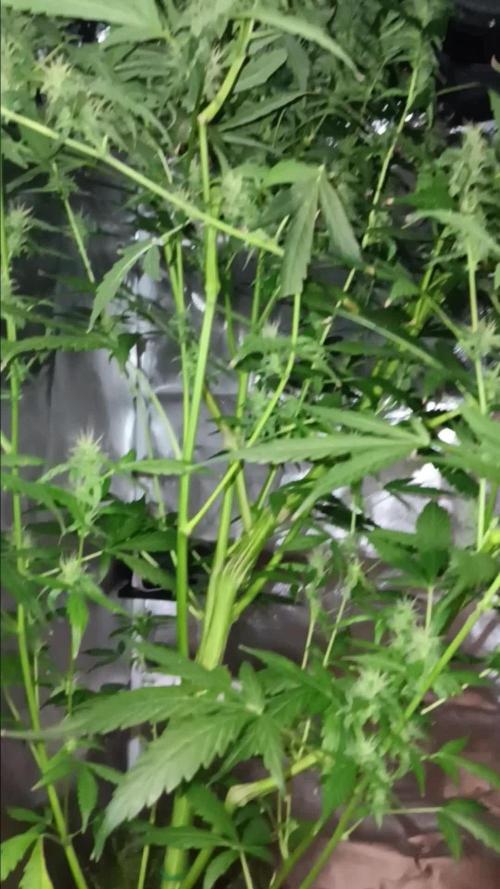
She is the energizer bunny of weed plants. Continues to get larger. Buds finally stacking and smelling so sweet. I am tiring of this grow as she takes up the entire tent and I can't even see the back side.