Likes
Comments
Share
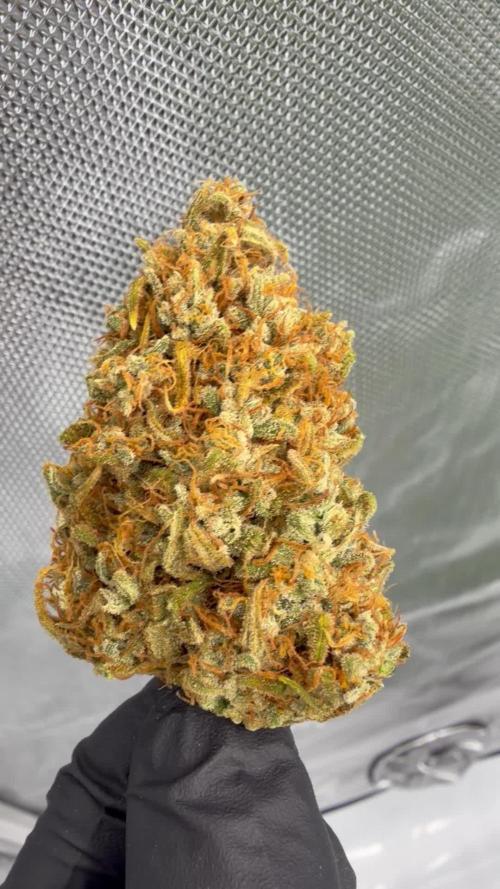
Time to harvest the Gelato. In this run, it turned out to be one of the best-performing strains. The main cola is rock hard and super dense, with the branches bending under the weight. Now it’s time to dry it and see what the final result will be. Cheers!
Likes
9
Share
Week 11 for Black Lebanon by SSSC Growth wise i don't feel that she's growing very much only thing i really notice from the pics is she might be filling in a little. Last week was another hot hot week but we are coming down to the low 30's again for the rest of the upcoming week so think the plants will be happier. I wish the growing area wasn't so sheltered to wind as i feel like these bigger girls would really benefit from it. This week ive tried to water wayyyyy more than i have due to the hot weather, she got 15L some days & 7L other days but nearly everyday.
Likes
57
Share
The cannabis strain Grape Guava can be a purple strain, depending on its specific phenotype and genetic makeup. While not all phenotypes of Grape Guava are purple, some variations, such as the Zatix Grape Guava, are noted for their striking purple appearance due to the genetic expression of anthocyanin pigments. Grand Cru Genetics is a cannabis seed bank that emerged in 2018 from a group of breeders in Madrid to provide a satisfactory experience to all cannabis users. "If we do things, we do them well. Due to our experience in the sector and our taste for excellence, we know high quality and we seek it in everything we propose and do." "We have a “cultivate without giving up” philosophy that we apply to everything we do. We do not give up, we are friends of change, and we adapt as necessary in a still restricted sector." "We speak relaxed because we know how to relax. We are not intense or preachy; we accept everyone as they are, and we understand that farming is not for everyone. But for those who do, we are here to accompany you. We like to do it and tell it. We are experts in the field because we are the first to do it. We speak from experience and connect with others because we share the passion for cultivation." "Cannabis has the ability to show us a world of possibilities. When you cultivate and live its growth process, you enjoy a path full of emotions and not just the final destination. At Grand Cru we find beauty in small things. We are attentive, observant, detail-oriented and aware of everyday things, and we savor them without rushing." In a garden of green, Grape Guava gleams, With its fruity aroma, enchanting dreams. Clusters of grapes, guava's sweetness ignite, A strain so divine, in purple and white. Euphoria whispers, a lush fruity haze, Grape Guava's embrace, a tranquil daze. Off and away.@1400ppm. The increased CO2 allows plants to thrive at higher temperatures, which in turn necessitates higher humidity to maintain the ideal VPD for healthy growth and transpiration. 80F -5F = 75F LST with 70% RH = 0.72 kPa. Higher temperatures and humidity promote rapid growth, nutrient uptake, and photosynthesis while maintaining a lower stress level. Temperature influences the rate of enzymatic reactions involved in aerobic respiration. Enzymes, such as those involved in glycolysis, the Krebs cycle, and the electron transport chain, work most efficiently at an optimal temperature range. In low temperatures, enzymatic activity will slow down, thus reducing the rate of aerobic respiration. In high temperatures, enzymes can become denatured, thus impairing their function and stopping the process of aerobic respiration. Glucose is the primary fuel for aerobic respiration. The rate of aerobic respiration increases with the availability of glucose, as it is the starting point for glycolysis. If glucose levels are low, cells may rely on alternative energy sources such as fatty acids or amino acids , but these processes may yield less ATP or be less efficient. To determine this effect, carbon dioxide volume was measured (as carbon dioxide is an output of aerobic respiration) 18/6 with the 6 being IR. The near infrared (IR-a) borders around 700nm up to 1400nm @ photon par flux density of 1.8 instead of darkness, keeping temps overnight a neat 77F-80F. I think of my tent as a lung. What goes in must come out. When the rate of air going out exceeds the amount of air coming in, it creates a negative pressure. Tent concaves (bends in). If set up correctly, the RH will begin to drop slowly to the desired level I set, and the extraction turns off when it reaches the desired RH. The plant, as it performs cellular respiration, will always release more water into the air; therefore, the RH% of the tent overnight will increase, as long as oxidative phosphorylation is occurring. As soon as the RH% creeps back up to 55%, the extraction turns back on, over and over. This creates a strong pressure differential, which will work wonders with mass flow. Replicating high and low-pressure fronts in nature. Critical for oxygen diffusion at the critical time of peak cellular respiratory function.. Moisture will not transfer from a saturated atmosphere to another if that air is already at or above its saturation point, meaning the air can't hold any more water vapor. Once I understood that water is produced as a by product during cellular respiration, specifically at the very end of the electron transport chain (ETC) where electrons are finally transferred to molecular oxygen, the higher the RH of the air, the more resistance there is for more moisture to be added to that environment, and effects the ease with which it does so. But none of that water comes from the pot; it's pulled from the air. If you run high daytime RH, your medium/pot is 100% reliant on transpirational root pull to move water. ZERO evaporation happens across the atmosphere if the tent air has high RH%, the medium cannot release its water through evaporation. Once a canopy develops, light no longer slowly wicks and evaporates from the topsoil. The Soil-Plant-Atmosphere Continuum (SPAC) describes the continuous pathway and process of water movement, driven by a gradient in water potential, from the soil, through the plant's roots, stem, and leaves, and finally evaporating into the atmosphere through transpiration. There is evaporation, there is transpiration, and then there is evapotranspiration; Evapotranspiration (ET) is the combined total of two processes: evaporation (water lost directly from soil and surface water into the atmosphere) and transpiration (water released from plants to the atmosphere through their leaves). Evapotranspiration represents the total amount of water that moves from the medium into the air. There is no such thing as a medium with too much water, only a medium that retains too much for too long. The water must always flow efficiently from one atmosphere(Medium) to another(Air) in a timely manner. Moisture is a critical factor for bacterial growth and decay. Dictating how long it's allowed to sit in any one location for any given period is a key preferred control. To ensure a net reduction in a bacterial population, the rate of removal (ET) must exceed the rate of bacterial growth (decay rate), which is often modeled as a growth rate for the specific bacterium under the given conditions. By optimizing daytime VPD, we also optimize conditions for bacterial growth to explode exponentially above 77°F.. If water is allowed to sit in a medium without an escape within a timeframe, nothing good will happen. IF High RH is maintained overnight as well as during the day, placing 100% of water movement at the behest of daytime transpiration, roots can only pull where they can reach, and if soil is compressed above a certain point, moisture will become trapped in a medium with no way of moving day or night. This will begin the countdown for decay to take hold. When water stagnates in a medium, it loses oxygen, creating anaerobic conditions that foster the growth of harmful microorganisms like bacteria and fungi, which can produce toxins and disease vectors. Thigmomorphogenesis, the process by which plants respond to mechanical stimuli like touch by altering their growth and development, results in significant morphological changes to improve survival against mechanical perturbations. This complex response involves sensing touch and initiating physiological and genetic responses, leading to changes in form and structure over days or weeks. The process is triggered by physical forces such as wind, rain, or touch. Plants adapt to these stimuli by changing their shape and structure, which may include slower growth, thickened stems, or altered leaf development. Plants possess sophisticated mechanisms to detect even subtle mechanical stimuli and initiate responses. A variety of molecules, including calcium ions, jasmonates, ethylene, and nitric oxide, are involved in signaling these mechanical inputs. Touch can induce the expression of genes that encode proteins for calcium sensing, cell wall modification, and defense mechanisms. A plant exposed to constant wind may become shorter and sturdier. A plant that is touched frequently might grow more slowly to conserve energy and develop thicker cell walls. These changes increase a plant's resilience and ability to survive in harsh environments. Let's get Thiggy with it.
Likes
5
Share
📆 Semana 9 El cultivo entra en su fase pre-final, con los cogollos prácticamente formados y alcanzando un alto nivel de dureza y peso. La compactación es muy notable en toda la canopia, mientras los cálices terminan de hincharse, aportando ese último empuje antes del cierre definitivo. La resina sigue aumentando y cubre completamente las flores, con tricomas mayoritariamente lechosos y una presencia de ámbar aún moderada, indicando que la maduración está avanzada pero todavía con un pequeño margen antes del punto óptimo de corte. La planta comienza a reducir ligeramente su actividad, manteniendo aún una buena absorción, pero enfocándose ya en afinar calidad, densidad y expresión aromática. El aroma se intensifica y se vuelve más profundo y definido, mostrando ya gran parte de su perfil final, aunque aún puede evolucionar un poco más. Seguimos creciendo fuerte 💪!
Processing
Likes
4
Share
Week 6. Installed a individual sog for this single plant. Is only one so lets get the more of it. The buds are starting to multiple very fast.
Likes
18
Share
I don’t think I ever had white powdery mildew and I was just noid of every little dust particle that came around. All good. I’m now battling high temps as we don’t have central air and it’s mid 90s outside. Most likely about to buy an ac unit. LST seemed to go ok but we shall see. Overall very pleased w my results so far. Cheers
Likes
9
Share
@RunWithIt
Follow
Don't mind the additional plants, they'll be joining along but won't be a focus in this journal. By this point, all of the plants are really upping their drinking frequency. I can tell by next week, I'll be watering every day. Seriously loving this pairing of nutrients together. A huge note to make though, is little pistils are popping up everywhere now! It'll be two weeks - max - before we are in flower! The health of all of these girls really makes the transition, that much more exciting! Got 4 really similar plants and 2 uniques to fill in the gap. My headcanon is treating all of these Ethos plants as rare items - like in a videogame 😂. Given how expensive these genetics are, it's kind of true lmao. One relevant footnote I wanted to make was that the Banana Dad Photo seems to have far thicker fan leaves than the autoflower counterparts at this stage. You can see it quite prevalently in the overview photo for the week. Tucking the autos has been very painless, and an emergency defol.(to get light where it needs to be) doesn't seem to bring any drawbacks. The photo seems to be recovering still from removing one of the main fan leaves about a week ago. Visually, she seems a bit behind the Banana Dad auto I refer to as BR, just with larger fan leaves. Either way, I'm sure they'll stretch a decent amount within the next two weeks. I also raised the light up a bit more, to hopefully encourage just a bit more vertical growth during the trans. stretch. Day 44 from seed update: All of the girls look great! As a matter of fact, there are actual buds now! And it may be hard to see, but there's a slight blue-ish hue appearing on the older fan leaves - A similar thing happened to my Early Lemon Berry just before she went completely purple/magenta. I'm also welcomed to a sweet grape scent now every time I open the tent, really pleasant. Things are going quite smooth during transition, within the next two weeks, I'll be removing XSD from the schedule(recommended according to Labmor). Then it will just be BSM and Liquid Seaweed until it's time to give em' the chop! Cheers all! Excited for what's to come. Stay safe & blessed!😄😷🙌
Likes
35
Share
@BUZIMAN
Follow
I will start rinsing, I think they’re ready in a week or two ☮️😎
Likes
21
Share
Info: Unfortunately, I had to find out that my account is used for fake pages in social media. I am only active here on growdiaries. I am not on facebook instagram twitter etc All accounts except this one are fake. Have fun with the update. Flowering day 68 since time change to 12/12 h. Hey everyone ☺️. Today the time has finally come and the last week of flowering has begun 😍. She looks beautiful and her buds smell very tasty 👍. The trichomes are 70% milky and 30% amber. The lady comes in complete darkness for 48 hours before the harvest. Of course, as always, there will be a small interim update of the harvest before the last major update. Until then, I wish you all a lot of fun and stay healthy 👍🙏🏻 You can buy this Strain at https://www.amsterdamgenetics.com/product/kosher-tangie-kush/ Type: Kosher Tangie Kush ☝️🏼 Genetics: Kosher Kush X Tangie 👍 Vega lamp: 2 x Todogrow Led Quantum Board 100 W 💡 Bloom Lamp : 2 x Todogrow Led Cxb 3590 COB 3500 K 205W 💡💡☝️🏼 Soil : Canna Coco Professional + ☝️🏼 Fertilizer: Green House Powder Feeding ☝️🏼🌱 Water: Osmosis water mixed with normal water (24 hours stale that the chlorine evaporates) to 0.2 EC. Add Cal / Mag to 0.4 Ec Ph with Organic Ph - to 5.5 - 5.8 .
Likes
5
Share
Day 70. So frosty and stinky but I can’t smell because my face is rebelling at me. My sinuses 😂🤦‍♀️🏻 She’s will be hopefully swelling more before her flush out. I’m excited to see her in her full glory.
Likes
5
Share
Week 9 commence flushing. This lady is looking great, super frosty, sticky and got a sweet aroma. Removed some dying leaves and now we wait for chop in about 6-7 days.
Likes
70
Share
All feeds with nutes use either a whole ratio or combination of "Veg Mix" and "Bloom Mix"concentrates DILUTED in water until a total ppm of add in is reached using a (Total Dissolved Solids)TDS Meter measured in PPM (parts per million). The "Veg Mix" concentrate will eventually be added in smaller ratios and "Bloom Mix" concentrate what will eventually replace the "Veg Mix" concentrate entirely with the ppm and ratios listed when I feed. Veg mix recipe is on week 3. Bloom Mix recipe is on week 5. Day 70/0 Flipped to 12/12 - increased ppfd by 100 and worked to stabilize temps/humidity with new gear. I used 15 minutes of IR light before main lights and then 30 minutes of UV light at mid day and will still use 15 minutes of IR light after main light are out. I plan to increase the time of UV lights to a max of 2.5 hours per day mid day but for now Im easing her into the treatments. Watered with 1.12 gallons of 6.3ph de-chlorinated tap water, used 50ppm of veg mix and 50ppm of bloom mix in the water. VPD is mostly steady 74F/65%RH/33%ILV Day 71/1 tested and calibrated my meter, tested the top soil 1 day after feed for ph - tested 4 times for an avg of 6.48 Trimmed brown leaves and did some HST/LST training/binding. Took control pics for UV treatments of 15 minutes per day. Will monitor and increase weekly it she holds up okay. Still doin 15 minutes of IR light before and after lights on/off. PPFD after training was 630 at highest and 540 lowest. VPD was 74F/60%RH/33%ILV Day 72/2 Just a watch today, VPD was 75F/60%RH/setting 4/10 of ILV (about 33% like the last tent) PPFD ranged from 530 to 650. I only used 5 minutes of UV light today as she has a tinge of browning on the tips of a few leaves. Im not cutting it out completely because I still plan to use upto 2.5 hrs by end of flower, so she needs to adjust. Im also still using 15 minutes of IR before and after main light schedule. Her stretch seems to be picking up, from 16 inches 2 days ago to 18 today. Day 73/3 VPD same as yesterday 75F/60%RH/40%ILV PPFD hit 670 at highest and 550 at lowest. Stayed with 5 minutes of UV light and monitored burnt tips from previous days... no spread, so I may add 5 more minutes tomorrow and monitor. 15 minutes of IR before/after main light schedule. Growth continues, another inch in stretch to 19 inches. I turned her slightly because there are still two runted colas that I rather provide more light to. It's been 3 days since last feed and I think with as much growth as she's putting on, I should feed again tomorrow. Im still introducing nutes in lower portions but will add 300ppm and feed about 2 gallons at a 25/75 ratio of veg:bloom mix to see if I can get some run off to measure conditions. Day 74/4 Watered with 2 gallons of 6.4 ph de-chlorinated tap water. I added 300ppm total of 25% Veg/75% Bloom. Starting ppm was 296; ending was 595 and I added a pinch of epsom salt. Poured over the whole base until I got runoff - Since I was so close to the whole 2 gallons, I used it all. I only used the feed water over the roots today as I want her to get the nutes from the soil since the transfer into new soil was so recent. So far VPD is 75F/60%RH/40%ILV. No issues with controls. PPFD was upto 700 at center so I raised the lights to almost 42" from soil - Since the plant is almost 20" that's 22" leaves to light. New PPFD now ranges at 480 to 650 on 70% power. I increased UV time to 10minutes today and took control pics for light burn. I am still using 15 IR before and after main lights. Took some black back picks since I think she's looking good now. Day 75/5 Started the day with evaluation of ph and control pics. Comparisons show no further spread of lock out issues from earlier or light burn of a more recent change. Upto 20 inches before HST/LST today. Meter was tested/calibrated and soil ph was tested 4 times for avg of 6.34 (yesterday's runoff was about 6.35 too) Soil temp is about 66F. Also tested CO2 and got 1050. Room VPD was 74F/60%RH/30%ILV I spread the leaves further apart because I noticed there were two colas not getting as much light and somewhat crowded by the colas near by. So I positioned the larger part of the tomato ring around the limbs extending here out to 32x32 and the used HST/LST to break and bend the center colas inward clockwise (I think I went a bit too hard on one as the others already show a bounce back and now one is still limp-ish (will monitor obviously) But with that the height is now 18" so 32x32x18 - but here's the kicker, I only have a 24x48 tent, so there's a few colas touching the walls and doorway now, so I may have to reconsider the larger ring. New position, new PPFD right?, not exactly, for some reason these settings still gave me range of 480 to 650 as I had yesterday with just a few more of the outer colas have 480 than yesterday. However, there's more light getting lower levels now and I only had to cut 1 leaf. Which is good because I did 15 minutes of UV today with the regular 15 minutes of IR before and after main lights. Day 76/6 VPD is a lil wonky now as humidity is starting to go up in the tent - so I plan to put in the dehumidifier this weekend and just leaving the humidifier off today and tomorrow. Heat seems to also be ticking up - so I reduced the temp on the heater and will monitor. Temps about 75 to 76 - humidity at about 62% as high as 65 though and Im trying to be at or under 60 this week. Increased ILV to 40% I repositioned the fans to hang on the lights while blowing down onto the plant. I tried to make every leaf dance a little. LST seemed to hold up okay - had to reposition a few branches and thinking I may have to build a larger box this weekend since the colas are now pressing the door and back wall. PPFD is between 470 and 700. I used 15 minutes of UV mid day with 15 minutes (30 total) IR before and after main light timers.
Likes
28
Share
@wolfvb
Follow
Week 5: babe this cake been baking for 30 days! Loving this girl so far looking strong and healthy. Will we have a new star ?
Likes
2
Share
@RatmanJR
Follow
November 2nd. 33 days post flip. Nothing crazy this week. Very light defoliation every couple days. At this point I am guaranteed no more defoliation to day 49. Along with this nothing but water this week. Plants should be able to get to the finish line with no added nutrients I’m really happy with bud development so far. They are not the largest yet but they are very very healthy and plentiful. They should really fatten up over these next few weeks. Temps have been running around 82 during the day. Because of this I’ll be adding two more small fans to the tent. One blowing on the medic grow, and one along the bottom of the canopy. I am doing this to ensure these buds stay compact. Both of the clones of the purple marmalades could not be happier. Really happy in their pots growing away slowly. The trick to keeping them small is using small fabric pots so their roots air prune, 24h light to severely limit root development and heavy defoliations whenever they get too happy. At this point in flower it is time to start giving more detailed descriptions of our 3 phenos so here we go. Plant#1(cherry chunks): 27” tall. Musty almost earthy scent. Kinda similar to pine. Weak scent so far. Appears to have the most densely populated Trichomes out of these three plants. Plant #2(Purple Marmalades): 30” tall. Smells absolutely insane. Like this is a terp monster. Very citrusy. Smells exactly like grapefruit. Very high concentration of valencene. Extremely strong scent. Also appears this one will have the largest buds of the three but only time can tell here. This one is my favorite one so far Plant #3(Purple Marmalade): 28” tall. Light scent of pepper mixed with a tiny bit of lemon. This one is the least exciting so far but only time will tell how it will turn out. As always guys. Thank you for following along and reading my updates. It’s a pleasure growing with you guys. God bless!
Likes
5
Share
@EKWCR
Follow
I was happy when i've seen the weight, i expected 70 or 80 grams and it's the double. I'm not sure if i will grow this strain again soon, there is plenty of strain waiting to grow.
Likes
12
Share
Aug 2: Mimosa Shot is hitting her stride now. She didn’t like the cooler temperatures as much as Sunday Punch EV, for example, but she’s loving this hot start to August. Aug 3: done with force flowering and will now just leave her in the yard. So, back up to 15.5 h of daylight here now. Still using far red light at dusk. Aug 6: Mimosa Shot has stretched again, likely mostly due to 3 days of hot weather.
Likes
13
Share
My Ladies definitely love their new Homes 👌🏼 now the BioTab is activated, i guess. Have a better Plan how to water them
Likes
6
Share
WEEK 3: The plants are now in the second week of the growth phase. I topped all three plants on the main stem and cut off the 4 largest top leaves so that the side shoots have more light available. Plant #1 is clearly the smallest and is not as developed as the other two. Since I only want to take two plants into the flowering phase, I tend to sort them out. Plant #2 looks the most vital and has already developed a noticeable smell. Plant #3 still has a strange leaf shape, although I have the impression that this has improved slightly The plants in 6L pots and added 5% FLO (Living Soil Fertilizer). I let the soil develop for 14 days beforehand. Clear mycelia have formed and the soil has a very pleasant forest floor smell. - Light Power: 40% - Soil: BioBizz Light Mix + 5% FLO (Living Soil Fertilizer) - Additives: Dynomyco mycorrhiza granules
Likes
4
Share
Repotted in definitive pot. Gonna top those in the next days. Something I learned: water on the edge of the pot, as roots extends as much as possibile.