


Likes
Comments
Share

@Ganjin
Follow
The review is finally there. I structured it in a new way. 4 categories, all count equally for the final rating. Growth, buds, taste and high. That are the only categories that matter for me. It was a funny journey and I learned a lot. The nutrients from BioTabs are absolutely amazing an I am very glad that I can work with them in future grows. I had no issues when it comes to the nutrients and the resulting product is top notch. Was a very easy process too. I am a huge fan of dry amendments now and will continue with BioTabs.
The yield of this strain or this particular pheno is out of this world. Because of the stretch I only was able to run the lights at 70 % which is approximately 70 W. In the VGrow with a grow area of 0.16 m². And I pulled exactly 100 g dry buds out of it. That's a wopping 142,9 g/W or 625 g/m². Insane. These Jet Fuel Gelato crosses from Compound are insane yielders, if you're looking for a lot of stank per grow, this is a legit breeding line for that. But be wary of stretch.
For my next grow I chose a breeder that I have already covered. I am still in the search for real dessert terps because I want to build up my palate. For that, one needs to taste every kind of weed and since I am really intrigued by sweet, creamy and spicy smells as well as tastes, this is the logical next step. The new seed is already popped, which means the new diary will start soon!
Thanks for hanging around and sharing this truly beautiful (would even say the very best) hobby. I cannot wait for the next grow season!
See you soon 🌱💚

Likes
45
Share


@MadeInGermany
Follow
Info:
Unfortunately, I had to find out that my account is used for fake pages in social media.
I am only active here on growdiaries.
I am not on facebook instagram twitter etc All accounts except this one are fake.
Have fun with the update.
Hey everyone :-)
She becomes a beautiful bush.
It was poured twice a week with 1.2 l and once with 1 g enhancer per l coco.
Furthermore, I continued to train her with topping because this time I want a real bush :-).
Have fun and stay healthy 👍
You can buy this Strain and Nutrients at :
https://greenhouseseeds.nl/
☝️🏼☝️🏼☝️🏼☝️🏼☝️🏼☝️🏼☝️🏼☝️🏼☝️🏼☝️🏼☝️🏼☝️🏼
Green House Seeds Company Cup Clone 🏆
Type:
Wonder Pie
☝️🏼
Genetics:
Wedding Cake x OG Kush
👍😍
Vega lamp: 2 x Todogrow Led
Quantum Board 100 W
💡
Flower Lamp : 2 x Todogrow Led
Cxb 3590 COB 3500 K 205 W
💡💡☝️🏼
Earth: Canna Coco
☝️🏼
Fertilizer: Bio Grow Feeding ( GHSC ) , Enhancer ( GHSC ) , Bio Bloom ( GHSC)
☝️🏼🌱
Water: Osmosis water mixed with normal water (24 hours stale that the chlorine evaporates) to 0.2 EC. Add Cal / Mag to 0.4 Ec Ph with Organic Ph - to 5.8

Likes
10
Share


@Thehill420
Follow
The fade is nice for the flowers colors they all have hues of purple but the b


Likes
64
Share


@Roberts
Follow
Baked bomb auto is doing good this week. She has not shown any pistils yet. I imagine they are not far off. She looks like she is starting a stretching stage. She loves extra cal mag as well. She got a decent defoliation to open her up. She is ready for another week. Thank you Bomb seeds. 🤜🏻🤛🏻🌱🌱🌱
Thank you grow diaries community for the 👇likes👇, follows, comments, and subscriptions on my YouTube channel👇. ❄️🌱🍻
Happy Growing 🌱🌱🌱
https://youtube.com/channel/UCAhN7yRzWLpcaRHhMIQ7X4g

Likes
105
Share


@Green_Friends_Inc
Follow
Commencing week 3/Day 15 on November 7th*
My 🍋 🍰 (Lemon Cake) & 🌻💣 (Flower Bomb) cross stock/stash has been transferred into foam cups with Pro-Mix. Light water with spring water and misting and they look like happy babies under the same lights in my parlor/living room they have been under since being sown.
After transplanting the personal stock; I moved the germination tray and dome along with the remaining GZs, BHs, 818s, and RD into the basement aka 'grow area' to acclimate: as this will be their new home. This basement is my hydroponic grow area and has a much lower ambient temperature - which is great for flowering - but can be tricky with vegging depending on how this winter 2018 treats us New Englanders. We shall see. Also the humidity is harder to control but I believe this year I am better prepared to manage optimally.
So now in order to follow along I must explain this. I have separated the seeds doc from my own and the feminized ones I have paid for. The stats reflected in the diary that you will now see Will Follow the hydro setup but I will continue to explain in the comment section the soil grow up stairs stats.
Day 15 my personal stock will remain upstairs underneath the 600 watt umbrella Hood that is dialed down to 250 Watts. (Which is shared with house plants). The lighting shedule here is 12/12. the intention here is to basically treat them as houseplants and be happy with whatever I get while I take note of phenotype variation and maybe hopefully I'll find a keeper or two 😄
They are now in one quart size foam cups of Pro-mix. the ambient temperature is 75 degrees and the humidity stays around 55.
Day 15 my paid for/professionally bred seedlings were acclimated to their new environment in the basement for a little while and then transplanted into their new outfits: 3.5 gallon deep water culture (DWC) buckets with 6 inch net pots, lava rock medium and regular 2 inch airstones. These plants are under a predominantly T5 lighting with the exception of two being under T5 and a diamond series LED with flowering Spectrum turned completely off and vegging Spectrum dial down to only 50 Watts. The lighting plan here is to keep them under 24 hours for just a few days.
Day18 the Gorillaz are beastly little things. They are growing the fastest and largest. The Boss and the Raspberry are close behind the GZ and tied for second place. The 818's still seem to be runt-like. Otherwise all in the hydro looks healthy. Also last night I put timers on so the plants are getting 16/8 (in the form of 8hrs on followed by 4hrs off. This happens 2x per 24hr day. Reason being that I've read the rate of photosynthesis peaks at 6hrs and then descends) lastly I've been PHing daily down stairs only making minor adjustments and keeping the PPM between 550-600 ppms
Day18 the Parlor stock is still doing well also. I've noticed this so far as differences:. The leafs are smaller and darker then the basement strains. And there seems to be more stem growth, or maybe stretch. Otherwise these plants are rivals the others in size. Except for the 2 🍋 🍰 seedling that popped open almost a week after the others.
Day 21Nov21 - the PH is staying nice around 5.8 for 3 days now with no minor adjustments.
Removed all mini plant stakes (ie paperclips etc lol), little baby seedlings no longer need help staying propped up.
Root hairs are poking out in every direction of Root Riot cubes, (see video) excited because once those roots hit the waterrrrrrrr 💣boom explosive growth!
As far as growth goes all three GZ still in lead. I might even have one early starting purple💜 🦍 baby (see pic of GZ2 DAY 21)
*This is day 15 from seeds being sown on Oct 22nd, not popped open and or tap root showing etc.


Likes
2
Share


@KeemBboomin
Follow
As you can see, these girls are looking good they are growing and you may see more than you know of. I got one from a buddy who said he did not know what he was doing after about a month and a half so I said give her here I’ll take her.
Likes
2
Share


@PrinceOfHerbs
Follow
The plants are growing very well and the flowers and resin are now clearly visible.
The Strawberry Gorilla is already slightly purple in color.
Likes
12
Share


@Alluvionated
Follow
They're surviving, and the flowers are perfects, only the plant is suffering now, but I think that the bio-bloom will do his work. We noticed some peaks where mold had developed, due to the very high humidity of the last few days, so we removed the infected part.

Likes
6
Share


@Hoodoo
Follow
The first picture day 44! Well, we've finally got the purple colours coming in very strongly! Even the fan leaves are turning purple. The progression of the pigment looks like a pathogen has taken over but it's just the cool genetics of this plant. Smell is increasing, they have a very sweet odor so far when crushing the flowers. Still nowhere near harvest but the buds and calyxes are starting to stack. Very exciting that I got this one to grow!


Likes
1
Share


@LAShugars
Follow
She has turned into a beautiful plant. Very wide and bushy. Lots of tops,smells piney with some funk
Smells like Lysol
Her buds arent huge but seem like the are going to be dense
Likes
1
Share


@Ultraviolet_
Follow
Turned off IR @ nights
Red wigglers (Eisenia fetida) are highly beneficial. They are considered an ideal choice for "no-till" or container-based organic growing because they live in the upper layers of soil, feeding on organic mulch rather than the plant's root system. Red wigglers accelerate the breakdown of organic amendments and produce high-quality, nutrient-dense worm castings directly in the root zone. Clover is another exceptional component of an organic rhizosphere, offering a sustainable, self-sustaining alternative to synthetic nitrogen fertilizers produced via the energy-intensive Haber-Bosch process. By forming a symbiotic relationship with Rhizobia bacteria, clover converts atmospheric nitrogen N2 into ammonium NH4, providing a steady, slow-release nutrient source that enhances soil health and reduces environmental impacts. Red clover offers superior nitrogen fixation and biomass production compared to white or yellow clover, making it the premier choice for maximum soil vitality, particularly for improving soil structure and providing a high-volume nitrogen credit for subsequent crops.
If it is fully functional and efficient soil, the rhizophagy cycle is far superior long-term than any synthetic delivery when it comes to preventing deficiencies, not because it's "better," per se. The medium will require a very high CEC to make it to harvest without re-fertilization. The rhizosphere acts as a dynamic, interactive exchange where plants and soil microbes trade resources based on immediate needs. When a plant lacks a specific nutrient, it changes its physiology and releases specialized chemical cocktails—root exudates—into the surrounding soil. These exudates, which include sugars, amino acids, and organic acids, serve as a "shopping list" to attract specific microorganisms, which in turn return higher levels of desired nutrients. There is nothing in comparison to synthetic delivery, which causes plants to stop producing exudates, effectively "starving" the beneficial soil life, over time turning the soil barren and void of microbial life. Responsible use, applying the right amount at the right time, can minimize these negative effects. Relying solely on synthetic fertilizers without replenishing organic matter is what typically leads to exhausted soil. The use of synthetic fertilizers can utilize the Cation Exchange Capacity (CEC) of the soil, but without a robust rhizosphere and active microorganisms, the efficiency of this process is significantly reduced. This makes synthetic growing more difficult to prevent deficiencies overall compared to an efficient organic living soil with a robust rhizophagy cycle, as there is no "one size, fits all" when it comes to different nutrient profiles of strains/genetics, making it trickier to "guess" and prevent creeping deficiencies.
CEC does not contribute towards EC. Add more CEC using biochar, problem solved. If you keep pH between 6.3 and 6.7, hydrogen is exudated to cycle the medium's CEC for its needs. Keeping the pH between 6.3 and 6.7 creates an environment where plants release H+ to displace positively charged nutrients (like Ca2+, Mg2+, K+ held on soil particles or within artificial media this cycle through nutrients via the medium's Cation Exchange Capacity (CEC)
Microorganisms generate a stable potential of approximately 0.5 V EC. The rhizosphere creates its own food, similarly to chelation, using 1000's of varying combinations to create its own food.
Start to finish, just add water. Eventually, more materials will need to be added at the beginning of each new grow, but very attainable to go from seed to harvest without ever fertilizing, regenerative cultivation.
ATP is king above all else when it comes to biomass accumulation. Cellular root respiration and cellular respiration are essentially the same biological process, the breakdown of glucose to create usable energy (ATP) in the presence of oxygen, just taking place in different parts of the plant. Synthetic (salt-based) grows have significantly lower levels of total rhizosphere respiration, often referred to as root-zone activity, compared to organic living soil grows. While the plant roots themselves may respire in both systems, the surrounding soil ecosystem in a living soil setup is vastly more active, teeming with bacteria, fungi, and beneficial microorganisms.
2 pools of ATP, it won't double in growth buuuut, but improving root respiration by ensuring high oxygen in the soil is crucial. Good aeration ensures roots can fully utilize glucose to generate the ATP necessary for nutrient uptake, leading to healthier and more productive plants, even if growth isn't exactly doubled. The ATP created using root respiration is dedicated to rootzone growth; the ATP created using regular cellular respiration in a synthetic system would have to dedicate a lot of ATP to the roots when there is little or no root respiration. It's true that there is less of an initial ATP cost in breakdown when nutrients are already in their final form (synthetic), but you lose a solid chunk of ATP when the entire plant is reliant on cellular respiration alone; a large portion of ATP is dedicated to root zones for "forced" (active) nutrient uptake. Making it overall less efficient, even if the initial cost of breakdown is higher. If that makes sense. Oxygen is of critical importance when growing in living soil compared to synthetic methods because it supports the metabolic needs of the microbial, fungal, and insect ecosystem, rather than just the root respiration required by the plant itself. While synthetic grows can survive in lower-oxygen environments with precise mineral feeding, living soil systems rely on aerobic microbes to decompose organic matter (microbial mineralization) to create plant-available nutrients, which is an oxygen-intensive process. While a specific fair percentage is difficult to guess, my experience points to a massive, compound difference between the two methods and the amount of oxygen required. All the ATP spared is used on more biomass, not only that, but the extra root respiration can achieve a much higher CO2 compensation point naturally than you could with synthetic and atmospheric CO2 alone.
As a plant grows faster and increases in size, its demand for nutrients to support that growth increases, requiring a higher rate of nutrient uptake. As plants enter phases of rapid vegetative/floral growth, their metabolic demand for nutrients increases exponentially. Without a robust buffer zone—whether in the soil (cation exchange capacity) or in a hydroponic reservoir—deficiencies will occur rapidly because the instantaneous demand for specific nutrients can quickly exceed the rate of supply.
A growing body of evidence suggests that organic living soil provides superior long-term soil health and environmental benefits compared to synthetic fertilizers, which are often criticized for promoting a cycle of dependency and degradation. While synthetic fertilizers offer short-term convenience and high yields, they often come at the expense of long-term soil health, sustainability, and increased corporate control over growers/ farmers. Organic living soil, while slower and requiring more care to establish, creates a sustainable, resilient, and, ultimately, more fertile environment.
We don't grow; we facilitate energy conversions.
Once all water is removed, approximately 95% to 97% of a plant’s dry matter consists of carbon, oxygen, and hydrogen. These three elements form the structural backbone of all plants. Corporate interest sells you the other 3-5% NPK & all the rest in RATIOS! Why not throw the 3-5% in a pot, and focus your energy on the other 95-97%?
Indigenous Amazonians created, or at least significantly enhanced, the fertile, dark soil known as Terra Preta de Índio (Portuguese for "Indian Black Earth") by incorporating biochar and other organic materials into the soil. This anthropogenic (human-made) soil technique, which dates back roughly 2,500 to 8,000 years, allowed ancient civilizations to flourish in regions with naturally poor, acidic, and nutrient-poor tropical soils.


Likes
27
Share


@adam_pawloski87
Follow
Over all was an amazing grow, super sticky dense nugs with smell of berries, highly recommended for everyone!!
Likes
33
Share


@BudXs
Follow
Low low low humidity is causing the plants to grow slowly, albeit healthily. Nothing to report other than friends dont let friends smoke CBD
Likes
2
Share


@Susquihanna
Follow
So, my "Skunk" puppies are always curious to see what I am doing when I am gardening. They are mischievous and would destroy my plants if I didn't have a fence around them.
Miss Skunk grew 4 inches this week! And my two new branches grew a lot, too. I took a picture of my hand behind one of the lateral growths. I think it is doing very well. They grew about 1 inch this week.
I started nutrients this week.

Likes
294
Share


@StarLorr
Follow
Welcome to my Ðivine ØG Ķush diary.
In this diary:
Seeds: sponsored by Ðivine Șeeds
Media: Promix HP
Nutrients: Advanced Nutrients, Diablo Nutrients.
Light and Weather: Şun☀️and Mother Earth.🌎
___________________________
Feeding:
Mon 03Jun: 2L water not pH'd in bottom saucer only.
Tue 04Jun: 2L water not pH'd in bottom saucer only.
Wed 05Jun: 4L nutrients pH'd 6.5
Fri 07Jun: 2L water not pH'd in bottom saucer only.
Mon 10Jun: 2 L water not pH'd in bottom saucer only.
___________________________
We had very warm weather and by the end of the week rain pouring.
Did spray the girls with Safers insecticide after sunset for good measure after discovering spider mites nests on june 3rd.
___________________________
Thanks for stopping by, likes and comments are appreciated!👊🏻😎
Keep on growin!
Keep on tokin!!!
😙💨💨💨💨💨

Likes
126
Share


@nonick123
Follow
Día 42 (27/02). Riego 1,25 Litro H20 + Wholly Base 2,5 ml/l + Solid Green 1,5 ml/l + Rise Up 0,5 ml/l de Gen1:11
TDS 898 PPMs - pH 6,5 (mínimo ajuste con pH+ para subirlo desde 6,2)
Plantas sedientas con un intervalo de riego cada 4 días. A partir de ahora regaré cada 3 días
Día 43 (28/02) Las ramas crecen muy rápido y se van colocando para recibir el máximo posible de luz. Es impresionante su evolución día a día!
Día 44 (29/02) Han crecido 17 cm desde que cambié a 12/12. Alucinante! 😍😍😍
Día 45 (01/03) Riego 1,25 Litro H20 + Wholly Base 2,5 ml/l + Solid Green 1,5 ml/l + Rise Up 0,5 ml/l de Gen1:11
TDS 891 PPMs - pH 6,25
Añado un poco de substrato al top y a los bordes de la maceta antes de regar, porque se ha compactado ligeramente.
Día 46 (02/03). Las plantas siguen su crecimiento imparable. 3 cm al día 😍
💦Nutrients by Gen1:11 - www.genoneeleven.com
🌱Substrate PRO-MIX HP BACILLUS + MYCORRHIZAE - www.pthorticulture.com/en/products/pro-mix-hp-biostimulant-plus-mycorrhizae
🎚️Controlled by TrolMaster TCS-1 Tent-X System Main Controller - https://www.trolmaster.com/Products/Details/TCS-1
Likes
18
Share


@Silverback_Guerilla
Follow
I thought I just had two of this strain, but it turns out that the 134g plant was actually a C4 hybrid!
It isn't as pungent smelling as the others, but seems to have it's own unique flavor going on. I like it!
115g - C4ndycaine [Candy Cane x C4]
134g - C4ndycaine [Candy Cane x C4]
151g - C4ndycaine [Candy Cane x C4]
TOTAL: 400g 👍
Likes
20
Share

@ThatsmyGrow
Follow
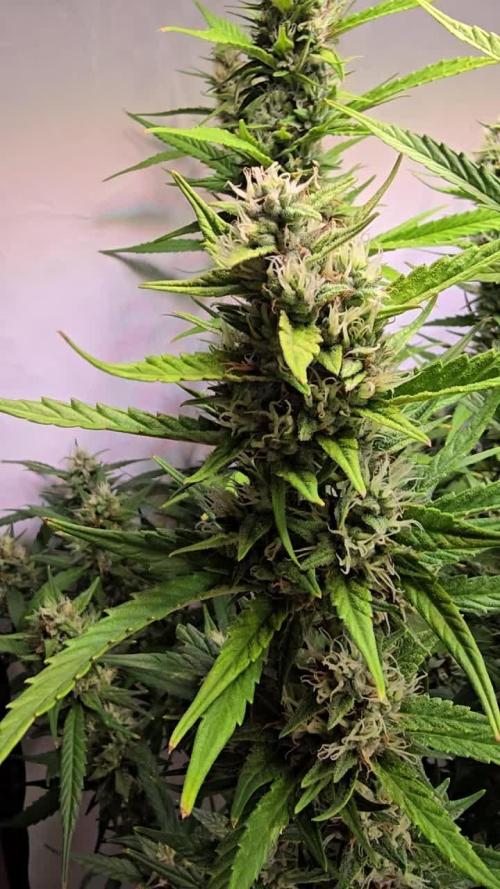
🌸 Week 11 – Gorilla Cookies Auto Pheno Hunt
Another week is in the books, and now all the phenos have officially entered the bulking phase. 🔥🌸
The flowers are swelling rapidly, and it's amazing to see how differently each phenotype is stacking and filling out. Every week brings more weight, stronger aromas, and denser buds.
📈 Current observations:
All phenos are now focusing entirely on bulking up their flowers.
Pheno #1 and #2 are producing massive buds, with some already reaching the size of soft drink cans. 🥤🔥
Pheno #6 has made incredible progress over the last two weeks. Although it had the slowest start, it has developed beautifully and is building flowers surprisingly well. It will most likely need around two extra weeks after the others and will probably finish the grow on its own.
Pheno #3 unfortunately never fully recovered after I had to remove several main colas because they were growing into the SANlight fixture. While it's still producing nice flowers, it clearly lost some of its potential.
Pheno #4 continues to be my personal favorite. The aroma is absolutely incredible, with a sweet Kush profile, and the buds are becoming rock hard already. 💎
📊 Current environment:
Temperature: 31°C
Relative Humidity: 63%
VPD: ~1.66 kPa
SANlight fixture at maximum height
Light intensity: 90%
⏳ Looking ahead:
If everything continues as expected, I think the first phenos will be ready for harvest in about two weeks. The final stage is always my favorite—watching the buds swell even more, the trichomes mature, and the terpene profiles reach their peak.
I'm excited to see which phenotype finishes on top, but right now Pheno #4 is definitely leading the pack. 👑🔥
💬 Which pheno would you harvest first based on these updates?