


Likes
Comments
Share

@RelaeX
Follow
Week 21: Flower Week 4 – Hesi Goodies, 7000-BTU Chiller & Frosty Tops! 🌸❄️
Week 21 is officially in full swing, and we have entered the glorious territory of Flower Week 4!
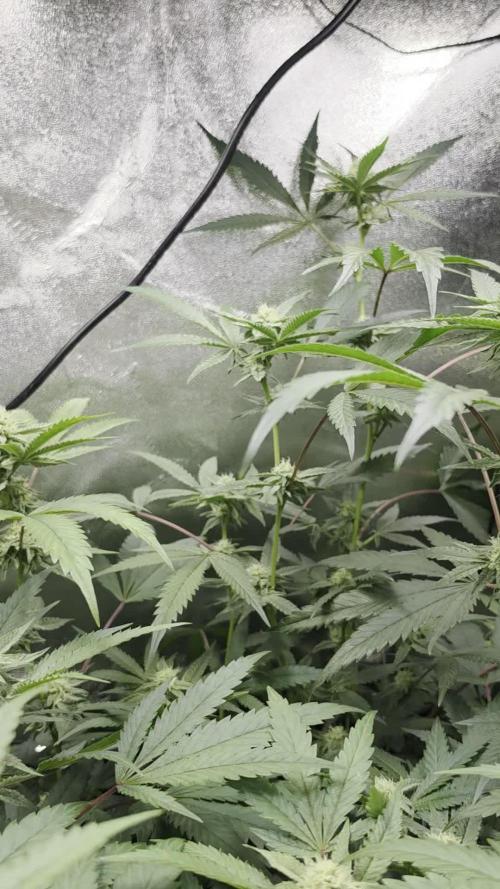
The stretch phase is officially history, meaning the girls have stopped reaching for the stars and are now putting 100% of their willpower into one glorious job: building fat, sticky buds. The view inside the flower tent is pure eye candy—a lush, deep green canopy soaking up every photon from the LED panels while the tops keep bulking up by the day.
Feeding Time: The Hesi Magic Cocktail 💧
To fuel this explosion of green goodness, we switched up the menu according to the official Hesi Schedule for Flower Week 4. The plants are thirsty, and they are getting top-tier nutrition!
* Feeding Schedule & Volume: Twice a week, a fresh batch of 20 liters of nutrient solution gets whipped up and distributed evenly across all 6 pots (roughly 3.3 liters per lucky plant each round).
* The Week 4 Brew (per 20L water):
* Hesi Bloom Complex: 100 ml (50 ml / 10 L) – The foundational fuel.
* Hesi Phosphorus Plus: 25 ml (12.5 ml / 10 L) – Unlocking the PK boost starting right now!
* Hesi Boost: 40 ml (20 ml / 10 L) – Flower accelerator engaged.
* Hesi PowerZyme: 40 ml (20 ml / 10 L) – Keeping the root zone pristine.
* Hesi SuperVit: 4–5 drops (1 drop per 4.5 L) – Pure vitality in a bottle.
* pH Target: Dialed in with a dash of phosphoric acid to sit at a sweet, stable 6.5. Root uptake is running in overdrive!
Bud Check & Tent Vibe 🌿✨
* Chunky Flowers: Every main stem is flexing tight, dense flower formations overflowing with fresh, bright white pistils.
* Let It Snow! ❄️ The trichome factory is officially open for business. A sparkling layer of sticky resin is spreading rapidly across the sugar leaves and calyxes.
* Squeaky Clean Legs (Lollipopping): The lower third of the canopy is completely stripped down. No waste-of-time popcorn buds down below—just smooth airflow through the root zone and zero trapped humidity!
* Level Canopy: Thanks to training, all the main colas are sitting flush at the exact same height, right in the LED sweet spot.
Tech Upgrade & Climate Control 🌡️❄️
* 7000-BTU AC Beast On Duty: With the canopy transpiring like crazy, the new 7000-BTU air conditioner was drafted in to keep the microclimate strictly under control.
* Climate Stats: Temps swung between a comfy ~21°C and a warm 30°C peak. Relative humidity stayed locked in between 55% and 82%.
* Wind Power: Clip fans are blasting right over the canopy level to keep air moving and ensure humidity pockets don't even think about settling in those bulking buds.
The stage is set for some serious density and trichome action over the coming weeks! Let’s grow! 🚀

Likes
35
Share


@Hiroots420
Follow
Esta planta viene de 1 año aproximadamente de cultivo y sigue impresionando como el primer dia, es un aroma que lo quiero tener en mis frascos para momentos especiales.

Likes
22
Share


@SirBudAlotts
Follow
From my previous experience with the outdoor grow.
I decided to put her to the test in an indoor grow setup.
I must say she is looking absolutely plush and green with strong leafs ..
I'm already super excited to see what this grow can produce with the correct training and feeding schedules.

Likes
28
Share


@Chubbs
Follow
420 Fastbuds
FBT2307 Week 5
What up grow fam. Hope everyone's grow are going good. Weekly update for these girls. The 3 of them seem to be growing and progressing well. Not as fast as the others in the tent but over all seem OK. The bigger of the 3 is like the odd one out as it is giving me trouble since sprout being super temperamental. The other two are a bit shorter but overall seem healthy. I did do a molasses tea this past feeding so hopefully that'll feed the microbs in the soil allowing the plant to intake what nutes it needs from a healthy soil. Still spraying once a week of Pure Crop 1 to combat any pest,mold, and promote healthy leaf growth. All in all Happy Growing.
Likes
16
Share


@ButterfliesLittleFarm
Follow
Hello Diary,
The third week of flowering has ended, Cherry Pie is progressing very nicely, which is clearly visible in the photos.
Cherry Pie has almost stopped growing, it has grown a scant 3 cm, which means that that is more or less the height.
72 cm is almost ideal considering the size of the grow box.
The main cola rises high above the other branches, it is completely covered with flowers.
As for the flowers, they are developing nicely, it is still early to make any predictions, but if it continues to develop like this, I will be very happy.
Cherry Pie has also started to smell more intensely, when I open the grow box, the smell is immediately noticeable.
The leaves are a healthy green color, there are no signs of a lack of anything.
Watering has become more frequent, they have become much thirstier.
I have continued to add CalMg and Bio Bloom Fertilizer with each watering.
All in all, I am very pleased with how Cherry Pie is progressing,
I try to provide them with the best possible conditions and the plants return the favor in their own way.
Here is what the past week looked like.
29/08/2024 - Day 36.
Watering.
I prepared 9 liters of water, added CalMg and Bio Bloom Fertiliser and lowered the pH to 6.0.
With that amount of water I watered all three plants on the "Farm".
01/09/2024 - Day 39.
Watering.
I repeated the same procedure as three days earlier.
03/09/2024 - Day 41.
Watering.
Same procedure.
04/09/2024 - Day 42.
End of the 6th week, or the third week of flowering. Photographing and measuring the height of the plants.
Cherry Pie - Day 42. - 72 cm.
That's all from me, see you soon.

Likes
3
Share


@JSanchezz
Follow
Finally harvested after a long back and forth whether too much fertilizer or too little fertilizer, I came to the conclusion that the left ladie was simply ready much earlier, which was probably due to the Co2.
I'm looking forward to the weight and the taste
it will take another 14 or at least 30 days until I know
2nd GROW :)
Thanks to everyone who helped !!!

Likes
59
Share


@Rap_a_cap
Follow
Perfect tropical-like weather. No problems to report. Excellent growth. Still rearranging net tent as this bastard stretch a lot.
The one that should have the fastest flowering is, on the other hand, terribly late compared to het sisters. But how long does this beast still want to grow? Royal Queen Seeds officially claims Pineapple Kush is better suited indoors than outdoors, for now RQS is wrong.
Likes
12
Share


@BrainStorm22
Follow
Nota:
La primers mitad de las imagenes corresponde al principio y la otra mitad al final respectivamente
En esta semana comenzamos a aplicar fertilizantes de engorde y se logro notar una diferencia al aplicar monster bloom el viernes hoy domingo ya se vio una diferencia de tamaño las plantas lucen bien y an empesado a adquirir resina y bellos colores
Martes : solo tek bloom , heavy bud pro (1600 Ec)
Viernes: monster bloom , vitamax , cal mag (800 Ec )
Ph 6.5

Likes
29
Share


@Reaper
Follow
All details will be added every day/week if u have any questions feel free to ask.
December 4th:starting in the winter, veg and bloom will happen under 400watt hps to keep the grow room warm. the seeds have been germinating for 2 days with the wet paper towel technique, they got root and are now in soil and the rockwool cube.
for now im just waiting for the seeds to show root coming out of the rockwool, then i transplant to the netpot with clay pellets straight in the dwc, untill then they get fluorescent light (max 7 days)
these are autoflowers so they get 18 or 20 hours light.
nutrients General hydroponics
three part :micro gro bloom
and calmag
water: rainwater (25ppm)
i hope the room wont cool of too much when the lights go out.
Day 1 (December 5)
seeds start to come above the rockwool and the soil
Day 2 (december 6)
stems start to stretch i give them both pure rain water with 100ppm calmag when they feel dry.
Day 4 (december 8)
still no root visible out of the rockwool
Day 5 (december 9)
root visible outside of rockwool cube and transplant to the 55Liter rdwc
air pumps 10l/minute
Day 7 (december 11)
root comes trough netpot, i lowered the water by removing 3Liters
Processing
Likes
10
Share


@Barcelona_Farmers710
Follow
Esta semana transplantamos nuestras plantas en tiestos de 7 litros de tela y un par de ellas en 11 L de maceta de tela. Utilizamos Azos y Mykos siempre para esa etapa con las recomendaciones de la fábrica, este cultivo Probaremos el delta 9 un compuesto de algas marinas. Espero que os guste Farmers!🍁


Likes
52
Share


@jmsky
Follow
Permanent Marker was the last one standing and got the chop at day 75 of flower, nearly 11 weeks. The trichomes were still not very amber anywhere except the top sugar leaves, but it was about 90% milky white, and the leaves were all drying out.
I bagged 36g of larfy buds and trimmings, 20.5g top buds, and 12g small buds. 32g smokable is not bad.
I will update with smoke report in a couple weeks, but initial tests were promising. Strong chemical taste not far off from its namesake, with a KO strength punch.



Likes
14
Share


@Lol_You_Looked
Follow
Feb 7th - pH 6.2, PPM 920, 1.8 EC, Temp 78f, Humidity 57% - Water Changed, 3 gals!
Feb 8th - Unable to get data for this day.
Feb 9th - Unable to get data for this day.
Feb 10th - Unable to get data for this day.
Feb 11th - Unable to get data for this day.
Feb 12th - pH 6.1, PPM 900, 1.8 EC, Temp 82f, Humidity 55% - Water Changed, 3 gals! Followed aggressive week 6 feed schedule, went back on the CalMag to 6ml/gal, and upped Sweet Berry back to 8ml/gal. The bihh is heavy, making it hard to get root shots these days. :(
Feb 13th - Unable to get data for this day.

Likes
3
Share


@mojo1985
Follow
Ja.. die auto moonrock... schönes wuchsbild... wächst fleißig und auch hier keine beanstandung. alles im allem bis jetzt top quali was man bis jetzrt sagen kann von divine seeds... zu empfehlen... ich denke das wird die kommenden wochen so bleiben. schauen wir mal 🙏🙏🙏🙏

Likes
19
Share

@Chubbs
Follow
420Fastbuds
FBT2306 Week 9
What up everyone. Weekly update on these two show stoppers and all I can say is 👌. They both are showing some really crazy colors and buds are nice and dense covered in trichs. I checked them under magnification and trichs are still clear and cloudy and I'm shooting for an 80/20 split of cloudy to amber. No major issues besides some fading in the leafs but that's expected at this point in flower. Guessing maybe another week or two before the chop. All in all Happy Growing.
Likes
17
Share


@Gasoliere_sama
Follow
Yesterday I started the radical washing. In about 2 weeks it will be ready to be cut.


Likes
7
Share


@Papabro2k
Follow
This plant was left in the corner and never had too much attention the toot system was not so good But! It’s very nice and dense with a potent smell of lime can’t wait to try. For sure Dutch passion is one of the best breeders I’ve used .. happy growing

Likes
25
Share


@The_Lonely_Farmer
Follow
Overall a great strain too grow as grows with ease and seemingly without issues even with minimal care.
With care she can produce hefty buds, as kept mine small my flowers reflect but still produced great smelling powerfully buds 🌱
Cycle finished in time essentially with ease and I'd be happy too recomend this strain from fastbuds.
I will update with more images and videos upon timing complete and give dry weight ect, these girls wont bring much but smell absolute treat.
Atm I have tried 1 small nug but still not ready not long untill can trim up, great oils and taste just need a little cure up once finished.
Tried uploading longer videos but again says error 👎 have now added few extra videos


