Likes
Comments
Share
@Borberad
Follow
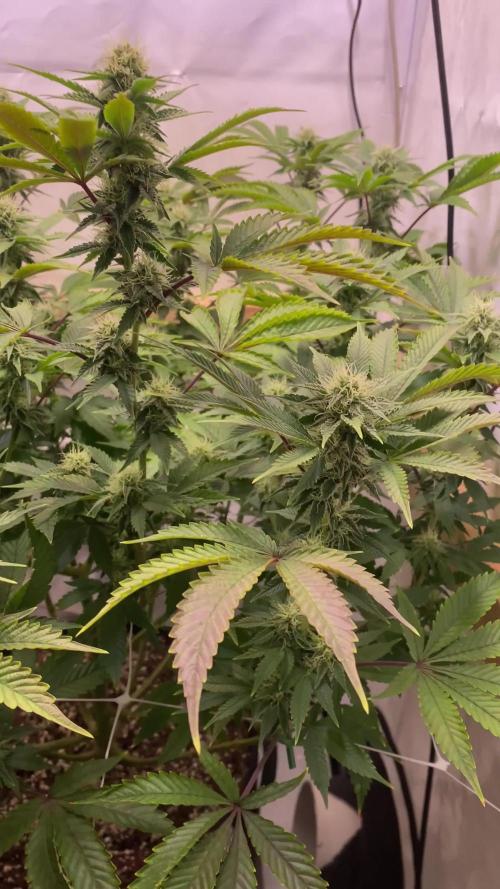
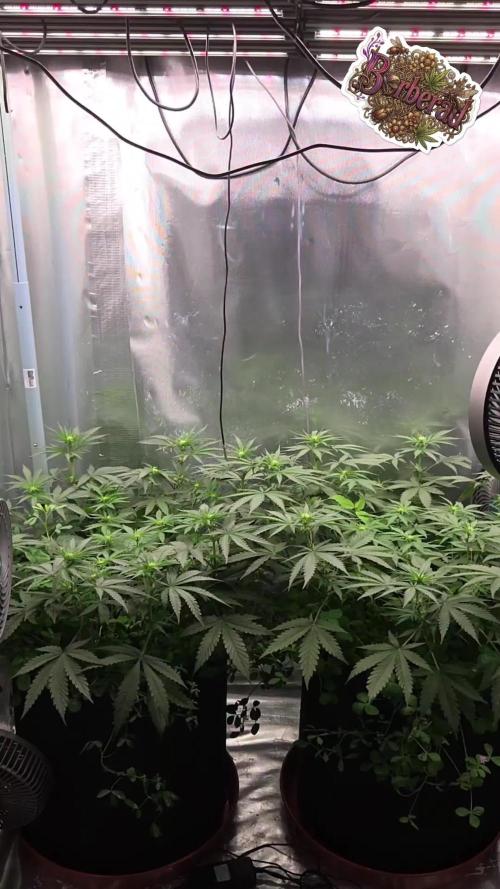
Woche 8 Das Pflänzchen hat vollständig auf Blüte umgeschaltet und wurde gleichmäßig in die breite trainiert, damit die inneren Bereiche mit ausreichend Licht, aktuell 900PPFD an der oberen Triebspitze versorgt werden. Blütetag 19 Der doch sehr dichte Unterbewugs wurde für bessere Licht- und Luft' Zufuhr etwas nach außen gedrückt und wird demnächst geschnitten.
Likes
47
Share
Einen wunderschönen guten Tag meine Pflanzen Freunde, ich hoffe ihr seid alle gut durch die Woche gekommen. Die Pflanzen haben das topping und entlauben Gut über standen. Sie haben jetzt ausreichend Zeit gehabt sich zu generieren. Am Ende der 8 Woche werde ich anfangen den Lichtzyklus langsam auf 12/12 umzustellen. Dann bekommen die Pflanzen für 3 Tage 15/9 Licht bevor ich auf 12/12 umstelle. Somit haben die Pflanzen Zeit sich auf die Blütezeit vorzubereiten. Ansonsten gibt es keinerlei Probleme. Aktuelle Pflanzen Höhe am Tag: 52 #1)18cm #2)14.5cm #3)16cm Denn Dünger scheinen die Pflanzen gut zu vertragen und schmatzen den so weg. In der 9 Woche werde ich anfangen den Dünger Zusatz von S&R Organics mit zu verabreichen, der bei jeder Greenpower 5 in 1 Flasche dabei ist. GREENPOWER20 mit diesem Code erhaltet ihr 20% auf euren Einkauf. Ansonsten gibt es erstmal nix weiter zu berichten, ist auch mal schön wenn alles wie am Schnürchen läuft. Wie immer bedanke ich mich für deinen Besuch und dein Like. Sei in der kommenden Woche wieder mit am Start und schau dir in der Zwischenzeit meine anderen Tagebücher an, ich würde mich über ein Besuch von dir sehr freuen. Oder komm auf mein Instergram Profil. Zamnesia gibt 20% ZAMMIGD2023
Likes
14
Share
Topped and pruned this week. Probably too late. Definitely watered a lot less. Be fore I am certain that I Was drowning them
Likes
6
Share
This week was great I am looking forward to watching her continue to bloom until her harvest day getting closer
Likes
19
Share
@Mazgoth
Follow
The plant is eating well and I’m giving more bio heaven,I used only twice the acti-Vera,Alg-A-Mic.
Likes
32
Share
@Sejnik
Follow
Dívky opět dostaly čaj od biotabs. Vařil jsem ho 34 hodin a každé rostlině jsem nalil 500ml tohoto lektvaru. Vůně dívek se dál příjemně rozvíjí a květy pomalu nabírají na objemu 🙂 jsem zvědavý jak toto dopadne.
Likes
1
Share
Growth went mad this week probably 2/3 bigger than last
Likes
127
Share
@DreamIT
Follow
🎃👹👽MONSTERCROPPING RED MANDARINE 👽👹🎃 ____________________________________________________________________________________________ 💀 5.2 ... 💀 6.2 ... 💀 7.2 All regular, Today we add the latest product from hesi to fertilization and wait for the last few weeks, yeah !!! 💀 8.2 💀 9.2 💀 10.2 I love this plant 😍 💀 11.2 _______________________________________________________________________________________________________ 📜👀 A look at the details of what I'm growing 👀📜 🍊💚 Red Mandarine F1 🍊💚 by 🌱🍭 Sweet Seeds 🍭🌱 📋 Details ⚧ Gender ▪️ Feminised ➰ Genes ▪️ 55% Indica / 45% Sativa 🎄 Genetics ▪️ Red Poison Auto (SWS39) хCalifornia Orange x Skunk hybrid) 🚜Harvest ▪️ 400 - 500 g / m² 🌷Flowering ▪️ 49 - 63 days ✨THC ▪️ 16% ✅CBD ▪️ 0,2% 🏡Room Type ▪️ Indoor 🌄Room Type ▪️ Outdoor 🕋Room Type ▪️ N/D 🎂Release Year ▪️ 2019 __________________________________________________________________________ 👀📷🥇 Follow the best photos on instagram 🥇📷👀 https://www.instagram.com/dreamit420/ 🔻🔻🔻Leave a comment with your opinions if you pass by here🔻🔻🔻 🤟🤗💚Thanks and Enjoy growth 💚🤗🤟
Likes
47
Share
2nd net is up. Early bud formations are promising. holding up to the extremes pretty well, some leaves taking minor damage, but overall, she is holding up, gave her 1 night at 50F see how she would react, stressful. Not advised as it messes with her metabolism, but I want to see if it triggers any anthocyanin response. Love to see her purp up but no signs yet. Remember, For every molecule of glucose produced during photosynthesis, a plant needs to split six molecules of water. This process provides the hydrogen needed for synthesizing glucose and other organic compounds, while oxygen is released as a byproduct. Homework. If Rubisco activity is impaired and it cannot properly function or regenerate its substrate, the plant's leaves are likely to turn a pale green or lime green, a condition known as chlorosis. Essentially, Rubisco activity is highly regulated and susceptible to various environmental and metabolic factors that can cause it to become inhibited, leading to an apparent failure in RuBP regeneration due to a lack of consumption. Rubisco regeneration is intrinsically linked to nitrogen supply because Rubisco is a major sink for nitrogen in plants, typically accounting for 15% to over 25% of total leaf nitrogen. The regeneration phase itself consumes nitrogen through the synthesis of the Rubisco enzyme and associated proteins (like Rubisco activase), and overall nitrogen status heavily influences the efficiency of RuBP regeneration. RuBisCO is a very large enzyme that constitutes a significant proportion (up to 50%) of leaf soluble protein and requires large investments in nitrogen. Insufficient nitrogen supply limits the plant's ability to produce adequate amounts of RuBisCO, thereby limiting the overall capacity for photosynthesis and carbon fixation. Maintaining the optimal, slightly alkaline pH is crucial for the proper function and regeneration of Rubisco. Deviations in either direction (too high or too low) disrupt the enzyme's structure, activation state, and interaction with its substrates, leading to decreased activity and impaired RuBP regeneration. (Lime/yellowing) Structural Component: Nitrogen is an essential building block for all proteins, and the sheer abundance of the Rubisco protein makes it the single largest storage of nitrogen in the leaf. Synthesis and Activity: Adequate nitrogen supply is crucial for the synthesis and maintenance of sufficient Rubisco enzyme and Rubisco activase (Rca), the regulatory protein responsible for maintaining Rubisco's active state. Nitrogen deficiency leads to a decrease in the content and activity of both Rubisco and Rca, which in turn limits the maximum carboxylation rate, Vmax, and the rate of RuBP regeneration Jmax, thus reducing overall photosynthetic capacity. Nitrogen Storage and Remobilization: Rubisco can act as a temporary nitrogen storage protein, which is degraded to remobilize nitrogen to other growing parts of the plant, especially under conditions of nitrogen deficiency or senescence. Nitrogen Use Efficiency (NUE): The allocation of nitrogen to Rubisco is a key determinant of a plant's photosynthetic nitrogen use efficiency (PNUE). In high-nitrogen conditions, plants may accumulate a surplus of Rubisco, which may not be fully activated, leading to a lower PNUE. Optimizing the amount and activity of Rubisco relative to nitrogen availability is a target for improving crop NUE. Photorespiration and Nitrogen Metabolism: Nitrogen metabolism is also linked to the photorespiration pathway (which competes with carboxylation at the Rubisco active site), particularly in the reassimilation of ammonia released during the process. To increase RuBisCO regeneration, which refers to the process of forming the CO2 acceptor molecule Ribulose-1,5-bisphosphate (RuBP) during photosynthesis, the primary methods involve optimizing the levels and activity of Rubisco activase (Rca) and enhancing the performance of other Calvin-Benson-Bassham (CBB) cycle enzymes. Biochemical and Environmental Approaches: Optimize Rubisco Activase (Rca) activity: Rca is a crucial chaperone protein that removes inhibitory sugar phosphates, such as CA1P (2-carboxy-D-arabinitol 1-phosphate), from the Rubisco active site, thus maintaining its catalytic competence. •Ensure optimal light conditions: Rca is light-activated via the chloroplast's redox status. Adequate light intensity ensures Rca can effectively maintain Rubisco in its active, carbamylated state. •Maintain optimal temperature: Rca is highly temperature-sensitive and can become unstable at moderately high temperatures (e.g., above 35°C/95F° in many C3 plants), which decreases its ability to activate Rubisco. Maintaining temperatures within the optimal range for a specific plant species is important. •Optimize Mg2+ concentration: Mg2+ is a key cofactor for both Rubisco carbamylation and Rca activity. In the light, Mg2+ concentration in the chloroplast stroma increases, promoting activation. •Manage ATP/ADP ratio: Rca activity depends on ATP hydrolysis and is inhibited by ADP. Conditions that maintain a high ATP/ADP ratio in the chloroplast stroma favor Rca activity. Enhance Calvin-Benson-Bassham (CBB) cycle enzyme activity: The overall rate of RuBP regeneration can be limited by other enzymes in the cycle. •Increase SBPase activity: Sedoheptulose-1,7-bisphosphatase (SBPase) is a key regulatory enzyme in the regeneration pathway, and increasing its activity can enhance RuBP regeneration and overall photosynthesis. •Optimize other enzymes: Overexpression of other CBB cycle enzymes such as fructose-1,6-bisphosphate aldolase (FBA) and triose phosphate isomerase (TPI) can also help to balance the metabolic flux and improve RuBP regeneration capacity. Magnesium ions, Mg2+, are specifically required for Rubisco activation because the cation plays a critical structural and chemical role in forming the active site: A specific lysine residue in the active site must be carbamylated by a CO2 molecule to activate the enzyme. The resulting negatively charged carbamyl group then facilitates the binding of the positively charged Mg2+ion. While other divalent metal ions like Mn2+ can bind to Rubisco, they alter the enzyme's substrate specificity and lead to dramatically lower activity or a higher rate of the non-productive oxygenation reaction compared to Mg2+, making them biologically unfavorable in the context of efficient carbon fixation. The concentration of Mg2+ in the chloroplast stroma naturally increases in the light due to ion potential balancing during ATP synthesis, providing a physiological mechanism to ensure the enzyme is activated when photosynthesis is possible. At the center of the porphyrin ring, nestled within its nitrogen atoms, is a Magnesium ion (Mg2+). This magnesium ion is crucial for the function of chlorophyll, and without it, the pigment cannot effectively capture and transfer light energy. Mg acts as a cofactor: Mg2+ binds to Rubisco after an activator CO2 molecule, forming a catalytically competent complex (Enzyme-CO2-Mg2+). High light + CO2) increases demand: Under high light (60 DLI is a very high intensity, potentially saturating) and high CO2, the plant's capacity for photosynthesis is high, and thus the demand for activated Rubisco and the necessary Mg2+ cofactor increases. Mg deficiency becomes limiting: If Mg2+ is deficient under these conditions, the higher levels of Rubisco and Rubisco activase produced cannot be fully activated, leading to lower photosynthetic rates and potential photo-oxidative damage. Optimal range: Studies show that adequate Mg2+ application can enhance Rubisco activation and stabilize net photosynthetic rates under stress conditions, but the required concentration is specific to the experimental setup. Monitoring is key: The most effective approach in a controlled environment is to monitor the plant's physiological responses e.g., leaf Mg2+ concentration, photosynthetic rate, Rubisco activation state, and adjust the nutrient solution/fertilizer to maintain adequate levels, rather than supplementing a fixed "extra" amount. In practice, this means ensuring that Mg2+ is not a limiting factor in the plant's standard nutrient solution when pushing the limits with high light and CO2. Applying Mg2+ through foliar spray is beneficial to Rubisco regeneration, particularly in alleviating the negative effects of magnesium (Mg) deficiency and high-temperature stress (HTS). While Mg can be leached from soil, within the plant it is considered a mobile nutrient, particularly in the phloem. Foliar-applied Mg is quickly absorbed by the leaves and can be translocate to other plant parts, including new growth and sink organs. Foliar application of: NATURES VERY OWN MgSO4 @ 15.0g L-1 in a spray bottle. For those high-intensity workouts when 1 meal a day is just not enough! Foliar sprays are often recommended as a rapid rescue measure for existing deficiencies or as a supplement during critical growth stages, when demand for Mg is high. Application in the early morning or late evening can improve absorption and prevent leaf burn. The plant was getting a little limey yellow in the centre. Shortly thereafter, she was back in business, green mostly regenerated. The starting point [of creativity] is curiosity: pondering why the default exists in the first place. We’re driven to question defaults when we experience vuja de, the opposite of déjà vu. Déjà vu occurs when we encounter something new, but it feels as if we’ve seen it before. Vuja de is the reverse—we face something familiar, but we see it with a fresh perspective that enables us to gain new insights into old problems. Confidence is evidence... nothing more. You are confident because you have driven 10,000 times, you are confident because you have spoken 10,000 times. People think confidence is a feeling, but it's not. If you want more confidence, then you need to create evidence, take more shots, collect more data, build more experiences, take more risks; fail, confidence doesn't come first; it is the reward you get for doing the work. no one else wants to do.
Likes
Comments
Share
Another week and great growth, expanded nutrient regiments with bat quano and bio-fish. Rode out some big storms this week as well. Shes big, she's bad, hope this trend keeps goin.
Likes
28
Share
Wow I say they are 13 foot tall some dank dank going on this year 🐜 killed one it was died and I pulled it up shit load ants stated coming out it was crazy but got cut for indoor this year and bad needing weed pulling going on crazy how sweet there smelling
Likes
21
Share
No more silica! ~~~~~~~~~~ Questions & Feedback are welcomed, feel free to message me! Thanks for stopping by growmies! 🤙🤙🤙🙏🙏🙏
Likes
17
Share
@RakonGrow
Follow
**** HAARVEST ZOE **** Nice Strain , My little Zoe really made all the mistakes you could possibly make. No matter when I give light or want water or fertilizer. It grows and grows and grows, the main thing is that there is light. It was one of my free seeds from Zamnesia. So far all seeds have germinated. I store my seeds in a dark, airtight container at 6°C. Tastes kind of sweet after curing. Greenhouse Feeding is a really easy fertilizer to use. I used the BioEnhancer again and again. My little Zoe thanked me. The BioGrow was used as topdressing and is doing its job. The BioBloom also does its job at the right time. And that's really great and easy if you don't have an autoflower. Of course there is a corresponding product. But I was happy to get anything here at all. Legalization has wiped out the market. But for next time I have an appropriate soluble fertilizer for fast-flowering plants. It doesn't work for 8 weeks :)) I use a Sanlight Evo 3-60 1.5 with Bluetooth dimmer. There's nothing to complain about there. Set daily cycle via app. Helpful if the weather or environment is so bad that you have to regulate the light intensity. 33g after 5 days dry . 24.5 °C to 22°C with 50%-60% . curing in a vaccum box at 18°C . It looks like I'm drying too long. // It tastes a bit crunchy. Day 79: trim , slow vacuum box to cure 22°C and 61%rH . Day 76: videostuff: been drying for 4 days (res 640x480) ( optical zoom x200 - x250 ) Day 72: DLI usage total this Plant : 2236.6 DLI in 70 Days . wet trimmed, cut off, hung upside down. see you after 14 days Day 71: preparing for harvest . 24h long night session . DLI : 0 Day 70: - Sanlight DaylightCycle - + ON 200PPFD (00:00) - 800PPFD (03:30) - 800PPFD (16:30) - 200PPFD (18:00) OFF video and photo tryouts with the digimicro mobil x300 optical zoom , mostly freehand Day 69: - Sanlight DaylightCycle - + ON 200PPFD (00:00) - 1000PPFD (03:30) - 1000PPFD (14:30) - 200PPFD (18:00) OFF incredibly hot and rain. lost some terpene :)) Well, summer is coming, Day 68: - Sanlight DaylightCycle - + ON 200PPFD (00:00) - 600PPFD (00:30) - 800PPFD (03:30) - 800PPFD (14:30) - 600PPFD (17:30) - 200PPFD (18:00) OFF - Added 1L bottle of water It's hot, hot, hot, Zoe would like more water. changed daylight cycle so it match the weather problems. tent is open until my real night comes. 103 flowers (including popcorn) counted, due to an accident about 15 flowers are missing. Day 67: - Sanlight DaylightCycle - + ON 200PPFD (00:00) - 600PPFD (00:30) - 900PPFD (03:30) - 900PPFD (14:30) - 600PPFD (17:30) - 200PPFD (18:00) OFF - watering bottle water 1.75L weather to hot , changed daylight start time and daylight cycle so it match the weather problems. I'm lucky, buds are still growing :))) Day 66 (we are on the road with maximum sanlight ) - analyse some trichome . - make some Zoom Pics and Video stuff . - Sanlight DaylightCycle : - + ON 200PPFD (00:00) - 1000PPFD (00:30) - 1000PPFD (13:30) - 800PPFD (17:30) - 200PPFD (18:00) OFF - DLI will stress alot ... Anyway, it's too hot in my room... I open the tent and now everything is fine with the temperatures and I increase the Sanlight to 100% for the first time. May Zoe love it or leave it :)) We'll see what happens Day 65 : Sanlight DaylightCycle : ON 200PPFD (00:00) - 800PPFD (00:30) - 850PPFD (13:30) - 800PPFD (17:30) - 200PPFD (18:00) OFF It will soon be ready for harvest.
Likes
6
Share
Comecei a semana realizando o treinamento de baixo estresse e uma desfoliação. Nao fiz poda top, não acho que seja adequado para plantas rápidas. VVamos ver como vai ser o resultado . Nao pretendo mais fazer intervenções no crescimento .
Likes
5
Share
Just over 6z from the 2
Likes
5
Share
@blackrain
Follow
Took some fan leaves from the second branches off that were covering lower branches and tied higher fan leaves down a little, I'll LST more throughout this week.
Likes
7
Share
Likes
52
Share
Likes
98
Share
💩Holy Crap We Are Back At It And Loving It💩 Growmies we are at DAY 21 and she's just killing💀it👌 So Shit , I gave them just a tad to much nutes 👈 But I have since fixed it So I'm starting to pull her over and do some low stress training 🙃 Lights being readjusted and chart updated .........👍rain water to be used entire growth👈 👉I used NutriNPK for nutrients for my grows and welcome anyone to give them a try .👈 👉 www.nutrinpk.com 👈 NutriNPK Cal MAG 14-0-14 NutriNPK Grow 28-14-14 NutriNPK Bloom 8-20-30 NutriNPK Bloom Booster 0-52-34 I GOT MULTIPLE DIARIES ON THE GO 😱 please check them out 😎 👉THANKS FOR TAKING THE TIME TO GO OVER MY DIARIES 👈