


Likes
Comments
Share

@Elguacho420
Follow
Buenos días y buenos humos para tod@s…
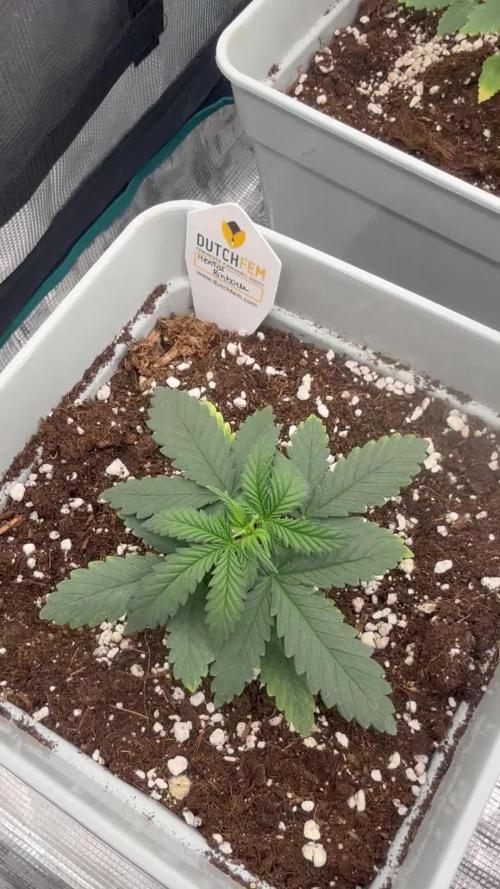
Estamos en la semana 3 de crecimiento y, por el momento, las plantas van como esperábamos. Están creciendo de manera continua y se mantienen en buenas condiciones.
Hemos añadido algo más de humedad, ya que estaba bastante baja, y de momento parece que está funcionando bien.
El riego lo hacemos cada 5 días: a las plantas grandes les damos 150 ml y a las pequeñas 100 ml. Tanto el pH de la humedad como el del riego está en 6.0 y, por ahora, va perfecto.
También hemos empezado a utilizar Plagron Grow, añadiendo tan solo 1 ml por cada 2 litros de agua. La idea es ir introduciendo la alimentación de forma paulatina, para que las plantas se adapten poco a poco y no generarles ningún tipo de estrés.
Mucha suerte en sus cultivos y seguiremos informando… 🌱💀💨
Likes
147
Share


@MrJones
Follow
What can I say this was my largest single yield harvest to date - The BlackBerry OG from Emerald Triangle Seeds are worth growing and just be prepared to have a load of bud to trim, there are other strains that are east to trim than this one, it was laced with sugar leaves and took a while to trim up,, it was in the dry tent for 15 days, honestly I was worried and should have trusted my instinct and left it in longer, this may have made it easier to clean.. If you do not buy this stran and give it a try you are missing out!

Likes
52
Share


@Ultraviolet
Follow
Its time to prepare for war. *Blows bagpipe*
FISH SH!T THE ORGANIC SOIL CONDITIONER (used twice before and always noticed instantly)
Fish Shit is a living product! It provides a complex Microbial profile that includes thousands of different species of bacteria, fungi, and protozoa. This profile is closer to a natural ecosystem than anything you will find on the market. Fish Shit helps release essential oils and terpenes which contribute to the building of a myriad of flavonoids. Flavanoids play a key role in the development of the most potent aromas and tasteful flavors of a plant and its fruit. Fish Shit contains beneficial microorganisms that help plants maximize nutrient uptake. It does this by transforming nutrients into more usable forms and keeping these nutrients in the soil longer. During photosynthesis plants naturally produce exudates (chemicals that are secreted through their roots). Through these exudates, plants can attract the types of good bacteria that are beneficial to them at different points in their growing cycle. These good bacteria cover the roots and act as a barrier to the invasion of disease-causing organisms that may harm the plant.
What Are Enzymes?
Before we dive headfirst into how, exactly, enzymes can benefit cannabis plants, it helps to understand a little about what these microscopic proteins do. Essentially, enzymes facilitate chemical reactions. They do so by binding with a substrate and forming or breaking molecular bonds. In this context, the substrate is the molecule upon which an enzyme acts to boost the efficiency of a reaction.
•substrate /sŭb′strāt″/
•noun
•The material or substance on which an enzyme acts. A surface on which an organism grows or is attached. An underlying layer; a substratum.
Enzymes are proteins with complex 3D shapes that feature regions called active sites. When the substrate binds to these active sites, it forms an enzyme-substrate complex that causes a chemical reaction to take place, temporarily changing the structure of the enzyme and ultimately causing molecules to either come together or break apart. As a result, molecular products are released, and the enzyme returns to its original shape.
Specific enzymes are capable of binding with certain substrates, as the substrate fits into the active site more or less via a lock-and-key principle. Although, new research suggests a more accurate theory of "induced fit", in which enzymes and substrates undergo structural changes to facilitate the reaction.
If you take the human body as an example, we have an abundance of enzymes in our saliva and digestive system. These molecules bind with substrates in these regions (food particles), working to break down the food we eat into usable parts before converting them to energy.
Enzymes in cannabis work in a similar way to the example highlighted above. Typically, enzymes occur in soil naturally, but if your soil mix is lacking organic material, or you're growing hydroponically, then adding enzymes directly to the substrate is crucial.
By using them in cannabis growing, enzymes not only help break down essential nutrients into smaller, more readily available pieces, but they also support the digestion of dead root cells, clearing a direct path for nutrients.
Overall, enzymes make it easier for your cannabis plants to absorb all the elements they need to reach their full potential. For growers, a plant that reaches its full potential means a bucketload of juicy buds come harvest. This is essential if you want to reuse a pot with old systems left over like mine.
Common plant enzymes include:
•Cellulase
•Xylanase
•Beta-glucosidase
•Hemicellulase
•Amidase
Amino acids are a crucial, yet basic unit of protein, and they contain an amino group and a carboxylic group. They play an extensive role in the gene expression process, which includes an adjustment of protein functions that facilitate messenger RNA
Nitrogen, phosphorus, and potassium are the three main pillars of nutrient solutions and fertilizers, but there are countless other nutrients that your cannabis plants need to produce the best possible harvest. Amino acids are one of them.
You may have noticed that amino acids get a lot of attention from bodybuilders and other athletes. That’s because they play a key role in the synthesis of protein, which, as you probably know, is super important for sports recovery and muscle growth. Amino acids are the building blocks of protein and the foundation of both plant and animal life.
But what do amino acids do for cannabis?
WHY IS PROTEIN IMPORTANT FOR CANNABIS?
Just like proteins are important for the human body, they are equally important for the growth and development of plants.
For example, proteins help plants:
•Facilitate the growth of intracellular plant structures
•Promote energy generation
•Stimulate metabolic processes
•Facilitate the absorption and transportation of nutrients
So, where do plants get these vital proteins from? Well, unlike humans, plants can’t source proteins or amino acids from other organisms. Instead, they need to create their own amino acids, and then use these to build protein. That's why gardeners, much like athletes, go wild for amino acid supplements.
Amino acids help plants by…
• Increasing their production of chlorophyll, which ultimately improves their ability to photosynthesize
• Serving as an easily absorbable form of nitrogen
• Stimulating the synthesis of key vitamins
• Improving their resistance to pests and diseases
• Boosting the strength of their cells
Amino acids also serve as the precursors to auxins, a group of plant hormones produced in the meristems—the apex of the stems where new leaves and stems are born.
Auxins play a key role in the plant, activating genes for plant growth and development by triggering a multitude of vital plant functions. In other words, they determine what its size and architecture will look like. Auxins influence the development of branches, flowers, and roots, and even help to regulate the photoperiod response of the plant.
Some amino acids, like cysteine, also work together with antioxidants like glutathione to help cannabis plants deal with oxidative stress, which can be caused by high-intensity lighting, some nutrient solutions, and high levels of CO₂.
Unlike humans, plants can synthesize all the amino acids they need to survive and develop properly. Unfortunately, however, amino acid synthesis is a really high-energy process, and plants may struggle to produce enough amino acids when exposed to stress.
WHAT FACTORS AFFECT A PLANT’S ABILITY TO SYNTHESISE AMINO ACIDS?
Any kind of stress can affect a plant’s ability to produce enough amino acids.
This includes:
• Drought
• Temperature extremes
• Poor soil health
• Pests
• Diseases
• Poor lighting
• Lack of space
• Poor root health
WHAT DOES ALL OF THIS MEAN FOR WEED PLANTS?
If you want to push your plants to their extreme in terms of floral growth and resin production, you should look into amino acid fertilizers. By making amino acids readily available to your plants, they’ll be able to use crucial energy to grow and bloom, rather than focusing on synthesizing amino acids themselves. Game of Inches, this is another Plants can absorb amino acids via their roots and leaves. They can also benefit from amino acids during both their vegetative and flowering phases. The fastest way for plants to absorb amino acids is via their leaves. The foliar application of amino acids is believed to improve the transportation of nutrients, increase transpiration, and boost photosynthesis. Hence, I recommend feeding your plants with foliar amino acid fertilizers. When doing so, however, carefully measure the amount of fertilizer you use, as—like with any nutrient—overfeeding can damage your plants.
FOLIAR FEED AND SOIL SOAK
• 1 crushed queen anne carrot
• Add 2 tbsp of NPK Raw powdered water-soluble cane molasses
• 20ml h2o2
• 1 crushed radish
• 0.25 tsp NPK Enzymes
• 0.25 tsp NPK Amino Acids
• 50ml coconut water ( nature's own amniotic fluid packed with amino, enzymes )
+ The sound of songbirds.
Onto the predators
1250 -Green Lacewings
Lacewings are extremely voracious predatory insects that feed on several pests. In adulthood, it feeds on pollen and nectar. In the larval stage, it feeds on aphids, thrips, and mealybugs at all stages of growth. It can also attack spider mites in moderate quantities. It is initially an aphid predator, but very effectively controls thrips and mealybugs infestations. It is so voracious that in the absence of prey, it will feed on its congeners. Lacewings are cannibalistic if there is no food available for them. It is therefore important to introduce them into an infestation situation, and not just preventively.
•congener /kŏn′jə-nər/
•noun
•A member of the same kind, class, or group.
•An organism belonging to the same taxonomic genus as another organism.
•A thing of the same kind as. or nearly allied to, another; specifically, in botany and zoology, a plant or an animal belonging to the same genus as another or to one nearly allied.
Ideal temperature 20°C – 26°C
Ideal humidity 60% – 70%
Predatory stage life cycle 21 days
Introduction rate 4 weeks
Storage Refrigerator
Use Immediately
Are there any specific instructions on how to use this predator?
Lacewings are available on small paper cards that you can hang to plant stems. On the cards are dozens of eggs ready to hatch. There are also sterile eggs they can feed on once they have hatched before they are ready to disperse in the foliage. It is important to use them quickly upon receipt to avoid cannibalism. If you don't use them right away, you can store the cards in the refrigerator for 24 to 48 hours to prevent the eggs from hatching too quickly. Avoid storing them for longer than this or you risk losing eggs. 1250 eggs are divided into 7.5 cards, 2500 eggs on 15 cards, and 5000 on 30 cards. The application rate is one card per square meter of growing surface.
Is this predator best used for preventive or curative treatments?
Lacewings are used as a curative solution.
Anything else I should know?
Lacewing eggs hatch approximately 24-72 hours after the cards are exposed to room temperature. When they emerge, the lacewings are just 1.5-2 mm long. They are very small so they are difficult to see. Once hatched, they will stay on the cards for a few hours and then disperse in the foliage. You quickly lose sight of them if you have not witnessed the hatching.
They then live in the foliage for about 3 weeks. Often, you will see them towards the end of their larval cycle. After feeding for 3 weeks, they will triple and even quadruple in size. At that point, they are easier to see. But they remain very discreet insects, it is not abnormal not to see them.
Egg carcasses left behind on the cards do not disappear after the hatching has happened. It's normal to see eggs still on the cards. Visually it is very similar before and after hatching.
Also, on the boxes, there are sterile ephestia eggs which are used to feed the lacewings once hatched. Not all lacewing eggs are viable either. Only a certain percentage of lacewing eggs will hatch. Once hatched, the eggs are white. You can observe this using a magnifying glass.
With,
5000 Stratiolaelaps Scimitus
It is used to prevent or control thrips pupae, fungus gnats larvae, and root mealybugs in the soil. It can also be used for red mites in bird farms or hen houses. The adult is about 1 mm long and is medium brown with a beige triangle on its back. Another fun fact about them is they can survive without prey. They can eat algae and plant debris. This is why they can reproduce and stay in plants for long periods.
Ideal temperature 15°C – 23°C
Predatory stage life cycle 18 days
Introduction rate 2 weeks
Storage Room temperature
Use Within one week
Are there any specific instructions on how to use this predator?
Sprinkle directly on the growing media. They can live in all types of substrates like potting soil, coconut fiber, rock wool, cedar mulch, etc. Stratiolaelaps establish easily so they are permanently fighting pests. One introduction is generally enough unless you have an infestation. In this case, introduce them at least twice at a 2-week interval for best results. If you grow your plants in a 100% mineral substrate, it will have to be released more often since there is less organic matter than in traditional soil.
Do I need to take any specific precautions?
Stratiolaelaps breed in the top layer of the soil. So it is important not to disturb them in the first days following their introduction. They don't like temperatures below 8 ° C. So be sure not to introduce them in a water-saturated or cold environment. Release them 24-48 hours after your last watering. They are very sensitive to chemical acaricides and diatomaceous earth. These methods are incompatible with their use.

Likes
9
Share


@chrizzle
Follow
went a bit down with ‚Autoflower Supermix‘ (22ml/10L)
7.06.2026: reduced light to 18hrs because some of the upper leaves were tacoing


Likes
18
Share


@raulmoat123
Follow
Extra few more days then these girls will be coming down , happy with how everything has gone . Blue gelato and inhouse genetics are my favourite . Will update soon


Likes
8
Share


@rorrobz25
Follow
Hola cultivadores. Se acerca la víspera de año nuevo, y con ello, la llegada de la floración.
El día 12/27 observé las plantas y se aprecian diminutos pelos blancos, no están presentes en todas las ramas. Pero es suficiente para comenzar la fertilización con productos de floración. Escogí Bio-Bloom de BioBizz en su dosis media para que se adapte poco a poco al cambio de alimento, reduciendo igualmente el Fish-Mix a la mitad. Se mantuvo el Acti-Vera y el Alg-A-Mic en su misma dosis.
Ya la planta alcanzó los 101 cm, esperemos crezca y engruese sus ramas porque igualmente están delgadas para soportar el peso de los cogollos.

Likes
Comments
Share


@En_Eff_Tee
Follow
Still have upward growth from the ends and switched to full flower nutes. Temperatures in the reservoir are starting to get worryingly warm 20c upwards. Middle of summer and a heatwave all compounded temp problems. May need a chiller to compensate.

Likes
12
Share


@yd_grows
Follow
Primeira semana de Flor BEM agitada.
Plantas Crescendo MUITO rapidamente devido a maior quantidade de luz, maior volume dos vasos e ao stretch natural do período.
Tive que instalar a grade para poder espalhar os ramos da planta e aproveitar toda a luz disponível.
Utilizei arame recozido para fazer uma grade rígida que depois pode ser usada como base para treinamentos futuros.
Likes
16
Share


@Noob_quest
Follow
So the pics are few days old due to there being a problem with my page for some reason.
Buds aren’t really getting fat and the girls have yellowed quite a bit since I took these pics on Monday.
Still learning I think I just didn’t start feeding them early or heavily enough and they never really recovered.
It looks like my yields will be well down vs my 2nd grow which was all organic... which I may go back to for G4.
Anyways, given them big feeds and plan to harvest the most developed plant end of this week and let the others go another few weeks to see if they gain any weight.
So lessons learnt. Can’t wait to get these down and start fresh.
Thanks for reading have a great week 😊
Likes
10
Share


@ZombieKushAddicted
Follow
the girls are now in my backyard, they are in a 1.5 x 1.2m terrace completely amended by @elcaudilloorganicproducts
Likes
57
Share


@MadeInGermany
Follow
Day 6 since the time change to 12/12 hrs Hey all together 😋.
in the last six days since the changeover, it has already made a nice boost 👌.
She looks beautiful and it is fun to watch her grow 😉.
In the next few days, as soon as the flowers start to appear, I will add GHSC Powder Feeding Bio Bloom to the coconut substrate 😃.
I wish you a lot of fun with the update 👍
You can buy this Strain at :
https://sweetseeds.es/de/red-mandarine-f1-fast-version/
Type:
Red Mandarine F1 Fast Version
☝️🏼
Genetics:
Red Poison Auto®️ (SWS39)
X
Tangie (California Orange x Hybrid Skunk)
👍
Vega lamp:
2 x Todogrow Led
Quantum Board 100 W
💡
Bloom Lamp :
2 x Todogrow Led
Cxb 3590 COB 3500 K 205W
💡💡☝️🏼
Soil :
Canna Coco Professional +
☝️🏼
Fertilizer:
Green House Powder Feeding
☝️🏼🌱
Water:
Osmosis water mixed with normal water (24 hours stale that the chlorine evaporates) to 0.2 EC. Add Cal / Mag to 0.4 Ec Ph with Organic Ph - to 5.5 - 5.8 .

Likes
14
Share


@LokalGrenz
Follow
The Amnesia haze 2 is turning light green yellowish some told me it could be deficiency or it could be just flowering taking energy from the leaves but I’m not sure I used Gaia green bloom recently thinking it would help I’m going to too water that haze from here out the other have and sour I’m going to continue to bottom feed
I took some trichome pics I don’t think there ready yet but I think I’m getting close to the date I feel the the amnesia haze 2 is going to hit 90+ days tho kind of hope not cause the other haze and
sour are probably going be done sooner I want to fry them all at the same time
March 7th I think the haze #2 and Sour d is ready but the other Haze is not I’m pretty sure I have another week pre maybe even two for it to be near ready I need the tent to harvest and dry what’s ready I’m going try leave the ready ones in for another week in hope it doesn’t mess them up

Likes
249
Share


@Metatronix
Follow
A big hello to all the cannabis growing gardeners...and all the other visitors that came across my grow journal.
This week was very relaxing, i add only PH+ (again ;), Calmag and PowerZyme.
----------------------------------------------------------------------------------
Now cannabis smell is overpowering in my grow room I can finally write something about Spider Farmers 6-Inch Inline Fan with Smart Controller and Carbon Filter :)
As my grow room gets really stinky at times i always invest in a top shelf carbon filter almost twice the size of the one provided by Spider Farmer, to my shock Spider Farmer carbon filter absorbs the smells wonderfully well.
No smell leaks and that just when the fan is running at 5 out of 10 levels of output. The smart controller is something completely new to me, and had a lot of fun experimenting with it during the veg and early flower, when the smell began i needed it to run full time at level 4 or 5 to rid the fragnance.
All in all the whole combo is a great deal. If you are not as keen on technology the set without the controller is awesome on it's own. But to have some extra options open, the controller at the device throws at you a ton of settings you can use to optemiase you grow enviornment.
The SE 7000 is hanged at 40 cm. over the canopy and runs at 550W.
This whole grow's main sponsor is Spider Farmer. You can easily obtain all the great grow equipment we use at: spider-farmer.com
A big thank you to Jessie and the whole Spider Farmer crew for supporting me with the newest technological advancements in horticulture. Thanks to them what i do here is possible.
Thank you Zamnesia for giving me the opportunity to try out your stock.
zamnesia.com/uk/7686-zamnesia-seeds-do-si-dos.html
20% discount code: ZAMMIGD2023
Plagron did send us their Contest package for the Power Buds competition .
Thank you for your visit, please leave a like and hope to see you beck here in about a week.
Likes
31
Share


@Mrs_Larimar
Follow
2024-06-08
structurewise the Plant is ready to start off into Flower.
i topped her several times, and she responded very well to the training.
BREEDER INFO
Tangerine Snow F1 Fast Feminised is a 75% sativa, four-way cross of (Boost x Tangelo) with (Lavender x Power Plant).
This Fast F1 hybrid is bred from Cali genetics and boasts great citrus terps, high resin production for extracts,
high levels of THC, very good yields and excellent mould resistance.
Tangerine Snow F1 Fast can be grown indoors as well as outdoors. Indoor flowering times are between 8 - 10 weeks
while harvest time in northern latitudes is during September while in the southern hemisphere growers will be harvesting during March.
Recommended climate regions are hot, dry, humid and warm. These are tall, semi-branched plants that grow in excess of 200cm
and display a high degree of vigour with very good uniformity.
In common with many other heavily sativa-dominant strains, Tangerine Snow F1 Fast offers excellent resistance to mould
as well as to plant pests and diseases. The combination of citrus terps and plenty of resin makes thi
a very good extract strain with the 'washing' method delivering very good yields of hash.
The citrus terpene profile is reminiscent of mandarins and tangerines and also has sweet candy notes.
THC production has been lab-verified at a strong 24% while CBD is low. The effect is uplifting and energising,
perfect for use during the day and early evening.
Likes
6
Share


@Rinna
Follow
This was a wild ride. Gave way to many nutrients and I realised this way too late, when lock-ups already started to happen. The buds still look very potent, I just think they had way more in em size/potency wise if the nutrients would've been on point. Not growing auto flowers indoor anymore, but I'll deffo be growing this one outdoors this year! The smell is out of this world, #1 smells like tropical fruit juice, #2 more of a candy-sweetness but definitely tropical. Can't wait for ya'll to grow this one!
Likes
18
Share


@eldruida_lamota
Follow
Hola familia, decidimos esperar y curar unas semanas antes de probarla.
19% de thc y es que esta cepa con predominancia indica no deja de sorprendernos a cualquier cultivador, es una cepa no muy complicada para cultivar pero tampoco fácil.
60/65 días de floración cruzada entre northern light x afghani .
Buenos céntrales y buenos satélites.
Hasta aquí el final del principio.

Likes
10
Share


@Kusunokii666
Follow
Ho avuto problemi di over fertilizzazione ora cerco di ristabilire i sali minerali nel terreno, ho toppato nuovamente per contenere le altezze e penso che tra poco piazzerò la rete
Likes
16
Share


@GrowBeforeHoe
Follow
The Royal Cheese Automatic stop growing the branches on top only the two lowest branches grow even further... So I bend her down so that the low branches can get the new tops... Hope this will work.
All the other plants doing good and growing along nicely!


Likes
6
Share


@NewbieLearner
Follow
Plants took a few days to get stripped down. Missed the second week of flowering and stretching but oh well there is always next time. Very excited to see this canopy full of uniform buds its going to be a sight to behold haha.
Likes
29
Share


@Growin_strong
Follow
Cold most of the week. I ran lights 24hrs last few days so temps wouldn't dip below 60. Punch 3.0 may be showing a little stress from all of it. Looking good so far.
Video is from Saturday - I normally use the vipar alone for veg, I added the UFO for heat for a couple of days. I expected it to be too much light for seedlings but they are taking it fine so far. I will see if I see a difference in growth from blue to red side.
