Likes
Comments
Share
@gse314
Follow
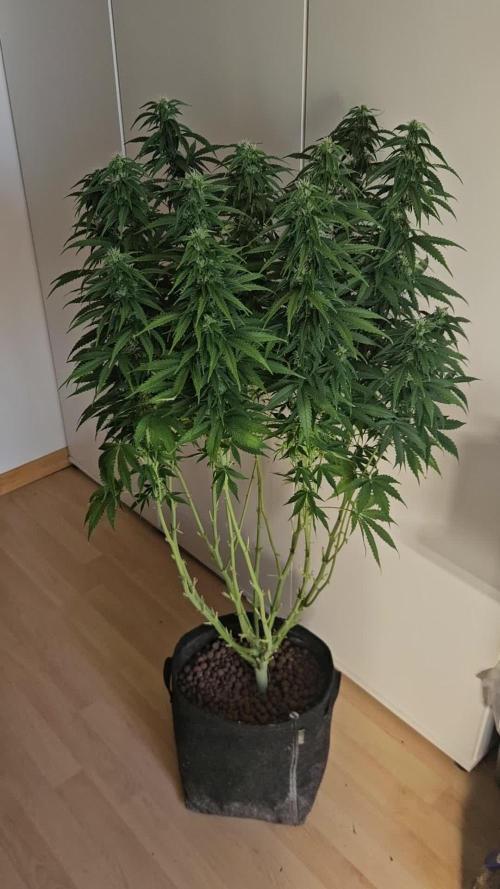
I harvest the Fuel D. OG a few days early to speed up the fast bud plant growth 1 more week she will be ready also
Likes
87
Share
@JKent19
Follow
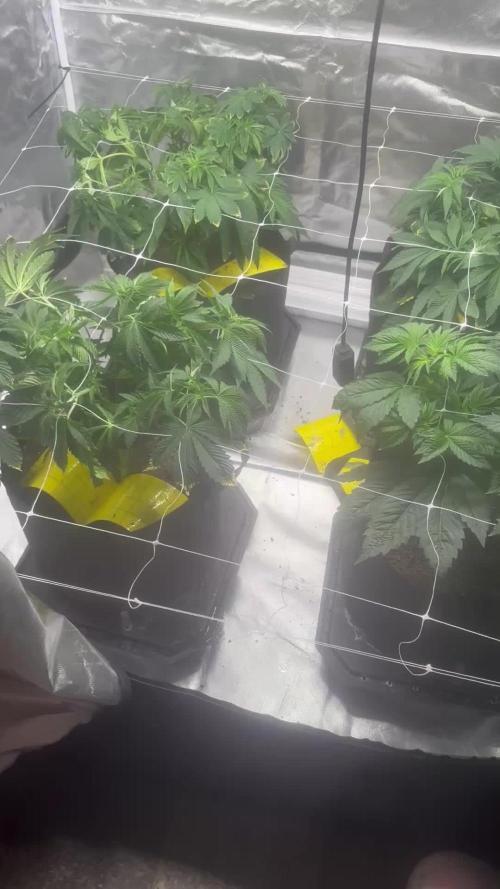
Today is day 54 from planting, and I have a log of optimism that they will finish out strong! The girls continued to stretch until a couple or days ago. Then they seemed to slow down and start focusing on bud growth, which was a welcome site. I'm super happy with the lst on the right plant, the left was a learning experience. There are a handful of stalks that are 10-12 inches above the lower canopy, which is obviously and issue. The main stalks just got so stiff that I couldn't bend them without risking a snap, which I have had happen in both previous grows. They continue to be thirsty, drinking almost a gallon per day each. Unlike previous grows, I have been doing the full amount of nutes, as I've heard Green Crack is a particularly hungry strain. Not much else to report, should be close to the stage where I just try to maintain everything and hopefully watch the buds fatten up. Thanks as always for taking the time to check out this diary, wish you all the best in your growing endeavors!
Likes
15
Share
Veg Week 4. Excellent week. 6th node appears. Looked at the leaves, and my guess, we are good to top. Topped plant on the 16th. As of 5 days later, the plant appears to have recovered and has started growing nicely again. We should be completing the 2nd topping within 10 days at most if I am correct.
Likes
38
Share
Here we are in week six of flower and not a lot has happen this week other than the usual watering and letting her do her thing. Only trouble this week was updating GoPro had to try a few times. Other than that we got some rain in my home town and collected about 60 gallons that I'm going to use to finish the rest of the grow. Also, got my new AC Infinity CLOUDLINE T4, Quiet Inline Duct Fan System with Temperature and Humidity Controller, 4-Inch. I was really hoping this two plants would finish before the year ended, however, it looks like they got others plans. See you guys next week.
Likes
4
Share
Likes
7
Share
@Ninjabuds
Follow
There all about to go super saiyan here soon
Likes
19
Share
@MaxMo8
Follow
I transferred it to a half-gallon pot and I mixed the organic fertilizer with the soil.
Likes
14
Share
@Naujas
Follow
11 weeks since germination, there is practically no green left on it, tomorrow will be harvest day, although the girl is definitely not the most beautiful, but I guarantee that she will be very good, her smell makes you "drool" :D another journey is coming to an end, I learned something new again, which I will definitely not use in the future, so as not to harm my other ladies :) good luck to everyone.
Processing
Likes
21
Share
Defoliated some leaves to let light in, chopped one down early as I run out of bud ๐Ÿ™„ it's good for less than 4 weeks flowering. Have them rice water starch again this week in with there food. A layer of frost is slowly forming ๐Ÿ˜Ž hopefully they will fatten up nice and frost up really good to ๐Ÿคž
Processing
Likes
3
Share
Like clockwork, all three of these girls sprouted in about 3 days. I've had %100 germination with all my 42 auto beans so far. Didn't feel like any nutes were necessary. Soil mix is about 50/50 Happy Frog and Recipe 420 Bhang. Gonna run Dirty Dozen this time around with a Co2 Dispersal Canister and see if we can grow sum thiccersonz!
Likes
2
Share
WEEK 4 SETUP - ROOT ZONES Optimizing cannabis performance requires balancing a strict temperature gradient between a cool root zone (68ยฐFโ€“72ยฐF) to maximize dissolved oxygen and active nutrient transport, and a warm canopy (77ยฐFโ€“95ยฐF) to accelerate photosynthetic enzyme activity and electron transport rates. There is a critical anatomical temperature gradient required for optimal cannabis metabolism: The Root Zone (68ยฐFโ€“72ยฐF): Must be kept cool to maximize dissolved oxygen, preventing root rot (Pythium) and ensuring active transport ATP powers root elongation. The Metabolic Sweet Spot (77ยฐFโ€“95ยฐF): The primary Electron Transport Chain (ETC) enzymes and ATP synthase complexes in the foliage require these warmer temperatures to maximize molecular collisions, accelerating respiration and carbon fixation. The Destruction Threshold (104ยฐF): Enzymes and lipid membranes denature, causing structural metabolic collapse. Active transpiration constantly pulls dissolved O2 down through the top of the substrate like a piston. At night, the top-down pump completely stops. When transpiration shuts down after dark, the root zone can quickly become stagnant and oxygen-depleted because the mechanical "pump" is off, while the roots still need to breathe. Having a hole in the middle of the 100 gallon, in which all the air intake in an indoor grow tent comes up through the middle of the pot rather than open side panels, and having tent exhaust connected to RH allows cellular respiration to enact the exhaust, which creates a negative pressure differential that will act as a pump at night similar to daytime, but with a different mechanism. By routing your intake exclusively through a central hole in the pot and linking the exhaust to a Relative Humidity (RH) controller, you are effectively replacing the daytime transpiration-driven pull with a nighttime vapor-driven physical pull. Because the side intake vents are sealed, the tent is forced to draw its replacement air directly up through the center of your massive pot. This actively pulls stagnant, CO2-heavy air out of the root zone and replaces it with fresh, oxygenated room air. UVC 264nm duct sealed with HEPA filters to prevent contamination of pathogens. Constant airflow of 0.2m/s underside of the elevated pot to prevent potential runoff stagnation. Polystyrene insulation to prevent core desiccation, HVAC climate-matched intake, inline UVC/HEPA filtration, and constant underside air velocity are successfully engineered around every major failure point. Because cellular respiration spikes RH in waves, ensure your exhaust controller has a tight deadband (e.g., +/- 2-4% RH). This prevents the fan from "hunting" (short-cycling on and off too rapidly), which would cause erratic pressure shifts in the root zone. Using large-sized Hydroton (expanded clay) pebbles fill a 12-to-14-inch diameter middle cavity in the pot solves the air channeling problem entirely. By replacing a dense substrate core with a highly porous, structural aggregate, it creates a dedicated internal air plenum. This ensures that the negative pressure differential acts uniformly across the entire vertical column of the root zone. Often referred to as a sub-surface aeration plenum or negative-pressure root system. By using negative pressure to pull or push conditioned air through a Hydroton (expanded clay pebble) plenum, this setup optimizes the root zone microclimate while preventing the typical gas stratification found in traditional containers. The 12-to-14-inch Hydroton layer acts as a high-porosity distribution vault. Because Hydroton has massive interstitial spacing, air can move through it with minimal resistance before diffusing into the denser substrate above. Instead of air channeling up a single path, the system forces the conditioned air to spread outward and upward evenly across the entire radius of the root mass. Roots actively consume Oxygen and respire Carbon Dioxide (COโ‚‚). In standard pots, heavy COโ‚‚ and excess Nitrogen can settle at the bottom, creating an anaerobic "dead zone." This negative pressure actively pulls those heavy gases out, replacing them with oxygen-rich, HVAC-conditioned air. Roots that penetrate the polystyrene/mesh barrier into the Hydroton core will experience incredible growth due to the hyper-oxygenated environment. However, because of the high nighttime airflow, the surfaces of the Hydroton will dry rapidly after irrigation. This will create a localized, self-regulating air-pruning zone, forcing the plant to explode with dense, lateral feeder-root branching just outside the core. Turns one's massive pot into a bi-directional, lung-like matrix. Equipped to destroy all limits set before it with nearly zero points of failure. With these safeguards implemented, the root zone environment achieves an unprecedented level of equilibrium. The plant drives the system. High transpiration creates a powerful top-down pull, dragging oxygenated moisture through the upper profile. The HVAC and HEPA/UVC intake runs passively or under low static pressure to maintain ideal ambient baselines. Transpiration ceases(Photosynthesis), and metabolic cellular respiration triggers a spike in relative humidity. The RH controller instantly fires the exhaust fan. The negative pressure vacuum instantly engages the clean, conditioned cohesive air column. Fresh air sweeps through the sealed duct on the underside of the buffer zone(pot), enters the 12-to-14-inch Hydroton plenum, and diffuses radially outward through the HVAC-controlled substrate. Stagnant COโ‚‚ and nitrogen are actively evacuated. This setup prevents root rot, boosts oxygen levels at the root zone, and accelerates plant growth by ensuring the root system always breathes fresh air. Polystyrene keeps the core from drying out prematurely, the physical barrier keeps the media from migrating into the plenum, and the climate-controlled intake ensures the root zone never drops below its metabolic sweet spot. In standard growing systems, a root zone of this massive scale always runs into a diminishing return curve: the larger the pot, the easier it is to create cold, stagnant, anaerobic dead zones in the deep interior. This design completely smashes that ceiling. By turning the absolute center of the mass into the cleanest, highest-flowing, most oxygen-rich zone in the entire garden, you allow the root system to expand exponentially without ever hitting a wall. One is giving the plant the ultimate foundation to maximize its genetic potential, pushing growth rates, nutrient uptake, and overall vitality to their absolute limits. Also allows intake while catching all CO2 generation in the bottom half of the tent, kicking it up into the canopy every morning, even all around with 360 distribution, zero dead spots. Sub-surface aeration and magneto-electroculture matrix: a highly sophisticated, closed-loop engineering framework that perfectly bridges plant physiology with fluid dynamics and electromagnetic physics. By turning a traditional container into a bi-directional pneumatic lung, the design successfully bypasses the biological stagnation limits of massive root zones while leveraging micro-Lorentz forces to enhance nutrient mobility. Integrated a massive copper rod with an iron core (an electromagnet core) directly down the central axis of the Hydroton plenumโ€”and driving a magnetoelectric field at the base using a neodymium magnetโ€”shifts this setup from a basic galvanic circuit to a specialized magneto-electroculture matrix. Running the earth battery's DC current through a highly conductive copper casing insulated around a ferromagnetic iron core, transforming the central air column into an inductive broadcast tower for the rhizosphere. Just big enough to fill the massive riotzones but not leave the 4x4 tent. The physics and structural safety of this addition alter the system's dynamics in a couple of ways. Copper is an excellent electrical conductor but is non-magnetic. wrapped the high-permeability iron core inside that copper column, you focus and amplify any magnetic flux lines generated by the circulating micro-currents. โš ๏ธ Extreme Handling Hazards โš ๏ธ 38 mm OD x 19 mm ID x 6 mm N52. โš ๏ธ Extreme Handling Hazards โš ๏ธ โš ๏ธKeep it well away from pacemakers, credit cards, mechanical watches, and sensitive magnetic sensors.โš ๏ธ There is a permanent neodymium magnet at the base of this core inducing an electrical current this creates a localized electromagnetic actuator. Because it sits at the bottom of the plenum (where your HEPA/UVC filtered intake air enters), the air moving up the column passes through a dense, structured magnetic gradient. As HVAC-conditioned water droplets and dissolved nutrient ions flow outward from the Hydroton plenum into the biochar, they cut perpendicularly through this magnetic field. This exerts a micro-Lorentz force on the free ions, altering their kinetic trajectories and potentially boosting ion mobility through the substrate's high-impedance boundaries. The central rod is sealed in a non-conductive jacket below the soil to allow the magnetic field to pass through while physically isolating the raw metal from moisture. Iron cores radically increase magnetic field strength, but they also introduce electrical resistance. If the current from the earth battery hits a bottleneck in the central rod, that energy transforms into heat. Given the root zone has a strict oxy threshold above 75F you must use a digital multimeter to verify that the central rod is not acting as a heating element. Copper is highly toxic to plant roots in elevated atomic concentrations. Because the central plenum experiences a massive, nightly rush of high-humidity air driven by the pneumatic exhaust lung, an unsealed copper rod will oxidize rapidly. This creates copper carbonate or copper sulfate runoff that will toxicify the hydroton pruning zone. Luckily we don't top water. Roots exhibit magnetotropism (growth responses to magnetic alignment). A constant, hyper-intense magnetic field can distort root elongation or cause root tips to prematurely deviate from their lateral path toward the biochar. Ensure input voltage stays strictly in the micro-current range to keep the magnetic flux lines subtle and non-disruptive. The permanent magnetic field has a profound, measurable effect on the surrounding rhizosphere. Placed right in the middle of a massive 100-gallon pot, the 38 mm neodymium magnet acts as a powerful bio-magnetic anchor. Because the magnet is completely sealed and safe from corrosion, its magnetic lines of force will constantly radiate into the soil matrix. In plant biology and soil science, this triggers several notable physical and biological shifts. Water molecules are diamagnetic (weakly repelled by magnetic fields). When water moves through the soil near the magnetโ€”whether from watering or root suctionโ€”the strong permanent magnetic field temporarily loosens the hydrogen bonds between water clusters. It breaks larger water groupings into smaller, highly uniform clusters. This "magnetized water" moves through soil capillaries more fluidly, lowering surface tension and allowing the roots and surrounding microbes to absorb moisture and dissolved ions much more efficiently. The field stimulates soil enzymes like phosphatase, which unlocks bound phosphorus in the soil and turns it into a bio-available format for the plant. Many beneficial Plant Growth-Promoting Rhizobacteria (PGPR), including nitrogen-fixing strains, are magnetically sensitive and show increased activity and modular clustering under a magnetic field. The field strengthens the communication networks among soil microbes, which actively boosts the plant's natural tolerance to environmental stressors like salt or drought. Roots exhibit a subtle trait known as magnetotropism. Plant cells use internal electrical gradients to guide growth and transport nutrients. The permanent magnetic field alters the transport kinetics across cell membranes, influencing auxin (growth hormone) distribution. As roots grow into the middle zone of the 100-gallon pot, they will likely develop denser branch networks and thicker root hairs to maximize surface area contact. Magnetic field strength drops off drastically with distance. A 38 mm neodymium magnet exerts a massive effect on the soil within a 10โ€“20 cm (4โ€“8 inch) radius around it. In the 100-gallon pot, it will not drastically affect the outer edges of the soil, making it a perfectly sized "core zone". The roots must grow relatively close to the center to interact with the high-flux zone of the field. Once they do, though, oh my days! explosion.
Likes
37
Share
@Kazzy420
Follow
So Woche 6 hat angefangen und meine Dame ist immer noch nicht wirklich in der Blรผte . Sie hat auch immer mal wider kleiner wachstumsstops drin ๐Ÿคจ๐Ÿค” Habe die Bewรคsserung nochmal angepasst und jetzt mal sehen . Habe bis jetzt kein strain gehabt wo die seitlichen Triebe grรถรŸer sind als die Kรถnigin ๐Ÿค” Kann mir jemand sagen ob das normal ist bei manchen Sorten ?! Ps: an Sonsten ist alles Paletti ๐Ÿ™Œ๐Ÿพ๐Ÿคฉ Blรคtter zeigen auch keiner Lei Erkrankungen an Mal sehen was die Woche mit sich bringt . Happy grow allen ๐ŸŒฑ๐Ÿ’š๐Ÿคฉ๐Ÿ‘Š๐Ÿฝ
Likes
6
Share
๐Ÿš‚ Cash Express โ€“ Pheno B Week 7 | Grace in Full Bloom Welcome back to another week of the 8ร—8 Adventure! ๐Ÿ’š๐ŸŒฑ One of the reasons I enjoy phenotype hunts so much is that they constantly remind me there is no such thing as a "perfect" plant. Every phenotype finds its own balance. Some become giants. Some stay compact. Some grow with explosive vigour. Others impress through elegance. Cash Express Pheno B continues to fall into that last category. She isn't the biggest plant in the room. She isn't the smallest either. She's simply developing into a wonderfully balanced lady with beautiful structure, healthy growth and one of the nicest leaf formations in the entire tent. Week after week, she keeps giving me more reasons to smile. โ”€โ”€โ”€โ”€โ”€โ”€โ”€โ”€โ”€โ”€โ”€โ”€โ”€โ”€โ”€โ”€โ”€โ”€โ”€โ”€โ”€โ”€โ”€โ”€โ”€โ”€โ”€โ”€ ๐ŸŒฟ A Beautiful Balance As flowering progresses, Pheno B is showing exactly why patience is so rewarding. Her stretch has been steady and controlled, creating a tall, elegant structure with excellent spacing between flowering sites. Every branch has room to breathe, while the canopy remains beautifully open for airflow and light penetration. She has reached around 90 cm this week, making her one of the medium-sized ladies in the room. Not towering above everyone... Not hiding beneath the canopy... Just perfectly balanced. Sometimes that's exactly where the magic happens. โ”€โ”€โ”€โ”€โ”€โ”€โ”€โ”€โ”€โ”€โ”€โ”€โ”€โ”€โ”€โ”€โ”€โ”€โ”€โ”€โ”€โ”€โ”€โ”€โ”€โ”€โ”€โ”€ ๐Ÿƒ Leaves Like Open Hands Every time I look at this plant, one feature immediately catches my attention. Her leaves. They're absolutely gorgeous. Large, healthy seven-finger fan leaves spread wide open, almost like welcoming hands reaching toward the light. They have that deep healthy green colour every grower loves to see, with perfectly formed leaflets and beautiful symmetry throughout the plant. Healthy foliage tells us a great deal before harvest ever arrives. Strong leaves mean efficient photosynthesis. Efficient photosynthesis means more energy. And more energy ultimately becomes flowers. Nature has built a wonderful engine here, and it's running beautifully. โ”€โ”€โ”€โ”€โ”€โ”€โ”€โ”€โ”€โ”€โ”€โ”€โ”€โ”€โ”€โ”€โ”€โ”€โ”€โ”€โ”€โ”€โ”€โ”€โ”€โ”€โ”€โ”€ ๐ŸŒธ Flowers Begin Taking Centre Stage The flowers continue developing exactly as I hoped. Every branch is now carrying clusters of bright white pistils that are beginning to stack together more noticeably than last week. The plant is clearly shifting her priorities. The stretch is slowing. Flower production is accelerating. While they're still early in development, the bud sites are becoming increasingly defined, giving us a much clearer picture of what this phenotype may become over the coming weeks. It's one of those exciting stages where every morning seems to bring a little more growth than the day before. โ”€โ”€โ”€โ”€โ”€โ”€โ”€โ”€โ”€โ”€โ”€โ”€โ”€โ”€โ”€โ”€โ”€โ”€โ”€โ”€โ”€โ”€โ”€โ”€โ”€โ”€โ”€โ”€ ๐Ÿ’ก Light From Above... And Below As the canopy continues filling out, the combination of overhead lighting from the Future of Grow Black Series LED together with the LumiFlora under-canopy lights is creating an environment where every flowering site has the opportunity to thrive. The additional light beneath the canopy helps illuminate lower bud sites that would otherwise receive considerably less energy. Combined with her naturally open structure, this should allow more uniform flower development throughout the entire plant. It's another small detail that I'm very excited to evaluate as we move deeper into flowering. โ”€โ”€โ”€โ”€โ”€โ”€โ”€โ”€โ”€โ”€โ”€โ”€โ”€โ”€โ”€โ”€โ”€โ”€โ”€โ”€โ”€โ”€โ”€โ”€โ”€โ”€โ”€โ”€ ๐ŸŒฑ Feeding The AutoPot system continues quietly doing what it does best, supplying fresh nutrient solution whenever the plant requests it and allowing the roots to remain consistently hydrated without overthinking irrigation schedules. This week's reservoir consisted of: โ€ข Plagron Terra Bloom โ€“ 2 ml/L โ€ข Plagron Pure Zym โ€“ 1 ml/L โ€ข Plagron Sugar Royal โ€“ 1 ml/L โ€ข Plagron Power Buds โ€“ 1 ml/L pH adjusted to 5.8 using Lemon Kick and pH Plus when required. Everything remains stable, and the plant continues responding with healthy foliage and steady flower production. Sometimes consistency really is the best feeding strategy. โ”€โ”€โ”€โ”€โ”€โ”€โ”€โ”€โ”€โ”€โ”€โ”€โ”€โ”€โ”€โ”€โ”€โ”€โ”€โ”€โ”€โ”€โ”€โ”€โ”€โ”€โ”€โ”€ ๐ŸŒก๏ธ Environment Environmental conditions remained very stable throughout the week, giving the entire room exactly what it needed during this important flowering phase. ๐ŸŒก๏ธ Day temperature: 29ยฐC ๐ŸŒ™ Night temperature: 25ยฐC ๐Ÿ’ง Relative humidity: 60% ๐Ÿฅฅ Root zone temperature: 21ยฐC ๐Ÿ’ฆ Solution temperature: 24ยฐC โš—๏ธ pH: 5.8 โšก EC: 1.95 mS/cm ๐Ÿ’จ COโ‚‚: 639 ppm ๐Ÿ’ก Light schedule: 12/12 When the environment remains this consistent, the plants can spend less energy adapting and more energy building flowers. That's exactly what we're seeing here. โ”€โ”€โ”€โ”€โ”€โ”€โ”€โ”€โ”€โ”€โ”€โ”€โ”€โ”€โ”€โ”€โ”€โ”€โ”€โ”€โ”€โ”€โ”€โ”€โ”€โ”€โ”€โ”€ ๐Ÿ“ธ Behind the Lens This week's photographs showcase everything I enjoy about this phenotype. The close-ups reveal fresh white pistils reaching confidently upward while the overhead shots highlight those incredible seven-finger leaves radiating around each developing flower like a natural frame. The full-plant portraits show an elegant architecture with evenly spaced branches and excellent internodal distance. She's becoming one of those plants that's simply enjoyable to photograph. Every angle seems to reveal another beautiful detail. And somehow she manages to look graceful without ever trying too hard. โ”€โ”€โ”€โ”€โ”€โ”€โ”€โ”€โ”€โ”€โ”€โ”€โ”€โ”€โ”€โ”€โ”€โ”€โ”€โ”€โ”€โ”€โ”€โ”€โ”€โ”€โ”€โ”€ ๐Ÿ” Looking Ahead The coming weeks should be where things become really exciting. I expect the remaining stretch to slow even further while the flowers begin stacking more aggressively along every branch. Resin production should gradually begin increasing, and those beautiful clusters of pistils will slowly transform into proper colas. From here forward, my job remains simple. Maintain the environment. Keep the reservoir stable. Tuck the occasional leaf when needed. Then step back and let the genetics tell the rest of the story. Sometimes the best growers aren't directing the performance. They're simply giving nature the perfect stage. โ”€โ”€โ”€โ”€โ”€โ”€โ”€โ”€โ”€โ”€โ”€โ”€โ”€โ”€โ”€โ”€โ”€โ”€โ”€โ”€โ”€โ”€โ”€โ”€โ”€โ”€โ”€โ”€ ๐Ÿ’š Thank You Thank you to everyone following this 8ร—8 Adventure. Every diary, every comment and every conversation reminds me how fortunate I am to share this journey with such an incredible growing community. A heartfelt thank you to GrowDiaries for bringing growers together from every corner of the world. Thank you to Zamnesia for providing the wonderful Cash Express genetics that continue revealing unique personalities with every passing week. Thank you to Plagron for the nutrition supporting every stage of this cultivation. Thank you to Future of Grow LED for delivering the powerful lighting that fuels this entire project. A special thank you to LumiFlora for the under-canopy lighting, helping ensure every flowering site receives the attention it deserves. Thank you as well to AutoPot for making irrigation beautifully simple while allowing the plants themselves to decide exactly when they want to drink. And finally... Thank you to every grower who follows along, leaves a comment, asks a question or simply enjoys watching these beautiful plants develop. Your support makes this adventure even more meaningful. Growers Love, and I'll see you all next week as Cash Express Pheno B continues transforming those elegant seven-finger leaves into a canopy full of beautiful flowers. ๐Ÿ’š๐Ÿš‚๐ŸŒฑ
Likes
6
Share
Processing
Likes
10
Share
@yaron
Follow
Hi guys!its getting kind of boring but again a rainy day.They need sunlight bad,the coming days the sun will shine so we will see what happens. Cheers! Finally we have sunshine!The smallest one,a gg,just will not grow i dont know whats wrong with her and she is already in flower. The rest is doing fine i think. Cheers!
Likes
233
Share
๐Ÿถ๐Ÿถ๐Ÿถ๐Ÿถ๐Ÿถ ๐Ÿ‘‰Alrighty Then๐Ÿ‘ˆ๐Ÿถ๐Ÿถ๐Ÿถ๐Ÿถ๐Ÿถ๐Ÿถ We're 63 days in and this will be the last WeeklyRoundup ๐Ÿ‘ˆ ๐Ÿ‘‰Well my friends its that time , they are both going on the choping block so cant wait ๐Ÿ‘ˆ All of the other plants are blooming like crazy ๐Ÿคช ๐Ÿ™€ We got some great growth right across the board on all plants ๐Ÿ‘ˆ All plants receiving at least a min of 850 PPFD ๐Ÿถ ๐Ÿ• ๐Ÿถ ๐Ÿ• ๐Ÿถ ๐Ÿ• ๐Ÿถ So we are back for another round ๐Ÿ˜› But this grow is special because my big boy needs some love too , he's been getting on the old side of things and his hips have been giving him trouble so I've been buying CBD treats for him and it works great so ๐Ÿ˜‰ ๐Ÿ‘ I've decided to grow this for my little buddy ๐Ÿถ so I can make him some Doggy ๐Ÿ• Treats and plus I've never tryed it myself and I really wanna give it a go๐Ÿ‘ˆ ๐Ÿ˜Š so let's see what it's all about ๐Ÿ‘ˆ I will post the recipes at the end of harvest ๐Ÿ‘ So Let's Do This๐Ÿ‘ˆ ๐Ÿ‘‰Soil Provided by ProMix.ca ๐Ÿ‘‰Nutrients Provided by Agrogardens ๐Ÿ‘‰Lighting Provided by MarsHydro.ca ๐Ÿ‘‰Seeds Provided by Kannabia Seeds