


shorts_status_processing


@Flashback25
Follow
Week is going great. Buds are starting to thicken up and trichomes are starting to form.
This is the thirstiest plant i have had, probably partly due to the high day time temperature, but it looks to be just a minor problem.
Can start to see that the yeald will be higher than i expected just by looking at the buds.


@CBD_Sweden
Follow
Hi all the happy people here in GrowDiaries.
This is my second cultivation ever and it will be fun to try a bigger space than my closet grows
First, I'm just going to say I'm done with the construction of my new growroom.
I put some pictures on the construction here in week one.
The room is 2.14 meters by 1.7 meters and has a ceiling height of 2 meters.
It provides a floor area of 3.6 square meters.
I use a 54 Watt Lightwawe T5 for germination and 2 Pcs 400 Watt HPS lamps.
I have a channel fan that replaces the room air about 40 times an hour to get a comfortable theme in the room, the air enters a fresh air intake from the outside.
The air is purified through a carbon filter to then leave the room to the rest of the basement.
Then I use that heat to heat the rest of the basement.
I will use 8 pcs 15 liter Autopots to grow with and a 100 liter water tank that supplies the pots of water and nutrition.
I will grow completely organically in soil and will watercure my buds to get the best possible medicine for me.
But there are no cultivation rooms to be displayed here, so I continue with what is most important.
I am very excited to see how the new growroom will work and how this CBD Fast Eddy plant from Royal queen seeds will turn out.
CBD Fast Eddy Automatic is combining Cheese x Juanita la Lagrimosa x Ruderalis, Fast Eddy is a rapid growing, flavourful, and CBD-rich auto strain that goes from seed to harvest in 8-9 weeks, produce generous yields, and induce a clear, mellow, and most importantly, functional high.
THC: 9%
CBD: High
Yield Indoor : 400 - 450 gr/m2
Yield Outdoor: 80 - 130 gr/plant
Height Indoor: 60 - 100 cm
Height Outdoor: 80 - 120 cm
Flowering: 6 - 7 weeks
Harvest month: 8-9 weeks after sprouting
Genetic Background: Cheese x Juanita la Lagrimosa x Ruderalis
Type: Sa 50% In 40% Ru 10%
Effect: Clear, Painrelief
Climate: Mild
-----------------------------------------------------------------------
2017-09-25. Week 5 starts. Added a video of the girls. Gave the girls water and nutrients. The beautiful girl is 41 cm high and have grown 5 cm in 7 days.
I flushed the girl yesterday with 40 liters of tap water. Im lowering the humidity in the room with a dehumidifier and try to have 50% air humidity. She looks great and starting to bud up.
----------------------------------------------------------------------
2017-09-29. Installation of the New light rail in the grow room. Its Advanced star light V 5.0. Added a video of it.


@Ju_Bps
Follow
Hello my friends 👨🌾🌲,
All was fine this week,
Some leaves continue to be burned, but really slow than early.
Ending is soon ✂️✂️, lot of leaves turn to yellow and purple 😍.
#2 and #3 are little than #1 but buds are so sweet, nice colors and looking compact.
I think #2 and #3 will be ready before the #1.
Probably harvest next week #2 and #3, we'll see about the #1
I continue my flush,
I give water + flash cleaner
#2 and #3 1.5 each 2 or 3 day
#1 around 2l each 2 or 3 day
PH@6
Sorry my friends I'm in late, but I was busy this week end with the Royal Gorilla Harvest.
Thanks to Mars Hydro for the TS1000 and Royal Queen Seeds for seeds ❤️❤️
https://www.mars-hydro.com/ts-1000-led-grow-light
https://www.royalqueenseeds.com/autoflowering-cannabis-seeds/537-mimosa-automatic.html
Have a good week end,
See you next week 💨


@Ferenc
Follow
Hey! Just back well I started a diary but stopped growing so placed to my friend's house. Now I decided to be back and yeah here we go....
They are nice fertilization happens 3x a week with the mixture of Biobizz family (Biobloom, Topmax, BioGrow, Epsom salt, Gunokalong extract.) They grow as hell. 600W LED, 18 hours on 6 hours off, 200 ml water per plant a day, humidity approx 35 percent.
Day 49: More LST has been done they grow unbelievably fast...



@Mrs_Larimar
Follow
2024-08-06
They began brilliantly, with every seedling emerging to greet the world. Their journey continued with remarkable performance, thriving in every environment they faced.
From their first moments in the nursery, to their time in the adolescent chamber, and even weeks outdoors braving cold and rainy days, these resilient plants rose to every challenge. No matter where they were placed, they flourished with unwavering determination.
Their final stage in the flowering room was a testament to their strength and adaptability. For me, they proved to be a joy to cultivate. The key to their success? Simply providing ample water, especially during the crucial final flowering phase.
The result? Luscious bud formations adorning the colas, a sight that filled me with pride and satisfaction. I'm thrilled with the outcome of this grow.
Stay tuned for the smoking report, where I'll delve into the nuances of the buds' aroma and flavor profile.
Smokereport does not work so i do it manually
Apricot Oreoz are classified as " hard Hitter" and thats what they are, indeed.
i gave some testers away and i got one uniquie Response.
smoking one bowl and your day is done.
i mean up to 5 hours couchlock.
not my kind of desire. but there are surely PPl who need it, and like it
best for medical purpose, you sleep like a Baby, your stress is gone, and pain sleeps too
perfect for that
nice yield and very good for extracts


@38PLAN
Follow
Siamo all'8 settimana le piante hanno sviluppato fiori ben formati,ora dobbiamo avere pazienza ed aspettare che diventino ancora più grandi,la maggior parte dei pistilli é ancora bianca e le piante ancora verdi,questo significa in grandi linee che la pianta può ancora produrre,incredibile la pianta in fondo a sinistra ha quasi toccato il soffitto,un autofiorente di eccezionali dimensioni,ancora all'inizio della fioritura


@stonedkoala
Follow
- Raised cal mag from 3 to 5 because I thought plant was lacking cal mag
- Upped nutes but it may have led to nute burn in the next few weeks (see pics)
- ~350-400 ppm for half nutes
- buds starting to form nicely


@Rock_n_Roll_Randy
Follow
This garbage plant that was supposed to be an autoflower but was a photoperiod turned hermaphrodite on me. Not a few pollen sacks but tons everywhere. I noticed some pollen on some of the closer plants leaves so I hope it didn't fuck em up. I'm hoping that they are so early in flower that it won't pollinate em
FOR EVERYTHING MARS HYDRO VISIT:
www.mars-hydro.com
www.marshydroled.ca
PROMO CODE: rocknroll
VISIT THE ALIEXPRESS STORE:
@marshydro_aliexpress
Instagram: @marshydropenny
https://youtube.com/channel/UChU5ZWwNi-DvnO3oWVU3ceA
(NEW) STRIVE NUTRIENTS 💪




@Ultraviolet_
Follow
Remember that, however you are played, or by whom, your soul is in your keeping alone. Even though those who presume to play you be kings or men of power, when you stand before God, you cannot say, 'But I was told by others to do thus,' or that virtue was not convenient at the time. This will not suffice. Remember that.
Day:18
84°F and 65% RH (VPD) for the vegetative stage. Approximately 1.15kPa(assuming leaf temperature is about 2°F cooler than the air), which falls right into the ideal vegetative sweet spot (0.8kPa to 1.2kPa). At 1.15kPa, plants can draw water and nutrients efficiently without risking stress or wilting. It keeps the leaf pores (stomata) open, allowing for ideal carbon dioxide intake and maximizing vegetative growth. VPD is determined by the leaf's temperature, not just the ambient air. Because leaves usually run 1° to 3°F cooler than room air under bright grow lights, my actual VPD will be slightly lower, closer to the 1.0kPa mark. As she transitions from vegetative growth to flowering, one can gradually lower the humidity (to around 45–60%) and drop temperatures slightly to prevent disease from settling inside dense buds when they appear.
Night:6
At 70°F and 60% relative humidity, Vapor Pressure Deficit (VPD) is 0.86 kPa. This is right on the cusp of whats optimal for the vegetative stage. During the nighttime, plants generally close their stomata and undergo cellular respiration rather than photosynthesis. Transpiration slows to a near stop, making VPD less critical at night than during the day. However, maintaining a nighttime VPD between 0.8 and 1.0 kPa is highly beneficial in that it ensures the air is dry enough to prevent powdery mildew or bud rot, but moist enough to keep the plant from undergoing unnecessary stress. This range keeps the environment comfortable for cellular processes and prevents large atmospheric swings. Keeping it all flowing.
(Not pushing them yet, these are photoperiods)
The optimal soil (root zone) temperature for cellular root respiration and nutrient uptake in cannabis is between 68F & 72F This narrow range balances biological energy production (cellular respiration) with the dissolved oxygen levels in the soil, maximizing plant growth and health. Warmer soils hold significantly less dissolved oxygen. When soil temperature exceeds 74F oxygen depletion occurs, inhibiting cellular respiration almost entirely, At 68-72F root cells generate optimal adenosine triphosphate (ATP) via respiration to power root-tip elongation and the active transport of water and nutrients.
Too Hot (Above 78F) Root respiration increases, demanding more oxygen, while the water's oxygen-carrying capacity drops. This creates a prime environment for anaerobic pathogens and Pythium (root rot).
Too Cold (Below 60F) Root metabolism and cellular respiration slow to a crawl. This severely impairs nutrient and water absorption, leading to yellowing, wilting, and phosphorus deficiencies.
A lot depends on whether it's automatic or photoperiod; with photoperiod, there is not as much of a need to push "hard" as the real countdown only begins once the flower is initiated. Automatics, on the other hand, the chronological "clock" begins ticking the moment the seed germinates. It is of critical importance that the seedling growth gets off to the races, understanding that early growth is like compound interest, which will pay off come harvest. This reality is why getting autoflowers "off to the races" early on yields such exponential benefits. The "compound interest" is directly related to the surface area of the leaves. Larger, faster-growing seedlings process more light and build bigger root networks early on, which translates into an explosion of vertical and lateral growth during their short vegetative window.
The margins for error are so thin with autoflowers; this early-stage momentum depends on several critical practices. Seedlings exposed to increased atmospheric CO2 levels early in life will develop at an increased rate. To effectively "extend" or optimize the capacity of Photosystem II (PSII) for increased photosynthetic efficiency. In standard oxygenic photosynthesis, Photosystem II (PSII) is naturally limited to the red-light spectrum, peaking at 680nm. Extending its light-harvesting capacity past 700nm into the far-red region requires bypassing the natural limits of standard chlorophyll a. Adding 730 nm (far-red) LEDs alongside standard red/blue lights has been shown to increase canopy photosynthesis by 20–30% in several crops by acting synergistically with shorter wavelengths. However, the limitation is that excessive, pure IR/Far-red light (without accompanying red light) can trigger the "shade avoidance response," causing plants to grow tall, weak, and spindly rather than robust. Utilizing infrared light (specifically the 700-750 nm far-red range) is a viable method to boost photosynthetic efficiency. It acts as a bridge to allow PSII to utilize a broader spectrum of light, breaking the traditional 700 nm barrier. UVR8-mediated signaling (often in conjunction with CRY proteins) triggers protective mechanisms that maintain the stability of the photosynthetic apparatus (including LHCII and reaction center proteins), thus ensuring that the efficiency of Photosystem II remains higher in UV-B-exposed plants compared to plants lacking this receptor. ΦPSII indictates the rate of electron transfer from water to plastoquinone, which drives the production of ATP and NADPH. There is a close link between ΦPSII and the true rate of CO2 fixation (Φ*co2).
ETR stands for Electron Transport Rate. It measures the speed at which electrons are moved through the thylakoid membranes in a plant's chloroplasts during the light-dependent reactions of photosynthesis. Infrared light (particularly Near-Infrared or NIR) improves cellular energy by interacting directly with the electron transport chain (ETC) in mitochondria. This process boosts adenosine triphosphate production, which acts as a metabolic coefficient multiplier by accelerating enzyme activity dramatically.
Extend then multiply.
Far-Red photons interact with plant photoreceptors to accelerate the plant’s biological "clock" or trigger a shade-avoidance response. Autoflowers don't use the plant's biological clock, although the IR will initiate a shade avoidance and make them stretchy. You can just add equal measures of 660nm-680nm to negate the shade avoidance effect. Replacing nights' "darkness" with a combination of IR+ and 660nm. Because autoflowers don't require a dark period to flower, many growers just blast them with light. 18/6 24/0. However, this ignores the plant's metabolic rhythms, where daytime photosynthesis (light reactions) must be perfectly balanced with nighttime carbon fixation and assimilation (Calvin cycle) to avoid bottlenecking plant development. Cellular respiration is a 24/7 process, but it can only function while the plant has the free oxidative capacity to do so. A 100% photosynthetically active leaf cannot perform cellular respiration. The viral trend of defoliation of every leaf that isn't "getting enough light" is of great detriment overall, putting 100% of the cellular respiratory "workload" and responsibility on the 0/4/6 hours of darkness in sub-optimal conditions for enzymatic activity. Photosynthesis captures nearly 100% of the initial energy as carbon, while cellular respiration is the process that unlocks 90% of that captured energy into usable ATP so the plant can use it. Respiration is considered roughly 30% to 40% efficient. It captures enough of the potential energy in glucose to synthesize around 30 to 38 ATP molecules per glucose molecule. The remaining 60% to 70% of the energy in the sugar is not captured in ATP; instead, it naturally escapes into the environment as heat, which helps regulate plant temperature. In plants, the primary enzymes of the Electron Transport Chain (ETC) and the ATP synthase complexes are typically adapted to function optimally in warmer temperatures (roughly 25°C to 35°C depending on the specific plant strain). As temperatures rise within this physiological range, molecular collisions increase, speeding up respiration and ATP production. The cannabis plant has a branched respiratory pathway. During heat or cold stress, plants activate Alternative Oxidase (AOX). AOX burns sugars to dissipate energy as heat rather than coupling it to ATP production. This pathway actually functions optimally at elevated temperatures to help protect the cell from the damaging build-up of Reactive Oxygen Species (ROS) during heat stress. Enzyme activity generally scales with heat; there is a strict biological limit. If canopy temperatures in a grow room exceed 40°C, the enzymes and their supporting lipid membranes lose stability. Not saying you need to go crazy, just optimize nights the same as we optimize days.
Phosphorus is the driving force behind early seedling development. It acts as the "energy hub" of the plant, directly driving cell division, robust root growth, and the creation of DNA. Without an adequate, easily accessible supply early on, the plant's overall growth potential and final yield can suffer permanently.
E=MC2 looks like a simple multiplication problem; it describes a fundamental physical truth: mass and energy are the same thing. The equation doesn't just calculate a value; it reveals that mass is effectively "congealed" energy. Energy is just numbers. Energy isn't a physical "substance" you can hold or touch. It is essentially an abstract, calculated number that we assign to a system to predict how it will change, interact, or move. A numerical label we attach to matter to track how it behaves. Because the universe runs on laws of symmetry (specifically, that the laws of physics don't change over time), a single global number must be conserved. We call that number "energy".
We don't grow; we facilitate energy conversion.
How well a seedling grows is essentially down to how much knowledge one can acquire to increase the level of conversion to occur. Applying knowledge effectively requires intuition, which comes from hands-on experience. A seasoned stoner learns to read subtle signs—like a slight change in leaf turgor (stiffness), subtle color shifts, or the specific texture of the soil—before a textbook diagnosis can be made. Ultimately, growing is the application of botanical science blended with active observation. Knowledge dictates your potential, but adaptability and attentiveness to the plant's immediate environment determine your results.
1.618 nature mathematically optimizes quantum energy transfer and light absorption efficiency within the photosynthetic machinery, as it naturally dictates energy scaling hierarchies and resonance dynamics. External vibration or electromagnetic wave that perfectly matches a plant's natural frequency directly influences plant growth. Low-frequency sound waves and targeted electromagnetic fields stimulate cellular processes and boost photosynthetic efficiency
Does it produce better yields?
How long is a piece of string? As long as you cut it. But isssss the juice worth the squeeze? The quantum framework of the IVM seems to think so. Good enough for the quantum firmware, good enough for the DNA software. Genetics are not dictated; they are expressed; the rate of that expression is dictated by the environment in which growth occurs.
Quantum Coherence in Photosynthesis occurs When a photon of sunlight strikes a leaf, the energy it carries must travel to a reaction center to be converted into chemical energy. This process operates at nearly 100% efficiency. If the energy moved in a traditional "bunching" or random hopping manner, a large portion of it would be lost as heat. Instead, plants utilize quantum superposition. The energy particle (exciton) doesn't just take one path; it exists in a wave state and explores multiple pathways simultaneously. It essentially "chooses" the most efficient route to the reaction center simultaneously. Research shows that molecular vibrations and the specific network arrangements of chlorophyll molecules (like the naturally evolved Chlorophyll A & B ratios) actively protect against energy overflow, optimizing light capture across different light intensities. Enzymes are the biological catalysts that speed up chemical reactions within a plant's cells, allowing them to grow, metabolize, and repair. Rather than relying solely on the classical kinetic energy of molecules colliding, plants use quantum tunneling. Subatomic particles like electrons and protons (hydrogen ions) can literally "teleport" through energy barriers that they normally wouldn’t have the energy to climb over. This makes vital metabolic reactions happen far faster than classical physics could ever explain.
Chloryphyll b has peak absorption at 460nm (Blue) and at 647nm(Red). If we take the blue peak wavelength 460nm and a UV-B, UVR8 peak absorption wavelength 285nm, Tryptophan-285 (W285) Sensing protein. 460/285=1.618 Φ If we take chlorypyhll b's Red absorption peak 647nm and a UV-A of 400nm, we get 647/400=1.618 Φ. "Structure of light". The cryptochrome photoreceptor (CRY) is a UV-A/blue light receptor that shares this dual sensitivity with several other biological structures and functions, including significant sequence similarity and a common evolutionary ancestor with DNA photolyase enzymes. These are light-activated enzymes that use blue/UV-A light to repair DNA damage caused by UV-B radiation in plants. Synergistic. But Shhh, it's a secret.
Effective quantum efficiency of photosystem II, often denoted as ΦPSII, represents the proportion of light absorbed by Photosystem II (ΦPSII) that is actually used in photosynthetic electron transport. It is a key indicator of how efficiently a plant is using light for photosynthesis, as opposed to losing it as heat or fluorescence. ΦPSII (effective quantum yield of photosystem II) functions primarily as a "multiplier" (a coefficient of efficiency) rather than an additive factor when estimating the overall photosynthetic electron transport rate (ETR). Multipliers are considered far more beneficial than additions because they generate exponential growth, leverage existing resources to their full potential, and create sustainable, self-multiplying capacity, rather than just incremental, linear increases. This fascinating observation is rooted in the intersection of subatomic geometry, fractal scaling, and quantum dynamics. In specific molecular arrangements—such as in conjugated polymer networks or biomolecular architectures—the Golden Ratio (PHI) naturally dictates energy scaling hierarchies and resonance dynamics. Mathematically tied to the fine-structure constant, which defines the strength of the electromagnetic interaction. The Golden Ratio can be mapped geometrically as the Golden Angle (137.5 degrees) in atomic structures, linking the charge of the electron to fundamental quantum constants like Planck's constant.
Electromagnetic.
The Golden Angle (137.5): This angle is derived from the Golden Ratio (1.618). It is the smaller of two angles created when a circle is divided such that the ratio of the arcs equals the Golden Ratio.


@TheBudWhisperer
Follow
Medium:
Yep - still gonna beat on the DWC drum. It just gets better and easier every run. Almost religiously changed out the res. every week and this was definitely overkill. Could’ve easily gotten away with every 10 days to 2 weeks. Stuck with peroxide this run again instead of going with bennies via hydroguard or hygrozyme. The results speak for themselves on a 6 week veg. That’s for sure. Still save’n them dolla bills on the nutes too. Minimal nute mixing (as well as simplistic regime) and for what we’re using in each res. - gotta be easily a 50-60% savings on nute consumption vs. more traditional methods. Honestly makes one wonder why organic soil grows are seemingly all the rage. I’ve found terp. Profiles, structure, plant health and of course yields to all be just that much better in straight water. What more can I say, we love our DWC.
Method 🎚️🎚️🎚️
The dueling methods were the whole point of this grow. Our best attempt to illustrate the differences between LST vs. LST/Topping ie. just how significant is the difference in terms of overall production? The truth of this test is a bit of a double edged sword. On the one hand, topping does have a significant effect on overall yield. This fact is regardless of whether or not from seed or clone.That said and when it comes to clones, you still have to be mindful of the drawbacks of further dividing (and thus reducing nug size for) main branches. Our topped clone #2 is a perfect example of this. While the structure demonstrates significantly more branching, the nug sizes are also significantly smaller. As you’ll see in the yield details it does somewhat make up for this through a higher overall weight but it was also a much less manageable plant than #1. Root mass on the topped plant was heavier and bulkier, drinking much more water than its counterpart. And in late flower half the plant was pretty much falling over. While some of this is attributable to the extremely hollow stems (and thus a carbon deficiency), making the most of the grow light proved difficult with the topped plant as bushy as it was. Basic summary - if ur cloning for profit or efficiency, stick with straight LST and grow a whole bunch of em. If I had to do it again I don’t think i would’ve bothered with topping - just for the sake of greater ease🤔🤔🤔. Then again, I’m greedy as fuck when it comes to my yields so I Could totally see myself trying to max everything out and go for broke🤙🤙. 3/5 volume bars for the rating - we accomplished what we were trying to.
Yield/Harvest🌴🌴🌴🌴
Awwwwwe yeah - down to where it counts and these girls were champs💪. While internodal spacing was longer than necessary and overall bud size was smaller than average; these plants pushed out some solid weight👍😎👍. Ran er through a 7 day dry and all jarred up on a slow cure.
Final numbers:
Total yield - clone #1: 5.14oz = 143.92g
Total yield - clone #2: 6.01oz = 168.28g
Approx. est. yield: 600g/m2 divides by 4.8, multiplied by 2 (approx. for 2/3 the cabinets sq/ft) = 250g per 0.41m2
Actual yield: 11.15oz. per 0.41m2 = 312.2g per 0.41m2.
That is some seriously good production right there😎👍😎. The high end avg. for this strain is 650g/m2. When you crush that out to my space and the numbers above, it works to about 270g per 0.41m2. Our actual yield still destroys the high end avg. by almost a zip and a half👍👍👍. The cree cob does it again. Fuck’n jazz hands y’all🙌!
With results like these you could really give the whole grow a 9/10. It’s only an 8 in my book because it’s not my preferred high. Otherwise, any time you’re north of 5+ oz. per plant, it’s a good day at the office👍👍.
Props👊👊👊
No choice but to shoutout Humboldt genetics. These beans have treated me so well and I can’t say enough Good things about the strains this organization puts out👌👍👌. Other than that, thanks to everyone who dropped by for a look and a comment. The convos always good and of course - any questions or enlightened conversation are welcome. Every time I try to take a break from documenting a grow, I end up growing something worth documenting. If your as high as I am right now, you should still be trying to figure out that last sentence.... stay lit y’all. See ya soon on the next one👊👊👊.


@Hashy
Follow
📋 This Truffle gas #1 is a really good strain. She put up with some abuse to keep her as low as possible and coped well with the conditions I managed to get.
After 2 weeks drying I put the buds into terplock bags, never used these bags before so I'm hoping everything works out.
Stats for the GDG21
Truffle gas.
Dry decent buds 94g
Dry larfy buds 4g
Lemonpaya
Dry decent buds 62g
Dry larfy buds 8g
Trashed buds 21g
Total decent buds=156g
Total larf=12g
Removed because of rot 21g
Hash=7g
Total=163g
Light power=217.11 KW during the 115 days of the grow. 18hrs for 35 days=630hrs, 16hrs for 7 days=112, 12hrs for 70 days=840hrs. Total hours lights on=1582hrs
Average watt per hour lights on=137w
1.18g/w





@Hydro_sweetness
Follow
Hey welcome back in the 7th week of flowering with the Dutch Passion’s Glueberry OG.
In this week I have nothing special to tell actually, everything goes well and everything looks good.
Next week I will only be giving the CannaZym and Canna Boost, after that week it wil be the 8th and last week of flowering.
I will take that week to flush here and let her dry out in the last 2 days.
Thast it for now see you all back next week!


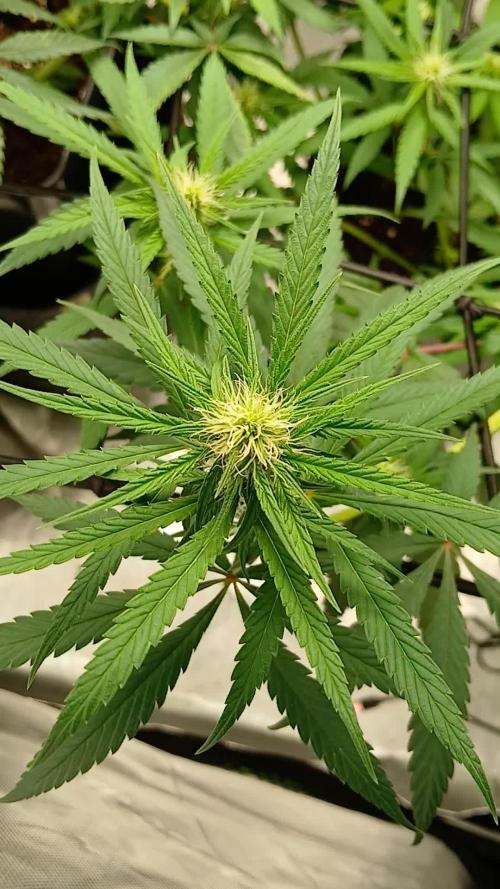

@kdifiori_
Follow
Week number seven for my little monster 💚
This week I set up the Scrog net to make it as wide as possible.
This beauty needs space! 🌳
Three good liters of nutrient-rich water for her this week. So far, I’m really happy with the results 💥
As always, stay tuned! ♣️



@gottagrowsometime
Follow
Welcome to my Damn Sour Diary sponsored by Green House Seeds.
DAYS 71-75 Pre Flower Days 2-6
Turning out to be a cracking little plant. Has a lovely uniformed structure that I'm very pleased with. Very healthy lush growth. Has throw up a leaf with cal def. So applied a high dose of Cal powder feed, "deeper details in Diet". She's taken to her LST great. Haven't had to adjust. She's making some lovely tight colas. Can't wait till pre is over so I can get in there and open her up. Haven't touched her defol wise, as you shouldn't while in Pre Flower. All the hard graft was done during her prolonged veg. She has just 3 top nodes. And was pult to make her fill out, and I think I've saved this from what it could of been, after I messed around with her. She's a very reliant Pheno as is all GHS gentics.
Diet:
Short flowering powder is currently been used, "From GHF". 5-550ppm. Also, I noticed a cal def on 2 leafs, "can be seen from 2nd last pic from above at the back" . So, gave her a dose of Calcium Powder from GHF. 270ppm 160ppm/110ppm ambient tap. Also she's been introduced to Terra Powers Bud Starter Fortuna, adds like 50-70ppm to water. PH - Bloom from Advanced Hydroponics is used to level it out to the feed level. I don't adjust my tap, seems to pick up the PH of what it's coming behind so not needed. Also Fire Yields will be used from TP enzyme line along with a few others from their collection. "Bud/Resin/Terp enhancers. Not many. I'll chose 1 of each and make that my primary Enhancer in its class. The days of juggling 14nutes are beyond over. Also, I'll be getting Green Sensation from Plagron with a few others. And whatever can be used in this grow will be used. So upon picking out what I like from there. Next wk, I'll be adding the 25:30 PK BOOSTER from GHF also. Rasing the ppm by another 150ppm to start off with .15G/L. As is the Short Flowering .45grams/L for an extra 450ppm added to your ambient tap ppm No.
LST
Was finally applied more to this fine lady. I opened her up some. I nearly snapped of the biggest of the nodes. She broke half way deep inearly taking the end of the top of the stem. I tied the node to the stem, securing it in place. I checked on day 77 and she seems to be pushing through it. Wonder what impact it'll have on the bud making process for that side of the plant. I'll go back after pre and open her up with hard defol(s) 15-20% 2-3x over the space of a week.
Lights
SP 3000 was used for most of this grow. And the IR/UV45 has made for such a quick flip. 5 days is all it took for her to be fully showing pre flower. I started seen a full flip within 3 days.
Big thanks to my sponsors from MarsHydro, Green House Seeds & Terra Power Nutrients. Much appreciated for all those who viewed, liked &/R commented. Look forward to seeing your own grows. Either way, thanks for stopping by.
COUPONS
Mars-Hydro (all sites) "ggs" 3% Discount
Zamneisa "GROWITGD" 20% Discount.
shorts_status_processing


@Jack_Greenstalk
Follow
growing happily along, platinum yeti stretching more then sour 76. defoliate day 21 . smell starting to come on, stopped using foliar feed this week, been on top of hitting compost teas every single off watering (1 feed heavy 16 nutes, 1 compost tea when coco dries. repeat).


