


Likes
Comments
Share


@Organic710
Follow
Great week for this tent. The plants are exploding with growth and the colour is incredible. The mammoth lights are really a game changer once you have everything dialed in. Still only giving them around 750ppfd to encourage more stretch.

Likes
7
Share

@DogDoctorOfficial
Follow
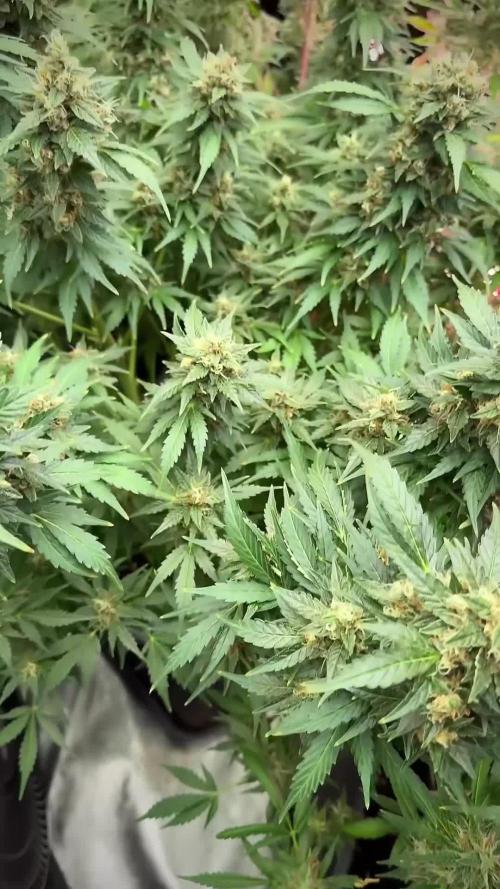
LSD — Week 12
12/12 from seed. Late flower. Full expression. Quiet hands, heavy flowers.
This is the stage where the grow starts asking less from us — and more from our patience.
By now, most of the work is already done.
Structure is built. Feeding has done its job. Environment has stayed stable. Roots have carried the weight.
And now the plant is doing what it was always meant to do:
Finish.
This is not the week for chasing numbers.
Not the week for aggressive changes.
Not the week for “fixing” what clearly isn’t broken.
This is the week for restraint.
For observation.
For letting the plant complete the final chapter on its own terms.
And LSD is doing exactly that.
⸻
Quick recap — how we got here
This run was never about force.
It was about rhythm.
From the start, LSD showed what stable genetics + stable conditions can do when they’re allowed to work without interruption.
No dramatic swings.
No constant corrections.
No overhandling.
No chasing deficiencies that weren’t there.
No feeding for ego.
Just consistent inputs, controlled environment, steady root-zone conditions, and enough discipline to leave healthy plants alone.
That’s what built this finish.
Now, in week 12, we’re seeing the result of every quiet decision made weeks ago:
* strong vertical structure
* dense flower stacking
* steady resin production
* proper late-flower fade
* increasing floral mass
* and a plant that is still focused on ripening, not surviving
That matters.
Because this stage is no longer about growth.
It is about conversion.
The plant is no longer trying to become bigger.
It is trying to become heavier, louder, stickier, and more chemically complete.
And it shows.
⸻
Late flower, properly explained
This is one of the most misunderstood stages in the cycle.
To newer growers, this phase can look confusing.
Leaves begin to fade.
White hairs begin to darken.
Growth appears slower.
The plant drinks differently.
Some leaves curl.
Some flowers swell unevenly.
The plant looks “older.”
And that is exactly what should be happening.
This is not decline.
This is maturation.
Late flower is the point where the plant shifts energy away from expansion and into completion.
That means:
* less vertical push
* less fresh green growth
* slower water demand
* increased resin output
* calyx swelling
* terpene maturation
* pistil oxidation
* nutrient drawdown from stored reserves
The plant is not slowing down because something is wrong.
It is slowing down because it is finishing correctly.
⸻
Trichomes — what they are, and what they are not
This is where the real story is now.
Trichomes are not “frost.”
They are not cosmetic sparkle.
They are not just visual proof that a plant “looks strong.”
And they are definitely not just sugar.
Trichomes are glandular resin heads — microscopic biochemical factories built by the plant.
Their job is protection.
They exist to defend the flower from:
* UV stress
* heat
* dehydration
* pests
* fungal pressure
* environmental stress
And inside those tiny resin glands is where the plant stores much of what we care about most:
* cannabinoids
* terpenes
* flavonoids
* volatile compounds
* aromatic oils
So when we say a plant is “getting frosty,” what we actually mean is:
The plant is reaching peak resin production and chemical expression.
That frost is chemistry made visible.
And right now, LSD is deep in that phase.
The resin is no longer just forming.
It is maturing.
That distinction matters.
Early trichomes are mostly clear — immature, still developing, not yet fully expressed.
Then they move cloudy/milky — peak cannabinoid development, strongest active expression.
Then amber begins — oxidation, degradation, and chemical transition into later-stage ripeness.
This is why trichomes matter more than pistils.
More than fan leaves.
More than fade.
Because trichomes tell you what the flower is doing chemically — not just visually.
And right now, these plants are no longer building resin.
They are finishing it.
⸻
The “curl” in the leaves
One of the easiest late-flower details to misread.
At this stage, some sugar leaves begin to curl, claw, or fold inward around the flower.
New growers often panic here.
But in late flower, this is often not a feeding issue.
It is not always heat.
It is not automatically toxicity.
Sometimes, very simply:
There is just too much flower and too much resin sitting on too little leaf.
At this point the plant is carrying weight, stacking density, and coating nearby leaf tissue in resin so heavily that those small leaves begin to tighten, curl, and fold into the flower.
It is a late-stage pressure response.
Part mechanical.
Part environmental.
Part genetic.
Very often normal.
Context matters.
And in this context — dense tops, heavy trichome load, stable temps, no major stress signals — this reads like maturity, not trouble.
⸻
Pistils — why the white hairs are changing
This is another classic late-flower marker.
Those white hairs are pistils.
Early on, they emerge bright white as the flower actively builds and reaches.
As the flower matures, those pistils begin to:
* darken
* curl inward
* oxidize
* retract into swollen calyx tissue
That change from white to orange/brown is not the plant “dying.”
It is the flower aging into ripeness.
Fresh white pistils usually signal active new flower development.
Darkened pistils usually signal that part of the flower is maturing and beginning to finish.
This is why late flower often shows both at once:
* older pistils darkening
* newer pistils still pushing
That is normal.
Flowers do not ripen all at once.
They ripen in layers.
And that’s exactly what we’re seeing now.
⸻
Feeding — why less is doing more
This is the point where overfeeding does more harm than underfeeding.
The plant no longer needs to be pushed.
It needs to be allowed to finish.
Right now the feed is still simple, controlled, and appropriate:
* Pure Zym
* Sugar Royal
* CalMag Pro
* Terra Bloom
* Power Buds
* Green Sensation
Nothing excessive.
Nothing chaotic.
No late-game bottle collecting.
No panic additives.
Just enough to support:
* final bulking
* resin maturity
* metabolic efficiency
* clean finish
That’s the right move here.
And yes — next week is likely the point where feedings begin to step down or stop entirely.
Not because the plant is starving.
Because the plant is done demanding.
That’s the difference.
Late flower feeding is not about force-feeding weight.
It is about supporting the final metabolic steps without leaving excess behind.
The closer we get to harvest, the less the plant needs to be fed — and the more it needs to be left alone.
⸻
Environment — why nothing is changing
This room is still stable.
And stable is exactly what late flower wants.
* 26°C day
* 18°C night
* 60% RH
* ~21°C root zone
* ~18°C solution
* 12/12 unchanged
* CO₂ stable
* watering controlled
And most importantly:
The plants clearly like it.
So we do not change what is working just because we are close to harvest.
Late flower is not the time to start experimenting.
Not the time to suddenly drop temperatures.
Not the time to force stress.
Not the time to chase color.
Not the time to “improve” a stable room.
Consistency is what got the plants here.
Consistency is what finishes them properly.
⸻
Weight gain — where the real growth is now
The plant is not stretching anymore.
But it is absolutely still growing.
Just differently.
This is density growth now.
Mass growth.
Calyx stacking.
Internal swelling.
Resin thickening.
Water redistribution.
Final weight.
This is where flowers stop looking bigger every day — but start feeling heavier every day.
That is late flower.
Less visible movement.
More invisible gain.
And this is where growers who harvest too early lose the most.
Not because the plant looked unfinished.
Because the final weight had not landed yet.
That weight is landing now.
⸻
What to expect next week
Next week is likely transition week.
Not dramatic.
Not aggressive.
Just the beginning of the final slowdown.
Expect:
* less water demand
* slower daily movement
* more pistil darkening
* more calyx swelling
* heavier tops
* continued fade
* trichomes shifting deeper into maturity
* feed reduction or full stop approaching
This is the point where observation becomes more important than intervention.
The job next week is simple:
Watch closely.
Touch less.
Finish clean.
⸻
Final thoughts
This is one of the most beautiful parts of the cycle.
Not because it is explosive.
Because it is precise.
This is where good structure becomes good flower.
Where patience becomes weight.
Where resin becomes chemistry.
Where restraint becomes quality.
LSD is no longer trying to impress.
It is trying to finish.
And it is doing that exactly right.
To everyone following along —
the growers, the learners, the skeptics, the silent watchers, the day-ones, the new names, the longtime supporters, the curious minds, the community, the platform, the sponsors, the believers, and even the doubters:
Thank you for being here.
Week by week.
Plant by plant.
Lesson by lesson.
Almost there.
📡 DELETED @ 1K Please stay tuned.we never quit https://www.youtube.com/@TheDogDoctorOfficial NEW 🙏 Thank you for your patience and continued support.
FOR DISCOUNT CODES AND MORE JUST FOLLOW THE LINK https://website.beacons.ai/dogdoctorofficial
📲 Don’t forget to Subscribe and follow me on Instagram and YouTube @DogDoctorOfficial for exclusive content, real-time updates, and behind-the-scenes magic. We’ve got so much more coming, including transplanting and all the amazing techniques that go along with it. You won’t want to miss it.
GrowDiaries Journal: https://growdiaries.com/grower/dogdoctorofficial
Instagram: https://www.instagram.com/dogdoctorofficial/
YouTube: https://www.youtube.com/@dogdoctorofficial Deleted by Youtube - https://www.youtube.com/@TheDogDoctorOfficial NEW
Vimeo : https://vimeo.com/dogdoctorofficial Under construction stay tuned ⸻
Explore the Gear that Powers My Grow
If you’re curious about the tech I’m using, check out these links:
🔆 Lighting & Environmental Control
• Future of Grow — Advanced LED lighting technology
https://www.futureofgrow.com/
DISCOUNT CODE: DOG20
• Lumiflora — Under-canopy LED lighting
https://lumiflorade.com/
• TrollMaster — Environmental controllers and automation gear (past collaboration)
⸻
Genetics
• Zamnesia Seeds — Genetics used in this project
https://www.zamnesia.com/
⸻
🌱 Soil, Substrates, Boosters & Root Support
• Plagron — Substrates, bio mixes, and supportive products
https://plagron.com/en/
⸻
🎒 Storage, Curing & Preservation
• Grove Bags — Curing and storage solutions
https://grovebags.com/
⸻
📸 Photography Equipment & Tools
(Not sponsors, but part of my creative toolkit)
• Sony A6700
• Sony full-frame macro lens + few more
• Stacking photography workflow - learning
• iPhone (for behind-the-scenes shots)
We’ve got much more coming as we move through the grow cycles. Trust me, you won’t want to miss the next steps, let’s push the boundaries of indoor horticulture together!
As always, this is shared for educational purposes, aiming to spread understanding and appreciation for this plant. Let’s celebrate it responsibly and continue to learn and grow together.
With true love comes happiness. Always believe in yourself, and always do things expecting nothing and with an open heart. Be a giver, and the universe will give back in ways you could never imagine.
💚 Growers love to all 💚
📸 P.S. – The Eye Behind the Lens
All photos in this diary (for now — except for the ones showing the camera, which I took with an iPhone) are taken with a Sony A6700 paired with a Sony full-frame macro lens and a few more.
Photography is part of the story — it’s how we share the fine textures, the glow, and the quiet details that words can’t always capture.
I’ve also started experimenting with photo stacking — a technique where multiple images, each taken at a slightly different focus point, are layered together to create one perfectly sharp image from front to back.
It’s not digital enhancement or AI; it’s pure photography — a way to reveal the plant’s beauty in microscopic depth, from trichome to petal.
You’ll even see a few shots of "ghost me" capturing the shots — camera, lens, setup — because every grow deserves not just to be cultivated, but documented like art.
FOR DISCOUNT CODES AND MORE JUST FOLLOW THE LINK https://website.beacons.ai/dogdoctorofficial
NEW DISCORD - Official Server Invite Link : https://discord.gg/ksjAkA5T74


Likes
Comments
Share
@DogDoctorOfficial
Follow
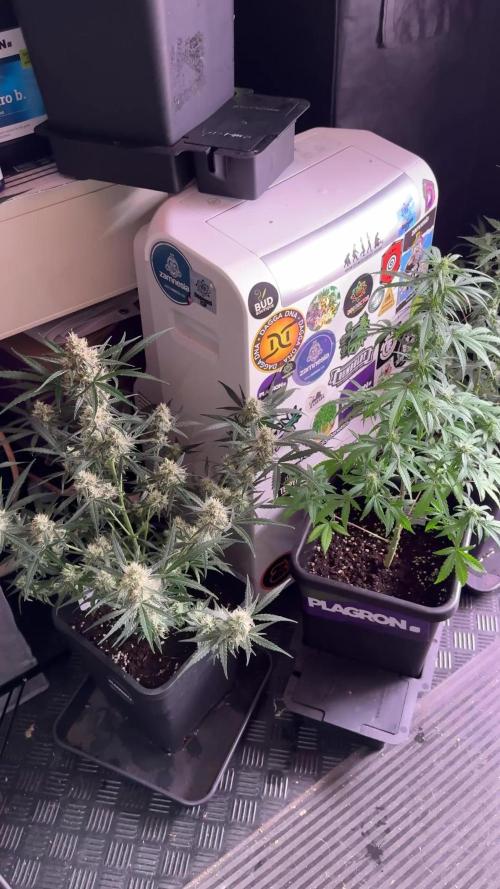
💜 Purple CousKush Auto by Zamnesia | Pheno A | Week 8 (Flower Week 5) 🌱
She Bent. She Bounced Back. And She Kept Building.
There are weeks in a grow where everything goes exactly according to plan.
And then there are weeks where life happens.
The room is busy.
The outside world keeps moving.
There are a thousand things happening at the same time...
And occasionally, one of the plants reminds you that even the best plans still require us to pay attention.
This week, Purple CousKush Pheno A taught me that lesson.
I underwatered her.
Nothing catastrophic.
Nothing that caused lasting damage.
But enough that when I looked at her, the leaves had completely dropped.
She was thirsty.
Very thirsty.
And this is actually an important distinction for anyone following the diary:
A controlled dry-back is not the same thing as allowing a flowering plant to become so dry that she starts wilting.
The first can be part of an irrigation strategy.
The second is simply me missing the watering window. 😂
So we corrected it.
She received her water.
We gave her time to recover.
And by the following day...
She was back.
And not only was she back...
She was ready for her next chapter.
💧 The Underwatering Lesson
When a plant becomes this thirsty, the first thing I look for isn't panic.
I look at the plant.
Leaves dropping dramatically from a lack of available water is usually a very different visual story from nutrient toxicity, heat stress or a root-zone problem.
In this case, the explanation was simple.
She needed water.
After watering, she recovered beautifully.
That quick recovery was reassuring and also a good reminder that plants can be remarkably resilient.
Still, during this stage of flowering, it's something I want to avoid repeating.
I personally prefer being slightly more conservative with irrigation rather than keeping the root zone constantly saturated.
But there's a difference between allowing a healthy dry-back and pushing the plant far enough that she has to start waving a little white flag.
This week, Purple CousKush definitely waved it.
Message received. 😂
I will do my best not to make her wave it again.
✂️ From Recovery Straight Into Defoliation
Perhaps the most impressive part was what happened next.
Once she had recovered and returned to normal posture, I gave her another day and then performed the flowering defoliation.
This was part of the broader room strategy we've been following.
The objective wasn't to strip her.
It wasn't because she suddenly looked unhealthy.
And it wasn't because every leaf needed to disappear.
The goal was simply to clean up the canopy and remove foliage that was no longer contributing much to the plant's structure.
Some of the interior and lower areas had become crowded, and selectively removing those leaves created more open space between the flowering sites.
More room for air.
More room for light.
More room for the plant to breathe.
And with the Lumiflora under-canopy lighting now part of the system, we're also able to observe which lower flowering sites are actually worth keeping.
The plant herself will tell us.
🌿 She Took It Like Nothing Happened
This is probably my favourite part of the entire week.
After being underwatered...
She recovered.
After being defoliated...
She didn't miss a beat.
She's standing there looking beautiful, healthy and completely ready to continue flowering.
No prolonged setback.
No dramatic reaction.
No hesitation.
Just...
Back to work.
And honestly, that's exactly what I love about this phenotype.
She has been one of the more energetic plants in this room from the beginning.
She stretched.
She branched.
She built an impressive framework.
She started stacking flowers.
And now she's moving deeper into the part of flowering where that structure needs to start paying for itself.
💜 Week 5 Flower – The Structure Is Paying Off
At approximately 125 cm, Purple CousKush Pheno A has become one of the taller and more distinctive plants in this room.
Her Christmas-tree-like architecture has become even more obvious.
A strong central leader rises through the canopy while numerous side branches form their own flowering towers around her.
And now, after defoliation, that architecture is even easier to see.
The plant has space.
The branches are separated.
The flowering sites have room around them.
And the entire structure feels much more open.
This is exactly what I want at this stage.
We're no longer trying to build the plant.
We're trying to help the plant finish what she already built.
🌸 Flowers Are Taking Over
The flowers continue developing along virtually every major branch.
Those bright pistils that were appearing last week are now becoming part of increasingly defined flowering clusters.
The buds are beginning to gain substance.
The calyxes are stacking.
And the first layer of frost that appeared earlier is becoming increasingly visible.
This is the beautiful transition where the plant starts looking less like a collection of flowering sites and more like an actual flowering plant.
She's not finished.
Not even close.
But the direction is very clear.
She's building.
And she's building everywhere.
💡 Photons, Air & Open Space
This is another reason I decided to clean her up.
Defoliation isn't about magically creating more light.
The photons are already there.
What we're trying to do is improve how effectively that light can travel through the canopy.
Every unnecessary leaf sitting directly above another flowering site can intercept some of that light.
Every dense pocket of foliage can also interfere with airflow.
By selectively removing some of those leaves, we create pathways.
Light can travel deeper.
Air can move more freely.
Humidity has fewer opportunities to become trapped between dense layers of foliage.
And the under-canopy lighting can interact with the lower structure more effectively.
It's a little like opening windows in a house.
We're not creating more air.
We're simply giving the air better places to go.
🌱 Same Genetics. Different Story.
One of the most rewarding things about this 8×8 Adventure continues to be the diversity happening inside one room.
Twelve different genetic expressions.
Same general environment.
Same cultivation philosophy.
Same room.
Yet every plant writes her own story.
Purple CousKush Pheno A has always been one of the plants that seems to have somewhere to go.
She's taller.
She's more energetic.
She keeps producing structure.
And even after a little reminder from me this week that she needed a drink...
she's right back there doing her thing.
That's genetics.
We can guide.
We can train.
We can manage the environment.
We can manage irrigation.
But ultimately, the plant decides what she's going to be.
💧 Feeding & Root Zone
The flowering feeding program continues with the Plagron lineup:
Terra Bloom — 2.2 ml/L
Pure Zym — 1 ml/L
Sugar Royal — 1 ml/L
Power Buds — 1 ml/L
Green Sensation — 1 ml/L
pH Plus / Lemon Kick — as required for pH adjustment
The target remains around:
pH: 5.8
EC: approximately 1.95 mS/cm
After this week's watering mistake, I'm particularly paying attention to irrigation timing.
Not because the plant is struggling.
Quite the opposite.
Because she's growing beautifully, and I don't want a preventable watering mistake interrupting that momentum again.
A healthy dry-back is part of irrigation management.
A wilted plant is my reminder to look at the clock. 😂
🌡️ Environment
The room continues providing a stable environment for the entire 8×8 Adventure:
Light schedule: 12/12
PPFD: approximately 850–1,000 across the canopy
Day temperature: 29°C
Night temperature: 25°C
Relative humidity: 60%
Solution temperature: 21°C
Root-zone temperature: 21°C
CO₂: approximately 639 ppm
The stability of this environment is what allows a mistake like underwatering to remain just that:
a mistake.
Not a disaster.
The plant was healthy before it happened.
The environment remained stable.
The root zone was given water.
And she recovered quickly.
That's one of the reasons I put so much importance on the entire ecosystem rather than chasing one individual number.
🔮 Looking Ahead
Now that the defoliation is complete and she's recovered, I'm expecting Purple CousKush to put her energy where we want it most.
Into the flowers.
The vertical stretch should continue slowing down.
Flower clusters should continue stacking along those long branches.
The calyxes should begin swelling more noticeably.
And resin production should become increasingly obvious as she moves deeper into bloom.
I'm particularly interested in watching how the cleaned canopy performs over the next couple of weeks.
More airflow.
Better light movement.
Less unnecessary foliage.
And hopefully...
no more thirsty ladies waving their leaves at me. 😂
💭 Final Thoughts – A Little Reminder From The Plant
This week wasn't perfect.
And I'm actually glad it wasn't.
Because growing isn't about pretending everything goes perfectly every day.
It's about learning to read the plants.
Purple CousKush told me she was thirsty.
I listened.
She recovered.
Then she let me clean her up.
And now she's standing there looking absolutely beautiful, waiting for the next chapter.
I still genuinely prefer a slightly cautious approach to watering rather than constantly keeping the root zone saturated. But there's a lesson here:
Dry-back can be intentional. Wilting is communication.
And this girl communicated very clearly. 😂
I'll do my best not to make her repeat herself.
For now, she's healthy.
She's recovering beautifully.
She's been defoliated.
She's producing flowers.
She's getting frosty.
And she's continuing to prove why she earned her place in this 8×8 Adventure.
Sometimes the plant teaches us through perfect growth.
Sometimes she teaches us by dropping every leaf in the room and saying:
"Hey, Doctor... I need a drink." 😂💜
A huge thank you once again to Zamnesia for these fantastic Purple CousKush genetics, Plagron for supporting the nutrition throughout this journey, Future of Grow for the incredible Black Series lighting, Lumiflora for bringing additional light beneath the canopy, TrolMaster for keeping the environment under control, and of course everyone following this crazy 8×8 Adventure here on GrowDiaries.
Every phenotype has a story.
Every week adds another chapter.
And Purple CousKush Pheno A?
She's still writing hers.
She bent.
She bounced back.
She got cleaned up.
And now she's shining again. 💜🌱
Until next week...
Growers Love and happy growing! 💚
Likes
2
Share

@IslandTerps
Follow
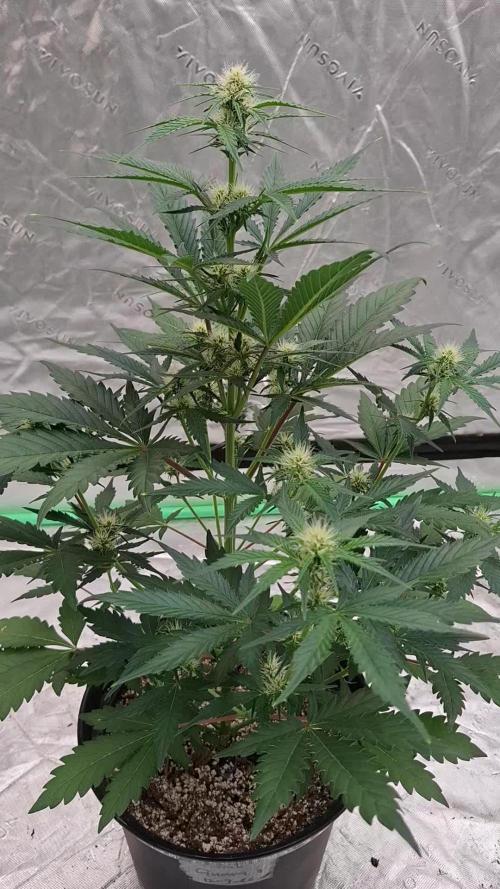
Strain: Fast Buds – Mendo Guava Auto
Grow Type: Indoor
Pot Size: 3 Gallon Pot
Medium: Peat Moss & Perlite
Nutrient Line: Athena
Week 4 Update
Well, this girl is shooting straight into flower now 🌿🔥. She is looking amazing and those bud sites are already starting to stack on some nice size. For only week 4, I'm really liking what I'm seeing from her.
At this point we've completely moved away from Grow and she's now running on Athena Bloom. I'm going to give those flowers a little more time to thicken up before introducing Athena PK at a low dosage. After seeing what PK did for the last run, I'm definitely looking forward to seeing how this girl responds to it.
So far everything is exactly where I want it. She's healthy, transitioning beautifully and there are no deficiencies or issues to report. Now we watch those buds start stacking 😏🔥.
Feeding
Volume: 1.5L
Athena Bloom: 45ml/gal
Athena Core: 25ml/gal
pH: ~6.2
PPM: 800–900 ppm
Frequency: As needed
Indoor Climate Conditions (Flowering)
🌡️ Temperature: 20–25°C
💧 Humidity: 45–55%
📈 VPD: 1.2–1.4 kPa
ISLANDT – 15% off Fast Buds strains 🌿🔥

Likes
13
Share


@COCOBAM
Follow
She is getting more and more white hairs.
We exposed a little more the bud sites.

Likes
51
Share


@kansasscott725
Follow
Well, this is it. Wish I had bigger buds. Everything was moving in the right direction until the end. I switched the Mars Hydro 3000 out with two HLG 300s, so I could maintain the PAR just under 1000, but perhaps it wasn't enough.
G13 is definitely not ready, and could benefit for a couple more weeks, but like a store liquidation, THEY ALL MUST GO NOW
All in all, Learned a lot. No seeds, reveg, or signs of mold, so hopefully I'll make up for quantity with quality.
Only Dry Time will Tell...


Likes
5
Share


@TheGreenRoom42
Follow
Maintains moisture with spray bottle and watering less than a 1/4 cup every few days starting 12/18. Cream Cheese with humidity dome germinated but didn’t root, reburied and now have 100% direct sow sprouts.



Likes
16
Share


@GorkedOut
Follow
Great grow from start to finish. Chopped on day 77 and very happy with the yield.

Likes
Comments
Share

@Yaadmanlabs
Follow
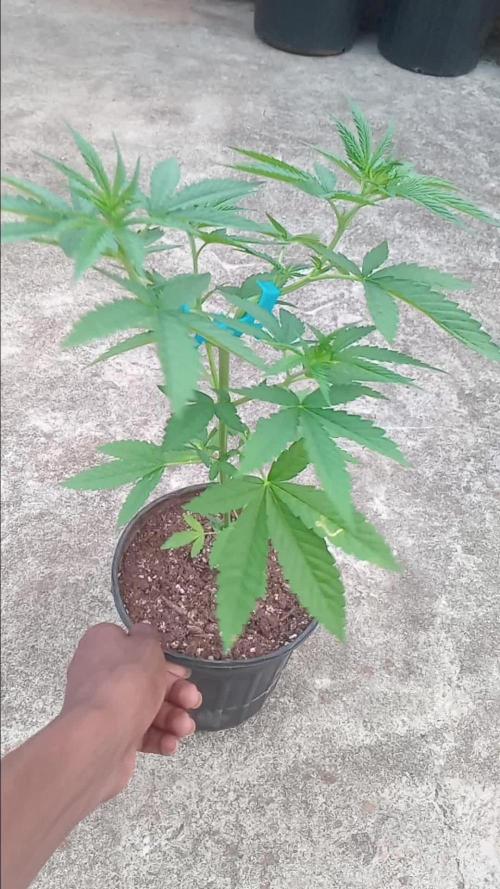
This looks amazing. Thinking of putting her straight in the ground in a few weeks
Likes
50
Share


@Wastent91
Follow
Ragazzi scusate il ritardo ma sono pieno di problemi in famiglia, che si stanno risolvendo, ma più lentamente del previsto, in ogni caso cerco di caricare il più possibile quando posso per tenervi aggiornati su questa splendida creatura, che si è rivelata una genetica pazzesca è dire poco! Potete vedere con i vostri occhi, una pianta neanche alta 60 cm che ha delle cime enormi, paffute, colme di resina e di profumi esotici! Spettacolare! Non ho altre parole per descrivere questa magnifica collaborazione tra sensi seeds e humbolt genetics! I fiori sono davvero stupendi! Mi disp quasi che debba tagliarla per fumarla, perché siamo in dirittura di arrivo, secondo me questa settimana è da raccogliere già, ma sta continuando a far diventare le cime sempre più grandi, quindi aspetto che sia completamente matura! Grazie a tutti voi che mi seguite! Un buon 420 a tutti voi e buone fumate! 👊💪😸😺🌱🌿🌴😽💨🇮🇹🌿


Likes
3
Share


@Skunkmaster420
Follow
A little upset with CROP KING SEEDS after I purchased Lambs Breath Auto and received a male seed from them.sad to say I had to pull the plant out.Now I’m watching the other 4 carefully and to me one of the small one in flower looks different as well I’m very upset with them .If there’s anyone who can tell me some trustee seed banks that ship to the US I’d appreciate it

Likes
2
Share


@BigDripFelgo
Follow
These buds are exploding in growth and trichomes. I do a very light defoliation plucking fan leaves here and there every couple days. Wish I would have cleaned up more on the lower of some branches for less energy waste on larf, will have to see how it finishes since this is the first time I use the SE1000 at 100% intensity.
Also want to mention that ever since I switched to water soluble Advanced Nutrients pro series the growth, development, visual, size, resin, scent and flavor of the buds has been day and night. Also it lasts ALOT longer compared to their liquid bottles, this is the second grow using it.

Likes
6
Share


@smokystyle35
Follow
Belle variété mais à du mal à pousser n'est pas très rapide.
Mais belle variété

Likes
Comments
Share


@CannabisCultivate
Follow
This one’s due for a little cleanup before she hits bloom cycle. Everything in the auto tent has taken very well to the Mills Nutrients.

Likes
19
Share


@Naujas
Follow
everything turned out very well :) and it's only with 50w and with 40x40cm space :) It was an interesting journey with her, a slightly different cultivation and old mistakes were discovered :) the flowers are not dense, but they are really very, very sticky :) I'm happy:)
Likes
5
Share

@ThatsmyGrow
Follow
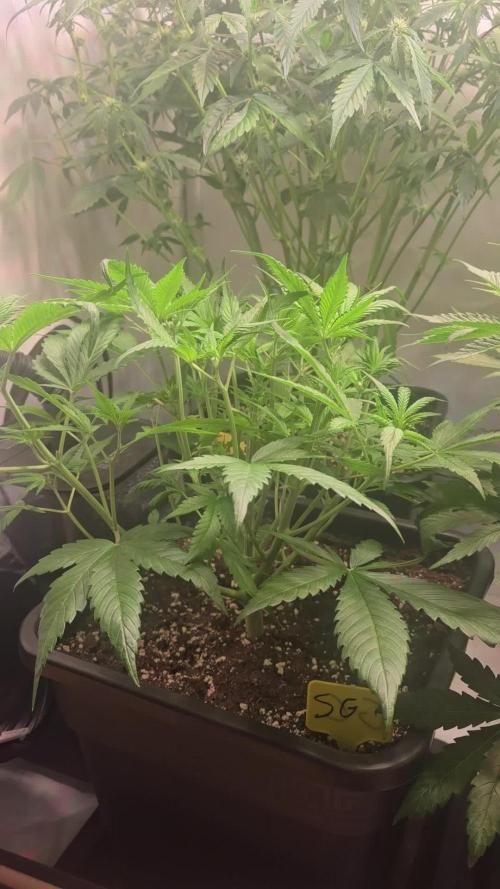
She's doing really well so far. I'm curious to see in the coming weeks whether she'll really grow as big as a gorilla.
Likes
27
Share


@Ganjagrandaddy
Follow
It is officially time to admit they are women now !.... Seeing all the little white pistils and the "starfish" look to the tops shows hope.
They have been spreading out nicely This week with even the Ghost OG gaining more vertical and lateral growth. There are easily defined differences already between these 3 ladies and having the variety to train together is always a challenge. I am hoping the Ghost can fill put in the next bit of stretch to get her canopy level with the others. The wedding cake is Thickening and growing daily so well now. She shows no signs of slowing yet either so I think she will dominate this NGT tray if not kept under manners !!. GG#4 is setting herself up nicely for some fruit bearing and I look at her skinny arms and wonder how thehell this strain can hold such dense buds without a total collapse but know from experience they can too. With these ladies being the last to officially become women , we are now in a full flowering room. Roll on harvest time in a out 8 weeks for these girlies now. stripping out at day 21 will help fix the final buds.
