


Processing
Likes
Comments
Share


@Isle_of_dank
Follow
Flicked to flower 21th June under two 600watts LEDs in bloom humidity 47to53 temperature 20c to 25c will update with pictures on 26th June

Likes
37
Share


@Wrongholn519
Follow
Day 70 for these Fastbuds beauties
Blackberry Auto:
With dark purple buds glowing fiercely and a dank smell to match, this girl could make anyone's tent look amazing. During the last few weeks her buds have become incredibly dense and sticky. She is very short and thick in stature compared to the other plants I have in flower. I inspected her trichomes over the weekend and ive determined that she is pretty much ready for harvesr. I expect about 2 oz of high quality flower after dry/cure.
Forbidden Runtz Auto
I'm really blown away with the turnaround in this girl. She was mutated & so small I almost tossed her out during early veg; I'm glad I changed my mind.
She stretched significantly between weeks 4-6 and I really wasn't expecting much from her. In reality, she has blown my mind... incredibly dense and sticky buds have developed in the past 4 weeks.
She's got the zkittles smell mixed with a gassy terp profile.. I think the higher humidity through flowering phase really helped develop these dense buds.
When I checked her trichomes over the weekend I determined that she will be cut down within the next 7-10 days.
Process/ Environment changes:
- Lowered my SF4000 roughly 20 cm to increase photon delivery to the canopy
- Water/kelp meal only from this point to harvest
- My temperature has risen due to change of seasons .. roughly at 27-28 deg C during daytime.. this is why I lowered my lights rather than turning them up
- Defoliating any unnecessary fan leaves at every chance I get
- I've had to use spools of twist tie to use to keep the branches from falling over from their own weight. I'll tie one end to the top of a branch, and the other to the stock. Not ideal but its working.
Cheese auto dry/ cure update:
After 10 full days of drying, I gave the buds a decent trim and put them inside glass jars where they will remain for many weeks. I add 2 way Boveda humidity packs to help regulate the relative humidity within the containers. I also use tiny hydrometer pucks to measure the humidity and temperature inside the jars. My ideal cure is at 62% RH

Processing
Likes
41
Share


@Hawkbo
Follow
Just started them all on the Green Buzz Liquid Organics and will run it the rest of the way. I'm not going to add much to the line just some calmag, enzymes maybe terpinator I have to experiment with it a little bit. The first feed went extremely well the plants instantly reacted within an hour after the feed especially the next day. The additives in this line barely raised PPM at all which I liked. It also doesnt stink like other liquid organics I've used.
These are doing good the big one seems to be flowering faster than the first run from seed with this cut. The second one is still completely untrained and the 3rd one is the weakling. Day 21 of bloom.
Added in a shot of the feed chart I'm using from G Buzz, white board is where I record the run off values especially during the flush👍

Likes
12
Share


@DrShotzUK
Follow
GORILLA PUNCH -420 FAST BUDS week 7
Such a nice smelling strain, been easy to grow without any issues so far, responds well to lollypopping technique..
Will use 420 fast buds for sure again.
DRSHOTZUK
Likes
25
Share


@Mosquito_Haarlem
Follow
Almost ready.
Look at the main bud 🤩
I will update fresh photos throughout the week.

Likes
42
Share


@GanjaReaper
Follow
In this week i decided to only give them another startbooster which contains some rootstimulator. Some days after feeding with startbooster, i gave them some water.
There are still so many kinds of nutrients in the soil.
The plants look a little light green, i have been checking my run-off water and it should be fine( still higher EC then i used to have but i have already explained why it is that way).
I'm not overwatering so it's not a (N)itrogen problem which can most of the time results into light green leaves.
( when there is no nitrogen in the soil the roots will not or barely take any water(nutrients)
I had the same thing with other sativas in the past, behind the window before and in later stages it got solved. I still have to remind myself that it is a fun-outside-grow so i should'nt complain about
low humidity(40-45) which should be 85%, temperature 20-21 degrees which should be 26-27, being behind a glas window instead of better exposure to the sunlight or lamps, not having fans on it to get
better firm stems or closer lightsource so they don't stretch that much.
For now i start getting them used to the sunlight by carefully putting them in shade places or with a few hours sunlight. It went well but except for the bigger pot plant,
you can see on the highest leaf that it got a little bit curly but still not a big issue.
I might buy some Canna Cure this week. Canna cure is good against insects, molts and such. It also holds some nutrients. Very usefull for outside growing.
Since i don't want to overwater or overfeed my plants because i want them to root alot, this might be a solution to give them some extra nutrients, it also makes the leaves more green.
When the plants are getting bigger and more thick i want to start doing LTS, i order to do so i just have a little bit time left to bully them a bit with keeping them dry for rooting.
I don't want to do that while doing LTS.
Don't mind the temperature meter, its not 32 degrees outside. It was still inside behind the window between the curtains. It hotter there. ( might also be the reason for some stretch in the plants)


Likes
5
Share


@Rizza78
Follow
Malt is sad after transplant. Red Hot good. Oozecake good. Seedlings are liking the new environment.


Likes
18
Share


@VI_Cannabis
Follow
First day went as expected. I put the paper towel in a small see-thru plastic container and put it on the table. With a bit of water and the seeds in side, the germination has now started!
Day 2 no progression, moved the tray into my furnace room (pitch black and warm)
Day 3 major progression. I got them out and started to prep the jiffy pellets. Shortly after I transferred the roughly half inch tarp roots with seeds into the jiffy pellets, root down, seed up, slightly covered with dirt. I soaked them in water (like a beginner i overwatered heavily knowing what I know now). I placed them back in the tray and put them at a window for light.
(Note) the plan was to do outdoor so no light or tent was ordered at this point.
Day 4-7 not much progression seeing as the clouds and rain showed up...
Likes
4
Share


@electabruce420
Follow
D33 15/04 one is flowering hard and the other one is stunted/taking its time
Healthy enough at least


Likes
23
Share

@kevxyn
Follow
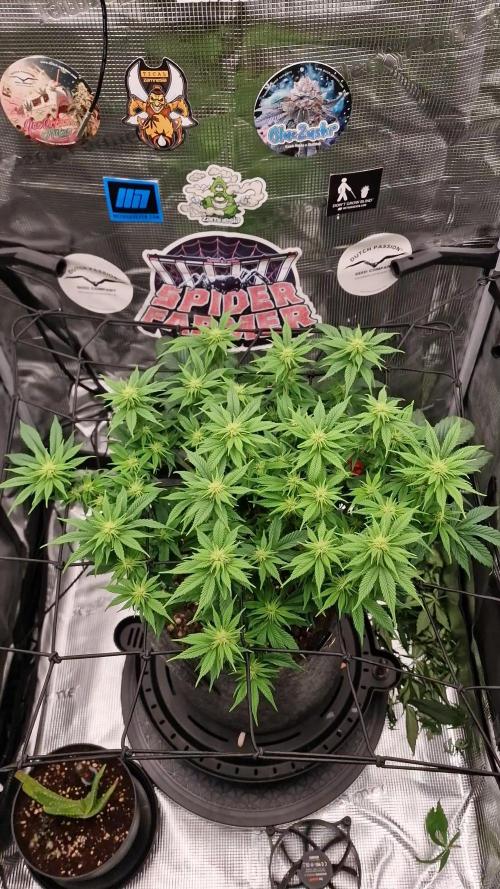
Diese Woche habe ich sie noch einmal ordentlich entlaubt. Jetzt ist sie ready für die Blüte. Die letzten zwei Tage durfte sie in Ruhe chillen und sich erholen. Ab heute bekommt sie 75 % Lampenleistung. Ich hoffe auf richtig große, schwere, fett stinkende Buds.😅🤣😎
Likes
4
Share


@MallorcaGrows
Follow
Not much to say, I've started to use the organic pesticide and it seems to work great, next week I am going to start adding Special Final Explosion (PK 52, 34) also I plan to harvest the left-side plant on week 11, I'll keep you guys updated, see you next week!
PD: sorry for the video quality

Likes
Comments
Share

@JorCones
Follow
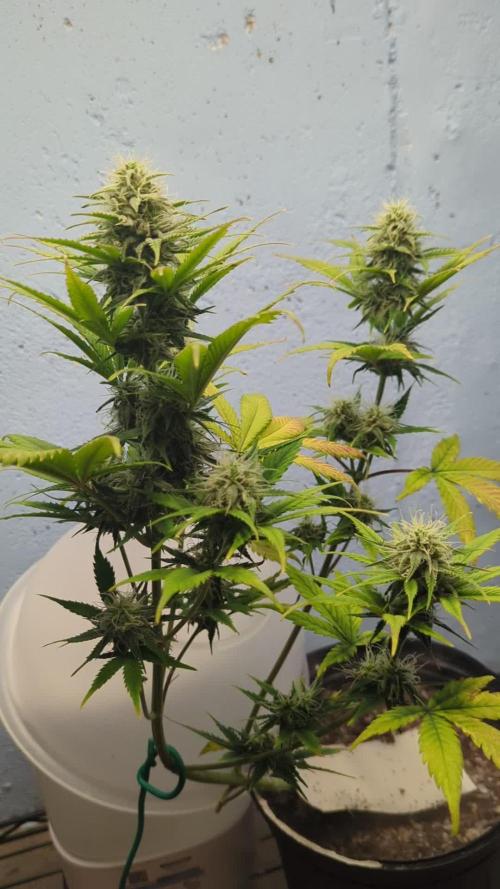
Again still not as healthy as I would like, but as a thrown together week-to,-week mess around project I think it's ok :).
Likes
8
Share


@Growin_Ish
Follow
Day 50 overdue feeding and watering. 5g SimPro Bloom half gallon of 6.5PH spring water each.
I'll never choose this fertigation method again. So much easier to amend the medium then top dress every 30 days.
The plants seem normal for 50 days from seed, but not normal for a plant that is supposed to be harvest ready 60 days from seed. A few people here on GDs ran this strain way passed 60 days and maybe this is why. It's possible some phenotypes just take longer. No smell and no trichomes at this point. I would guess they need another 25 to 30 days to nug up.
Day 52 they are both praying but still cannibalizing themselves. 5g isn't enough. Considering a top dressing.
Day 54 - pulling 5 yellow leaves per day. This is not nutrient deficiency, these plants are fading. SMH I am behind pissed! Wasted 2 months of tent space and nutrients. I didn't do everything right, but the lesson for me is to stay away from fast strains. This is actually motivation to switch to photos. More forgiving of the small mistakes.
In this case I overwatered in early veg. I should have tossed them both then.
My preamendment ratios were off and I switched to water feeding during preflower. All of this has resulted in a plant that looks to be done in a week with marble sized fluffy buds that have zero trichomes and no smell. PISSED OFF!!!!!
I'm learning through my failure but it still sucks!
Day 55
Watered both with rain water, CalMag, and SimPro Bloom. I know CalMag isn't recommended in flower but I don't care about this bull crap plant anymore. I'm popping new beans and am gonna run these two as far as possible to see if I can get a decent top cola at least. Still pretty pissed.
Day 56
Pics show how they respond to watering. Sheryl is praying, Candace leaves are up, but not praying like Sheryl. The only smell on either is from a stem rub. No visible trichomes. Not when I even zoom in. So odd!
Day 58
Finally have some odor! These plants are growing like a regular auto-flower. I've been freaking out because the breeder says it's a fast strain (60 days). The lesson here is to always listen to the plant. Scrap the website crap and pay attention to pistils, leaves, and trichomes.
They look and smell good for day 58. The yellow leaves are likely due to me adopting an abbreviated / hybrid feed schedule to suit 60 day seed to harvest. The day 55 feeding was 6g of SimPro Bloom in 51oz of water and that seemed to hit the spot.
I need a good loupe so I can have a strong finish.
Day 61
Fed Candace 1tbl of Terp Tea with Azos & Mykos, plus Fish Sh!t. Half gallon of Spring water.
Bottom fed Sheryl Azos, mykos, & half tbls of SimPro Veg in 16oz of Spring water.
Likes
103
Share


@DeepWaterGrower
Follow
🌱🌿🌸SUMMARY🌸🌿🌱
I started this crop with 4 plants as you can see in the pics, 2 autoflowers by RQS and 2 photoperiodics. My plan was as follows: grow the two autoflowering plants until harvest and in the meantime do a long vegetative period for the two photoperiodic plants, and then proceed with the switch. One autoflowering plants, the Titan F1, did not respond well to the training and I preferred to remove it on week 5. Fortunately there were no problems with the other three plants (I made a different diary focused on the two photoperiodic). Milky Way F1 grew in a space dedicated to her of 90 cm x 40 cm (0.36 m2), under a 150 watt lamp which in the meantime also illuminated the other plants.
🌱 GERMINATION (2 days)
Seed in a glass of EC 0.4 tap water for 10 hours, then in root riot and under the lamp. It sprouted after 48 hours from dry seed.
🌿 GROWING STAGE (3 weeks and half)
During the 23 days after sprouting she had an impressive growth ratio. When she reached 25 cm in height I decided to bent the main stem to the side. On day 24 I opened the canopy with some tie, then I removed a good amount of leaves. The key with this kind of auto, the F1, is not stress them in the wrong moment but if you want to boost them yield you need to do some train, carefully!
During the veg stage PH was always between 5.5 and 5.9, about EC I started with 0.6 and was 1 on the last veg week.
🌸 FLOWERING STAGE (7 weeks)
She began the flowering stage on day 26 from dry seed (was 20 cm height after the bending) and by the end of the stretching she more than doubled the height, reaching 46 cm despite the LST on week 3 and 4. During the flowering I just removed some leaves on week 4 and 8. The light cycle I used is 18/6 and the last two weeks I lowered the light hours to 16/8 first and 14/10 then. I chopped her when trichomes were 95% milky and 5% amber. That gave me a very balanced high.
During the flowering stage PH was always between 5.9 and 6.2, about EC I started with 1.6 and was 2 on the last week before flush.
✅ HARVEST
- From dry seed to harvest: 74 days (2 days germination + 23 days veg + 49 days flo).
- Chopped after 4 days flush, no dark time;
- Wet trim, removed fan leaves. This plant had a ridiculous calyx-to-leaf ratio, it was just big buds!
✅ DRYING STAGE
- Time: 15 days;
- Average: 18° C - 60% RH.
- After that I made a dry trim, removed branches and sugar leaves.
⚖️ DRY WEIGHT
- 110 gr very frosty buds, no larf 😁
✅ CURING STAGE
- Curing is done after 45 days with Boveda 62%.
Likes
41
Share


@Mother
Follow
Hey everybody! Kaiydaan, Kaiydan, Kaiydaan. I have no idea what's going on with this gal, she isn't doing to much of anything. Unlike, Freeman who's just flourishing, showing all shades of pinks and purples and swell calyxes. Anyone got any advice on Kaiydaan?
I'm watering pH'd tap water. I tried to indicate that in "Nutrients", but the Diary made a Frown Face at 0 nutrients.
Aug. 26, 2021, Thursday. I watered Kaiydaan and Freeman.
Aug. 27, 2021, Friday. Freeman is doing well no issues. Kaiydaan, I just don't know. Her calyxes are not swelling, they're growing in and what seems to be dying off a bit. Her leaves are dead, dry, brittle and yellow. I don't know she is a complete nightmare compared to "Freeman"
Maybe I'm reading to much into it and Kaiydaan is going through a natural fade. Any ideas?
Aug. 29, 2021, Sunday. Nothing new to report.
Aug. 30, 2021, Monday. Nothing to report.

Likes
71
Share

@Mosquito_Haarlem
Follow
Hoi leuk dat je een kijkje neemt.
Week 9 is begonnen en ze gaat onverstoord verder.( ik maak een telfout 🤦♂️🏽 eigenlijk begint week 9 over 2 dagen 😆)
Prachtige kleuren bladeren en de toppen worden dikker en dikker. Ze is eigenlijk te groot voor de tent, de hoofdtop staat 15 cm van de lamp verwijderd. Veel te dichtbij eigenlijk.
Heb niet al te veel bladeren weggeknipt (defoliation). Minimaal.
Ze drinkt wel zeer veel. Bijna anderhalf liter per dag.
Laten we kijken hoe zij zich deze week weet te ontwikkelen. 🧐
Ik zal gedurende de week nog verse foto's updaten, dus hou het in de gaten.
To be continued....
Day 59 begonnen met toevoegen van sugar royal


Likes
5
Share


@Smokeitup091191
Follow
This week has gone well again. All plants are in flower now 3 I would say are a week behind the others. Ztrawberries without doubt is looking like the busiest girls with each day presented new changes in there grow the terps are starting to come through abit now, all smell amazing and it will only get better!! This week increased EC to 1.8 and plants are reacting very well not really had any issues as yet 🤞🏼
Ztrawberries seem to have stopped with the stretch ranging between 130 to 100cm, Tropicana cookies are between 120- 100 but one is still stretching and Cherry cola seems to be having a little stretch at the minute at 80cm but still going ✌️🏽
Likes
1
Share


@Ogchemst
Follow
First day in Flower! It's been... very interesting 2 weeks.. now that I survived tha, im having some lockout due to being unable to take care of my plants for the past 5 days and someone having no idea had to do the job, I'm not afraid of showing these mistakes I'm always looking forward to the outcome so I'm still having some hopes for this og kush, not everything here went as planned and that's why I want to focus on finishing up the grow and starting new ones, better ones as soon as possible, I will definitely never grow autos again as I'm just not a fan of them having to be on 18/6 schedule and I like having co trolley over my plants as sometimes things can go wrong.
Og kush had a lockout after flush it grew beautiful but still ate up some of the upper leaves.
Runtz.. yeah I like him he is a beautiful little bonsai he didn't get lockout too much but also did I'm looking forward to seeting the stretch on him if it so happens.
Cherry gusher, a tiny pheno I got this time I'm looking forward to growing 4 next time and hunt down a pheno.
They say outdoors you have to play with God and indoor you try to play God.. we are not perfect and that's why I'm looking forward to the finish line.
Will i scrog? I have the net setup but I'm not sure if I will get enough stretch.
Day 3 I noticed some light white spots on bottom leaves of the plant after a flush I did recently, I diagnose this as magnese or magnesium deficiency, I'm going to up the cal mag to 8 ml and a+b to 10ml per 5 L of water along with additives extra 0.5 ml just as a touch up. Also I noticed we are at 47cm at the tallest branch after topping and lst and this thing is an absolute bush.. I could probably hide behind it if I was a kid playing hide and seek!.
Likes
4
Share


@AJarOfNotDirt
Follow
Plant starts to change colours , trichomes start changing from clear to cloudy . I am checking the development every 3 Days , looking in top , middle and bottom , to get a good avg. result .
Overall I want like 5-10% Clear ones , 70-90% cloudy ones and around 5-10% amber ones , this wont be achieved perfectly in every layer , but gives me a little more variety in the effect later on.
I do sort them when I put them in jars or curing bags.
I flush with around 2-3l with a little top max acti vera and heaven like 1-2ml per l on the first flush with like 10 % runoff , after like 2 Days i went with clear water aiming for very little run off .
Also cleaning my pot with a pump sprayer to get salts and used fertilizer out of it .
I think the plant has another 1-2 weeks to go .