




Likes
148
Share


@BioBuds
Follow
An here we are. At the end of another cycle. The end of another year, and what a year it was. For Sunshine and me personally, it was a tough year, with our families sick on multiple occasions, life-threatening. We are very thankful for many things but most of all that all our parents are healthy again.
We wish your families are as fortunate in the coming year.
So we end this Gorilla's life with a swift cut of the scissors, after thanking her again for the companionship, the well-needed distraction, and all the love she has given me already.
I sometimes read that people won't go near their plants when they are angry or sad. Please do go to your plants when you are sad or angry!
They are millions of years old. They have been healers of animals and humans since they were around. Our emotions can not taint something so pure as the spirit of this plant.
She will heal us, give her life for us, sacrifice herself for our healing. She is all-powerful and all-knowing, there is nothing we mere humans can do, except disrespect her powers.
Bask in her glowing light, enjoy her soothing energy, her creative spark when you are in need of love, just don't smoke her at that time, for she will soothe you bit not give her treasures, she will seduce you.
Next to thanking Santa Maria for her healing, we would like to thank our friends here, all who shared their kind words, advice, and attention.
I had made a video to share my thanks on video, but every time I got very emotional. You guys have no idea how tough this year was.
The gorilla is real easy to clean and sticky and cristally. Its amazingly great to smoke!
So a special thanks to: @Sailormoonflowers for being a buddy to talk to, @JamMAKEcan for being there with ideas and always a lot of love, @Roberts for being an inspiration @Cannabeast and @LegendarySeedThumb for always checking out my grows, to all who I forgot who are always here to greet me! @Growdiaries for being an awesome site and community and last but not least: @MarsHydroLED for letting us try their SP-3000.
VERY HAPPY NEW YEAR XXX
We wish all of you freedom, love, happiness, but also the awareness to see many of us are still being repressed, with growing but also with our human rights.
Jah jah gave us life to live, so let us live brothers!
It is time the rastaman made a plan!
We are 99% loving people on this planet, we need no 1% to fuck it up with wars and strife.
We need to stop cooperating, peacefully resist. If you can buy local, ban exploiting multinationals.
Help your local businesses, help your neighbors, we need to wake up and stop funding this black stain on our planet.
Sell your stock in multinationals, invest in local businesses.
Buy local products, speak out when you get taxed higher than millionaires (and you are).
The day is coming my brothers and sisters. Soon a handful of CEO's will find out when billions are done with them.
For now thanks for everything!

Likes
8
Share


@Fa5Venom
Follow
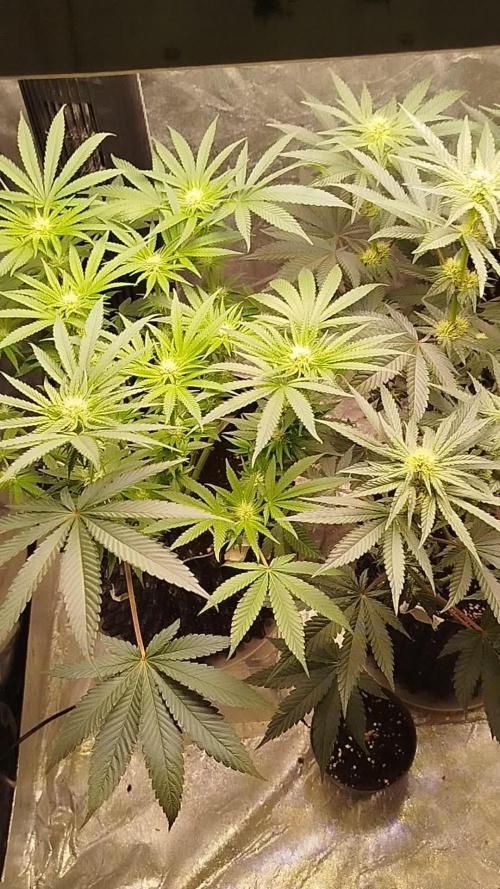
End of 4th week soil had dry out so wasn’t taking any waters? Plants droopy like crazy had to soak them in the sink to get soil wet. Good after that gave them a little nutrients since it’s day 37 and they are doing really good. Took some leaves of that were blocking bud sites and little lst to stretch this branchesw

Likes
5
Share

@Ruthlez
Follow
Anfang bis Ende der 2. Blütewoche.
Ich habe noch ein letztes Mal entlaubt und Äste in position fixiert

Likes
167
Share


@PapaNugs
Follow
An exciting week here training this girl. Was spacing her out throughout the week using the low stress ties. You can see all of them pulling her out. Idk what to do with the middle ones. I've tried those before but they kinda stunt for me.
Watering every other day right now. And I know, I've gotta defoliate her. I'll do that when I lollipop mid week. Having said that, there won't be much this run as I trained while in flower.
At 100% power
Here are the lights details:
Medic Grow Mini Sun-2 150W LED
Model: MN150-022
Spectrum mode: V1
Efficacy: 2.8 umol/J
Thanks for stopping by!
You can find the light on Grow Diaries:
https://growdiaries.com/grow-lights/medic-grow/mini-sun-2-150-watts
You can find the light on Medic Grow's website:
https://medicgrow.com/

Processing
Likes
15
Share


@dank604
Follow
Girls are trucking along without much issue. I did have a bit of PH flux due to my PH meter calibration being off but no biggie, she didn't show too much signs of stress. These girls are starting to stink which I'm happy about, hoping for a really cheesy harvest :D

Likes
5
Share


@weedelicious030
Follow
Diese Woche stand eine große Entlaubung auf dem Plan. Alle haben es gut vertragen. Ende dieser Woche wird die Vorblüte eingeleitet

Likes
4
Share


@Farmeryo901
Follow
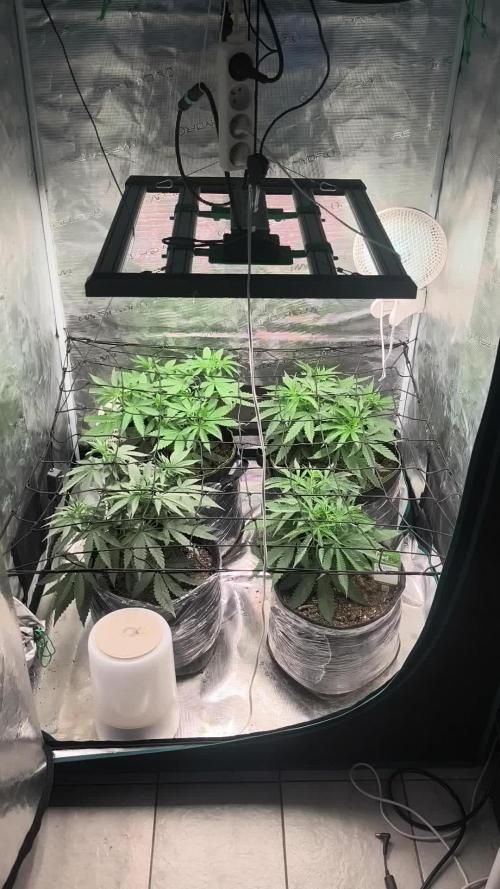
Experiencing what seems to be my first nutrient lock out. Bought a soil ph tester from homdepo its reading 7.0 so that what bring me to that conclusion on top of the slower growing and the slight yellowing around the leaves. I was being cheap and using the liquid ph tester that comes with the ph up and down and im regretting now seeing my plants in not the best condition. Im ordering a better ph pen today i used the vivosun one the i currently have got the water to 5.8 checked the run off and its at 6.2 hopefully that helps. Saturday im going to top dress and water at 5.8 aging and im thinking that should put me back on track
Any advice i could definitely use some tips and pointers


Likes
176
Share


@Herbalize
Follow
Hello folks
Havest Day 53 of flowering ( Life cycle 93 days )
Drying with 59% RH--17/18°C since about 10 Days
it's the start for curing.
Overall everything went well
I learned a lot, and I must be close to 0.7 G / W which is good in my opinion.
6 Plant was way too much with 40 days of growth and my little square meter , next time 4 max!
I would also reduce the doses of fertilizer because Canna remains strong enough
Now it's time to invest and improve some things !!! Soon ™️ 😋
Thanks to all who comment / like either to encourage or give advice
see you soon guys 😘
Peace Love and Weed 000

Likes
6
Share


@Roller
Follow
Semi Jealousy-Zamnesia, messi ieri nel bicchiere, si aspetta che germini, intanto sto preparando il box e la lampada, per quando saranno pronti per la vegetazione

Likes
70
Share


@KilgoreTrout
Follow
Going great. All my perameters are right where I want them. Scroging has begun and I’m adjusting every two days or so. Feedings about three times a day. Going through about five gallons per day without a lot of runoff. How are the ladies looking to you lot?
By the way today’s date is December 15th 2018 because grow diaries doesn’t tag these updates automatically(a really big oversight in my opinion) I use this diary mostly for personal reference.

Likes
7
Share


@BiofuelEmpire
Follow
This was one seed that sprouted two plants i found its not all that uncommon in plants but cannabis specifically i believe it is they both look healthy i seperated them carefully from the peat pellet nothing broke i ven found the seed casing and carefully transplanted them into solo cups i hope this works and they are female i would love to clone these as well as see the phenotypic differences between the two
Likes
361
Share


@Ju_Bps
Follow
Hello my friendly growmies 👩🌾👨🌾🌲🌲,
We start to be really close to the harvest 🌲✂️, trichromes not yet ready but soon, I like a few percentage of amber, they are almost totally milky, so probably ready in end next week 🙂🙂
Smeel fruity/diesel
💦 1 watering this week 2.75l/plant
Water + flash clean
Lamp @100% and start to be really close to the plant, but not burning sign for the moment.
Thanks community for follow, likes, comments, always a pleasure 👩🌾👨🌾❤️🌲
Have a nice end years 2022 💜👨🌾👩🌾🎅
See you new year 🍻🥂🥃🥃💨💨
Mars Hydro - TS1000 💡💡
https://www.mars-hydro.com/ts-1000-led-grow-light
Mars Hydro - FC3000 💡💡
https://www.mars-hydro.com/fc-3000-samsung-lm301b-led-grow-light
RQS - Fat Banana Auto 🍌🍌🌲🌲
https://www.royalqueenseeds.com/autoflowering-cannabis-seeds/487-fat-banana-automatic.html
Likes
2
Share


@eldruida_lamota
Follow
Que pasa familia, vamos con la novena semana de floración de estas Gorilla Melón feminizadas de fastbuds.
Vamos al lío, de las 3 plantas, me quede con 2 por espacio, siempre pongo alguna semilla de más por si no abriese alguna por no perder ese hueco del indoor.
También se trasplantaron a su maceta definitiva, en este caso de 7 litros que además provocó un shock que también solucione.
El ph se controla en 6.2 , la temperatura la tenemos entre 20/24 grados y la humedad ronda el 50%.
Las flores están bien prietas y sacan unos aromas afrutados y dulces increible, está acabando de madurar pero no veas como se han puesto.
Hasta aquí todo, Buenos humos 💨💨💨

Likes
20
Share


@Bread_n_Buds
Follow
Our Zamnesia autoflowers have been on their journey through the magical flowering period for a while now, this is the second week of flowering considering that autoflowers still flower spontaneously some sooner than others but all around the 3rd-4th week. .
---- The general environmental conditions are good, the heat has increased a bit more but for the first weeks of flowering it is not a big problem, let's remember to never exceed 27 degrees centigrade in the last 4 weeks to avoid compromising the quality of the flowers. If necessary open the growbox but never let it exceed 27-30 degrees
where 30 is already a lot. The positive thing is that as soon as the lights go out the change is already somewhat visible and as autumn progresses we will also improve. The humidity is fluctuating but we try to control it with two dehumidifiers when necessary, pushing both of them possibly not into the growbox but directly into the room. (I dehumidify the room and the air in the growbox should also be dehumidified)
--- This strain is another important name of the old school. The Zamnesia elves noticed that I am gray and surely thought that I am a lover of old flavors. In fact, if I taste the original Northern Light I immediately go back to Amsterdam in the 90s early 2000s. And this happens to me with the cheese when I find it, with the Blueberry that broke my legs on arrival once, with the Skunk and SuperSkunk that were the first Dutch things that arrived in Italy. Wow what memories. Terpenes also do this, they leave well-defined memories thanks to smells and flavors. It grows vigorous and strong, old school strains are super stable, we know. AH there is a second twin that I have not shown you yet that in my opinion, judging by the leaf, is the closest to the Classic Northern Light. A strain to go to bed peacefully, they used to say.
--- Fertilizer program - The fertilizers are always Plagron and I am following the table that I generated on the site depending on the chosen substrate. Create your own card and follow it, never be presumptuous my friend as I have been in the past, follow the card and look at the plants, not all need the same amount of fertilizer. We have come to the time to give a good dose of iron in the first weeks of flowering, already of race life not sprayed but mixed with fertilizers. We then added the power buds to stimulate the birth and development of the flowers.
---- https://plagron.com/it
- Power Roots - 1ml/l
- Alga Bloom - 4 ml/l
- Pure Zym - 1 ml/l
- Sugar Royal - 1ml/l
- Vita Race - 5 ml/l
- Power Buds - 1 ml/l
--- The dehumidifier now runs between 50% and 55%
--- The 100% Organic pack by Plagron can be found on Zamnesia at the link: https://www.zamnesia.io/it/11457-pla gron-easy-pack-natural.html
// Strain Description // Born from the rib of a classic, Northern Lights Automatic is a weed from the past, but with a futuristic update. This feminized version sees Northern Lights hybridized with a ruderalis to create an extra sweet variety, that all fans are sure to love. Growers can expect abundant results in just 9 weeks, from seed to harvest! -
- Get a seed of this fantastic strain --- https://www.zamnesia.io/it/3324-zamnesia-seeds-northern-lights-automatica-femminizzato.html
- Soil and Fertilizers entirely organic --- https://plagron.com/en buy on www.zamnesia.io
- Growbox and air sistem --- https://www.secretjardin.com/
- Light — P2000 - https://www.viparspectra.com
- Music and sound --- I made my girls listen to 432hz frequencies and music from www.radionula.com
- Z --- You can find these seeds, much more from the world of cannabis, mushrooms and an incredible series of accessories and gadgets on the reference site not only mine but of many growers ---- https://www.zamnesia.io
Processing
Likes
17
Share


@Elpakkio
Follow
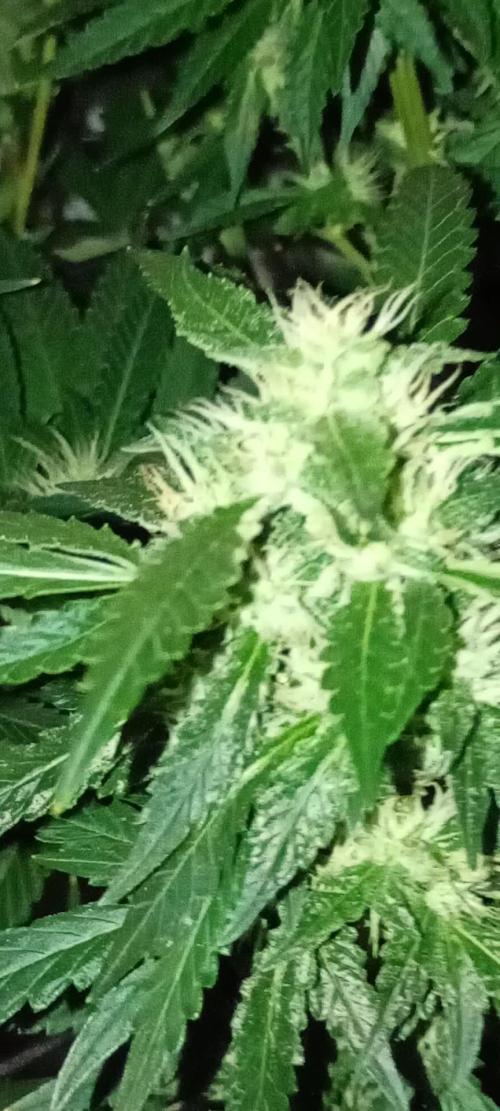
This week will be the last week I make a flush on this girls 5 days ago and I still waiting the day cut! The smell of this plant is amazing




Likes
7
Share


@Mrg7667
Follow
Rough week! Found two major hermie issues Pheno #5&2. Could be because they where the OGs and they just had a long stressful life. Really bummed because they where the biggest in the tent for sure. Have a coupoe tops with orange hairs so maybe got pollinated, all i can do is keep my eye on them!
Besides that everything is looking so great had to re-train and move canopy around but still have full coverage. Getting allot more tops

Likes
33
Share

@BabaHase
Follow
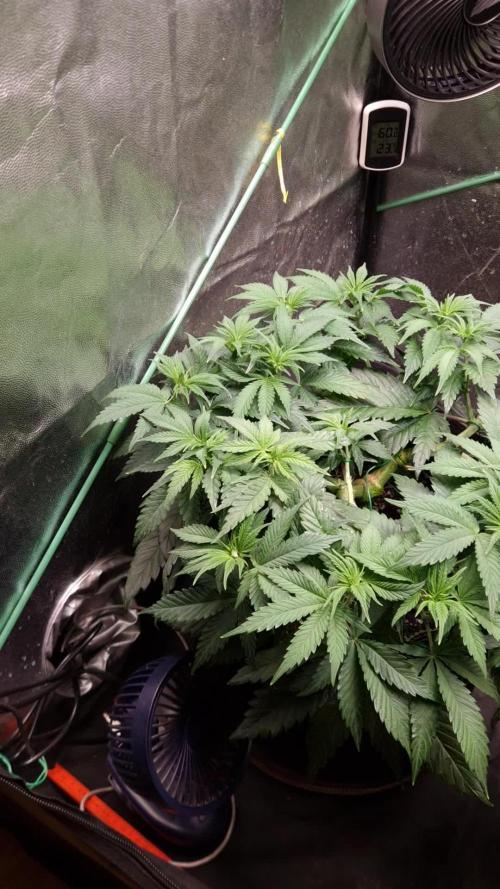
Nach 55 Vegetationstage wird nun endlich die blüte eingeleitet. Habe heute am 01.03.2026 das licht auf 12/12 umgestellt und somit hat der 1. Blütetag begonnen.
Habe ihr 1,5 wochen ruhe gegeben um gelassen in die blüte zu starten. Sie hat in den 10 tagen ca 10cm zugelegt auf allen 16 trieben. Die untersten hab ich bereits an Vegetationstag 49 entfernt. Jetzt heißt es erstmal beobachten und schauen was wird. Wir hören uns nächste woche gemeinde 🍀🍀