


Likes
Comments
Share


@HazeGrowGang
Follow
Buds are looking hairy and pretty dense not the exact look I was going for but its looking kinda good but I don't think this will be my best grow I'm not exactly sure what went wrong. I'm looking to get that real nugget looking type of bud and less hairy and airy. Please Help!

Likes
1
Share


@BucketHatJack
Follow
Watering every day. Tucking leaves and tying down whenever I’m in the tent. Removing large fan leaves blocking prime bud sites. Looking good.

Likes
17
Share

@RakonGrow
Follow
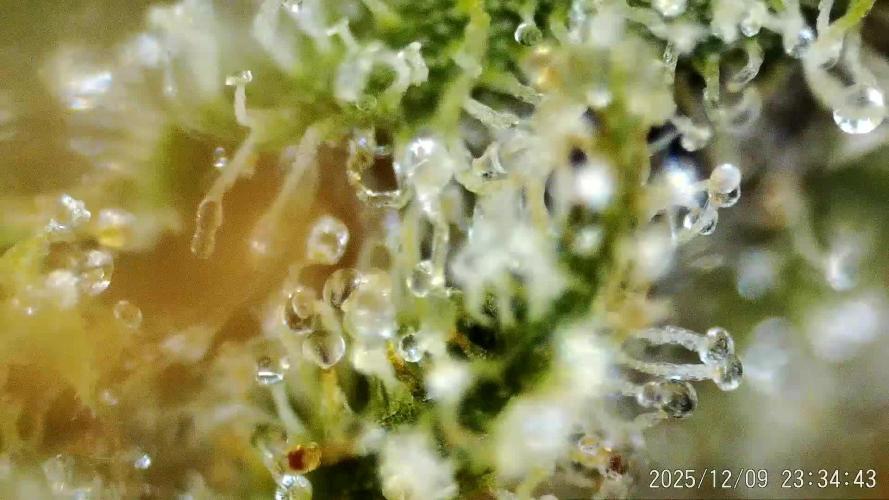
Harter ritt diese Dame , alles viel zu schwer das es gleich umknickte beim defolieren .
Hab mal ein getrockneten Bud aus der mitte genommen und Trichom analyse (Videos und Bilder) gemacht . ja viel klar wenig milchig und einige rot . Ergo , zuviel Licht an der Spitze (abstand zum licht viel zu gering) und im Boden zu kalt ist keine gute Kombination .

Likes
27
Share


@MaltaHerbman
Follow
Every Tuesday is a bless as the cookies pass other week.
She smelling nice a few more weeks

Likes
17
Share


@Dunk_Junk
Follow
Wow she tripled her height this week! From 20cm to 60cm!!
She has very long internodal spacing.
I note a VERY short veg period in this strain.

Likes
8
Share


@eldruida_lamota
Follow
Que pasa familia, vamos con la cuarta semana de floración de estas Gorilla Girl F1 fast version de Sweetseeds.
Vamos al lío, las plantas se trasplantaron a macetas de 7 litros.
El ph se controla en 6.5, la temperatura la tenemos entre 24/21 grados y la humedad ronda el 50%.
El ciclo de crecimiento puse 12h de luz, el foco está al 70% de potencia.
Tengo visitantes, trips que combatiremos con control biológico.
Me gustaría estar más encima este cultivo pero la salud me está impidiendo un poco este 100% con el proyecto. Con suerte la semana que viene andaré mejor.
- os dejo por aquí un CÓDIGO: Eldruida
Descuento para la tienda de MARS HYDRO.
https://www.mars-hydro.com
Hasta aquí todo, Buenos humos 💨💨💨

Likes
28
Share


@Grow_N_Smoke
Follow
We are down to the final week! Just 2 more watering days and then I'll be ready to cut them down, trim, and hang this weekend.
It had been a long 21 weeks and I am not prepared for my next grow. Usually I like to run perpetually with my 2x4 tent, I should have had another set of 6 starting when I flipped these ladies into flower. That way when these finish I could have had another set ready to go in.
But things came up and I am behind schedule and running out of nutrients. Honestly that is okay though because I am planning my whole year out. I'll buy the few items that I need such as PH Down, some ph pen calibrating powder, grab some more Flora micro and bloom, stock up on fabric pots, coco coir, and perlite. I'm even thinking of getting some new strains!
Stay tuned for next week's harvest!


Likes
52
Share


@Pr3m_85
Follow
▪️︎02/26/21 (Day 8) : started a new week ! ✌️🏼
▪️︎02/28/21 (Day 10) : the leaves appear to be healthy. Flowering intensifies !
▪️︎03/01/21 (Day 11) : photo caption :
#BR = Bubble Runtz
#TP = Tropical Punch
#WC = Wedding Cake
#FT = Fruit Tartare
#KC = Kosher Cookie
▪️︎ 03/03/21 (Day 13) : #Fruit Tartare started to show her precious treasure smelling more and more pineapple 🍍🍍🍍!


Likes
31
Share


@MadeInGermany
Follow
Info:
Unfortunately, I had to find out that my account is used for fake pages in social media.
I am only active here on growdiaries.
I am not on facebook instagram twitter etc All accounts except this one are fake.
Flowering day 24
since time change
to 12/12 h.
Hi everyone .
The lady is developing beautifully :-).
The buds start to get thicker and it smells better and better :-).
I added 2 g GHSC Bio Bloom per l coco.
That should be enough for the remaining weeks.
Otherwise everything was checked and cleaned as usual.
Have fun with the update and stay healthy 🙏🏻
You can buy this Strain at :
https://www.royalqueenseeds.de/feminisierte-hanfsamen/220-pineapple-kush.html
Type:
Pineapple Kush
☝️🏼
Genetics:
Pineapple x O.G. Kush
👍
Vega lamp:
2 x Todogrow Led
Quantum Board 100 W
💡
Bloom Lamp :
2 x Todogrow Led
Cxb 3590 COB 3500 K 205W
💡💡☝️🏼
Soil :
Canna Coco Professional +
☝️🏼
Fertilizer:
GHSC Powder Feeding Bio
☝️🏼🌱
Water:
Osmosis water mixed with normal water (24 hours stale that the chlorine evaporates) to 0.2 EC. Add Cal / Mag to 0.4 Ec Ph with Organic Ph - to 5.5 - 5.8 .
Likes
3
Share


@GelatoTerps
Follow
Deep watering on Sundays (buildaflower compost tea)
Moist watering on Wednesdays ( vitamin c water & jay plantspeaker )
Cut down 3 hermies from light leak
2 charmz
1 Apple fritter

Likes
57
Share


@GreenISR
Follow
8.2.20 day 2
Rise a&b to 3.5 ml/l and new water mix.
Some leaf getting burn on the side and purple color below ,probbly its in the genetics.
10.2.20 day 4
What a grate smell and color just wow.
11.2.20 day 5
No comment .

Likes
11
Share


@GREENPHOENIX6262
Follow
Week - 4 - Thus far everything is running fine. Dropped a 4x4 Ac infinity net for better light coverage and introduced an Exhale 365 Co2 bag.
*End of Week 4 (Recap) - 08/21
Thus far all running smoothly - 1.5 - 2.0 Inch growth from Canopy
C02 bag running ( 2 weeks )
Pulled into trellis
Light Defo - Heavy nute feed

Likes
17
Share


@420DeepGrow
Follow
Gracias al equipo de AnesiaSeeds, Marshydro, XpertNutrients y Trolmaster sin ellos esto no sería posible.
💐🍁 Violet Face:
Esta variedad feminizada es como un dream team de la realeza del cannabis, que mezcla la majestuosa Blue Face con las frías vibraciones de la Frozen Black Cherry. Es como el perfecto día de verano: vibraciones soleadas con una brisa fresca.
Blue Face aporta esa refinada magia Z, con notas cremosas de naranja y pastel de plátano que te harán sentir como si estuvieras en un paraíso tropical. A continuación, Frozen Black Cherry entra en escena con su aspecto escarchado y su aroma a cereza dulce y ácida que es sencillamente adictivo.
Sube el volumen porque Violet Face golpea fuerte con niveles de THC que se disparan hasta el 35%. Cada calada es un billete al paraíso, que combina los lujosos aromas de la cereza con una embriagadora mezcla de dulzura y sabor afrutado.
Violet Face no es sólo un estilo de vida relajado; también es una campeona de peso pesado, con rendimientos de 600 g/m² en interior y unos exuberantes 900 - 1200 g por planta en exterior. Esta belleza florece en 8-9 semanas, y está lista para la cosecha a finales de septiembre. Tanto si la mantienes acogedora en interior como si la extiendes bajo el cielo, Violet Face se extiende con alturas de 80-120 cm en interior y 160-200 cm en exterior.
🌻🚀 Consigue aqui tus semillas:
💡TS-3000 + TS-1000: se usaran dos de las lámparas de la serie TS de Marshydro, para cubrir todas las necesidades de las plantas durante el ciclo de cultivo, uso las dos lámparas en floracion para llegar a toda la carpa de 1.50 x 1.50 x 1.80.
https://marshydro.eu/products/mars-hydro-ts-3000-led-grow-light/
🏠 : Marshydro 1.50 x 1.50 x 1.80, carpa 100% estanca con ventanas laterales para llegar a todos los lugares durante el grow
https://marshydro.eu/products/diy-150x150x200cm-grow-tent-kit
🌬️💨 Marshydro 6inch + filtro carbon para evitar olores indeseables.
https://marshydro.eu/products/ifresh-smart-6inch-filter-kits/
💻 Trolmaster Tent-X TCS-1 como controlador de luz, optimiza tu cultivo con la última tecnología del mercado, desde donde puedes controlar todos los parametros.
https://www.trolmaster.com/Products/Details/TCS-1
🍣🍦🌴 Xpert Nutrients es una empresa especializada en la producción y comercialización de fertilizantes líquidos y tierras, que garantizan excelentes cosechas y un crecimiento activo para sus plantas durante todas las fases de cultivo.
Consigue aqui tus Nutrientes:
https://xpertnutrients.com/es/shop/
📆 Semana 5:
Comienzan a formarse los cogollos, las hojas se llenan de resina cada dia y el olor es bastante fuerte. Parece que ha terminado de estirar. Practico una defoliación intensa para airear los futuros cogollos y dejar mas espacio en el cuarto de cultivo.
Agrupo de nuevo las macetas en su lugar optimo para asi rellenar por completo la carpa @marshydro.
Me quedé algo corto de nutrientes pero estoy muy contento con los resultados, cada vez le voy encontrando mas su punto optimo. Siempre es mejor quedarse corto que pasarse.


Likes
68
Share


@715creeks
Follow
looking really good now. i removed some of the larger fan leaves at the top and trimmed the bottom to tidy up :)
still loads of white hairs, a few have turned brown but not too many.



Likes
7
Share

@GreenHobbit
Follow
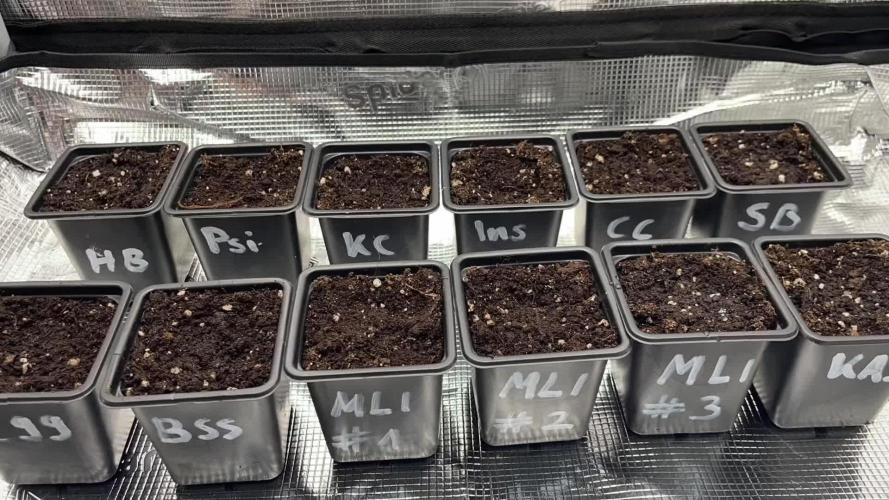
Maple Leaf Indica – Sensi Seeds 🍁
Three seeds, one diary.
Bei der Maple Leaf Indica wird der Start etwas interessanter, denn hier habe ich drei reguläre Samen angesetzt. Alle drei haben erfolgreich gekeimt und stehen mittlerweile über der Erde. 💚
Schon jetzt entwickeln sich MLI #1, #2 und #3 etwas unterschiedlich – genau deshalb werden erstmal alle drei unter denselben Bedingungen weitergezogen. Aussortiert wird hier noch überhaupt nichts.
Später wird es spannend, Wachstum, Struktur, Internodien und Verzweigung miteinander zu vergleichen. Und irgendwann kommt natürlich die entscheidende Frage: Wer von euch drei ist eigentlich eine Dame? 💃🤣
Bis dahin dürfen alle drei zeigen, was in ihnen steckt.
3/3 Maple Leaf Indica successfully started. 🍁


Likes
2
Share


@DogDoctorOfficial
Follow
🍮 8×8 Adventure – Week 14 🌸
Chem Brûlée – Pheno B 🔥
👑 The Beast Keeps Evolving — Her Own Story, Her Own Finish Line
Hello everyone, and welcome back to another chapter of the 8×8 Adventure! 🌱💚
And here she is again...
Our beautiful Chem Brûlée Pheno B! 🍮🔥
My friends...
WE STILL HAVE A BEAST! 😂🔥
Look at this girl.
Look at her flowers.
Look at that main cola.
Look at the way she's continuing to evolve.
And look at how different she is from her sister!
She's amazing.
She's peculiar.
She's got her own character, her own structure, and her own way of expressing herself.
And the further we go into this adventure, the more I appreciate having the opportunity to follow these plants individually.
Because this girl isn't simply another Chem Brûlée.
She's Chem Brûlée Pheno B.
And she's doing a fantastic job of reminding us why individual phenotype diaries are worth the effort.
This week, we're not doing anything spectacular to her.
We're not introducing some dramatic new technique.
We're not trying to force her into a different shape or make her follow somebody else's schedule.
We're providing what she needs, observing her development, taking photographs, and letting her continue toward her own finish line.
And honestly?
She's doing enough work for all of us. 😂🍮🔥
So let's give this beautiful beast her own spotlight!
────────────────────────
🔥 STILL A BEAST — AND STILL COMPLETELY HERSELF
Last week, I described this girl as a different kind of beast.
And I'm sticking with that description.
😂🔥🍮
She's fascinating.
The flowers have their own expression, and that structure is part of what makes her so interesting to follow.
She's continuing to evolve, and the overall plant is giving us plenty to appreciate.
That main cola deserves attention, of course, but I don't want this report to become a story about just one flower.
Because there's more to this girl than her main event.
The surrounding flowers have their own character.
The overall structure deserves a closer look.
And the plant as a whole is what makes this phenotype so interesting.
One of the best things about documenting plants week after week is that we get to follow the complete journey rather than judging everything from a single photograph.
We saw her developing.
We saw her establish her own personality.
And now we're continuing to watch that expression unfold.
She's a beast.
She's beautiful.
And she's still writing her own story.
🍮🌸🔥
────────────────────────
👑 THAT MAIN COLA DESERVES HER OWN FAN CLUB
Come on...
We have to talk about that main cola!
😂🔥🌸
Every time I look at this girl, that impressive central flower catches my attention.
It's one of those features that makes you stop for a moment and appreciate the structure the plant has developed.
But the best part is that the main cola isn't the only thing worth looking at.
The other flowers deserve their share of the spotlight, too.
This is why I enjoy taking photographs from different angles.
A full-plant photograph tells one story.
A closer photograph tells another.
And when you start looking at the individual flowers, you notice details that can easily disappear when you're looking at the plant from across the room.
Different shapes.
Different structures.
Different little details.
And all of them contribute to the identity of this particular phenotype.
So yes, the main cola gets its moment.
But the rest of the girl gets to shine as well.
😂🍮💚
────────────────────────
🌸 THE FLOWERS ARE TELLING THEIR OWN STORY
At this stage, I'm particularly interested in watching how the whole plant continues to develop.
We're not trying to force a specific appearance.
We're not trying to make every flower look identical.
And we're certainly not expecting every phenotype in this room to reach the same stage at exactly the same time.
We're observing what is actually happening.
The flowers.
The overall structure.
The changing appearance of the plant.
The differences between this girl and her sister.
And the progression from one weekly update to the next.
That's the beauty of the 8×8 Adventure.
We have a shared environment, but the plants aren't carbon copies of one another.
And Chem Brûlée Pheno B has given us plenty of reasons to keep looking closely.
She's developing in her own way.
And that's precisely what we're here to document.
────────────────────────
🌿 SAME ROOM, DIFFERENT PERSONALITIES
For anyone discovering this diary for the first time, welcome to the 8×8 Adventure!
Twelve plants.
Different genetics and phenotypes.
One shared room.
One general environmental strategy.
One 12/12 lighting schedule.
One nutritional program.
One lighting ecosystem.
And twelve individual stories.
That's the experiment.
We provide the plants with a shared environment and observe how their different genetics express themselves.
Some plants stretch.
Some remain compact.
Some develop unusual structures.
Some progress faster than others.
And even plants from the same genetic line can show differences that make following them individually worthwhile.
Chem Brûlée Pheno A has her own expression.
Chem Brûlée Pheno B has hers.
They're related, but they're not identical.
And I don't want to lose that individuality by treating them as one generic plant.
That's why we're giving this girl her own report again.
Same room.
Same general conditions.
Same photons.
Different phenotype.
Different expression.
Different story.
💚🌱
────────────────────────
💡 THE ARTIFICIAL SUN — FUTURE OF GROW BLACK SERIES
The upgraded lighting setup remains part of the 8×8 Adventure.
Our Future of Grow Black Series LEDs continue to provide the main lighting, with the two additional Black Series 600W fixtures supplied for this experiment remaining part of the setup.
Following their installation, the output was reduced to approximately 59% from the plug.
Our previous working reference was around 1,500 PPFD across the upper canopy, with actual intensity varying according to plant height and position.
The interesting part isn't simply having more lighting capacity.
It's having that capacity available while being able to control the output.
We're not running everything at maximum just because we can.
And across this room, we're getting to observe how different plants develop under the same general lighting environment.
Chem Brûlée Pheno B is giving us her own answer.
Same artificial sun.
Same room.
Different genetic expression.
☀️💚
A massive thank you to Future of Grow for supplying the two additional Black Series 600W fixtures and allowing us to explore this upgraded setup.
It's been a great addition to the project, and having the opportunity to document the plants throughout the experiment makes the whole experience even more interesting.
────────────────────────
🔴 THE RED-LIGHT UPDATE — LET'S TALK SCIENCE
As promised, we're continuing the discussion about the additional 15-minute red-light period after the main lighting period.
And since these are individual reports from the same room, I want to keep the explanation consistent across the diaries.
Plants respond to more than just the total amount of light they receive.
They also respond to wavelength and timing.
One important group of plant photoreceptors is the phytochrome system, which responds to red and far-red light and helps plants interpret changes in their light environment.
These responses can influence plant development, but the outcome depends on several factors, including the spectrum, intensity, duration, timing, and the plant's physiological state.
Our additional 15-minute red-light period is part of the lighting routine we're documenting.
However, I want to be clear about something.
We're not claiming that this short period automatically improves flowering, increases yield, or guarantees a better finish.
Those are specific outcomes that require evidence.
We're documenting the routine and exploring the science behind it, rather than promising results we haven't established.
That's an important distinction.
There's nothing wrong with experimenting or being curious about different lighting approaches.
But we should always separate what we know from what we're investigating.
And that's exactly what we're doing here.
🔴🌱💡
────────────────────────
🔬 THE EMERSON EFFECT — WHY TWO PHOTOSYSTEMS MATTER
While we're talking about light, let's revisit the Emerson effect.
This is a well-established phenomenon in photosynthesis, and it's a fascinating example of how plants use different wavelengths of light.
In simplified terms, the Emerson effect describes an increase in photosynthetic activity when certain red and far-red wavelengths are supplied together, producing a response greater than expected from their individual effects under the relevant experimental conditions.
The explanation involves two cooperating photosystems:
🌿 Photosystem II (PSII)
🌿 Photosystem I (PSI)
Both are essential parts of the light-dependent reactions of photosynthesis.
They work together to convert light energy into chemical energy that the plant can use.
Their light-absorption characteristics differ, and under suitable conditions, combining particular wavelengths can improve the balance between their activity.
That's the basic principle behind the Emerson effect.
But here's where we need to be careful.
The Emerson effect doesn't mean that any red-light treatment will automatically increase photosynthesis.
And it doesn't mean that our additional 15-minute red-light period after the main lighting period is necessarily reproducing the classic Emerson effect.
The classic phenomenon involves the combined effects of particular red and far-red wavelengths under specific illumination conditions.
Our lighting routine is a different situation.
To establish a measurable benefit, we would need to know the actual spectrum and intensity and use suitable comparisons to determine whether the treatment produces a meaningful difference.
So, the Emerson effect is real.
The underlying science is fascinating.
But we shouldn't automatically attribute a benefit to our particular routine without evidence.
That's how we keep the educational side of this adventure honest.
We can explore.
We can question.
We can observe.
And we can keep learning.
🔬💡🌱
────────────────────────
🌙 RED LIGHT AND THE END OF THE LIGHTING PERIOD
One final distinction is worth mentioning.
Red light and far-red light are not interchangeable.
They interact with plant photoreceptors differently, and their effects depend on the conditions in which they're used.
A short red-light period after the main lighting period isn't automatically equivalent to a far-red treatment, and neither guarantees a particular outcome.
For this project, we're documenting our additional 15-minute red-light period as part of the lighting routine.
We're not presenting it as a proven yield-enhancing treatment or claiming that it necessarily improves the plant's transition into darkness.
If we want to determine whether it makes a measurable difference, we need suitable comparisons and measurements.
Until then, we can discuss the science, document our observations, and remain open to what the evidence shows.
That's what I enjoy about these projects.
There's always something new to learn, and we don't need to pretend we have every answer.
💚🔬
────────────────────────
🌱 NUTRITION — PROVIDING WHAT SHE NEEDS
As with the rest of the room, the general nutritional program remains consistent with our previous update.
Our last recorded recipe reference was:
🌱 Plagron Pure Zym — 1 ml/L
⚗️ Plagron pH Plus — 0.03 ml/L
🍋 Plagron Lemon Kick — 0.03 ml/L
🌸 Plagron Terra Bloom — 2 ml/L
🌿 Plagron Power Buds — 1 ml/L
🍯 Plagron Sugar Royal — 1 ml/L
🌱 Plagron Green Sensation — 1 ml/L
The previous solution readings were approximately pH 6.04 and EC 2.05 mS/cm.
We're not introducing a dramatic new nutritional change simply to make this week's report sound more exciting.
We're continuing to observe the plants and maintain the shared approach.
As each plant progresses, we can assess whether anything actually needs to change rather than making decisions based solely on the calendar.
Consistency is part of the experiment.
And individual observation is what helps us understand the differences between the girls.
────────────────────────
🌡️ WEEK 14 — ROOM CONDITIONS
The previous room reference readings remain:
🌸 Flowering — Week 14
💡 Light schedule — 12/12
💡 Lighting — Future of Grow Black Series, upgraded setup
🔌 Approximate lighting output — 59% from the plug
☀️ Upper-canopy PPFD reference — ~1,500
🌡️ Day temperature — ~27°C
🌙 Night temperature — ~26°C
💧 Relative humidity — ~61%
⚗️ Previous pH reading — ~6.04
⚡ Previous EC reading — ~2.05 mS/cm
🌡️ Nutrient solution temperature — ~25°C
🌱 Substrate temperature — ~25°C
🌬️ CO₂ — ~693 ppm
🌱 Pot size — 15 L
💦 Previous irrigation reference — ~1.45 L per plant / 24h
These are the previous shared room readings, rather than a claim that every parameter has been remeasured this week.
The overall approach remains consistent, and we're continuing to observe how each individual plant develops within that environment.
Same room.
Same general setup.
Same lighting ecosystem.
And Chem Brûlée Pheno B continues giving us her own expression.
────────────────────────
📸 WE'RE OBSERVING, NOT INVENTING WORK
I think this deserves its own little section because it reflects where we are in the adventure.
We're doing very little physical work with this girl right now.
And that's intentional.
We're not looking for something to change simply because another week has passed.
We're not trying to force a new technique into the diary.
We're not trying to make the plant follow a schedule we've invented for her.
We're observing.
We're documenting.
We're providing what she needs.
And we're letting the plant continue her journey.
Sometimes a grower needs to intervene.
Sometimes a grower needs to investigate a problem.
And sometimes a grower simply needs to step back, look at the plant, and appreciate what's happening.
This week is very much about that last part.
😂🍮💚
The plant is the main character.
We're here to document her story.
────────────────────────
💬 COME JOIN THE DOG DOCTOR COMMUNITY!
If you're enjoying the 8×8 Adventure and want to talk about growing, genetics, lighting, equipment, experiments, or your own growing journey, come and join us on Discord!
We love a good discussion.
Questions are welcome.
Different experiences are welcome.
And respectful debates about techniques and equipment are part of how we all learn.
Whether you want to share your progress, ask questions, exchange ideas, or simply hang out with fellow growers, come say hello.
💚🌱
🔗 https://discord.gg/dogdoctorofficial
Bring your questions.
Bring your experience.
Bring your curiosity.
And let's keep learning from one another.
Growers helping growers.
That's what it's all about!
────────────────────────
❤️ FINAL THOUGHTS — THE BEAST IS STILL SHINING
Week 14.
Chem Brûlée Pheno B.
And yes, my friends...
we still have a beast! 😂🍮🔥
She's beautiful.
She's peculiar.
She's continuing to evolve.
And she's doing it in her own way.
That main cola deserves its attention, but the entire plant deserves appreciation.
We're watching the flowers.
We're watching the overall development.
We're documenting her progress.
And we're allowing her to continue toward her own finish line.
No unnecessary interventions.
No invented harvest dates.
No dramatic changes just for the sake of having something new to report.
We're simply providing what she needs and observing the journey.
We've also revisited our red-light routine and the Emerson effect because these reports are an opportunity to share knowledge, not just photographs.
The Emerson effect is an established photosynthetic phenomenon involving the cooperation of two photosystems under particular illumination conditions.
Our additional 15-minute red-light period is something we're documenting, but we shouldn't claim that it reproduces the Emerson effect or guarantees a particular benefit.
We can experiment without overpromising.
We can be enthusiastic without abandoning scientific accuracy.
And we can appreciate a beautiful plant while remaining curious about the science behind the environment she's growing in.
That's what makes this adventure worthwhile.
💚🔬🌱
So, Chem Brûlée Pheno B...
Keep doing your thing, beautiful beast.
Keep evolving.
Keep showing us your personality.
We're not going to rush you.
We're not going to make unnecessary changes.
We're simply going to keep observing, keep documenting, and enjoy the journey toward your own finish line.
Same room.
Same photons.
Different phenotype.
Your own expression.
Your own story.
🍮🌸🔥💚
And when you're ready for the next chapter, we'll be here with the camera.
────────────────────────
🙏 THANK YOU
A huge thank you to Zamnesia for the Chem Brûlée genetics and for giving us the opportunity to follow these individual phenotypes throughout the 8×8 Adventure. 🌸🙏
Thank you to Plagron for supporting the nutritional side of the journey and helping us maintain consistency throughout the project. 🌱
A massive thank you to Future of Grow for the Black Series lighting and especially for supplying the two additional Black Series 600W fixtures we're testing in this room. 💡🔥
Thank you to LumiFlora for adding another lighting dimension deeper into the canopy.
Thank you to TrolMaster for helping us monitor and maintain the environment behind the scenes.
And, of course, thank you to everyone following these reports on GrowDiaries.
Every comment.
Every question.
Every observation.
Every photograph.
Every week spent following these twelve different plant stories.
It all becomes part of the adventure.
And Chem Brûlée Pheno B?
She's still giving us plenty to appreciate.
A beautiful phenotype.
A peculiar expression.
An impressive main cola.
And a personality that makes her stand out in her own way.
🍮🌸🔥💚
If you'd like to join the conversation, come and find us on Discord:
🔗 https://discord.gg/dogdoctorofficial
Let's keep sharing experiences, asking questions, and learning together.
Until next week, keep shining, beautiful beast.
We're watching, we're learning, and we're enjoying every chapter.
Growers Love & Happy Growing! 🌱💚🍮🔥

Likes
Comments
Share


@SmithNuggets
Follow
2/17 have about one week before harvest. Then 4 more will move in to the
2/18 harvested 3 plantz. 1 strawberry cough and 2 runtz. 66 days of flower. I will post picture of when done drying and going to cure.
I defoliated my week 4 of flower girls. Adjusting week 7 girls under the net so they stay upright under the weight of bud there. And moving 3 more girls in to flower 1 runtz, one washington apple, and 1 . Also water night one gal of water per stage of flower. So the 3 in weeks 7 get 1 gal split between them and so do the week 4 girls 1 gal split between them
