


Likes
Comments
Share


Likes
59
Share


@Neo09
Follow
Finaly, they started to build some buds.. im sorry guys for prety weak updates,.. hopefuly ll change it in close future :) 💚
Likes
6
Share

@PapaTerps
Follow
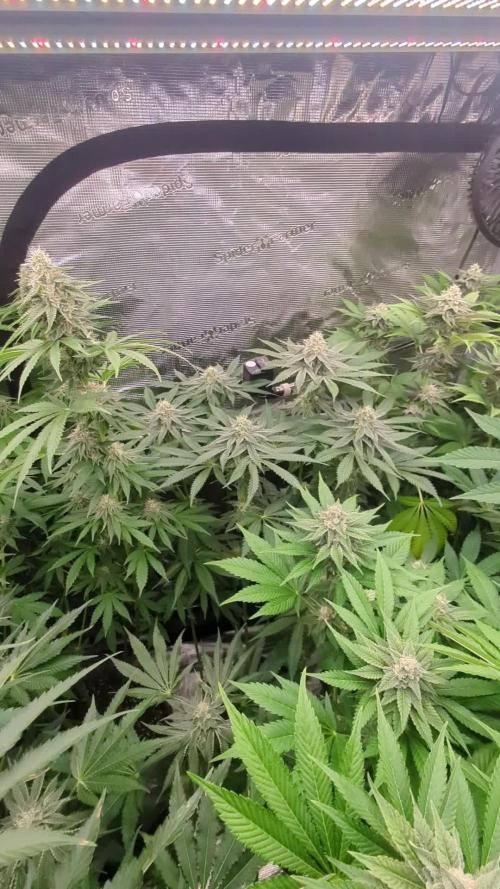
Black Beretta - Cipher Genetics
Week 5 Bloom
🌸 Great week for her, she has bulked up a huge amount and is absolutely covered in trichomes - she hasn't grown any pollen sacs since the first week in flower so I'm confident we got away with that 👍🏻 Her flower is beautiful and has already started to show signs of maturity, with many of her pistils starting to turn - she might also finish in 8-9 weeks 🙌🏻 Her scent is blackberries with a sweet finish, and it has a punch, one of the strongest smells in the tent!
✂️ No work this week, she hasn't shown any more herming and she has great airflow and light penetration 👌🏻
💧 Watered every three days with 4L of RO water - nutrients were mixed individually, in order and then finally pH'd to 6.3. I've increased her nutrients again to keep up with her flower production.
💡 PPFD: ~900
♒ VPD: 1.53kPa
🌱 Days from seed: 95
🌸 Days in Bloom: 34

Likes
97
Share


@CANNASIM
Follow
GENERAL COMMENT
The SKR is dry and starting the cure in jars, and the NL is done.
RQS NORTHERN LIGHTS AUTO COMMENT.
This is the final week, next time will be the harvest, this girl just got mature from a day to the other, lost 70% of the top bud due to rot i haven t seen. So i could get virtually 30-40% yield from this girl
Without the locks or rot, anyhow still looking ok as far as harvest, quality will be a bit compromise, not the end of times though lol! 🙃👊🏻👍🏻

Likes
23
Share


@Kirsten
Follow
18.5.25:
I watered with 3ltrs of dechlorinated water PH'd to 6.4.
I added Per 6.5 litres;
♡ 1Tsp Sea K(elp)
♡ 1/2 Tsp Bud Explosion PK booster
♡ 7ml Trace
PH: 6.4
PPM: 780
I added the PK booster this feeding, just to provide some phosphorus without risking an excess. Next time, I won't use it.
☆ Xpert Nutrients PH down, up to 1ml.
☆ Ecothrive Neutralise 1 drop per litre from the 1ml pipette, which is attached.
This is my dechlorinator.
22.5.25:
Well, I had a total disaster with my HulkBerry.
My tall, oscillating fan fell over and smashed straight down on her.
3 tops broke, so I had to improvise. I made the repairs and took the photos in under 5 mins. The next morning, the branch closest to the camera had fallen again, attached by only a small membrane.
Amazingly, she had turned all the leaves, now on the floor of the tent, upwards towards the light. I patched it up again, and she's not looking too bad.
However, I'm going to have to be exceedingly careful when watering the two other plants and moving the pots. I'm going to need to add support, stakes, maybe. I will think of something, no doubt.
After all this occurs, I taped her up and watered. I fed 3ltrs of dechlorinated water PH'd to 6.4 with;
♡ 1/2 Tsp of Ecothrive Biosys. I also added
♡ 3ml of Xpert Nutrients Cal-Mag amino acids.
I figured she would need some nitrogen and the building blocks to heal. N5-P0-K0.
I will water again with the same today.
Send some healing vibes 🍃✌️💚🤞🌱😊
24.5.25:
I watered with Ecothrive Biosys 3ltrs each.
The plants are still drinking at least 2 litres per day. They are increasingly thirsty, and it's important that I don't let them dry out.
The soil is mostly coco and perlite, so it can dry out quicker. There are plenty of worm castings, too, so that definitely helps.
The buds are developing and progressing very nicely, keeping up with the flowering nutrients and alternating between Ecothrive Biosys, Trace, and Greenleaf Nutrients.
25.5.25:
I watered with 2.5 ltrs of dechlorinated water PH'd to 6.3
I added Per 6.5 litres;
♡ 1Tsp Sea K(elp)
♡ 1/2 Tsp Bud Explosion
♡ 7ml Trace
PH: 6.3
PPM: 840
SOLUTION TEMP: 30°C
SOIL PH: 7
SOIL TEMP: 21°C
AMBIENT TEMPERATURE: 23-26°C
RELATIVE HUMIDITY: 58%.
Thanks for stopping by 😊🌱🤞💚✌️🍃
Likes
25
Share


@NorseGrower
Follow
Week 8: Everything is going great. I didn't plan on taking them all out again till they got chopped, but decided to get them out one at a time today and give them a good thorough defoliation, peeled off any undergrowth and water and feed them all. Temps remain completely under control and no longer an issue, even in 90 degree weather here. I've continued to alternate between feeding and just water, cal mag and fish shit. The only plant of the 6 to show any deficiencies was the #1 Skunk. Every leaf on leaf chart looks same to me lol. I upped today's feeding to 3/4 strength instead of half strength. If I had to guess, I would say that this is the last feeding for the Creme de la Chem, Strawberry Couch and the Double Grape. Those three will likely all fall in the 70-80 day harvest range and those three are at day 58. Not 100% on the #1 Skunk or not, it may get one more feeding, along with the Watermelon Skittles. The Fruit Punch? Well there is a chance I will be smoking cured Creme de la Chem before that one gets chopped lol. It will continue to get fed for a while as buds still very under developed. Today's defoliation was barely anything for a couple plants like the Watermelon Zkittles. A few big fan leaves blocked bud sites, but the Skunk needed thinned out badly and I took a good 20 minutes to go around the outside them come in from over top to really get in there and try to make some airflow and better light penetration. These are definitely drinking at different rates but in order to not be mixing up stuff daily, I feed them all on the same day and the couple that still had some weight to them just get less. I think these will all meet and exceed my 2 ounce goal per plant and 5 of the 6 after topping and training have conformed to the types of plants I really want to grow with the space I have. Thats 6-8 tops on a short compact plant. The Fruit Punch went off the reservations waiting till day 50 to start flower and is acting like this is a 3 plant grow not a 6. But shoving it in corner and putting short Skunk plant by it on bucket to raise up canopy along with raising one side of my TSL2000 and lowering other side towards shorter plants appears to be working great. Its great to be thinking about the flush. Having plants out, I did check trichomes on a couple just for the fun of it and mainly clear so got couple weeks or more for most of these.


Likes
5
Share


@OntarioAutoGrower
Follow
03.22.23. Start Week 3. Today i started the Low Stress Training on the plants. I first carefully start to bend the plant kinda massaging the plants and making the plants softer and easier to bend down. I then tie the base on one end to keep the plant from snapping, and bend the plant the opposite direction and tie it down. I will continue this daily until flower starts to create a perfect even top canopy.
End of week Review. All 3 plants seem to be reacting well to the nutrients and LST they are getting. Also the few leave trimmings seemed to go well with them all. I have officially named the plants. There names are Megan, Lucille, and Alien. Very excited for these plants to start there flowering stage

Processing
Likes
2
Share


@Kindbot
Follow
Kindbot has been taking care of this grow since these were tiny clones. This is the most recent grow by the device we are developing called Kindbot. Kindbot has fully documented and controlled this grow since they were small clones. Follow our journey here and on kindbot.io. We are also on instagram- @kindbot and twitter- @Kindbot_io :D. We look forward to sharing what Kindbot can do!

Likes
13
Share


@FowerTwennyNoob
Follow
Day 7---Defoliated good bit from all plants removing afflicted leaves, looks to be typical cal/mag deficiency with ph issues.
Topped off 2 big plants with ro water, added 6ml micro 6ml bloom and 3ml gro to 2 big plant ppm 900, 2 smaller plant ppm over 1000.
Day 6--- Topped off all plants with RO water, added 1ml ph up to plants 1,3,4 to adjust ph. PH of plant 2 more basic than the other 3.
Day 5--- Topped off biggest plant 2, added back 10ml cal mag, ppm about 600-700 will check again soon and add back some nutes.
Added 1ml ph up to plants 1 and 3 , didn't adjust other two yet.
Day 4---
Added 3ml cal mag to all plants as it could be lacking. Added 5ml soul grow and 5ml soul bloom to plant 1 to see something, ppm up to about 1020.
Some light defoliation of afflicted leaves on all plants.
Day 3---Added 5ml micro and 5ml bloom to plant 2 now at 750ppm. All plants are above 700ppm but below 900ppm. All plants showing signs of something on the leaves but IDK what, manganese?
Added 3ml cal mag to biggest plants. Topped off water of 2 biggest plants.
Day 2---Checked PH, more minor defoliation of afflicted leaves and to uncover a few more bud sites.
Day 1---
Added about 1.5ml ph up since the waters keep going a bit acidic. Some leaves still show some issues but didn't wanna defoliate too much. IDK if it is from PH or over/under feeding plants. Added 2ml cal mag.
These plants are continuing to grow and flower, 2 biggest drinking lots of water and making the water more acidic. Topped of water in buckets with RO water. Added 3ml cal mag to all plants
Added 5ml micro,bloom, 3ml gro to 2 smallest plants. Added 10ml micro, bloom, 3ml gro to 2 bigger plants. Added .75ml ph up to all plant water to help the PH stay in range. TDS on all are around 800
Light defoliation of all plants to uncover bud sites and remove afflicted leaves.
Processing
Likes
10
Share


@Familytrees19
Follow
This is 2 out of 2 journals
Strain: blueberry cookies
Breeder: Dinafem
Clones: by me farmer2k
Nutrients: bluesky organic kit
Tent: gorilla 5x5
Light: kind led k5 xl1000 wifi
Ok ok this my other journal using bluesky organic kit.
The clones were well rooted and I transplanted them all into 3G pots. I’m using bluesky super soil mix they gave me with it. I like the fact they have their own natural ph up and down! So this is day 1 of week 1. Mother to these clones grew nice and bushy. She seemed to like LsT and pruning often. Thank you for following

Processing
Likes
5
Share


@Mr_nugs_lover_David
Follow
One of the 2 seeds the #1 pheno didn't make it to the surface after 72 hours, so I'm gonna have to replace it with another same strain seed which is the last one I got. Let's see how this baby girl of hard diesel #2 perfoms.

Likes
13
Share

@420DeepGrow
Follow
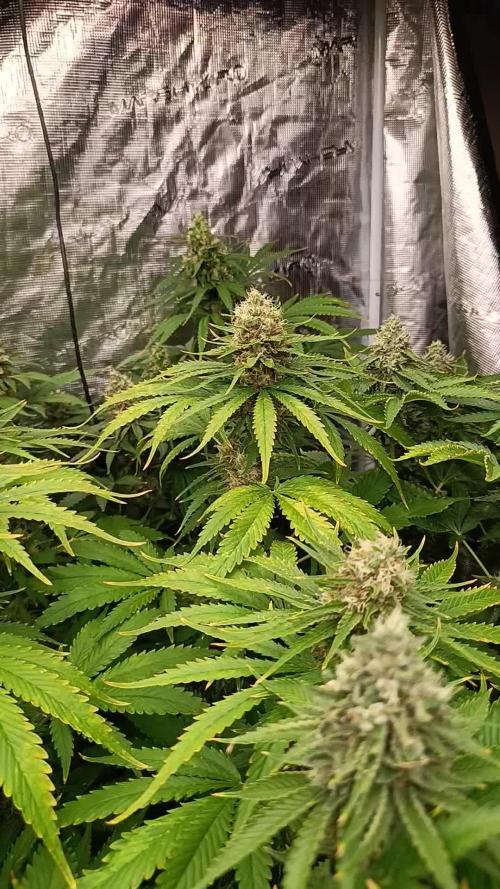
📆 Semana 7
Los cogollos alcanzan un gran volumen y empiezan a endurecerse de forma notable. La mayoría de los cálices terminan de engordar, la producción de resina es muy abundante y el aroma se vuelve intenso y penetrante. Cada vez aparecen menos pistilos nuevos, mientras una parte de los existentes comienza a oscurecerse y replegarse.
Bloom Booster entra en su última fase de trabajo, ayudando a completar el engorde y la maduración de las flores. La planta sigue demandando agua y nutrientes, aunque es recomendable mantener una fertilización estable sin aumentar la EC para favorecer una maduración limpia y equilibrada.
⚡ EC: 1.8 - 1.9
💧 pH: 6.2–6.5
🌡️ Agua: 21°C
🌫️ Humedad: 35–40%
💡 Intensidad: 1000–1050 PPFD
🔥 Nota: La prioridad pasa a ser la maduración y el endurecimiento de los cogollos. Mantener un ambiente seco y una buena circulación de aire ayudará a maximizar la producción de resina y a prevenir problemas de humedad.
Seguimos creciendo fuerte 💪!

Likes
4
Share


@KronicAquaponic
Follow
So, after seeing the N deficiency and feeding it some protein, I noticed after all this time there were no new roots forming in the sencond zone in the hydroton, so I thought maybe I forgot to drill holes to let the roots through. Turns out when I was moving things around, only the very bottom of the basket was in the water, so the hydroton was mostly dry and the roots were drying up before getting to the water. So this week I made a new carrier for the pot to sit further down in the water and this should remedy future N deficiency as the roots will be getting the nutes from the aquaponic system. Plant still looks great, started LST this week to help fill the width of the screen. Will be moving into the tent after my widow gets harvested.

Likes
11
Share

@BioGrowBayer
Follow
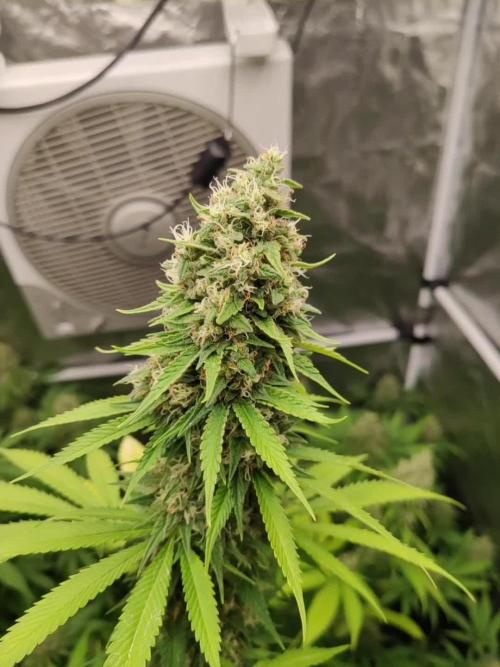
Blütewoche 6 verläuft ohne Probleme. Die Pflanzen sind gesund, Buds werden dicker, Trichome entwickeln sich gut. Kein Mangel, alles im grünen Bereich. Leichte Entlaubung für bessere Luftzirkulation, Gießen wie im Schema. Bin sehr zufrieden – weiter so!

Likes
13
Share


@BrigadeDesTerps
Follow
Recette du tco pour 20 litres. (Grammes : gr)
50gr biochar
250gr zéolite
3gr granulé Micro-Organisme IT45
10gr pollen d’abeilles
10gr levure de bière
3gr endomychorize
10gr consoude
20gr vers de farine
10gr cendre coque de ricin
12gr ortie microniser
15gr Kelp
10gr spiruline
10gr de cbd living soil
20ml de miel liquide
30ml de mélasse
20ml d’acide humiques et fluvic
Mettre tous les ingrédients (sauf la mélasse ,l’acide h/f et le miel) dans un filtre 400micron, le placer dans un seau avec de l’eau (10litres). Rajoutez le miel et 10ml de mélasse
Y mettre un micro bulleur alimenter sur une pompe à air et faire oxygéné le mélange pendant 24h. Rajout de 10ml de mélasse après 12h le début de la mise en route de la pompe.
A la fin des 24h rajoutez le restant de mélasse et d’acide h/f, mettez y en plus 10litres d’eau au mélange.
Reste plus qu’à arroser!
j’y ai incorporé 7litre de mélange
La veille j’ai préparé le pot à l’arrosage avec 500ml d’eau et 2gr de Bacillus IT35 Amyloliquefaciens X5
Bacillus Amyloliquefaciens : rhyzosphère, probiotiques. Aspersion et arrosage. Utilisable pour toutes cultures.
La bactérie Bacillus Amyloliquefaciens se fixe dans la rhizosphère en se nourrissant des exsudats racinaires. En contrepartie, elle stimule la croissance racinaire en sécrétant des métabolites de croissance et solubilise le phosphore en sécrétant des phytases (enzymes).
Effet probiotique consistant en l’utilisation de micro-organismes bénéfiques pour la nutrition et la santé des plantes.
La spiruline, le plus riche et le plus complet des amendements organiques
La Spiruline est une algue aquatique connue comme complément alimentaire, la Spiruline est aussi un amendement organique et écologique très complet.
D'une grande qualité nutritive, elle apporte à vos plantes une quantité de nutriments, dont l'azote, phosphore, potassium, minéraux, acides aminés, vitamines, chlorophylle et protéine.
Le charbon végétal actif est capable d’absorber jusqu’à cinq fois son poids propre en eau ainsi que les éléments nutritifs qui s’y trouvent. Il joue ainsi le rôle de catalyseur et d'amplificateur pour les fertilisants traditionnels, qu'ils soient d'origine organique ou minérale. Ce pourquoi il est idéal pour activer un sol et pour les thés de compost oxygénés.
Le charbon végétal améliore la diffusion et la disponibilité des éléments nutritifs dans le sol et offre des conditions propices au développement des micro-organismes.
Le Biochar peut être introduit dans une grande variété de sols. Il est particulièrement efficace dans les sols pauvres, difficiles et acides.
Pour faire agir rapidement et efficacement sa capacité d’amendement, le charbon végétal est enrichi et biologiquement activé avec des micro-organismes. Le Biochar se comporte ainsi comme un structurateur et un activateur dans le but de valoriser les sols.
Composition :
• Charbon végétal actif 31%
• Matière organique 33%
• Matière sèche 75%
• C/N : 17
• PH : 7,2
• Azote (N) : 2,1 % dont 1,2 % azote organique
• Phosphore (P205) : 0,74%
• Potassium (K20) : 1,18%
• Calcium (Ca) : 6,8%
• Magnésium (MgO) : 0,65%
Le pollen est l'ingrédient de base de la fabrication du miel par les abeilles. Riche en vitamines et minéraux, il est qualifié « d'aliment parfait », y compris pour les plantes !
Les zéolithes sont des roches cristallines, présentant des capacités d'adsorption particulièrement importantes vis à vis des polluants que l'on rencontre dans l'eau et dans certains liquides, ainsi que dans l'air et les gaz. Elles sont extrêmement poreuses comme les charbons activés et elles peuvent être chargées électriquement pour opérer comme des échangeurs d'ions.
La zéolithe est un produit naturel qui respecte notre environnement. Utilisé dans le milieu industriel depuis de longues années déjà, ce minerai aux propriétés filtrantes particulières commence à se vulgariser dans le domaine de la piscine privée, de l'aquariophilie, des bassins d'agrément, de la récupération des eaux de pluie, ou encore de la culture des bonsaïs et autres plantations diverses par exemple...
4 points techniques majeurs :
- Grâce à leur propriété hydrophile, les zéolithes peuvent adsorber l'eau jusqu'à 30% de leur poids total et sans aucune variation de volume : pas de gonflement en présence d'eau ni de craquement en cas de déshydratation comme certaines argiles. Les zéolithes sont d'ailleurs de puissants agents anti-mottant (anti-agglomérant). Cette propriété est très appréciée dans le cas des terrains de golf et autres aires de jeux.
- Les zéolithes ne captent pas l'eau de façon irréversible, elles se comportent comme une réserve au voisinage des racines. Celles-ci peuvent capter l'eau en fonction de leur besoin. Les zéolithes permettent ainsi de réduire les besoins d'arrosage jusqu'à 35 %.
- Une zéolithe se comporte comme une "Zone de Stockage" qui retient l'azote et les éléments minéraux nutritifs au voisinage des racines et les relâche lentement en fonction des besoins de la plante. Cela se traduit par une croissance harmonieuse mais rapide du végétal.
- La capacité d'adsorption et l'énorme rapport surface/volume des zéolithes, vont permettre à la fois la rétention de la solution du sol et une bonne oxygénation au voisinage du système racinaire. Les zéolithes favorisent donc l'organisation biologique des sols en contribuant au développement de la micropopulation. L'apport en nutriments (N, P, K) est réduit de 20 à 25 %. Ces derniers, adsorbés par la zéolithe, sont beaucoup moins sensibles au lessivage et à l'évaporation.
Composition minéralogique :
* Chabasite 70 %
* Phillipsite 2 %
* Feldspath 5 %
* Augite 3 %
* Illite - Mica 2%
Analyse atomique:
* Sio2 52 %
* AL2o3 17 %
* CaO 5,7 %
* K2O 6,1 %
* MgO 2 %,
* Na2O 0,6 %
* Fe2O3 3,6 %
Amendement calcaire, dolomie et gypse avec préparation microbienne à base de Bacillus Amyloliquefaciens IT45 et Saccharomyces cerevisiae LYCC6420
Formulation : micro granulés (1 – 1,6 mm) à base de rhizobactéries favorisant la croissance des plantes qui se multiplient et colonisent rapidement la zone des racines, et de levures Saccharomyces cerevisiae souche LYCC ayant un effet probiotique.
Les PGPR produisent des enzymes qui solubilisent le phosphore à partir de complexes inorganiques et organiques dans le sol et stimulent la croissance des racines efficaces augmentant ainsi la zone d'interception des éléments nutritifs. Les levures LYCC permettent une occupation de la rhizosphère par une flore bénéfique.
Composition :
• Matière sèche : 96,8%
• Matière organique : 91,5%
• N total : 6,6% dont N soluble dans l'eau 0,17%
• P total : 2%
• K total : 1,7%
Micro-granulés :
• Oxyde de calcium (CaO) total : 30%
• Oxyde de magnesium (MgO) total : 7%
• Anhydride sulfurique (SO3) : 13%
La levure de bière est une matière vivante qui permet un meilleur fermentation pour les thés de compost oxygénés notamment conseillé pour accompagner les croissances ou apporter un gros coup de pousse pendant la floraisons.
La levure stimule la vie des sols également à l'arrosage direct en apportant tout aussi bien que dans le TCO sa population l'espèce micro-bactérienne positive pour votre sols ainsi que des oligo-éléments et diverse vitamines.
Composition :
• 2,8% (N) total dont 1% (Norg),
• 2,3% (P205)
• 1,6% (K20)
• 35% de MO
• C/N : 8. PH : 8,4.
Sous forme de poudre mouillable. Il contient des spores du champignon mycorhizien Rhizophagus Irregularis MUCL57891 avec des levures inactivées spécifiques. 2000 spores/gramme d’endomycorhize Rhizophagus Irregularis MUCL57891 et Saccharomyces Cerevisiae LYC6420 inactivée. Se connecte efficacement au système racinaire et forme un vaste réseau souterrain de filaments, qui agissent comme des extensions pour atteindre les nutriments et l’eau au-delà de la rhizosphère
Composition :
• Poudre contenant 2000 spores/g. d’endomycorhizes Rhizophagus irregularis
La Consoude (Symphytum Officinale) est une plante présentant de nombreuses propriétés.
Particulièrement riche en Potassium (K) organique, la consoude est une alliée idéale pour les périodes de floraison. La consoude a tout pour plaire : riche en vitamine B12, elle agira également comme stimulateur racinaire, mais aussi comme biostimulant cellulaire, grâce aux alcaloïdes, aux allantoïnes et jusqu'à 30% de protéine !
100% déjection de vers de ténébrions.
Très riche en microorganismes, le guano de vers de farine est une matière directement composté par les vers. En effet, c'est bien la digestion de matières végétales par des larves, insectes ou autres arthropodes qui valident le processus de compostage, que ce soit en zone de production de cultures d'insectes, pour le compost maison ou la dégradation de litière forestière.
Les bactéries et autres champignons obtenus grâce au système digestif de nos vers, permettent la dégradation accélérée des éléments nutritifs dans vos supersoils, et les symbioses permettant l'assimilation des éléments nutritifs.
Cette bio-activation intense mettra dans vos sols, à la disposition de vos plantes, un panel tellement varié de nutriments frais qu'il nous est aujourd'hui technologiquement impossible de pouvoir tous les nommer et de les compter.
Le guano de vers de farine fournit une grande polyvalence. Très équilibré, il s'utilise en entretien ou en apport ciblé seul ou en complément de d'autres amendements ou fertilisants organiques.
Il agit comme un puissant activateur de sol et/ou de substrat.
Cendre coque de ricin NPK 0,1-18,6-16,5. 0,1% (N-Azote), 18,6% (P205-Phosphore), 16,5% (K2O-Potasse), 11,7%(Ca0), 9,1 (Mg0) - Origine : Inde
ACTION SOL • rend rapidement accessible au sol Phosphore, Potasse, Magnésium et Calcium.
ACTION PLANTE • Apport aux stades agronomiques propices. • Produit riche en éléments fertilisants : combinaison NPK 35%. • Régularité de l’apport, milieu et fin de floraison. . Favorise la sénescence.
Analyse chimique :
• NPK 0,1-18,6-16,5
• N-Azote 0.1%
• P205-Phosphore 18,6%
• K2O-Potasse 16,5%
• CaO-Calcium 11,7%
• MgO-Magnésium 9,1%
Ortie bio micronisée Stimule la vie du sol et la végétation.
Composition :
• 2,8% (N) total dont 1% (Norg),
• 2,3% (P205)
• 1,6% (K20)
• 35% de MO
• C/N : 8. PH : 8,4
KELP poudre
ascophyllum nodosum
- amendement sol
Croissance et floraison - Meilleure germination - Meilleur développement racinaire Meilleure assimilation - Résistance aux stress osmotiques - Augmente la production de chlorophylle = plantes plus vertes = lumière mieux captée - Lutte contre le stress osmotique - Développement des Micro-Organismes dans le sol – Riche en vitamines, fer, iode, oligo-éléments, hormones de croissance auxines et cytokinines - Idéal en épandage et pour les thés de compost oxygénés.
Important : notre Kelp est un goémon noir mais il n'est pas le varech bien moins fertile de la même famille qui est l'algue qui pullule et pollue la Bretagne, notre algue pousse uniquement à plus de 50 mètres de fond dans les grands courants froids au large de la Norvège.

Likes
Comments
Share


Likes
2
Share


@Yeyup
Follow
I’ll update with better photos and weight for people who want to know
Thanks for having a look 👌
Likes
70
Share


Likes
19
Share


@Regenwurm
Follow
Explosion bei der Tangie!
Unglaubliche Fortschritte in dieser Woche in Sachen Blütenbildung und Wachstum.
Blüte ist im vollen Gange, sie sehen sehr gesund aus.
In dieser Woche Entlaubung ( immer wieder) Lollipopping und ein klein wenig HST
Tage der Keimungsphase = 5 Tage.
Tage in Wachstum = 28Tage
TAge in der Blüte = 14 Tage
Wachstum h = 20 cm
2 mal in dieser Woche mit Purolyt Mischung 1:25 besprüht
Lichtstärke: 85 %
PPFD: ca. 850 umol
Lichtabstand: 35 cm
Std Tag/Nacht: 18/12
Temperatur Tag: ca. 26 Grad
RLF Tag: 60%
Temperatur Nacht: 21 Grad
RLF Nacht: ca. 60 %
VPD Wert: ca. 0,9
PH Wert Wasser/Düngelösung: 5,8
EC Wert: 1,7
Ventilator Oszillation: Stufe 1
Befeuchter: aus
Entfeuchter: 24/7 an um auf 60 % im Zelt zu kommen außerhalb vom Zelt im
Bewässerung: 7* bewässert mit Wasser/Dünger mit den o.g. Mengen
Purolyt Besprühung: 2 mal
Controlling: Grow Control
Dünger: Plagron Coco
Licht: Pro Emit Vollspektrum
Abluft: EC Carbon Active 750 m3
Likes
12
Share


@Chuckwaggon420
Follow
It's going great with these girls oya by the way there is only 2 now! Thats what happens when growing regular seeds you get males no biggie clones will make these 2 more!! 1 I have taken clones off already since100% female and toped and defoliated to produce many tops with net in flower tent. Getting a interesting smell off her it's sweet and skunky but it's very mild rn. Took some clones a day after moved them into 3 gallon show no sign of stress during transplant but play safe did next day and even after toping/ clone take and defoliate still stay strong no sign of shock!! So now have a clone off 1 will take other soon as preflower shows.
Giving them there normal 5.6-5.7 ph and about a gallon of water every 3 days at the moment with the same dose of food for now. They seem to both be very happy and they love the 3 gallon pot. They both are very short and have indica dominate traits. The leafs are cute but still show hybrid traits as they are not fat like a thumb but still short fingers. Small spacing between nodes so that makes them both nice and get a star on there pots for 2 good traits! 1 with most stars at end of flower is the winning clone!!!
Stay tuned
Always changing


