


Likes
24
Share


@OGOZHigh
Follow
Kleines Update :
27.05.24
Lemon Cherry Cookies und Papaya Cookies getoppt
28.05.24
Guava Auto angefangen mit LST
Weitere Updates folgen


Likes
21
Share


@Ultraviolet
Follow
Heyoka.
12x12=144, A dodecahedron is a polyhedron with 12 faces, and in coordination chemistry, it refers to a geometry where ligands surround a central metal atom (in this case, Magnesium) in a specific, 8-coordinate arrangement. Dodecahedrane is a hydrocarbon, meaning it's composed solely of carbon and hydrogen atoms. The carbon atoms are arranged at the corners of a dodecahedron, a 3D shape with 12 pentagonal faces. The water molecules in the dodecahedron form hydrogen bonds that are individually slightly weaker than in either the dimer or the tetramer. However, because three-quarters of the O -H groups in the dodecahedron form hydrogen bonds, it has a more negative energy per molecule than has either the dimer or the tetramer. Magnesium (Mg2+) is the essential, central metal ion in the chlorophyll molecule, crucial for photosynthesis by enabling light absorption and energy transfer. It is chelated by four nitrogen atoms within the porphyrin (or chlorin) ring structure. Chlorophyll appears green because it reflects light in the green region of the visible spectrum, specifically between 490 and 570 nm. The main resonance electronic frequency of a neutral Magnesium (Mg) atom corresponds to the transition from the ground state to the first excited state. Resonance Line Wavelength of Mg2+: 285.1nm (UVB light). The central atom of the chlorophyll molecule is Magnesium (Mg2+), which is coordinated within a porphyrin ring. The electronic "resonance frequency" of this central atom—meaning the frequency at which its electrons absorb energy—is primarily driven by the electronic transitions (ETR) of the surrounding conjugated chlorin ring structure, rather than a discrete atomic transition of the Magnesium atom itself. The resonant electronic frequencies of the chlorophyll porphyrin (technically, a chlorin) ring are determined by the energy required to promote π-electrons within its conjugated system, primarily appearing in the blue and red regions of the visible spectrum.
In standard physics, Chloryphyll b has peak absorption at 460nm (Blue). If we take the peak wavelength 460nm and a UV-B, UVR8 peak absorption wavelength 285nm Tryptophan-285 (W285) Sensing protein. 460/285=1.618 Φ, "natural harmony" and the "structure of light". The cryptochrome photoreceptor (CRY) is a UV-A/blue light receptor that shares this dual sensitivity with several other biological structures and functions, including significant sequence similarity and a common evolutionary ancestor with DNA photolyase enzymes. These are light-activated enzymes that use blue/UV-A light to repair DNA damage caused by UV-B radiation in plants.
Dodecahedrane (C20H20) is a hydrocarbon with a cage-like structure where carbon atoms form 12 pentagonal faces (a regular dodecahedron). It is highly symmetric (icosahedral), contains no delocalized electrons (no aromaticity), and has minimal angle strain, but significant torsional strain. Water Dodecahedron (H2O) forms hydrogen-bonded cages. While individual hydrogen bonds in this structure are weaker than in the linear dimer or tetramer, it has a more negative total energy per molecule. This is because three-quarters (75%) of the groups are involved in hydrogen bonding, creating a very stable, closed-shell configuration. a 3D carbon hydrocarbon (C20H20) to stable water clusters in hydrate, while the Magnesium ion acts as the central activator within a conjugated ring in biological systems, with its electronic absorption dominated by the ring, not the atom itself.
Effective quantum efficiency of photosystem II, often denoted as ΦPSII
In horticultural lighting, adding 730 nm (far-red) LEDs alongside standard red/blue lights has been shown to increase canopy photosynthesis by 20–30% in several crops by acting synergistically with shorter wavelengths. However, the limitation is that excessive, pure IR/Far-red light (without accompanying red light) can trigger the "shade avoidance response," causing plants to grow tall, weak, and spindly rather than robust. Knowing is half the battle however, engineering or utilizing infrared light (specifically the 700-750 nm far-red range) is a viable method to boost photosynthetic efficiency. It acts as a bridge to allow PSII to utilize a broader spectrum of light, breaking the traditional 700 nm barrier.
Extend, then multiply.
UVR8-mediated signaling (often in conjunction with CRY proteins) triggers protective mechanisms that maintain the stability of the photosynthetic apparatus (including LHCII and reaction center proteins), thus ensuring that the efficiency of Photosystem II remains higher in UV-B-exposed plants compared to plants lacking this receptor. ΦPSII indictates the rate of electron transfer from water to plastoquinone, which drives the production of ATP and NADPH. There is a close link between ΦPSII and the true rate of CO2 fixation (Φ*co2), particularly in C4 plants.
Effective quantum efficiency of photosystem II, often denoted as ΦPSII, represents the proportion of light absorbed by Photosystem II (ΦPSII) that is actually used in photosynthetic electron transport. It is a key indicator of how efficiently a plant is using light for photosynthesis, as opposed to losing it as heat or fluorescence. ΦPSII (effective quantum yield of photosystem II) functions primarily as a "multiplier" (a coefficient of efficiency) rather than an additive factor when estimating the overall photosynthetic electron transport rate (ETR). Multipliers are considered far more beneficial than additions because they generate exponential growth, leverage existing resources to their full potential, and create sustainable, self-multiplying capacity, rather than just incremental, linear increases.
Humans, and most other mammals, rely on other mechanisms, such as nucleotide excision repair, to manage and repair UV-induced DNA damage. As such, humans do not have the direct, light-driven repair mechanism that photolyase offers in plants.

Likes
17
Share


@Leonweed10
Follow
Una cepa muy fácil de cultivar, y muy agradecida de los cuidados y alimentos dados... En sus últimas 3 semanas engordaron muy bien llegando a formar muy lindos apicales centrales.

Likes
3
Share

Likes
8
Share


@FarmerT
Follow
The lsd-25 on the right is starting to taking on a gassy smell and the left one is still smelling more floral. The big bud in the back is doing great but I think the buds are going to be more fluffy than dense unless it starts packing these next 20ish days. The cherry cola is looking good still very behind the other 3 but I think I got her under control and good for now.



Likes
110
Share


@BelSun_420
Follow
Hey Growmies,
We’re kicking off another week — and we’re officially in flowering mode now! 😄
She’s showing a few signs of deficiencies from the past weeks, but only on the bigger fan leaves (which I’ll be removing sooner or later anyway). The ones supporting the buds are still looking good 🙂
This week I’ll slowly start clearing out the soil and see how she responds, checking if she’s rooted enough into the new pot to hold herself up once the base soil is removed and it’s just the roots keeping her in place.
All in all, I’m happy with this girl 🙂🧡💚

Likes
99
Share


@TheFoxFarmer
Follow
Thanks once again to RQS for sending me this girl. She's not the most fruity smoke, but more of a pine with a unique tropical/banana peel to it. A nice strain for the cannasseur, and one I'm really enjoying, especially for my back. Thank you to everyone who follows, likes, comments and supports in any way. In means a lot and keeps the passion to grow and continue uploading content on here and IG.
Because I have 4 seperate plants/strains in one tent, under one light, I've had to calculate these by dividing the conditions by 4 (4 plants in total sharing same conditions). This is the fairest and only way to work it out on average as a full tent.
Happy growing! 🐺

Processing
Likes
3
Share


@LongJohn420
Follow
Gorilla Zkittles going down friday looks awesome! Gelato is gonna get one more time nutes and then to flush till day 70.
Pretty happy with these.. Gelato smells like blueberries and GoZKi has that fruity dank smell nice 😋

Processing
Likes
19
Share


@Oldmanbud__50
Follow
So week 4 of veg all going well had to trim a lot of fan leaves off. But have done them the world of good. I have tried my hand at supercroping 1 of them. Learning curve. Taking cuttings tomoz the 1 more week 18.6.then think about flowering..even got myself some tea bags for the little devil's lol
Likes
27
Share


@OldDabKing
Follow
Smells on this bud are amazing! Very piney with hints of berries 😋 Not the biggest harvest, but that was expected seeing as this plant was grown in a 1 gal pot. None the less, I am happy with the results 😁
Likes
64
Share


@Wastent91
Follow
Eccoci ragazzi siamo a più della metà di fioritura.. Purtroppo poca resina, ma le cime sono belle compatte e dure, non c'è molto aroma nella aria, speriamo che migliori nelle prossime settimane, purtroppo ho fatto qualche errore forse con questa ragazza, ho dato troppi nutrienti e troppo poco calcio e magnesio.. Staremo a vedere come procede e cosa ne esce fuori, come struttura è davvero una pianta imponente, praticamente l ho solo stoppata due volte e per il resto l ho lasciata crescere nel modo più naturale possibile, senza defogliare o togliere rami, infatti è diventata un mostro come grandezza, ma purtroppo per ora c'è poca sostanza di quello che mi interessa veramente è avere tanta resina.. Speriamo continui ad ingrossarsi, provvederò a mettere dei sostegni, anche se penso che non ne abbia bisogno dato che la struttura ad albero di Natale, sembra bella solida.. Grazie ad anesia seeds che ha reso possibile tutto ciò, hanno delle genetiche grandiose! Il prossimo ciclo di sicuro metterò di nuovo loro perché esce Dell erba meravigliosamente potente! 💪😸🌱🌿🥦🧑🌾🤞🍀😽💨🔥

Likes
8
Share


@Fullmeltalchemist
Follow
Was a good learning experience. I'm not going to get near the weight I expected from these, and though the bud turned out really tasty, I don't think I'll grow it again. I'm not sure I would recommend to a newbie. It was in some awesome living soil, but some deficiencies crept up in flower, and I wasn't impressed with the roots upon post mortem exam. On second look, even the photo on msnl's site shows some spots that looks like deficiencies. Definitely some grower errors here, but all of my ongoing grows faced the same challenges and these just seemed less adaptable. Anyhow, I've been graced with some clean meds for now, and I'm a happy growin hooman. 👽
I also probably won't do any more autoflowers moving forward. Just not my style. There are some great peeps doing outstanding work with autos though. Best to them and all! :)
D82 - 12.12 - cut the second auto cheese yesterday. Let her go as long as I was comfortable. Think her run in with the gnats resulted in the the deficiencies. Awfully covered in trichs, so it should make for tasty smoke after dried, trimmed and cured.. Shall update

Likes
21
Share

@ThatsmyGrow
Follow
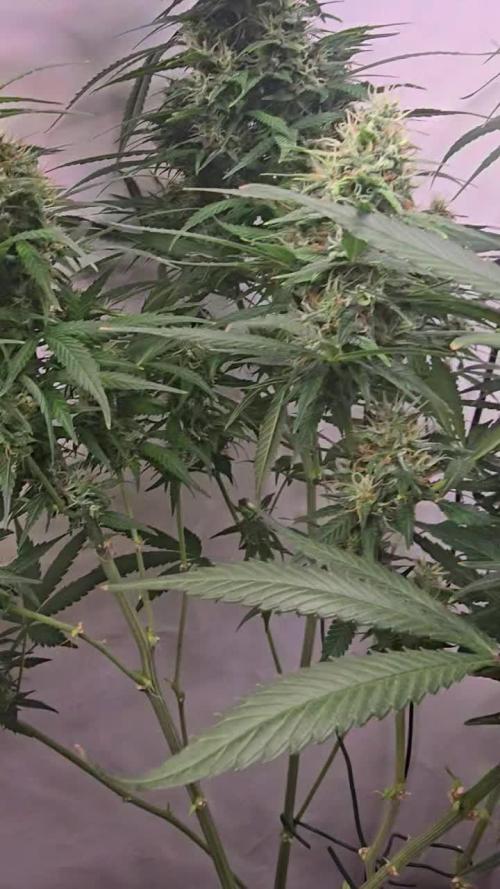
🌸 Week 11 – Gorilla Cookies Auto Pheno Hunt
Another week is in the books, and now all the phenos have officially entered the bulking phase. 🔥🌸
The flowers are swelling rapidly, and it's amazing to see how differently each phenotype is stacking and filling out. Every week brings more weight, stronger aromas, and denser buds.
📈 Current observations:
All phenos are now focusing entirely on bulking up their flowers.
Pheno #1 and #2 are producing massive buds, with some already reaching the size of soft drink cans. 🥤🔥
Pheno #6 has made incredible progress over the last two weeks. Although it had the slowest start, it has developed beautifully and is building flowers surprisingly well. It will most likely need around two extra weeks after the others and will probably finish the grow on its own.
Pheno #3 unfortunately never fully recovered after I had to remove several main colas because they were growing into the SANlight fixture. While it's still producing nice flowers, it clearly lost some of its potential.
Pheno #4 continues to be my personal favorite. The aroma is absolutely incredible, with a sweet Kush profile, and the buds are becoming rock hard already. 💎
📊 Current environment:
Temperature: 31°C
Relative Humidity: 63%
VPD: ~1.66 kPa
SANlight fixture at maximum height
Light intensity: 90%
⏳ Looking ahead:
If everything continues as expected, I think the first phenos will be ready for harvest in about two weeks. The final stage is always my favorite—watching the buds swell even more, the trichomes mature, and the terpene profiles reach their peak.
I'm excited to see which phenotype finishes on top, but right now Pheno #4 is definitely leading the pack. 👑🔥
💬 Which pheno would you harvest first based on these updates?
Likes
1
Share

@DrStoned067
Follow
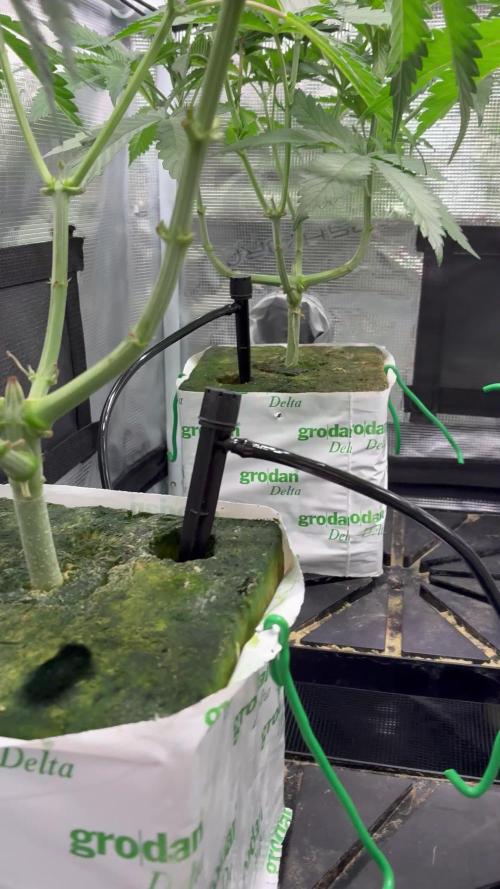
Ppfd: 500-600, Ec: 1,3-14, Ph:5,8, Drain: 10% Max.
Tent is Full After a week of flower, One Main per Square of the Trellis netting. Planning to defoaliate and probably take off everything under the trellis between day 14-21 of flower. Limit the Stretch through generative steering, dropping Night Temperature to 20-23 Celsius and 25-27 Düring the day. Lowering humidity according to VPD. Reaching 40% dryback in the Medium daily, signaling drought and therefore increasing ec in the medium for More osmotic pressure which results in the plant Building flower sites rather than roots and leaves.
Likes
9
Share


@LetsGrowSome
Follow
Starting week 5 now. Still just watering with rain water. Girls still doing exceptionally well. Still no deficiencies and 2 of outer plants now trying to out grow center plant. Trichromes starting to form. Good leaf colors and room really starting to fill up with bud sites.
Processing
Likes
10
Share


@Dunk_Junk
Follow
Day 77 - She's growing well this week. Starting to show her trichomes 😍


Likes
47
Share


@BloodBath
Follow
Two in the tent are in flower week 2. ONE SKYWALKEROG and One northern lights. 5 plants in veg week 7 or 8 all SOUR WIZ. Another week and they should be ready to flower. Thanks for looking 🖤
