The Grow Awards 2026 🏆
Likes
Comments
Share
@Abuelito
Follow
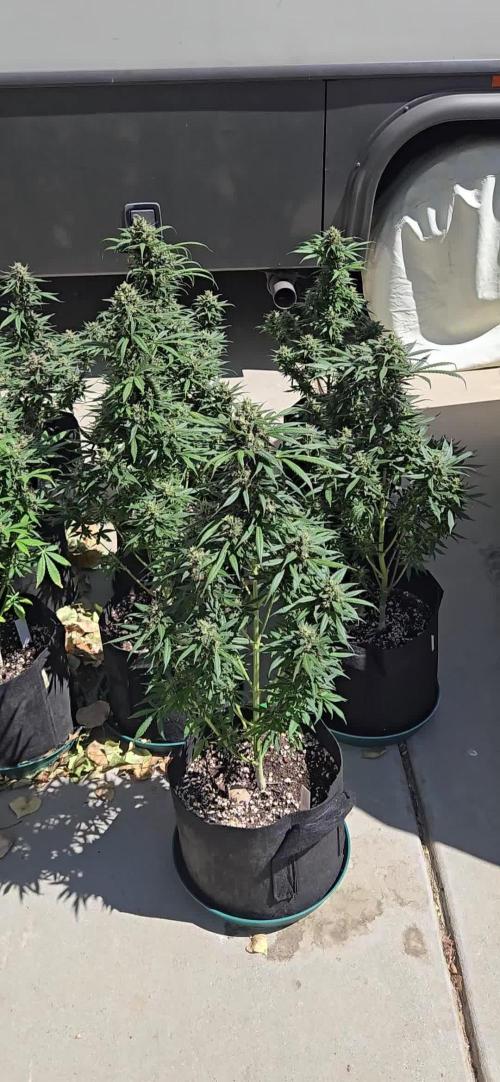
Had to leave out of town for 8 days. My girls suffered both heat stroke and dehydration. I fed them and saturated the fabric pots. I also turned the dehumidifier off for the next 12 hours since the rain has slowed, for now. It doesn't look like the grew much this week. I'm afraid this is going to make the final weight significantly less than it would have been.
Likes
17
Share
@BLAZED
Follow
Week 10 (3-4 to 9-4) 3-4 Temperature: 22.5 degrees (lights on) 19.3 degrees (lights off) Humidity: 64% (highest) 59% (lowest) 4-4 Temperature: 22.5 degrees (lights on) 19.5 degrees (lights off) Humidity: 66% (highest) 59% (lowest) 5-4 Temperature: 23.4 degrees (lights on) 20.1 degrees (lights off) Humidity: 64% (highest) 56% (lowest) No pictures. 6-4 Temperature: 24.4 degrees (lights on) 20.7 degrees (lights off) Humidity: 64% (highest) 55% (lowest) It looks like the plants are doing better since they havent got any water the past couple of days. Today i decided to heavily defoliate the plants. I also found a old feeding schedule from Green House with PH values, and it recommends that i should give an PH of 5.7 on coco. I thought PH 6 was good, but i was wrong, maybe this in combination with the plants being too wet, is the reason for the weird growing leaves, and the problems they show. I cleaned the reservoir and made sure there is no old water in the lines. I made a full strength 10L feed, and added it to the reservoir. I turned the reservoir on for around 3 mins, just to the point that the AutoPot trays are full of water and the valves are shutting them off, then i turn the reservoir off. I will do this every other day, so 1 time in 2 days. 7-4 Temperature: 25.7 degrees (lights on) 22.1 degrees (lights off) Humidity: 64% (highest) 50% (lowest) 8-4 Temperature: 26.4 degrees (lights on) 22.4 degrees (lights off) Humidity: 64% (highest) 55% (lowest) Today i turned on the reservoir for 3 minutes again, just till the trays are full of water. 9-4 Temperature: 25.9 degrees (lights on) 21.2 degrees (lights off) Humidity: 60% (highest) 51% (lowest) No pictures.
Likes
18
Share
@ZalySk
Follow
F49: 49 days of flower. Probably 20 more? I know blue dream goes a little longer and the buds on two of the plants still look young. I'm gonna have to do a close up shot next weekend to figure out just how close I am. I harvested the terple day 50 and that caused a ruckus in the net. All the plants are a floppy mess but I'm not concerned. The net package I got actually came with a larger upper net but I never installed it like an idiot. Getting the Terple out of the gross space caused everything to fall over but it's all right because now all the side buds are exposed to light lol.
Likes
14
Share
Plants are doing well. the Psychosis is catching up I've taking a video of my room too show the inside a bit better. Noticing some issues with my room set up. The 2" air stones are making too much noise at random points of the day/week. I assume the stones move slightly and cause a rattle noise when the stone is at a certain angle *** ill update this week more today after I have been to the hydroponic shop to pick up a few things Having some issues with the 2"airstones. Due to screeching and rattling. The let the perfect amount of air out for my 19l pots but the noise isn't worth it. Here is and 18" air curtain. Super silent and works great. I bought 30" curtains too.. They let even more air out and form around the pot better 👍
Likes
3
Share
Decima settimana di veg sul balcone..inizia a riprendersi anche le foglie inizia ad uscire bene,(normali)...💪👍
Likes
91
Share
These one was a big messy jorney, everything happened from almost kinling them, to almost no space for them to grow, LED broken middle flower and still perform like the queen champion she is!!! I am felling her mature over cycles , i am thinking of her like a wine vine that gets better over time , these one in my humble opinion its a must in everyones garden <3 <3 <3 Wen harvesting these one i felt the need to break it all apart to prevent bud raw or anything we do not want on our medicine, i like to hang them all and let them dry but in these case there was no chance i was taking that big of a risk with these big fruits all over the place, what a blessed run, my rack is completely full, there was no more space , i mean no more space at all hahah amazing , thank you thank you thank you <3 <3 <3 As always thank you guys for your love , your time, your support and it all, i fell blessed and i am truly thankful <3 <3 <3 All info and full product details can be find in can find @

 https://www.zamnesia.com
 https://aptus-holland.com 

#aptus #aptusplanttech #aptusgang #aptusfamily #aptustrueplantscience #inbalancewithnature #trueplantscience #zamnesiaseeds #growerslove

With true love comes happiness <3 <3 Always believe in your self and always do things expecting nothing and with an open heart , be a giver and the universe will give back to you in ways you could not even imagine so <3 <3 <3 

 More info and updates @ 
https://growdiaries.com/grower/dogdoctor

 https://instagram.com/dogdoctorofficial

 https://youtube.com/channel/UCR7ta4DKLFMg2xxTMr2cpIg

 <3 <3 <3 Growers love to you all <3 <3 <3
Likes
14
Share
The girls are really starting to fruit up, they have been on 10 scoops of flower food per week and this past week we added one scoop of flower finisher to the mix. Their feeding has been split into two days so as not to flood the plants with nutrients and burn the leaves. This means they still get their 10 scoops but in 5 scoop intervals. Watering has been every 2 days because of the 12/12 light schedule the soil doesn't dry out as quickly. The buds are getting massive on the White Widow plant, they are getting to be too heavy for the branches so I have begun to support the lower branches by tying them up to the main stem. I am using a plant wire so that as the plant moves and grows it isn't constricted. You can see the green supports in the newest pictures I uploaded. I also began thinning out the fan leaves so that all of the plants energy can be focused on the bud growth regions. I began removing the larger fan leaves that were blocking light to the bud regions. You can see how the plants are less bushy now. This should provide some low stress to the plants and boost bud production. Continued to thin out the fan leaves today. Made a lot of progress, now all of the bud sites should be receiving light. We also began a new fertilizer. I added a flower finisher into the mix with the Build A Bloom 2-10-5 flower food. Starting with just a 2 scoops mixed into the other flower food from pride lands. Cut down the pride lands scoops to 3 per serving to balance out with the new 2 scoops of flower food. This will keep me at 1 scoop per gallon of media per plant per week.
Likes
16
Share
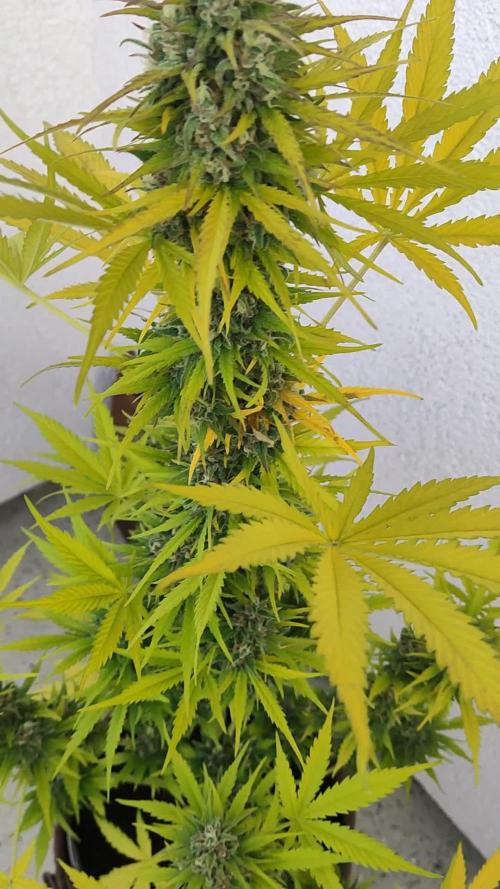
Plants are getting really top heavy, added bamboo support, I aim to cut in a couple weeks or so.
Likes
55
Share
2nd net is up. Early bud formations are promising. holding up to the extremes pretty well, some leaves taking minor damage, but overall, she is holding up, gave her 1 night at 50F see how she would react, stressful. Not advised as it messes with her metabolism, but I want to see if it triggers any anthocyanin response. Love to see her purp up but no signs yet. Remember, For every molecule of glucose produced during photosynthesis, a plant needs to split six molecules of water. This process provides the hydrogen needed for synthesizing glucose and other organic compounds, while oxygen is released as a byproduct. Homework. If Rubisco activity is impaired and it cannot properly function or regenerate its substrate, the plant's leaves are likely to turn a pale green or lime green, a condition known as chlorosis. Essentially, Rubisco activity is highly regulated and susceptible to various environmental and metabolic factors that can cause it to become inhibited, leading to an apparent failure in RuBP regeneration due to a lack of consumption. Rubisco regeneration is intrinsically linked to nitrogen supply because Rubisco is a major sink for nitrogen in plants, typically accounting for 15% to over 25% of total leaf nitrogen. The regeneration phase itself consumes nitrogen through the synthesis of the Rubisco enzyme and associated proteins (like Rubisco activase), and overall nitrogen status heavily influences the efficiency of RuBP regeneration. RuBisCO is a very large enzyme that constitutes a significant proportion (up to 50%) of leaf soluble protein and requires large investments in nitrogen. Insufficient nitrogen supply limits the plant's ability to produce adequate amounts of RuBisCO, thereby limiting the overall capacity for photosynthesis and carbon fixation. Maintaining the optimal, slightly alkaline pH is crucial for the proper function and regeneration of Rubisco. Deviations in either direction (too high or too low) disrupt the enzyme's structure, activation state, and interaction with its substrates, leading to decreased activity and impaired RuBP regeneration. (Lime/yellowing) Structural Component: Nitrogen is an essential building block for all proteins, and the sheer abundance of the Rubisco protein makes it the single largest storage of nitrogen in the leaf. Synthesis and Activity: Adequate nitrogen supply is crucial for the synthesis and maintenance of sufficient Rubisco enzyme and Rubisco activase (Rca), the regulatory protein responsible for maintaining Rubisco's active state. Nitrogen deficiency leads to a decrease in the content and activity of both Rubisco and Rca, which in turn limits the maximum carboxylation rate, Vmax, and the rate of RuBP regeneration Jmax, thus reducing overall photosynthetic capacity. Nitrogen Storage and Remobilization: Rubisco can act as a temporary nitrogen storage protein, which is degraded to remobilize nitrogen to other growing parts of the plant, especially under conditions of nitrogen deficiency or senescence. Nitrogen Use Efficiency (NUE): The allocation of nitrogen to Rubisco is a key determinant of a plant's photosynthetic nitrogen use efficiency (PNUE). In high-nitrogen conditions, plants may accumulate a surplus of Rubisco, which may not be fully activated, leading to a lower PNUE. Optimizing the amount and activity of Rubisco relative to nitrogen availability is a target for improving crop NUE. Photorespiration and Nitrogen Metabolism: Nitrogen metabolism is also linked to the photorespiration pathway (which competes with carboxylation at the Rubisco active site), particularly in the reassimilation of ammonia released during the process. To increase RuBisCO regeneration, which refers to the process of forming the CO2 acceptor molecule Ribulose-1,5-bisphosphate (RuBP) during photosynthesis, the primary methods involve optimizing the levels and activity of Rubisco activase (Rca) and enhancing the performance of other Calvin-Benson-Bassham (CBB) cycle enzymes. Biochemical and Environmental Approaches: Optimize Rubisco Activase (Rca) activity: Rca is a crucial chaperone protein that removes inhibitory sugar phosphates, such as CA1P (2-carboxy-D-arabinitol 1-phosphate), from the Rubisco active site, thus maintaining its catalytic competence. •Ensure optimal light conditions: Rca is light-activated via the chloroplast's redox status. Adequate light intensity ensures Rca can effectively maintain Rubisco in its active, carbamylated state. •Maintain optimal temperature: Rca is highly temperature-sensitive and can become unstable at moderately high temperatures (e.g., above 35°C/95F° in many C3 plants), which decreases its ability to activate Rubisco. Maintaining temperatures within the optimal range for a specific plant species is important. •Optimize Mg2+ concentration: Mg2+ is a key cofactor for both Rubisco carbamylation and Rca activity. In the light, Mg2+ concentration in the chloroplast stroma increases, promoting activation. •Manage ATP/ADP ratio: Rca activity depends on ATP hydrolysis and is inhibited by ADP. Conditions that maintain a high ATP/ADP ratio in the chloroplast stroma favor Rca activity. Enhance Calvin-Benson-Bassham (CBB) cycle enzyme activity: The overall rate of RuBP regeneration can be limited by other enzymes in the cycle. •Increase SBPase activity: Sedoheptulose-1,7-bisphosphatase (SBPase) is a key regulatory enzyme in the regeneration pathway, and increasing its activity can enhance RuBP regeneration and overall photosynthesis. •Optimize other enzymes: Overexpression of other CBB cycle enzymes such as fructose-1,6-bisphosphate aldolase (FBA) and triose phosphate isomerase (TPI) can also help to balance the metabolic flux and improve RuBP regeneration capacity. Magnesium ions, Mg2+, are specifically required for Rubisco activation because the cation plays a critical structural and chemical role in forming the active site: A specific lysine residue in the active site must be carbamylated by a CO2 molecule to activate the enzyme. The resulting negatively charged carbamyl group then facilitates the binding of the positively charged Mg2+ion. While other divalent metal ions like Mn2+ can bind to Rubisco, they alter the enzyme's substrate specificity and lead to dramatically lower activity or a higher rate of the non-productive oxygenation reaction compared to Mg2+, making them biologically unfavorable in the context of efficient carbon fixation. The concentration of Mg2+ in the chloroplast stroma naturally increases in the light due to ion potential balancing during ATP synthesis, providing a physiological mechanism to ensure the enzyme is activated when photosynthesis is possible. At the center of the porphyrin ring, nestled within its nitrogen atoms, is a Magnesium ion (Mg2+). This magnesium ion is crucial for the function of chlorophyll, and without it, the pigment cannot effectively capture and transfer light energy. Mg acts as a cofactor: Mg2+ binds to Rubisco after an activator CO2 molecule, forming a catalytically competent complex (Enzyme-CO2-Mg2+). High light + CO2) increases demand: Under high light (60 DLI is a very high intensity, potentially saturating) and high CO2, the plant's capacity for photosynthesis is high, and thus the demand for activated Rubisco and the necessary Mg2+ cofactor increases. Mg deficiency becomes limiting: If Mg2+ is deficient under these conditions, the higher levels of Rubisco and Rubisco activase produced cannot be fully activated, leading to lower photosynthetic rates and potential photo-oxidative damage. Optimal range: Studies show that adequate Mg2+ application can enhance Rubisco activation and stabilize net photosynthetic rates under stress conditions, but the required concentration is specific to the experimental setup. Monitoring is key: The most effective approach in a controlled environment is to monitor the plant's physiological responses e.g., leaf Mg2+ concentration, photosynthetic rate, Rubisco activation state, and adjust the nutrient solution/fertilizer to maintain adequate levels, rather than supplementing a fixed "extra" amount. In practice, this means ensuring that Mg2+ is not a limiting factor in the plant's standard nutrient solution when pushing the limits with high light and CO2. Applying Mg2+ through foliar spray is beneficial to Rubisco regeneration, particularly in alleviating the negative effects of magnesium (Mg) deficiency and high-temperature stress (HTS). While Mg can be leached from soil, within the plant it is considered a mobile nutrient, particularly in the phloem. Foliar-applied Mg is quickly absorbed by the leaves and can be translocate to other plant parts, including new growth and sink organs. Foliar application of: NATURES VERY OWN MgSO4 @ 15.0g L-1 in a spray bottle. For those high-intensity workouts when 1 meal a day is just not enough! Foliar sprays are often recommended as a rapid rescue measure for existing deficiencies or as a supplement during critical growth stages, when demand for Mg is high. Application in the early morning or late evening can improve absorption and prevent leaf burn. The plant was getting a little limey yellow in the centre. Shortly thereafter, she was back in business, green mostly regenerated. The starting point [of creativity] is curiosity: pondering why the default exists in the first place. We’re driven to question defaults when we experience vuja de, the opposite of déjà vu. Déjà vu occurs when we encounter something new, but it feels as if we’ve seen it before. Vuja de is the reverse—we face something familiar, but we see it with a fresh perspective that enables us to gain new insights into old problems. Confidence is evidence... nothing more. You are confident because you have driven 10,000 times, you are confident because you have spoken 10,000 times. People think confidence is a feeling, but it's not. If you want more confidence, then you need to create evidence, take more shots, collect more data, build more experiences, take more risks; fail, confidence doesn't come first; it is the reward you get for doing the work. no one else wants to do.
Likes
30
Share
@GoodBudz
Follow
Another week of waiting!! We have AMBER!! Flower times according to TNSB Purple Kush est. Flower time - 8 weeks Cheese est. Flower time - 8-9 weeks The Purple should be done next week and is only getting water when she is thirsty.... lift the pot technique works great!! Like previous Purple Kush grows I've done she is very popcorn like nugs and might be a little tricky to trim. The Cheese still has a few weeks left. Nice bud structure with the smallest nug being the size of a golf ball.... LOVE IT!! This was the last week for nutrient feeds and was still on a Nute, Water, Water schedule. (950 PPM on nutrient feeds)
Likes
33
Share
DAY 87: So I finally repotted the White Widow, though, still not into a 5-gallon. I have a second tent on the way that I'll use strictly for vegging and will allow me to the room to veg out in larger pots with more freedom. I also gave the White Widow some much needed defoliation, and now I can finally see the structure of the plant. I also topped two of her tallest colas to let the rest of the canopy catch up. The Lucky Charms is moving right along. She has a very lemony smell to her. Maybe even closer to a Skittles smell. Also happy to say that the Lucky Charms clone has rooted, and this plant's legacy and beast genetics will continue.
Likes
21
Share
In the end I can say that I am satisfied with both the yield and the taste of Mimosa. It will definitely satisfy my daily needs :). I wrote earlier but I will repeat the basic information: 81 days from when it sprouted until it was harvested. 3 weeks of vegetation. 7 weeks of flowering. 14 days drying. 123 g total yield. 2 Mimosas grown. They have both grown taller than 110cm making them one of the taller strains I have grown so far. All ten or so weeks passed without any problems, the only thing I was not very happy when I saw in which direction Mimosa # 1 is developing. After 14 days of drying in a grow box in the dark, I did the final trimming, weighed the dried flowers several times to keep my Mimosa # 1 and Mimosa # 2 from mixing, although it can be immediately recognized by the structure of the dried flowers. I then put them back in the jars and put moisture fighters in them that will regulate the moisture during curing in the jars. And here we are at the end, it’s obvious given the amount of text I’m enjoying Mimosa’s smokes as I write this latest report. Thank you all for the comments and a big thank you to James from RQS for the great support. I hope the information will help future growers who will grow this great strain. See you soon.
Likes
12
Share
@Bluemels
Follow
Tag 60: Endlich geht es in die Blüte für die Fat Banana 😎
Likes
16
Share
@Mastr
Follow
She is so stinky I recommend everyone but you def need fan and filtre love her fruity smell she was big plant and I think she produce over 3 ounces dry bud for sure
Likes
8
Share
@Kingseeds
Follow
Another powerful strain form in-house genetics (OGKB V 2.1 x Platinum ) pure gassy flavour and aroma which will have all the Kush lovers out there going crazy Absolutely frozen cola
Likes
42
Share
Info: Unfortunately, I had to find out that my account is used for fake pages in social media. I am only active here on growdiaries. I am not on facebook instagram twitter etc All accounts except this one are fake. Harvest day 71 since the time change to 12/12 hrs. Hey guys :-) Finally the time has come . The lady was harvested. After the trichomes have been checked (70% milky 30% amber) as always, it was left in complete darkness for 48 hours before it was neatly trimmed by hand. After trimming, she was put back in the drying tent on nets. There they are allowed to dry for the next 8-12 days at 62% humidity before they are put into the jar to ferment with 62% boveda packs. After about 4-6 weeks in the jar I will swap the 62% boveda pack for a 58% boveda pack where it can be ready for another 4-6 weeks to enjoy :-). As always, the remains of the leaves are used to make Ice o Lator and oil. Of course, as always, there is a final update during the fermentation process. Until then, I wish you all a lot of fun with this update. Stay healthy 🙏🏻 and let it grow 👍. You can buy this Nutrients at : https://greenbuzzliquids.com/en/shop/ With the discount code: Made_in_Germany you get a discount of 15% on all products from an order value of 100 euros. You can buy this Strain at : https://sweetseeds.es/de/cream-caramel/ Type: Cream Caramel ☝️🏼 Genetics: Blue Black x Maple Leaf Indica x White Rhino 👍 Vega lamp: 2 x Todogrow Led Quantum Board 100 W 💡 Bloom Lamp : 2 x Todogrow Led Cxb 3590 COB 3500 K 205W 💡💡☝️🏼 Soil : Canna Coco Professional + ☝️🏼 Nutrients : Green Buzz Liquids : Organic Grow Liquid Organic Bloom Liquid Organic more PK More Roots Fast Buds Humic Acid Plus Growzyme Big Fruits Clean Fruits Cal / Mag Organic Ph - Pulver ☝️🏼🌱 Water: Osmosis water mixed with normal water (24 hours stale that the chlorine evaporates) to 0.2 EC. Add Cal / Mag to 0.4 Ec Ph with Organic Ph - to 5.8 - 6.4
Likes
299
Share
Good day to all my friends and visitors here on GD. Decided to finally finish this diary, I took my time with his one ;) Now we cut the second POGP auto plant, the first cut you can find in week 17. The plant from week 17 weighted 660g. wet, this one finished at 1,85kg. wet. The girls where autoflower but thanks to me starting this grow in cold day temps (14 degree Celsius) the started flower really late, maybe that's also the reason for all my problems with this strain during the grow?! The two plants where different phenotypes, the smaller one (from Week 17)though small had nice hard flowers, the bigger one as the only plant from four I grew during the growop started foxtailing. Both of them branched nicely the smell was quite strong and awoul xD like gasoline and something rotten, it smelled so bad i checked a couple times under microscope for any signs of mold in the flower and to my suprise I found nothing. Thank God later during drying the smell would subdue to a more generic "hazediesel" smell -------------------------------------------------------------------------------------------------- SE7000 done it's magic with this grow as with all my other grow ops. For anyone who is interested in obtaining this efficient and affordable light fixture ($ to gram) here's the link: https://spider-farmer.com/products/spider-farmer-upgraded-se7000-730w-commercial-led-grow-light/ A shout out to SSSC for the gift of genetics: supersativaseedclub.com/ Thank you all for your companionship on this voyage, I hope you enjoyed it at least as much as I did. Also thank you for this awesome year together here.
Likes
12
Share
@Bluemels
Follow
Tag 74: Die Fat Banana hat sich doch mehr gestreckt als ich erwartet hatte. Morgen werde ich sie noch etwas entlauben, und hoffen das sie sich nicht noch mehr streckt, platz für die Lampe ist nicht mehr.😬 Tag 75: Leider musste ich die Fat Banana mittig toppen sonst wären die Spitzen zu dicht an der Lampe, ich hoffe sie verträgt es😨 Und gründlich unterhalb entlauben war nötig.
Likes
4
Share
@Andres
Follow
she stopped growing and now she's just getting fat, they eat only organically with earthworm humus and red bird guano...just wait for this flowers...