


Likes
Comments
Share


@OhanaMatata
Follow
stopped feeding the plants nutrients let them flush for the final few weeks.


Likes
8
Share

@420DeepGrow
Follow
📆 Semana 6
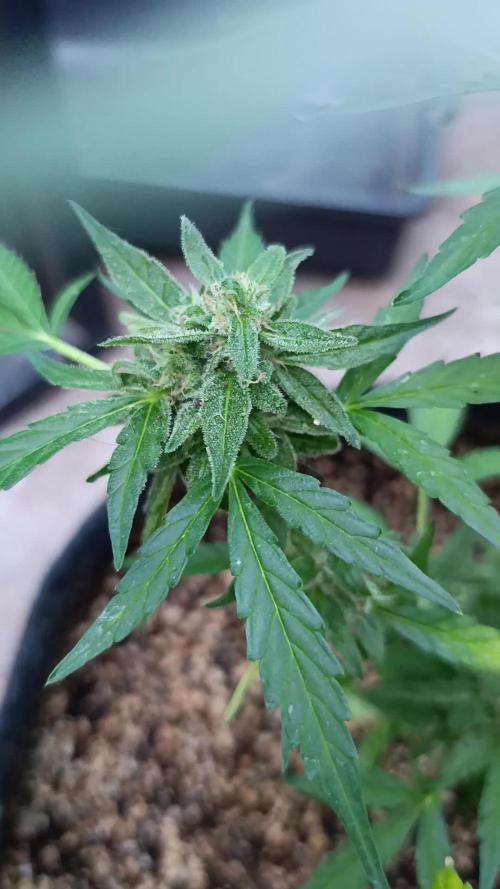
Durante esta sexta semana, la planta continúa desarrollando los cuatro cogollos que han quedado tras retirar la punta dañada. Aunque son pequeños, siguen ganando algo de volumen y se mantienen en buen estado.
⚡ EC: 0.3
💧 pH: 6.2
🌡️ Agua: 21°C
🌫️ Humedad: 45–55%
💡 Intensidad: Luz directa del sol
🔥 Nota de cultivo: Los cuatro cogollos restantes siguen cogiendo algo de tamaño. La idea es dejarlos avanzar durante estas próximas semanas y realizar la cosecha aproximadamente en dos semanas.
Seguimos creciendo fuerte 💪!

Likes
18
Share


@xtchill
Follow
Done a bit of defoliating and pulled them down a little.
Bit of a mess bit she will bounce back.
Hopefully.haha

Likes
11
Share

@all_about_420
Follow
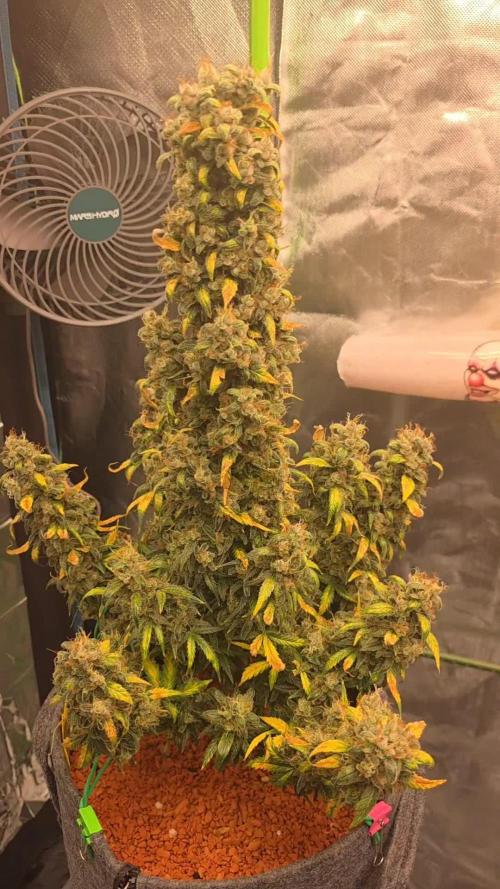
89 Tage wurde sie alt
Die Mexican Airlines hat meine Erwartungen mit einer riesiegen, über 30 cm langen Cola absolut übertroffen.
Durch das LST sind auch die Seitentriebe schön prall und buschig geworden und tragen ordentlich Gewicht.
Für so n kleines Ding, nicht schlecht.

Likes
57
Share


@SmokieMcPot
Follow
Two girls one cup week 5?? I cant count ATM.. if you're just tuning in, check previous week's for daily progression.
Day 28- off to an explosive start for the week. Eating and drinking more than ever. Topping off RES daily between 30-40 fl oz with calmag'd water. Changed RES yesterday to 3/4 strength week 4 GHE light. Breakdown as follows.
2gal water/calmag - 200ppm
Micro - 9mL
Grow - 8.4mL
Bloom - 6.3mL
RES total after ph corrections - 720 @ 5.68.
Light up 30in - 20 DLI
Already had to top off with 26oz calmag'd water this morning and I just changed RES last night. TDS dropped from 720 to 661 within 12hrs, as well as the water level. Ph drift up to 6.18 as usual. I really think every other day RES changes may help keep these girls npk right where it needs to be with how much they're eating. As long as I don't stress em too much more that is. Last week was rough on the girls for sure. Gave em a .5mL shot of Micro tonight to boost nitrogen levels a bit due to the coloration on lower fan leaves and some uppers. May supplement more N into next RES change right off the bat
Will add to the timelapse daily as long as i dont f up the footage like i have done many times already.
Day 29- still looking a little hungry and how fast tds is dropping it def shows in more than one place. Bump up RES to full strength week 4 GHE light. Breakdown as follows.
Water - 2gal
Micro - 12mL
Grow - 11.2mL
Bloom - 8.4mL
Total after ph corrections: 5.68/980
They're def bushing up. The stretch is coming and GC already shows signs of it starting. Wish they'd bush up more before, but i gotta roll with the flow. Definitely branching out down all over and are showing signs of explosive growth yet again. Thinking about turning on the green night light again to show night time movement with the day. Thoughts??
Day 30- these girls are some PIGS! I JUST changed RES yesterday, and they've already eaten 1/3rd of its concentration. From 980 down to 601 in 24hrs! More if you think about my RES top offs every 12hrs (with 200ppm calmag'd water) adding back something versus just diluting further. I know I said I wouldn't stress the girls anymore, BUT... I supercropped the stretching tops on both, and gave em a mild defoliation. Hated to see more big leaves go.. but they're blocking light to everything I want to bush out NOT stretch up. The stretch is coming, but we still have time to train so may as well.
*edit* went a lil nuts supercropping.. WG is taking it like a champ. GC I was a little rough with and crushed the 3 up top a lil too much. They're turned up towards the TSW2000, so they're not dead. RES change tonight with TDS drop as fast as it did. So there will be two updates today. woohoo!
Day 31- both made a speedy recovery from the second round of abuse. will be doing another RES change tonight. same week 4 GHE light, i may bump up the formula some since the TDS dropped 360+ ppm in 24 hrs the other day. just dont want to overdue it since i just got done stressing them TF out AGAIN and they wont be eating as much while repairing (i think)... i will update later after RES change if i decide on running anything other than whats mentioned above.
*TDS broke a thousand tonight.. lets see if we can keep em from dropping too much in the next 12hrs. Not fully repaired, but S.C. locations all over are already growing like nothing even happened. Wedding Glue's branches and main are thick asf! Wait till harvest and I bet they'll double or more. Will have to cut bigger openings in the silicon mat to keep from choking them off.
**update** AM RES check, TDS dropped from 1077 to 679 in 12hrs! And I've read all over not to take autos over 6-700ppm... seems I feed em more, they eat ALLOT more. WTF??!
Day 32- got out a net to see if it actually fits the tent, and to see how I felt about using it. So far, it fits but I'm not feeling it. So it came back out. Another round of defoliation tonight, and standard top off ph correct RES. am going to start every other day RES changes now to keep em happy.
Day 33- plants drinking roughly 42fl Oz every 12hr. Defol AGAIN... got rid of some of the smaller stuff down low so all the plants energy can be focused to somewhere that matters. bumped up the TDS around noon today a bit and moving towards bloom nutes. Giving them a little more calmag to help with repairs from supercropping and all the defol 3 days in a row. Breakdown as follows.
Water/calmag/h²o² - 2 gal (300ppm)
Micro - 10.6mL
Grow - 9.2mL
Bloom - 12mL
RES total after ph correction - 1174ppm
Just did my every 12hr RES check and TDS has dropped from 1174 to 881. I measure before topping off with calmag'd water too. Helps in my data crunching and calculations. At this rate, they'll be down below 600 by morning. Wasn't planning on daily RES changes until they were much further along. Really want to see how big the root structure is in the RES, but don't want to rip roots wrapped on the ice probe. If I had one of those probe cameras I could poke it in my top off/fill port and take a peek.
Day 34- really wish i had a spare down tube installed so i could utilize a top off RES. once this gets too low, it stops top feeding. not a big deal cause theres plenty of bubbles brewing in the RES to dwc it for a few hours. well... theres two bitches in the cup, theyre eating and drinking like pigs already. i am WELL over the "650-700" max ppm for an auto and climbing trying to keep both of them as happy as possible without hurting em. theyre only going to get bigger, thirstier, and hungrier as time passes. i see the 2k mark in the near future for sure. GC showing some purple on the tops of a few bigger petioles on GC and WG showing purple striping on the bottom of some of its branches. after watching vid from today, I DEF need to hit my fans with some tape like a lint roll. and yes, I play them music 🤣. WG is def a strong fucking pheno for sure!! thick branches, tight node spacing when given appropriate lighting. props to FastBuds for sure! changed RES tonight around 6pm to the GHE wk1 bloom MEDIUM feed. breakdown as follows:
water - 2gal (300ppm)
micro - 12.2mL
grow - 10.6mL
bloom - 13.6mL
RES totals after PH corrections - 1237 ppm, 5.51 PH (letting them get the full sweep today)
didn't I say I wasn't going to stress the girls anymore?? damnit! guess I'm a liar.. did a lil schwazzz on the girls tonight. left a few fans for shits and giggles. they're either going to stack up or herm out 🤣.. either way, we're in this together to the end.
Thanks for stopping by and checking out my current grow. I apologize for rambling, but information collected will be good references for future auto grows for me.
Likes
7
Share


Likes
26
Share


@Gunnen
Follow
This week the plan will be to continue LST by tying down new shoots to encourage new flower sites. I am starting to see some hairs so I am going to call this week 1 of flower. I had hoped for a bit more of a pre-flower stretch on the girls, but hopefully they get a little taller during the flower stretch. At the same time, with continued LST, hoping to increase bud sites and increase overall light penetration. Keeping an eye on the water PH level as mine switches a bit in the winter vs. the summer time. Same system of watering thoroughly when dry, also adding water to the bottom of the fabric pots to be soaked up, to encourage lower soil moisture for root stretching. The Low Ryder genetics in the AK74 seems to be keeping to squat. Hopefully some of the AK47 bud structure comes through in some of these phenotypes.
I've taken out measuring the plant height, as it is slightly hard to accurately describe that with the constant LST. I've also highlighted HST as a grow technique, but this is mostly just some simple Super Cropping on some of the bud sites that are a bit more awkward to tie down with soft ties. At the end of this week or early next week I plan to amend the top soil with some more Gaia Green Power Bloom, as the nutrients used during initial planting will be starting to be used up and we are entering flowering phase with more need for the bloom nutrients. I will likely also add a little bit of the 4-4-4 All Purpose as well, in case the plants still have a bit of nitrogen requirements for vegetation. Otherwise, things are green and things are looking healthy to date. I have some moisture gnats, but not enough for it to be a pain. I will be adding an additional dehumidifier into the environment as we progress into flowering, to make sure to discourage mold or mildew from forming. Additional fans are being added as well for better air flow.

Likes
1
Share


@kauilmayel1996
Follow
Me está gustando mucho como huele
Muy frutal
Estoy agradecido ya que las plantas resistieron y siguen creciendo
Revisando parámetros y limpiando
Alistando para el día de corte
Processing
Likes
6
Share


@Jack_Greenstalk
Follow
3 Plants. 3 citrusy phenos!
#1 : First to sprout rapid rooter. TASTE: Pure Lemon front end into hashy cakey afghani. refer to this as the "lemon hashcake" phenom very dense, beautiful nug structure. Yielded 24.5 dry grams of primo smoke. Uplifting more cerebral sativa high with some punch in body as well. happy stress reliever for sure! has some "gassy" or fuel notes to it but very subtle
#2 Tangerine pheno: I orginally thought sour 76 was sour diesel x 76 Afghan til i read hso marks post on uk420 forums saying its cali sour d x 76 afghan. cali sour d is cali orange x sour d x mexican sativa. and it shows in this pheno which smell and taste pretty similar to tangie my friend grows which is cali orange x skunk 1 (mexican sativa x Colombian sativa x afghan indica) pretty similar genetics roots! Smell: Sweet tangerine 🍊
Taste: Just like tangerines 🍊
Medical Effects: Hybrid feeling effects felt both in body and mind. Stimulating mentally, relaxing in the body. Mild pain relief generally with amazing relief improving feeling in joints (reduced swelling or irritation in otherwise aching areas, loosened tension at joints)
Notes: After breaking up or grinding the sweet tangerine open jar/bud smells turns more sour tangerine with very subtle gas aroma. This one is scary strong! I am an all day regular smoker of the most potent buds I can find, and I never make it thru 1 bowl of this without long breaks after each hit. Starts off strong and creeps to EXTREME psychoactivity. Not for the faint of heart this one might not be best for "new smokers" 😎🔥🔥🔥 yielded 26.1 grams if id have taken clones this woulda been the keeper of the batch, but I got more to check out in future run :) and I got a cloner and veg chamber to start keepin the keepers now I know i like the strain!
#3 Lime Fuel pheno: Smell: Lime🍈 and gas ⛽
Taste: lime
Medical Effects: Cerebral uplift. Creeper. thought it was weakest on initial smoke but 10 minutes in it end up being strongest high of all 3. super wicked sativa, buzzy uplifting all similar to Cinderella 99 or strong jack herers this has almost a "scary high" first few times but once you get used to it or microdose, it is a super fun creative medicine. Helps my arthritis pains and gives me the clean up the house kind of high
Notes: Foxtailed, lowest yield of 3 sour 76's likely because its place directly under the light (perhaps didnt like too intense direct light) but is the most potent of the 3 as well. yielded 22.5 grams of dry
Likes
18
Share


@Grower_Of_Persia
Follow
week intel:
its time for second pruning they grew up too fast and need second pruning as below :
first i remove big fan leaves and only leaves then let them rest for 1 day then the second part of pruning will get done that is removing branches based on these conditions:
1-if the branch is very low and never can make it to the top ,
2- if branch is in shade even after pruning fan leaves ,
3- if there are too many branches at the small space then non of them will get resources so if there is no space for branch then , they must get remove.
everything is perfect!
stresses :
pruning big fan leaves and lower branches + a little E.C stress around 1.7 once a week
feeding:
i feed them 3 times this week with this order :
day 1 : i feed them heavy with silicate +base nutrients(calcium & micros + Bloom) about 884 ppm - 1.7 e.c to cause a little stress.
day 3 : i feed them low dose of Feeding Booster + Karbo Boost around 325 ppm - 0.6 e.c to let them recover a little but not fully recover still a little stress will caused.
day 5 : i feed them with low dose of Top-Max + B-52 around 213 ppm - 0.4 e.c to let them recover the stresses to get ready for another stress next week.
guide of the week :
no more stresses from now on till the end and from next week i'll reduce the amount of nitrogen and calcium to below half to the end.

Likes
8
Share


@Herbangardener671
Follow
Put a lot of love into this grow. She grew for 4 months from seeds to harvest. About 5 weeks and 56 days of flower. Overall great strain to grow and great site @growdiaries for giving the platform and help from other growers. I’ve learned so much about growing and especially about this strain.

Likes
24
Share


@GR0WER
Follow
New week starts!
☀️12.10.2023
Pre-flowering state begins! There are white stigmas on the top of every plant. My garden is full of nice green bushes. But I'm still worring about they tall: maybe I'll use a SCROG net later, we'll see.
Another deal is a roots coming from lower part of trunks. It's because of 80% humadity in the box bottom. I should mount one more ventilator to aerate it.
☀️14.10.2023
78cm tall plants are too large for my box. I considered to mount a SCROG net and another 100w LED lamp to bend them down and give more light. Pre-flowering goes on...
Likes
26
Share


@BlackDragon22
Follow
Sulla più piccola sono arrivate le mosche bianche per sfortuna, spero che non invadono le altre, non da nemmeno segni di sviluppo la Cherry, peccato.. Le altre in grande forma, soprattutto il mostro di skittles! Ho annaffiature solo 2 volte con noci questa settimana il resto solo acqua, non voglio stressante troppo, ormai è ora della fioritura per loro ❤️
Spero che non continuino a nutrirsi delle mie piccole..per ora gestibile, stiamo a vedere. Le infiorescenze iniziano a ingrandirsi, il profumo anche, meravigliose.
Likes
9
Share

@KnightRider
Follow
Hey Cannafam Happy Monday
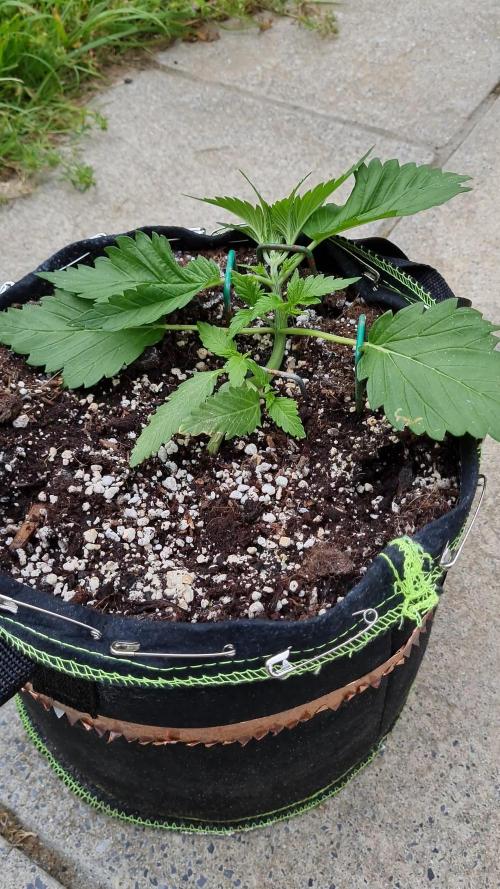
Its been a real mixed week for my gal. We started the first half of the week like the last, low tempretures around 17c daytime 12c night, continous rain and winds at around 30mph with high humidity 80%. On Friday afternoon things to dry out a bit, with Saturday and Sunday having some decent Sun at 23c, however last night we had a thunderstorm and today has been grey and overcast. Daylight hours are currently at 16hrs 24minutes.
Ive been in two minds about the route to take with this gal as FastBuds recommends defoliation or LST due to the strains bushy nature. For outdoor plants i dont normally bother much with training due the Sun moving, but i decided on Friday to give LST a bash and she was pinned down with a few turf pins, ive also turned the edges of the pot down and added safety pins around the circumfrence which can then be used as anquor points with twisty ties if needed.
Growth wise shes not got allot taller this week due to the weather, In retrospect i planted this gal little early, but was tricked in by a particularly nice warm May for the UK. She did however dry out enough for me to get her first feed in yesterday and she is looking healthy still despite the weather 😊
Shes also had some leaf miner damage, nothing major but will keep my eye on. Ive not seen my friend the squirrell again and ive started putting the diamatous earth around the base of the pot when dry to ward off any slugs/snails
Thats all from me for now, thanks for stopping by ✌️💚
Likes
7
Share


@frogDUDE
Follow
Sooo much Frost! Still smells very sweet - like fresh fig newtons. Very low pungency compared to other strains. Growing fast still with no sign of slowing down

Likes
4
Share

@Hempface86
Follow
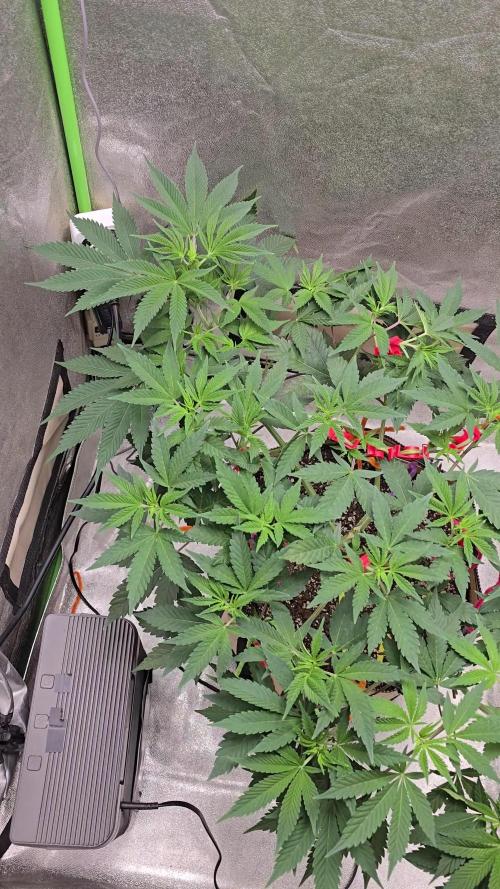
Alright, so I flipped her a couple days ago and she's staying in the big tent for obvious reasons... this should be a big girl... Now i've kept her in veg for longer than the dots say, but she has not been lacking anything , but if she starts asking for stuff, I will have it for her.. i still have some green sensation for late flower, as well as some other bloom boosters, and if she needs nitrogen, I got her there too, but I have a feeling she's not gonna need much aside from a tea here and there... I'm looking forward to this one... Really hoping I pull at least 10 oz... Hope everyone is doing well.God bless and happy growing 🙏

Likes
16
Share


@MrGoonai
Follow
She finally stopped her heightgrowth. Happy with that, because i don't have more space to hang the growlight any higher.
I decided to give her more nutrients this week. She also did trink more water (4.2L in this week), although she was only exposed to the growlight and had no direct sun anymore.
She smells incredibly sweet. I quite enjoy it, and sniff here every day 😅 Really curious how long it will take until i'm going to harvest her. I decided to wait until she has 60 to 80% brown trichomes.
One of her leafes on the bottom still isn't looking too good and is more yellow, so i probably going to cut it in the next few days.

Likes
13
Share


@TheSource
Follow
I I’m filling a 100l water butt with 250ml each of dutchpro A and B and 150ml of explode in the same brand also used 30ml of rootexcelarator by house an garden and 15ml of x-force by bio green also 5ml of canna version of calmag!

Likes
5
Share


Likes
18
Share


@MadeInGermany
Follow
Hey everyone 😃.
This week she has done great 👍.
It was done again on all the drifted topping and sprayed one last time with neem oil so that the last trips are finally gone 😁.
We haven't had any pests for so many years and all of a sudden we have such little shit parts 😅.
This week it was poured twice with 1.2 l of water.
GHSC enhancer was added during a pouring (1 g per l)
The tent was cleaned every day this week and the plants were checked for health.
The humidifier is filled once a day.
Next week I will decide how I will continue the training because I have space again in the flower tent 😀.
Until then, I wish you and your families a good start into the new year 2021 🙏🏻.
Stay healthy and let it grow 🍀
You can buy this Strain at :
https://sweetseeds.es/de/red-mandarine-f1-fast-version/
Type:
Red Mandarine F1 Fast Version
☝️🏼
Genetics:
Red Poison Auto®️ (SWS39)
X
Tangie (California Orange x Hybrid Skunk)
👍
Vega lamp:
2 x Todogrow Led
Quantum Board 100 W
💡
Bloom Lamp :
2 x Todogrow Led
Cxb 3590 COB 3500 K 205W
💡💡☝️🏼
Soil :
Canna Coco Professional +
☝️🏼
Fertilizer:
Green House Powder Feeding
☝️🏼🌱
Water:
Osmosis water mixed with normal water (24 hours stale that the chlorine evaporates) to 0.2 EC. Add Cal / Mag to 0.4 Ec Ph with Organic Ph - to 5.5 - 5.8 .
