


Likes
Comments
Share


@FreezingIslandBoi
Follow
Most of the pistils are brown and fewer is coming out. This is the last week that I will feed them and will flush with pH water tomorrow. They have gained quite some size during this week and couldn’t imagine chopping them down last week. Tangerine Dream got bleached a little bit, height issue. There is also a tiny bit of purple on the bleached area. Overall trichomes on the bud gland are starting to become cloudy with some amber.


Likes
22
Share


@LordAzrael
Follow
**** Wed 8 Jan - day 57 ****
Nothing to report yet
**** Fri 10 Jan - day 59 ****
Red plant is looking near the finish - decided to try a bit of defoliation - see pics
She's about a foot high but lots of bud - a little bonsai wonder
I now realize it's using the flash makes all the bud look so frosty... !
Actually there are lots of nice colors coming through in the buds, and a little purple in the leaves
Giving Black a bit longer before I do the same
**** Mon 13 Jan - day 62 ****
I gave Black a bit of a trim the other day - she's about 40 cm and must weigh double the other
Red is looking very close to finish - see today's video
No feeding of any kind
Water is from the tap at PH 7, they are drinking a liter a day, Black a bit more even
**** Tue 14 Jan - day 63 ****
The top of Red is starting to show some blueberry colors - now I'm interested in what happens if I leave her longer
Both seem to have stopped growing some time ago - maybe concentrating on flowering
Black plant is I guess a week behind Red, but Red really peaked early
Looking forward to the final stages
Having done scientific tests, I can affirm this is going to be pretty good
That's week 9, cheers all


Likes
19
Share


@Karl_Heinz420
Follow
Blütetag 22 🌺
1,5 l Osmosewasser bei PH 6,3 mit Calmag, Bio-Heaven, Bio-Grow, Top-Max, ALG A MIC und Bio-Bloom.
Blütetag 25 🌺
1,5 l Osmosewasser bei PH 6,3 mit 1,2ml Calmag.
Blütetag 28 🌺
1,5 l Osmosewasser bei PH 6,3 mit 2,0ml Calmag und 1,0ml Alg-A-Mic.
Sunlight Evo 3-60 60% 45cm Abstand (ca. 700 PPFD)
22-25 Grad Celsius bei 50-55% Luftfeuchtigkeit (VPD 0,8 - 1,0 kPa)
Likes
16
Share

@Joni2017
Follow
Hello, Growdiaries Community!😎
The small one follows its rhythm 14 cm 💪👏🏻, temperature 27º C ☀️ humidity 70% 💧 irrigation 500 ml 💦 alternating one day with nutrients and another without nutrients.
Happy growing, and see you in the next update!😉👍
Likes
21
Share


@BLAZED
Follow
Week 15 (9-6 t/m 15-6)
9-6
Temperatuur: 30.8 graden (licht aan) 22.2 graden (licht uit)
Luchtvochtigheid: 66% (hoogste) 40% (laagste)
De toppen beginnen al wat dikker te worden, en de geur is nu ook erg aanwezig, het gaat de goede kant op!
Watergift: 1000 ml, met 0.2 ml Silica Power per liter, 0.3 ml CalMag per liter en 1.3 gr Calcium PowderFeeding per liter. EC: 0.7 PH: 6.5
10-6
Temperatuur: 32.2 graden (licht aan) 23.2 graden (licht uit)
Luchtvochtigheid: 62% (hoogste) 44% (laagste)
Vandaag de lamp op 95% sterkte gezet.
Watergift: 1500 ml, met 0.2 ml Silica Power per liter, 0.3 ml CalMag per liter en 1.3 gr Calcium PowderFeeding per liter. EC: 0.7 PH: 6.4
11-6
Temperatuur: 31.4 graden (licht aan) 24 graden (licht uit)
Luchtvochtigheid: 70% (hoogste) 45% (laagste)
Watergift: 1500 ml, met 0.2 ml Silica Power per liter, 0.3 ml CalMag per liter en 1.3 gr Calcium, 0.5 gr Hybrids en 0.5 gr PK+ PowderFeeding per liter. EC: 1.7 PH: 6.4
12-6
Temperatuur: 31.7 graden (licht aan) 24.5 graden (licht uit)
Luchtvochtigheid: 62% (hoogste) 39% (laagste)
Watergift: Geen.
13-6
Temperatuur: 31.7 graden (licht aan) 24.4 graden (licht uit)
Luchtvochtigheid: 50% (hoogste) 35% (laagste)
Watergift: 1250 ml, met 0.2 ml Silica Power per liter, 0.3 ml CalMag per liter en 1.3 gr Calcium PowderFeeding per liter. EC: 0.7 PH: 6.4
14-6
Temperatuur: 32.3 graden (licht aan) 23.7 graden (licht uit)
Luchtvochtigheid: 50% (hoogste) 35% (laagste)
Watergift: 1100 ml, met 0.2 ml Silica Power per liter, 0.3 ml CalMag per liter en 1.3 gr Calcium en 0.25 gr PK+ PowderFeeding per liter. EC: 1.0 PH: 6.4
15-6
Temperatuur: 31.6 graden (licht aan) 23.4 graden (licht uit)
Luchtvochtigheid: 54% (hoogste) 37% (laagste)
Nu nog 2 weken te gaan! 😁
Watergift: 1100 ml, met 0.2 ml Silica Power per liter, 0.3 ml CalMag per liter en 1.3 gr Calcium PowderFeeding per liter. EC: 0.8 PH: 6.4

Likes
3
Share

@AestheticGenetix
Follow
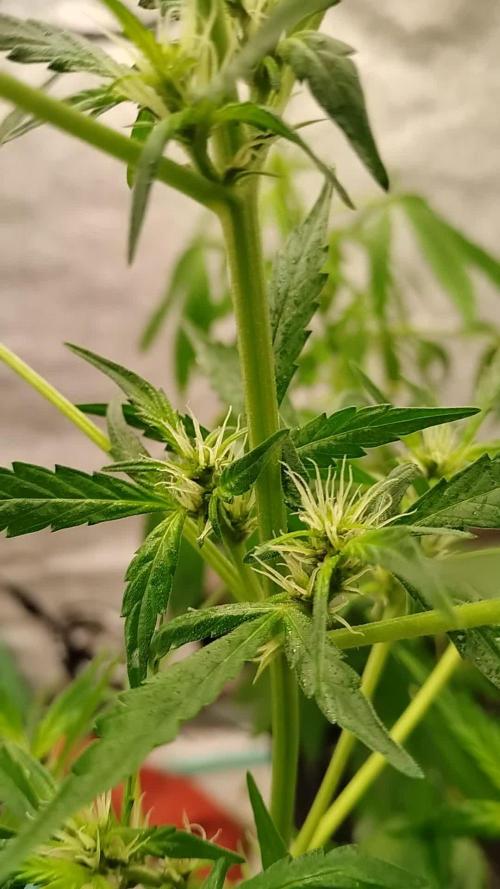
7/23/25 I'm not sure if this plant is meant to purple but this one is showing inner flower purpling. Plants that do this tend to be very purple all the way through
7/24/25 plant is praying and super happy. I hope autos can't reveg with an increase of light schedule

Likes
3
Share


@SSKNFbyHAZE
Follow
⚡️⚡️ Instant Organic Feeding starts here!⚡️⚡️
Hey Growmies~!
Hope your week’s off to a great start!
So far, the Organic Instant Feeding method is working perfectly! I haven’t added any dry nutrients or Cal/Mag, and there are no signs of nutrient deficiencies.
It’s been about three weeks since I last top-dressed with dry nutrients, and as we head into the fourth, everything looks healthy. The only minor issue is a bit of phosphorus toxicity from using more bloom nutrients than veg nutrients, but it’s not a big problem. Her buds are filling out nicely, and we’ve got about two weeks left before harvest!
More trichome and bud pics coming soon~!
Hope you enjoy!
[9th Week Feeding for a 10-Week Strain]
- 60ml per liter of homemade liquified veg nutrients
1 Corinthians 10:26

Likes
42
Share


@MrJoint
Follow
🍁Dicas e sugestões?
As meninas agradecem.
📸Update de fotos, vídeos e informações diariamente.
DAY 29
As meninas vão ficar alguns dias sem água até secar completamente suas raízes.
Agradeço @LaBossanova @Mr_Weeds_Autos pela dica do overwater. O diagnóstico ajudou muito!
DAY 30
Como é meu primeiro cultivo estou fazendo algumas experiências práticas para entender mais sobre a PLASTICIDADE FENOTIPICA e FISIOLOGIA DA PLANTA na prática.
Das 5 sementes:
✂️C1 e C3 parecem estar felizes com a poda e LST.
☀️C4 também está muito feliz morando na varanda, com o sol da manhã, me ajuda a observar o comportamento da planta na luz natural.
COP e C2 iniciarão as podas ainda esta semana...ou não😁estou tentando criar intimidade.
DAY 31
Terceiro dia sem regar as meninas.
Consertando o overwater.
Boa notícia: O calor foi embora e voltou a marcar 26°C no grow.
DAY 32
Após breve seca, as meninas receberam um pouco de água oxigenada para ajudar as raízes prejudicadas com o overwater.
DAY 33
Minhas garotas estavam com sede, ficaram felizes... Eu também!
Espero desta vez não errar na quantidade de água.
DAY 34
Aumentei o intervalo das regas. Acho que estou acertando.
DAY 35
As podas resultaram muito bem.
Ansioso pela próxima semana.
🎃Obrigado por verificar meu cultivo.

Likes
7
Share


@Nikkov
Follow
What's up guys
let's go to a week passing by, right?
and I'm happy that they have resined a lot, it's a shame they didn't develop better but due to the heat and low humidity this cycle they didn't grow much but I'm already improving in the next cycle and we'll see what happens. =D
Likes
Comments
Share


@GreeneScene
Follow
Day#29Update : I took off about 8-10 fan leaves although I really did not want to take anything . I pony-tailed her main top although I wanted to pony-tail each of her tops . I’m hoping this second lite defoliation establishes those lateral branches letting them become symmetrical with the main top . If this happens I’ll pony-tail each branch for a day or two then when I untie them I’ll top each branch . For now that’s the plan , make as many arms “branches” with equal growth to the central “main” branch .
Day#30 update : she’s been ponytailed for an entire 24hrs which is a 1st she always breaks out of the tie . This makes me happy I timed it better . Usually I ponytail her top when it’s slightly to large/strong so the benefits are short lived at most about 8hrs which still definitely helped those lateral branches reach the light but I was aiming to ponytail her at a smaller growth so that it would remain restrained until I decided to remove it . She’s almost ready for a drink . She could go for one today but I really want to wait until she’s absolutely famished and begging for it . So I’m going to wait another day or two then water her until runoff . The last time she received water was day #24.
Day#31Update: well she’s still pony-tailed ! I’m shocked and amused . I’ll let her down finally tomorrow . Made it through an entire month she’s only gotten more beautiful since fixing the VPD issue. I broke and gave her water before she was absolutely begging for it . Mainly to address the low and falling humidity in my tent . I don’t want to lose anymore precious time dealing with issues and setback on those autos finishing up in here . After I last watered the tent day #24 I did a massive leaf defoliation of the flowering girls which dropped the overall tent humidity massively . So I adjusted the intake/exhaust fans as well as the oscillating fan to allow the humidity to rise in the tent . That worked well enough until but as the girls drink slowly the humidity is back falling again into the 45s. I don’t want it in the 40s until buds are swollen . I mixed up a gallon on water and added an ounce of trace micronutrients to it and ph’d it down to 6.4 loaded it into a 1gallon sprayer & sprayed my 3 autos . Having a little less than 1/4 gallon of this full strength solution I decided to see what my Cereal milk plant was made of and gave it to her .
I haven’t given any of these girls a full strength dose of anything other than the Gaia Green . At day 42 & Day 35 of the autos in flower I did a too dress of flower nutes & a week later all 3 ladies showed burnt tips so I very well may exacerbate the issue by giving them a full stenches feeding of micronutrients .
“Cellie” who went into this 1 gallon pot day#9 is showing what looks hunger signs with the yellowing of the lower leaves . Maybe because I’m letting her go thristy considering there should be 28 days of food in this medium at minimum really even more considering I added more than the recommended amount . So we’ll see.
Month 1 Veg went great excited to see what kind of bush she looks like at the end of month 2 and fingers crossed by month 3 she’ll be read to flip to flower and scrog down
Day#32 Update: RELEASE FROM PONYTAIL PRISON so to speak 😭. She has so many tops already ! It’s going to be a pleasure and a joy to defoliate her , ponytail all her tops for a couple days , then release the ponytails & top all the main tops once to widen her up some more ! She hasn’t shown signs of stress from that full strength micronutrient feeding I gave her last night so that’s wonderful .
She’s going to look absolutely crazy when I strip her bare of a lot of these leaves and ponytail those tops BUT the woman she will be once she fills back out will be worth the temporary tragedy .
It will take her relatively 14 days to rebound from the defoliation I’m going to put on her if I go as heavy as I’m planning to .

Likes
25
Share

@THcHunteR23
Follow
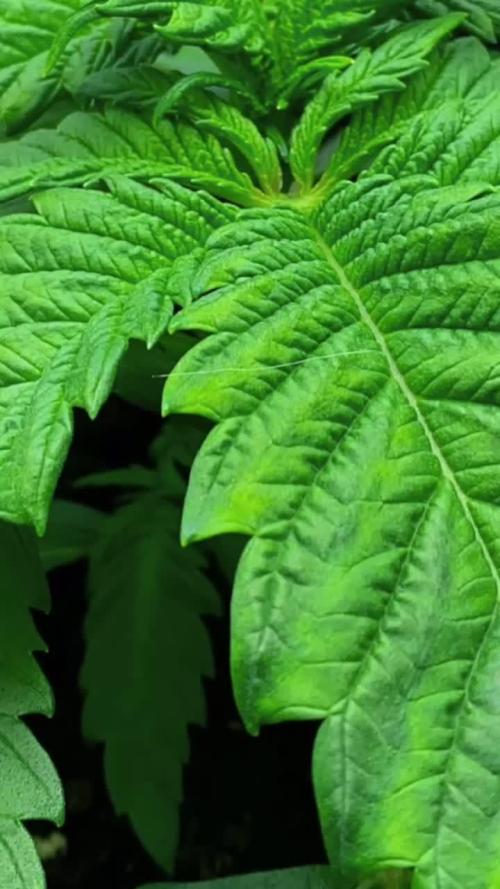
J’ai commencé à monter l’intensité de la lumière tranquillement de 50 % à 60 %

Processing
Likes
9
Share


@MG2009
Follow
04/03/2020
Day 28 of flowering first pistils are fading and tons of new pistils popping up everywhere! Whew!
Got a couple nice pics this week, getting a faint scent of tangie and berries Mmmm!
Leaves are getting pretty frosty
Likes
250
Share


@Ju_Bps
Follow
Hello my friends 👩🌾👨🌾,
Week was good, nice weather, some days too much hot 🔥, but no rain .
I've removed several leaved burned by heat, they was all dried.
I've given 1.5l per plant,
#1 and #2
1x 1.5l water + canazym + sugar royal
#3
2× 1.5l water only
1x 1.5l water + canazym + sugar royal
PH @6
Harvest is very close ✂️✂️🌲🌲,
I had not yet check trychrome, and as usually I'm in late lol...
(See videos)
I'll start my flush this week, weather would be nice for the last week, under 30*C with nice sun 😎🌞🌞 and low humidity.
See you soon for harvest my friends 👩🌾👨🌾💕
Thanks for likes, comments and follows 😘
Likes
158
Share


@SEGA_Y_Griega
Follow
The week passed like in the movie * Leon * when he ran with his ficus from one location to another, like a partisan hiding and saving his flower 😂 I wanted to start cutting, but there are a lot of new stigmas on the buds, it was decided to leave for another week 🤙
Processing
Likes
45
Share


@UKauto
Follow
Not long left for her now I don't think.
Buds are fattening up nicely the main cola is rock hard almost.
Ridiculously strong pepper smell to her haha if you give a bud a rub a lovely fruity smell comes through though. Gonna do a week of dragon force next week then possibly start flush depending on trichomes. I have even checked them at all yet but will get it done over the weekend.
Likes
5
Share
@Chrisandweed
Follow
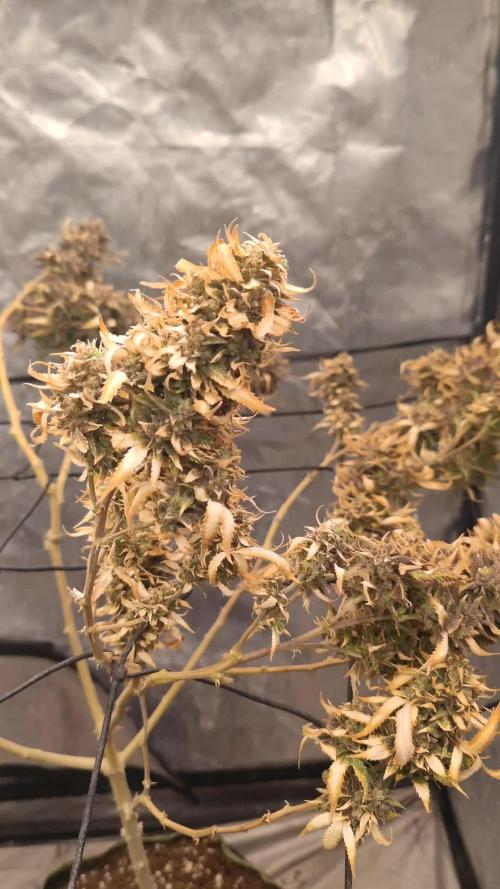
Bueno, ayer hice el ultimo riego, mas cantidad de lo habitual, y ya cuando seque, se corta, supongo que actualizaré fotos, conforme avance la semana, del corte y posterior proceso ya que dado que hubo araña y ciertos problemas, voy a hacer el budwashing que habitualmente hago.


Likes
30
Share


@Sense63
Follow
🌿 Woche 4 – Vegetative Phase (27. Oktober – 2. November 2025)
Nach drei Wochen stabiler Entwicklung ging es in Woche 4 in die entscheidende Aufbauphase.
Die Pflanzen haben sich sichtbar verdichtet, die Kronen geschlossen, und die Spider Farmer SE3000 liefert bei 55 % Leistung (≈ 480 µmol/m²/s) gleichmäßiges Licht über die gesamte Fläche.
Am 27. Oktober war dann der große Eingriff fällig: erstes Topping und leichte Entlaubung bei allen sechs Pflanzen.
Das Ziel: strukturierter, flacher Wuchs – die Basis für das kommende LST-Training und ein gleichmäßiges Canopy.
🗓️ Chronologie Woche 4
27.10. ✂️ Erstes Topping + Entlaubung Alle 6 Pflanzen getoppt (oberste Nodie entfernt). Je 1–2 untere Blätter/Triebe entfernt. Keine Stresssymptome danach.
28.10. 🌱 Erholungsphase Blätter wieder aufgerichtet, neue Spitzen sichtbar. Kein Gießen. Licht 55 % @ 60 cm Abstand.
29.10. Kontrolle & Beobachtung Erde weiter getrocknet. Wurzeln an Topfböden sichtbar → Umtopf-Zeitpunkt erreicht.
30.–31.10. (geplant)
💡 Klima & Licht (Woche 4)
27.–29.10. 55 % 60 cm 25–26 °C 55–60 % Optimales vegetatives Klima, keine Hitzespitzen.
30.–31.10. 50 % 65 cm 24–25 °C 60–65 % Nach Umtopfen zur Stressminderung.
01.–02.11. 60–65 % 60 cm 25 °C 60 % Wieder Aufbau der Lichtintensität nach Erholung.
🌱 Strain-Layout / Pflanzenstatus
Front L/R Cherry Poppers 🍒 Kompakt, kräftig, gleichmäßiger Austrieb nach Topping Bereit für LST ab 5.–6. Nov.
Center-L (gelb) Karate Kit 🥋 Etwas gedrungener, dunkles Grün, kräftige Mitte Wuchs leicht langsamer, aber stabil.
Center-R (terracotta) Lemon Orange 🍋 Größte Pflanze, sehr vital, breite Blätter Beim Umtopfen leicht tiefer setzen.
Back L/R White Gorilla Haze ×2 🦍 Buschig, dichte Struktur, kräftige Stiele Leichte Mg-Symptome → Bittersalzgabe nach Umtopfen.
💧 Gieß- & Nährstoffplan (Übersicht Woche 4 + Vorschau)
24.10.
Düngung (vor Woche 4) Orgatrex 2 ml/L 0,9–1,1 L Letztes Vorgießen in 5 L-Töpfen
27.–29.10. — — — Keine Bewässerung, Substrat trocknet für Umtopfen.
30.–31.10. Anwässerung Bactrex 1 g/L 0,8–1 L Nur zur Wurzelaktivierung, kein Orgatrex.
03.–04.11. Erste Nachdüngung Orgatrex 1,8 ml/L + Bittersalz 0,5 g/L (nur WGH) 1 L pH 6,2–6,4, langsames Angießen.
07.–08.11. Nur Wasser — 1–1,2 L Erhaltung der Bodenfeuchte, keine Zugabe.
🧠 Beobachtungen & Pflege
Erholungsphase: 1–2 Tage nach Topping leicht verlangsamtes Wachstum, danach starke Triebneubildung.
Bodenleben: aktiv, feine Myzelstrukturen sichtbar.
Keine Mangelanzeichen: außer leichtem Mg-Bedarf bei White Gorilla Haze.
LST: Beginn voraussichtlich 03.–06. November (sobald neue Triebe 4–5 cm lang sind).
Entlaubung: keine weitere vor Mitte November.
✅ Fazit – Woche 4 (27. Oktober – 2. November)
Diese Woche war der Übergang vom Aufbau zur Strukturphase.
Das Topping am 27. Oktober hat den Wuchs geformt und die Basis für das spätere Training gelegt.
Die Pflanzen zeigen kräftige Triebe, gesunde Farbe und aktives Wurzelwachstum.
Mit dem Umtopfen zum Wochenende beginnt die letzte große Wachstumsphase der Vegi-Stage.
Vitales, harmonisches Wachstum, starker Wurzeltrieb, perfekte Vorbereitung für den „großen Umzug“.

