Processing
Likes
Comments
Share
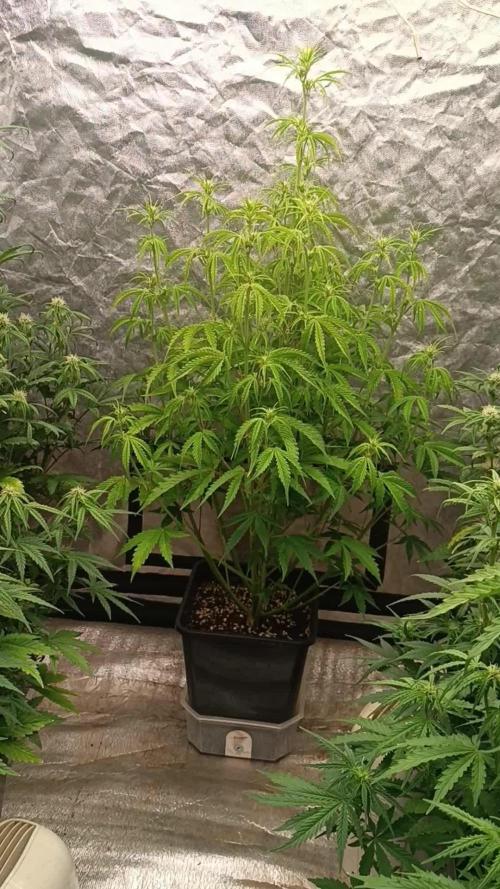
Desgraciadamente el cultivo se quedó estancado en altura y demás. Estoy decepcionado pero la próxima saldrá mejor, no haré tantas podas y quizás cultive automáticas para cosechar rápido
Likes
28
Share
Welcome to week 5 of flower. Trichome production and the density of the buds is really starting to accelerate. My dehumidifier is not stable, so VPD ranges from 1.2-1.4. I lightly defoliated 31/10 and last watering was 6/11 👽👉7/11 The day after watering and the day my timer messed up my 12/12 schedule. But hope it brings no problems. I defoliated lightly and only removed most under the SCROG line. Even a couple of underdevoloped branches that stretched below SCROG-net got cut. 👽👉8/11 Their smell is starting to get more extreme. 👽👉9/11 I removed a bit of the bottom foliage and cleaned up the dead leaves. It has been really tight around the SCROG net, so it was highly needed for airflow and humidity 👽👉10/11 Waterday* ml/L change from last watering - to this. BioHeaven 4 > 4 BioGrow 4 > 2 BioBloom 3.5 > 4 TopMax 1.5 > 4 Calmag 0.5 > 0 Rootjuice 1 > 0.5 👽👉11/11 Amazing growth in thickness and they look alot more frosty today! 👽👉12/11 Same story as yesterday 👽👉13/11 Today should have been waterday, however i was missing some nutrients so postponed till tomorrow 👇_____________________________________________ Flowering feeding recommendations: Early bloom: 5:7:10 Mid-bloom: 6:10:15 Mid–late bloom: 4:7:10 BioHeaven The NPK ratio is 0.91-0.18-0.24; BioGrow The NPK ratio is 4-3-6. BioBloom The NPK ratio is 2-7-4; Topmax The NPK ratio is 0.1-0.001-0.1; Rootjuice The NPK ratio is 0.1-0.1-0.1; 👆_____________________________________________
Likes
563
Share
@Ju_Bps
Follow
Hello my friends 👨‍🌾👩‍🌾, Week was good, babies 👶 continue to grow up.☺️ On the #3 on the same nodes, 2 leaves look strange, maybe burned? Since I've make the treatment, I didn't found sign attack on my leaves. 💦 I give water each 2 or 3 days. I had a rest of mix rqs grow tabs, so I've used to don't waste. 200 ml Water + Grow Tabs RQS + Rhyzo 200 ml Water + Cannazym + Rhyzo 250 ml Water + Grow Tabs + Rhyzo 250 ml water + Grow Tabs + Rhyzo PH@6 Lamp @100% I'll start Train and Topping next Week. Bisous 💋😘, and see you next week. Thanks community for follow, likes, comments, always a pleasure 👩‍🌾👨‍🌾❤️🌲 Mars Hydro - TS 1000 https://www.mars-hydro.com/ts-1000-led-grow-light Mars Hydro - FC3000 https://www.mars-hydro.com/fc-3000-samsung-lm301b-led-grow-light Mars Hydro - SP3000 https://www.mars-hydro.com/sp-3000-samsung-lm301b-greenhouse-led-grow-light The High Chameleon - Bisous Au THC 💋💋🌲🌲😘😘 https://www.thehighchameleon.com/shop/bisous-au-thc-83
Likes
3
Share
@GorkedOut
Follow
My favorite strain I've grown from Divine Seeds thus far. I chopped the plant on day 97 from seed . She produced 67 grams (2.39 ounces) of very dense nugs. The smell is incredibly pungent. She is SUPER sticky. Currently in grove bags curing. I'll update on the terps and such once I do a smoke report in a few weeks.
Likes
6
Share
🌸 Pink Rosay Auto by Zamnesia | Pheno A | Week 7 (Flowering) 🌱 Sometimes the Quiet Ones Steal the Show One of the things I love most about growing is that plants don't compete with one another. They simply become the best version of themselves. Pink Rosay has never been the biggest lady in the room. She hasn't stretched toward the ceiling. She hasn't demanded constant attention. Instead, she's quietly transformed into one of the most elegant and captivating plants in this entire 8×8 Adventure. Standing at approximately 111 cm, she remains beautifully compact while filling her own little corner of the tent with an incredible number of perfectly formed flowering sites. She's one of those plants that makes you stop for a second every time you walk into the room. Not because she's loud. Because she's beautiful. 🌸 Week 7 – Finding Her Spotlight This week she's truly beginning to shine. The stretch is now almost completely behind her, allowing nearly all of her energy to be redirected toward flower production. Every branch seems alive. The flowers are stacking rapidly, calyxes continue swelling, and every cola is crowned with an explosion of brilliant white pistils that make the entire canopy glow beneath the lights. There is something incredibly clean about her appearance. Every branch is organised. Every flower seems perfectly positioned. Every day brings noticeably more substance. She's developing with confidence. And she's moving surprisingly fast. ✨ Already Frosty Before Her Time One detail that's impossible to ignore this week is just how quickly resin production has begun. For this stage of flowering, she's already wearing an impressive coating of trichomes. The sugar leaves are becoming increasingly dusted with sparkling resin glands, surrounding each developing flower with that unmistakable frosted appearance that every grower loves to see. It's still very early. These aren't finished flowers. They're only just getting started. Yet the genetics are already hinting at the incredible resin production waiting later in bloom. It's like watching winter slowly arrive, one crystal at a time. 🌼 The Language of White Pistils Everywhere you look... White. Fresh. Healthy pistils. One of the most rewarding parts of early flowering is watching these bright white hairs emerge across every flowering site. For newer growers, it's worth remembering that these aren't the flowers themselves. They're part of the female reproductive structure, growing from each calyx as the plant continues building her buds. They're essentially the roadmap of flower development. Today they're long, soft and brilliantly white. Over the coming weeks they'll slowly mature, change colour and retreat back into the swelling calyxes as each bud becomes larger, denser and more mature. For now, they're telling us exactly what we want to hear. "This plant is building flowers." And she's doing it beautifully. 🍃 Healthy Leaves, Vibrant Colour & Perfect Balance The foliage continues looking absolutely outstanding. The leaves display a rich, healthy green from top to bottom, maintaining excellent posture throughout the day without signs of stress or nutrient imbalance. Everything feels incredibly balanced. The stems have become thick enough to support future flower weight, while the internodal spacing remains open enough to allow excellent airflow throughout the canopy. Nothing feels crowded. Nothing feels wasted. The plant simply looks comfortable. Comfortable with her feeding. Comfortable with her environment. Comfortable becoming exactly what her genetics intended. 💡 Lighting From Every Angle Although Pink Rosay isn't the tallest plant in the room, she's receiving approximately 1,000 PPFD across the canopy from the Future of Grow Black Series LED. That level of light provides more than enough energy to support vigorous flower production while allowing this compact phenotype to maximise every square centimetre of her canopy. Below the canopy, the Lumiflora under-canopy lighting continues adding another layer to the lighting strategy. As the flowers become larger and the canopy naturally thickens, those lower branches often receive significantly less light. The additional illumination helps maintain energy deeper into the plant, giving secondary flowering sites the opportunity to continue developing alongside the upper canopy. The true difference will reveal itself at harvest. But watching the room evolve under this combination of top and under-canopy lighting has been incredibly exciting. 💧 Hand Watering – Every Plant, Every Day Like the rest of the garden, Pink Rosay is now completely hand watered. It certainly takes more time. Every plant needs individual attention. Every watering means preparing nutrients, checking EC, adjusting pH and carefully delivering exactly what each lady needs. It's more work than automation. But it's also one of my favourite parts of the day. It forces me to slow down. To observe. To notice small changes before they become big ones. And honestly... I wouldn't have it any other way. Current feeding: • Terra Grow — 2 ml/L • Pure Zym — 1 ml/L • Sugar Royal — 1 ml/L • Power Buds — 1 ml/L • Green Sensation — 1 ml/L Maintaining: • EC: 1.95 mS/cm • pH: 5.8 Consistency continues to be one of the biggest reasons this garden keeps performing so well. 🌡️ Environment The environment remains stable, allowing Pink Rosay to focus entirely on producing flowers. Current conditions: • Day temperature: 29°C • Night temperature: 25°C • Relative humidity: 60% • Solution temperature: 21°C • Root zone temperature: 21°C • CO₂: Approximately 529 ppm Healthy roots, stable temperatures and consistent environmental control continue allowing these genetics to express themselves naturally without unnecessary stress. 👀 Looking Ahead Over the next week I expect the pace of flower development to accelerate even further. The calyxes should begin stacking much more aggressively, individual flowers will gradually merge together into larger colas, and resin production should spread rapidly across the sugar leaves surrounding every bud site. The pistils will continue multiplying before eventually beginning their slow journey toward maturity later in flower. She's still far from finished. But every single day she's becoming more impressive. If she continues evolving like this, I genuinely believe she'll become one of the standout plants of this entire project. 🙏 Final Thoughts Pink Rosay continues proving that elegance doesn't need to shout. She has grown with remarkable balance from the very beginning, requiring very little intervention while rewarding that trust with beautiful structure, exceptional health and flowers that seem to become more attractive every single day. Her compact frame, brilliant white pistils and rapidly increasing layer of resin make her one of those plants that's impossible to walk past without stopping for another look. Some plants ask for attention. Others simply earn it. Pink Rosay has definitely earned hers. A huge thank you once again to Zamnesia for these incredible genetics, Plagron for providing outstanding nutrition throughout the grow, Future of Grow for powering the garden with exceptional lighting, Lumiflora for bringing additional energy beneath the canopy, TrolMaster for maintaining precise environmental control, and to everyone following this journey here on GrowDiaries. Your support, encouragement and shared passion continue making this 8×8 Adventure something truly special. Until next week... Growers Love and happy growing! 🌱💚
Likes
6
Share
Start of week 7. Week 6 went well, however she still required and extra 2 liters of food on day 6 of week 6. This girl is insanely sticky, she's getting super dense and frosty, with a sweet earthy smell.
Processing
Likes
20
Share
Hello everyone, We'll sorry I'm late, 😂😂 I've been sick for a few days but I'm back again, and good thing because my girls where thirsty as heck, lol I cant find my tape measure so I'll update you guys on the height next week, everything else is good See you guys next week ✌️✌️
Likes
12
Share
@H2Smith
Follow
📅 23.04-21 (Flo day 57) 📜 trichome analysis: not ready to flush. ⚗️ 1.85 💦 6.2 🌊 40L 📏 cm 📅 24.04-21 (Flo day 58) 📜 removing 30l from the system, the plants drank 30l. 60l filling. EC dropped to 1.83 at 1:00 AM. Trichome analysis: not ready to flush. ⚗️ 1.88 💦 6.2 🌊 30L 📏 cm 📅 25.04-21 (Flo day 59) 📜 trichome analysis: not ready to wash. Plants have drunk 40l at 8:00 PM 50l at 11:00 PM ⚗️ 1.77 💦 6.2 🌊 50L 📏 cm 📅 26.04-21 (Flo day 60) 📜 Set Ph 6.1 to the Ph Controller. ⚗️ 1.79 💦 6.18 🌊 30L 📏 cm 📅 27.04-21 (Flo day 61) 📜 Trichome analysis: Not ready yet. ⚗️ 1.80 💦 6.10 🌊 45L 📏 cm 📅 28.04-21 (Flo day 62) 📜 drained 50 liter from the RDWC system. Objective EC 1.60. Add 175ml total care ⚗️ 1.78 💦 6.10 🌊 35L 📏 cm 📅 29.04-21 (Flo day 63) 📜 -------------------- Nothing to say ⚗️ 1.67 💦 6.10 🌊 40L 📏 cm _____________________________________________________ 📅 Day - 📜 Note - ⚗️ EC -💦 PH -🌊 Water -📏 Height Equipment: Idrolab 12 bucks Chiller teco Hy500 weather controler with Co2 : PRO-LEAF BECC-B2 Bavagreen 720w Bavagreen 720w Bavagreen 240w Bavagreen 240w Nutrients and PH controller: PRO-LEAF PHEC-B2 Nutrients: Green House feeding - powder feeding hybrids | Powder feeding boost Extractor: primaklima PK250-1 PK250-L1 x2 System and roots care: Idrolab Total care
Likes
45
Share
The cannabis strain Grape Guava can be a purple strain, depending on its specific phenotype and genetic makeup. While not all phenotypes of Grape Guava are purple, some variations, such as the Zatix Grape Guava, are noted for their striking purple appearance due to the genetic expression of anthocyanin pigments. https://www.youtube.com/watch?v=cKdVmdoKJ5k In a garden of green, Grape Guava gleams, With its fruity aroma, enchanting dreams. Clusters of grapes, guava's sweetness ignite, A strain so divine, in purple and white. Euphoria whispers, a lush fruity haze, Grape Guava's embrace, a tranquil daze. Off and away.@1400ppm. The increased CO2 allows plants to thrive at higher temperatures, which in turn necessitates higher humidity to maintain the ideal VPD for healthy growth and transpiration. 80F -5F = 75F LST with 70% RH = 0.72 kPa. Higher temperatures and humidity promote rapid growth, nutrient uptake, and photosynthesis while maintaining a lower stress level. Temperature influences the rate of enzymatic reactions involved in aerobic respiration. Enzymes, such as those involved in glycolysis, the Krebs cycle, and the electron transport chain, work most efficiently at an optimal temperature range. In low temperatures, enzymatic activity will slow down, thus reducing the rate of aerobic respiration. In high temperatures, enzymes can become denatured, thus impairing their function and stopping the process of aerobic respiration. Glucose is the primary fuel for aerobic respiration. The rate of aerobic respiration increases with the availability of glucose, as it is the starting point for glycolysis. If glucose levels are low, cells may rely on alternative energy sources such as fatty acids or amino acids , but these processes may yield less ATP or be less efficient. To determine this effect, carbon dioxide volume was measured (as carbon dioxide is an output of aerobic respiration) 18/6 with the 6 being IR. The near infrared (IR-a) borders around 700nm up to 1400nm @ photon par flux density of 1.8 instead of darkness, keeping temps overnight a neat 77F-80F. Think of my tent as a lung. What goes in must come out. When the rate of air going out exceeds the amount of air coming in, it creates a negative pressure. Tent concaves (bends in). If set up correctly, your RH will begin to drop slowly to the desired level you set, and the extraction turns off when it reaches 50% RH. The plant, as it performs cellular respiration, will always be releasing more water into the air, so the RH% of the tent overnight will always increase, so long as oxidative phosphorylation is occurring. As soon as the RH% creeps back up to 55%, the extraction turns back on, over and over. This creates a strong pressure differential which will work wonders on your grow. Replicating high and low-pressure fronts in nature. Critical for oxygen diffusion at the critical time of peak cellular respiratory function.. Moisture will not transfer from a saturated atmosphere to another if that air is already at or above its saturation point, meaning the air can't hold any more water vapor. Once I understood that water is produced as a by product during cellular respiration, specifically at the very end of the electron transport chain (ETC) where electrons are finally transferred to molecular oxygen, the higher the RH of the air, the more resistance there is for more moisture to be added to that environment, and effects the ease with which it does so. But none of that water comes from the pot; it's pulled from the air. If you run high daytime RH, your medium/pot is 100% reliant on transpirational root pull to move water. ZERO evaporation happens across the atmosphere if the tent air has high RH%, the medium cannot release its water through evaporation. Once a canopy develops, light no longer slowly wicks and evaporates from the topsoil. The Soil-Plant-Atmosphere Continuum (SPAC) describes the continuous pathway and process of water movement, driven by a gradient in water potential, from the soil, through the plant's roots, stem, and leaves, and finally evaporating into the atmosphere through transpiration. There is evaporation, there is transpiration, and then there is evapotranspiration; Evapotranspiration (ET) is the combined total of two processes: evaporation (water lost directly from soil and surface water into the atmosphere) and transpiration (water released from plants to the atmosphere through their leaves). Evapotranspiration represents the total amount of water that moves from the medium into the air. There is no such thing as a medium with too much water, only a medium that retains too much for too long. The water must always flow efficiently from one atmosphere(Medium) to another(Air) in a timely manner. Moisture is a critical factor for bacterial growth and decay. Dictating how long it's allowed to sit in any one location for any given period is a key preferred control. To ensure a net reduction in a bacterial population, the rate of removal (ET) must exceed the rate of bacterial growth (decay rate), which is often modeled as a growth rate for the specific bacterium under the given conditions. By optimizing daytime VPD, we also optimize conditions for bacterial growth to explode exponentially above 77°F.. If water is allowed to sit in a medium without an escape within a timeframe, nothing good will happen. IF High RH is maintained overnight as well as during the day, placing 100% of water movement at the behest of daytime transpiration, roots can only pull where they can reach, and if soil is compressed above a certain point, moisture will become trapped in a medium with no way of moving day or night. This will begin the countdown for decay to take hold. When water stagnates in a medium, it loses oxygen, creating anaerobic conditions that foster the growth of harmful microorganisms like bacteria and fungi, which can produce toxins and disease vectors. Thigmomorphogenesis, the process by which plants respond to mechanical stimuli like touch by altering their growth and development, results in significant morphological changes to improve survival against mechanical perturbations. This complex response involves sensing touch and initiating physiological and genetic responses, leading to changes in form and structure over days or weeks. The process is triggered by physical forces such as wind, rain, or touch. Plants adapt to these stimuli by changing their shape and structure, which may include slower growth, thickened stems, or altered leaf development. Plants possess sophisticated mechanisms to detect even subtle mechanical stimuli and initiate responses. A variety of molecules, including calcium ions, jasmonates, ethylene, and nitric oxide, are involved in signaling these mechanical inputs. Touch can induce the expression of genes that encode proteins for calcium sensing, cell wall modification, and defense mechanisms. A plant exposed to constant wind may become shorter and sturdier. A plant that is touched frequently might grow more slowly to conserve energy and develop thicker cell walls. These changes increase a plant's resilience and ability to survive in harsh environments. Let's get Thiggy with it.
Processing
Likes
12
Share
Ok so had a bit of a bad week ph was way out causing problems at 6.4 so had to flush and get ph back to 5.8 also had big problems with high humidity like 80 90 % even when lights are off so I've decided I've upgraded to a 2.0 x 2.4 x 1.2 so hoping the more space and also upgrading to the black orchid 6 inch fan n filter along with the 4 inch fan and carbon filters plus clip on fans but big things to come I've also purchased a 4 pot auto pot system for the next grow so keep eye out guys
Likes
21
Share
@Budhunter
Follow
As I did the flushing in day 68 I was watching the trichomes and on day 87 I could see 25-35% amber so I decided to cut it. I cut the whole plant on the base and hang them all to dry. For this reason I will update my findings later when it gets dry and trimmed. So far really happy with the results. It won’t yield much but the quality is impressive
Likes
7
Share
@Salokin
Follow
Week 6 | Glookies Auto The stretch continues. From 50cm last week to 78cm this week — the outdoor environment is pushing her hard and she’s responding exactly as hoped. Structure remains solid, internodal spacing is consistent, and the canopy is filling out well in all directions. Looking closely at the top, the first signs of flower sites are beginning to show. The auto trigger has kicked in and she’s starting to transition. From here the focus shifts — veg growth will slow down and the energy goes into bud development. Feeding and environment holding steady: CANNA Aqua Vega at 3 ml/l, CalMag Agent 0.9 ml/l, Aptus Regulator 0.1 ml/l. pH 6.2, EC 1.2 mS/cm, 1L per plant per 24h. Temperatures settled at 28°C day, 18°C night, humidity 60%. Updates every Sunday. Stay tuned.
Likes
39
Share
Aparecieron unas pequeñas manchitas en las hojas más viejas, se realizó el trasplante a maceta de 5 lts y se regaron foliarmente con Knactive por estas hojas amarillas que comenzaron a salir y para que tomaran de buena manera el trasplante. Seguimos ... Pronto se viene la floración
Likes
6
Share
@rvabudman
Follow
Graduated, and am off from work for a few weeks, so went overboard on photos. Plant is doing well, leaves are starting to turn yellow (strain trait). Can't wait for the harvest and being able legally gift my xmas ornaments to my cousins during our "cousins walk" at our family xmas party.
Likes
Comments
Share
Harvest ended up being a 14 day hang dry as the entire plant. Dry weight between both plants yielded 40 grams only. I did 2 runs of this. The genetics seemed very inconsistent. One plant was very small, and one plant was so large it was almost touching the light at the top of the tent. The bud structure was not great. They did make some pretty pictures though. The smoke is not bad, its smooth and has hints of fruit to it, almost like a mango or papaya. It also smells sweet. It could be used for daytime if you control it correctly. It doesn't hit you hard. Its mellow but lacks that sativa focus.
Likes
11
Share
Likes
7
Share
@MaxWax
Follow
The plants are all doing well, unfortunately they are developed differently, in the future I will make a report per plant
Likes
1
Share
Creciendo bastante bien Talvez yo no sé cómo hacer el lst pero está aguantando bastante bien está nena En un semana creció bastante!!! Estoy contento Me está aguantando Ok Sábado No sé si el lst ayuda al crecimiento pero siento que va a avanzando mucho... No tengo ni idea de que estoy haciendo ni estaba preparado para hacer amarres Ni tengo idea de cómo lo voy a hacer... Pero realmente quería experimentar ya que veo que todos lo hacen aún que me da miedo romper la planta o estresar la y tampoco se que cortar!!! 😔