Likes
81
Share


@NugLife420
Follow
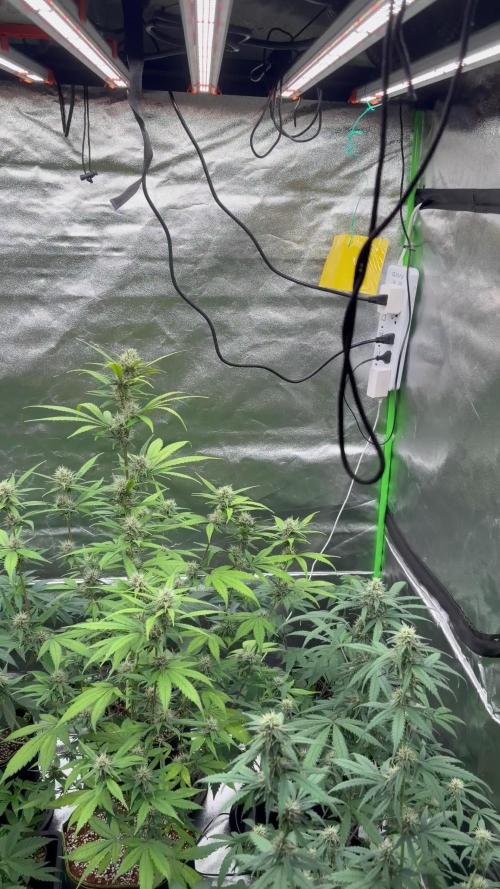
I was finally able to sex them all. 1 Male/Hermie, and the rest have beautiful white pistles forming. They are starting to go through a stretch now as well. I also ordered some more grow lights 3 Mars Hydo TS1000's. I can't wait for those to arrive.)

Likes
3
Share


@ghost8782
Follow
i over fed her big time this is my 1st grow DO NOT defoliate lol i did it twice in veg and stunted her big time tricombes look nice i got about 3 weeks till done she smells great and is frosty dence buds so far

Likes
3
Share


@Olduffybastard88
Follow
Red mandy in around 16 weeks veg while the tropicanna next door is around 6 weeks flowering

Likes
6
Share


@MyloGrow2019
Follow
Bloom week # 1 , had to dial the nutrients back a bit but I think I’ve got it dialed in now , explosive growth now with the heat pump and Co2 are in a sealed room . Lots of new shoots , going to be a very full canopy .
Did some cleanup in the bloom room last night and lollipoped the Zombie Kush , will finish the under canopy cleanup this weekend


Likes
37
Share


@masterofsmeagol
Follow
8/26 FED TODAY. 2 GALLONS TO THE GARDEN. THE WATERING CAN I USE IS ABOUT A HALF GALLON SO THAT'S WHAT A NORMAL PLANT HAS BEEN GETTING. Wow. What a week I had last week. I'm hoping things are going up from here. It's overcast but we have a 90% chance of rain. Thunderstorms. I'm wondering if I should put my back tarp up. The wind doesnt seem too bad so I'll play it by ear. The remaining plants seem to be doing good to me. I wanted to let the soil dry out but I NEEDED to feed. Buds are popping up everywhere and increasing in size. Earwigs still seemed to lollipop the interior branches (mostly larfy stuff but still). I attached a picture so people can see what I mean. I'm getting hit on all fronts but I'm still kicking! I'll update as I go. Some pictures won't upload. I'll have to do it later. Oh and my ph is on point for once. I tested all plants a bunch of different places and readings were 6.6 to 7.3 at the highest.
8/27 Rained last night but not as bad as I thought it would. We are supposed to have some good weather coming up so I'm hoping my medium will get a chance to dry put. Still liking the liquid kool bloom. I'll up the dose next feed. I'm going to need to do another application of plant doctor this week too. It's about time for a BT application as well. I see moths flying off when I check early in the morning and I've observed some pillar damage. I'm slightly worried about soul going anaerobic. The color of the gdps are too lime green for my liking but our weather has been horrid. I never remember having to deal with shit like this. The branch that was all drooped with fusarium wilt has one (the closest to the stalk) shoot that has repaired itself. That gives me hope but I really should just amputate that branch. I guess I'm just nervous because of the reaction I had last time. Granted I've cut tons and tons of branches off in the past and prune things they didn't have whatever pathogen these do. Septoria is still there on one of the GDPs but it seems to be doing okay. I'm SLIGHTLY worried about the change in color on my big NYCSA. It's lost some of its vibrancy. I think it's kinda normal. I'm sure it has some PM (which I'm hoping plant doctor and the silica will help repress) but I think it will be a heavy yielding plant. Sun's poking out. The little clones I took are exploding in growth. They might not yield much but I'm glad I didn't just chuck them like I was going too.
8/28 Things are still looking good! We got some sunshine yesterday and the sunshine out today. Buds are really starting to form and colas are taking their shape. I'm slightly concerned with the coloring of my NYCSA but it started flowering later than the others so senescence may be behind. I may have lost half this year but looking at other diaries and attitudes of soms others I'm pretty fucking lucky. I didn't have much time this morning so I'll update later. I need to keep up with my IPM and do BT treatment and follow up with a second dose of plant doctor.
8/29 Super rushed morning. Only had time to shake the dew off the plants and snap a couple quick pictures. I lowered the growbig this week. I think that was a mistake. Plants are flowering like crazy. My NYCSA doesn't seem as vibrant green as it was. I may up feeding to twice a week or at least give them a little growbig if I need to water. I want tge medium to stay dry for a while. I also needcto cut that dead branch. I'm just afraid of a situation line before where the whole plant died. My anxiety disorder really hampers my growing ability. I qorry far too much. I should just cut it off right now. I've also seen pillar damage so I'm going to need to do a BT spray. I have the other organocide that's the 3 in 1 but I can't use it in flower. I'll just have to stagger applications. Either that or do another root drench or "sprench" and a foliar with the BT on another day. I have WPM on the garden and I'm pretty sure septoria. This plant was perfect though. I'm afraid it might be getting sick. Either way it'd an extremely resilient strain. The little 9lb kush I have in a 3 gallon is flowering the fastest. It really fuckihgcsucks I lost those massive plants. Judging by this "clone" I took off the other clone (I know) this strain wouldve been the first to finish. EDIT: Went back over to check the medium and do some slight defoliation. I inspected the stalks and the dead branch. The dead branch has a small indent (from breakage, insects or rot) where the branch connects to the stalk. I've seen this before but had no problems. However THIS branch seems to he coming out of the stalk RIGHT where the rot is. I cut the other one off that ENORMOUS 9lb Kush and it was dead a few hours later. I talked to my father who has degrees in biology and forestry (among other things) and he said he couldn't really see the harm in leaving it. I am worried that a cutworm mightve gotten in bit I don't see any evidence of any borer insect. Under that stem there is more "bark" and other stuff but nothing like a borer makes. I'm going back over tonight to treat with either BT or Plant Doctor. Haven't decided which. Probably the plant doctor.
8/30 Didn't have time for pictures. Large NYCSA NOW has fusarium wilt. Either I'm the most unlucky grower in our area or my plants got dosed with fusarium. After the research I've done I've cone to the conclusion that this season will be a complete loss. Maybe the two small separate cuttings will make it through flower. The rest is just a waiting game to see if fusarium kills it before they finish flowering. Even if it doesn't then I don't know if I would want to smoke the flowers. I'm shopping online for grow equipment. I'm going to do some indoor this winter. Wow this feels like a kick in the nuts. I'm a good dude. Like I said I'm just either the unluckily grower around or my plants had a little help. Who knows. EDIT: I treated everything with Pkant Doctor again. I'll feed tomorrow and see if some miracle happens and I actually get something
8/31 I added a few pictures so folks can see what fusarium looks like and how it progresses. As you can see it killed a branch and is progressing to the next and so on until the plant is typically dead. No need to get too scientific on the mechanism of action. I FED 2 gallons today. Still kept growbig low dosing.






Likes
3
Share


@Aleks555
Follow
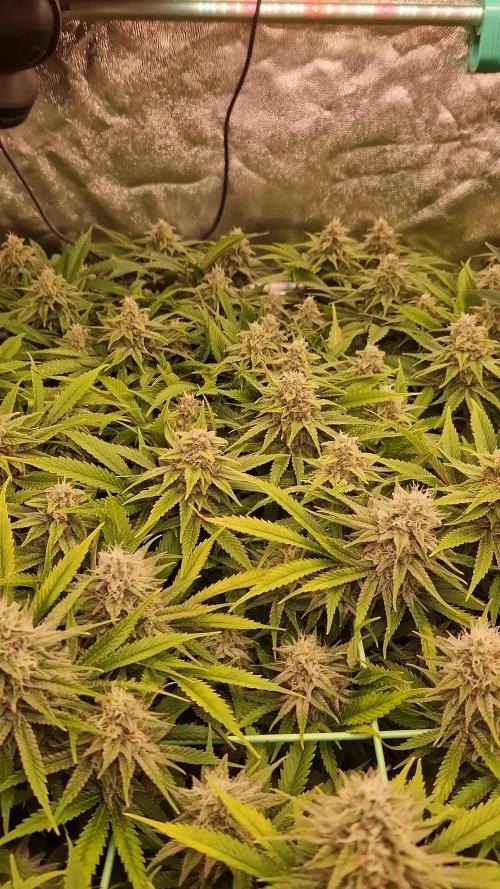
The fourth week of growth has begun, and our FBA 2504 from 42Fast Buds is thriving. After the transplant into a 10-liter pot, the plant has adapted well and continues to develop strong and healthy. Despite being an autoflower, we're experimenting with a 12/12 light cycle, and so far, the results look promising.
The temperature remains stable, reaching up to 30°C during the day, with an average of 27°C–28°C. Humidity is maintained between 60% and 65%, providing optimal conditions for growth. The plant has grown noticeably, now standing between 20 and 25 cm, with well-developed foliage.
We've started applying low-stress training (LST) to shape its structure, encouraging better light penetration and maximizing potential yields. Additionally, we continue to feed our beauty with Xpert Nutrients, and the results are already visible—strong, vibrant growth and lush green leaves.
Everything is on track, and we’re excited to see how our experiment unfolds in the coming weeks!


Likes
15
Share


@Growshh
Follow
Almost there! Final lap, colors really coming in! Thrichs are milky with some clear...can't wait!


Likes
148
Share


@CrazyHorse
Follow
After a hard week, you can finally see the effects of my efforts, if you look at the photo of my girl from day 43 and you compare it with 45, you can see the differences in the color of the leaves. The new set of fertilizers works and my darling seems to be happy, let it be like that all the time without any problems :)
This is the first time that I am growing a photopyriodic girl, after changing the light cycle to 12/12 you can finally see her reactions.
I am excited and waiting for the situation to develop 😍
By the way, she drinks 1.25 liters a day, 5 liters in 4 days.
If I drank as much as she did, I wouldn't have liver anymore
All The Best, You Lovely Girls Growers :D


Likes
2
Share


@Ultraviolet_
Follow
The nighttime VPD does not need to mirror the daytime VPD. Daytime VPD dictates the pull of water and nutrients, while nighttime VPD acts mostly as a prevention tool. A high nighttime VPD increases the risk of the leaf temperature dropping below the dew point, which can trigger bud rot and powdery mildew.
Switched down to 12's hours of light mid-week, changed spectrum, increased light intensity from 840umol up to 1150umol at current height. Overnight from 800ppm to 1500ppm, morning compensation point (microorganisms) 46-47 days from germination, she fills the canopy herself, once the apical dominance is broken.
Measuring a plant's overnight CO2 emissions provides an accurate estimate of its dark respiration rate. Because photosynthesis stops in the dark, you are isolating the respiration process, which allows you to gauge how much stored energy (glucose) the plant has consumed and estimate the scale of oxidative phosphorylation. Oxidative phosphorylation is the final stage of respiration that generates the bulk of the plant's ATP (90%) and relies directly on the oxidation of these respiratory substrates NADH and FADH2 along with the consumption of oxygen.
From a thermodynamic standpoint. Growth is an energy-capturing process, and the rate of that growth is bound by the available free energy (Gibbs free energy) and the First Law of Thermodynamics. While the ceiling or upper limit is dictated by free energy (such as photosynthetically active radiation), the actual amount of growth relies on how the plant balances that energy with other limiting factors. These are often described as the nine cardinal parameters of plant growth. 4 Above, 5 Below. If any one of the 9 becomes bottlenecked, the entire plant's cycle is restricted.
Operating an 80F+ environment at night to force rapid carbon conversion comes with major drawbacks, as the biochemical processes work differently than the deductive logic suggests. While raising nighttime temperatures to 80F indeed accelerates respiration and speeds up the conversion of captured sugars (sink activity), doing so also radically increases the plant's overall metabolic baseline. If the plant's metabolic rate is artificially forced too high via heat, it can actually "burn" through more energy than it managed to assimilate during the day. This leads to carbohydrate starvation, stretching, and a net loss in final biomass yield.
400 ppm is near the standard ambient level; the plant's stomatal intake is the primary limiting factor, not the dark-reaction enzymes. To push 45 DLI without burning out the plant. Trying to force the conversion of a massive daylight DLI in a compressed time frame (12 hours) becomes highly inefficient because the Rubisco enzyme simply hits a saturation limit. To successfully convert a 45 DLI into dense, productive mass, the ambient CO2 generally needs to be elevated to the 1000 to 1200ppm range. This creates a steeper concentration gradient, driving the stomata to inhale CO2 fast enough to match the high photon energy.
It's not all about the amount of light, but the ratio too, as this will dictate growth through the ratio of phytohormones. In order for correct bud development, there needs to be a correct ratio of RGB. Different wavelengths have different penetration depths. When one grows using top-down lighting, only the entire canopy is limited to 2-3 layers of leaf, meaning there will only be correct bud development in those layers, regardless of getting 45DLI.
The biomass potential of a plant is linked to root mass. Generally, when a plant reaches its maximum biomass, you can help to chop off parts of the plant that are in less than efficient areas of the plant (low light) so that it can create new biomass growing towards the light.
Strength is the maximum potential, and power is the rate of conversion. You can have the biggest veg period of 18 weeks, and it means nothing, as soon as you start flowering, the chronological clock starts ticking, the only metric that matters to bud size is how much energy you convert each cycle, not by how long it took you to build the framework, it helps a lot nonetheless.
Not saying anyone should not defoliate for a reason, only that you should have one, and at the right time. Don't defoliate 30+% on autoflowers or 4 weeks into the flower period and expect an increase in yields; it doesn't work like that. There is room for dictating growth patterns and clearing out overcrowded nodes, but it needs to be done in veg because once that timer starts and buds start growing, it's all just energy conversion. One barely needs to defoliate at all in a 4x4 because with side lighting, turning a 2d canopy penetration into a 3d, even lower buds are 90% the quality and density of top ones. The rate of photosynthesis and the ultimate density of lower buds aren't just about the sheer number of photons PPFD. The specific ratio of R:G:B dictates canopy penetration and drives different photochemical reactions. The Electron Transport Rate (ETR) measures the speed at which electrons are driven through Photosystem II (PSII) during photosynthesis. The ratio of Red, Green, and Blue (RGB) light heavily dictates this rate.
Plant leaves continuously perform cellular respiration regardless of the time of day, using energy and oxygen to fuel essential metabolic maintenance. If you over-defoliate, the remaining canopy may be unable to produce enough net sugars during the day to offset the constant respiratory demands of the plant. Must balance fixation with assimilation; there's no point in capturing 45 DLI if you only convert 20% every cycle due to an extreme lack of respiratory capacity to perform cellular oxidative phosphorylation.
You can have a 4x4 canopy or a 4x4x4 canopy, yes, we know that side lights are not as effective at absorption from the sides or underneath, but it's not about DLI, it's never been just about efficiency, it's about the penetration ratios of RGB that drive ETR of/photosynthesis and trigger correct bud development. The size of each bud is its own ability to perform the ETR required for its own personal growth, and bud development is dictated by the ratio of RGB. It drives localised growth and acts as a regulatory switch for that development. Turgor pressure is another very important factor in understanding if you want big buds, for it is the "steam engine" that dictates the rate of bud expansion. Simply, a lot harder to achieve metabolically at ambient 75F than at say 86F
Because buds have less chlorophyll, they do not suffer from the same photosynthetic shutdown that over-exposed, light-stressed leaves do. They can soak up direct light energy to swell in density and size. Their tolerance to intense light is heavily limited by the temperature and humidity, but if you can control those temps and keep the rot away, buds have a much, much higher tolerance to high light than leaves. Beneficial to hammer with high light before trichomes appear. Balancing this with trichome maturity is key for rich terpene and flavonoid profiles, want it just right, somewhere in the middle, not too much, not too little. Find cannabis plants can defoliate themselves come harvest, given the right signals. Every last ounce of potential is recycled into buds by the plant itself (senseceance), given you can keep the level of conversion high enough to prompt a need to do so.
Get the canopy @ optimal PPFD range, 45-55DLI, then let the plant "stretch" the stems into a "PPFD range much higher, one that leaves don't like to grow in, but buds thrive in. What is optimal for a bud is different from what is optimal for a leaf photosynthetically. Genes provide the blueprint, but the environment dictates how, when, and if those genes are expressed. Must first signal the condition to increase the expression you want to exist through stress and response, cause and effect. A well-buffered CEC medium prevents extreme nutrient swings, allowing plants to maximise their dedicated genetic expression.
A plant is either genetically expressing "growing" or "recycling" genes based on its nutrient starvation level in the medium. Constantly toggling between "growing" and "recycling" hormonal states creates a futile cycle that wastes valuable metabolic energy. Plants rely on sophisticated biochemical switches to manage this trade-off and prevent rapid fluctuations that disrupt that balance.
This energy inefficiency is a recognised biological challenge. Plants avoid this costly "flip-flopping" by using hierarchical master regulators (like the TOR and SnRK1 protein kinases) that act as strict molecular switches. These networks enforce cellular commitment to either growth or survival, preventing mixed signals.
This is something that was missing from previous grows.
Under nutrient-rich conditions, TOR promotes protein synthesis, cell division, and structural expansion.
Under starvation, TOR is inhibited, and SnRK1 is activated. This triggers autophagy—where the plant breaks down old macromolecules and organelles to scavenge and reallocate essential nutrients to critical sinks.
"What's the point in flushing?"
The core idea behind a PK booster is to deliver a massive, concentrated surge of P&K exactly when buds are swelling in conjunction with a N starvation. Because these are short, targeted windows, the nutrients must be highly bioavailable so the plant can process them immediately. As soon as you go "organic," that's out the window. Much slower release, uncontrolled, very difficult to "spike". to cause the ratio that will initiate a response.
High-volume PK spikes rely strictly on the immediate uptake capabilities of mineral fertilisers. Making it far less efficient in organic/living soil setups.
When you use organic nutrients, it changes the dynamic with which the plant delivers and trades its nutrients; organic is always releasing new nutrients into the immediate EC. This prevents a lot of autophagic responses from occurring due to a constant stream of new nutrients into the immediate medium's EC. This can prevent nutrient starvation from being signalled.
PK boost is essentially just N starvation, triggering an autophagic response. Concentrated ratio of P&K while tapering off the Nitrogen base. To the plant, the sudden drop in Nitrogen registers as a severe environmental stressor—essentially, the beginning of starvation protocols. She aggressively strips nutrients and proteins from older leaves and vegetative structures and shuttles them directly to the developing flowers and fruit. Ta daaa. Call it a PK booster and sell it. Nothing to do with the P and K itself, it's the ratio immediately available in the medium triggering a nutrient recycling mechanism within the plant itself; all the "booster" sells is the trigger to the signal.
PK BOOST with 50% ammoniacal N signals floral maturation.
PK BOOST with N starvation signals nutrient recycling/sinking.
Very difficult to initiate a response when organic nutes are doing their thing. It takes 4x5x more water significantly to leach or wash ammonia out than it does nitrates. This can prevent triggering N starvation from having its normal impact.
Manipulating the C:N ratio in the medium. One autophagic response has multiple potential signal triggers. Nutrient starvation is not an option.
Likes
5
Share

@hinterhofgrower
Follow
.
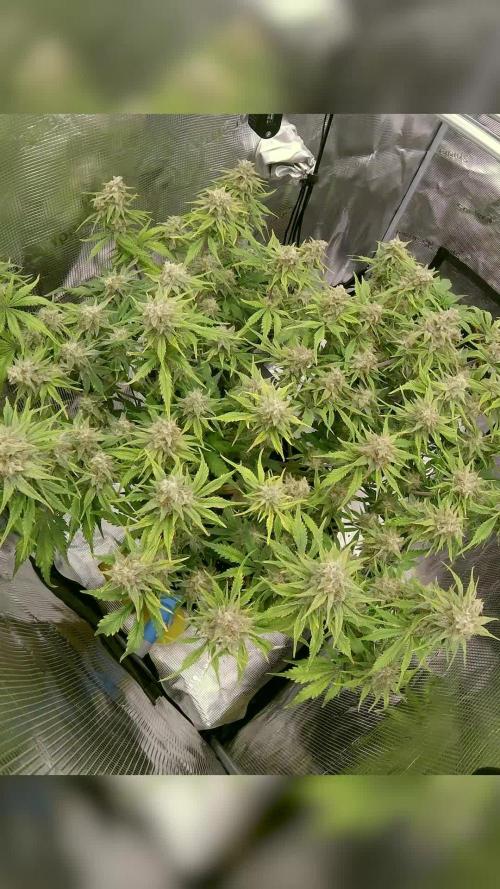
📹 : Full Video on YouTube @hinterhofgrower, please like & subscribe
🌱 :
💧 : 4l day 71, 4l day 76
💡 : Dli: 45 mol/m²/d
🤔 :
Likes
Comments
Share


@Leonweed10
Follow
En pleno proceso de engorde los 16 clones en macetas de 7 litros,con un leve problema de araña roja ya solucionado orgánicamente.
Ya todo funcionando mejor

Likes
13
Share


@Darsilius
Follow
I found out by measuring the water going from the pot that I probably over fertilize the plant.
My mistake Was to use some cheap guano from local shop to the pot directly and also full plan with shogun fertilizers.
I find out it before leaves start necrosis and now the plant is on diet with 1,4 ec and i control the outcoming water every day to be sure that situation In pot is better.
Colas still growing but it slows a bit and will do some impact on my yealds at the end for sure. I will learn from my mistakes !
You can seen on pictures some improves on vent system, keep growing guys! Keep improving 👌🏻🤩
Likes
20
Share

@PhinolaGreen
Follow
Harvest
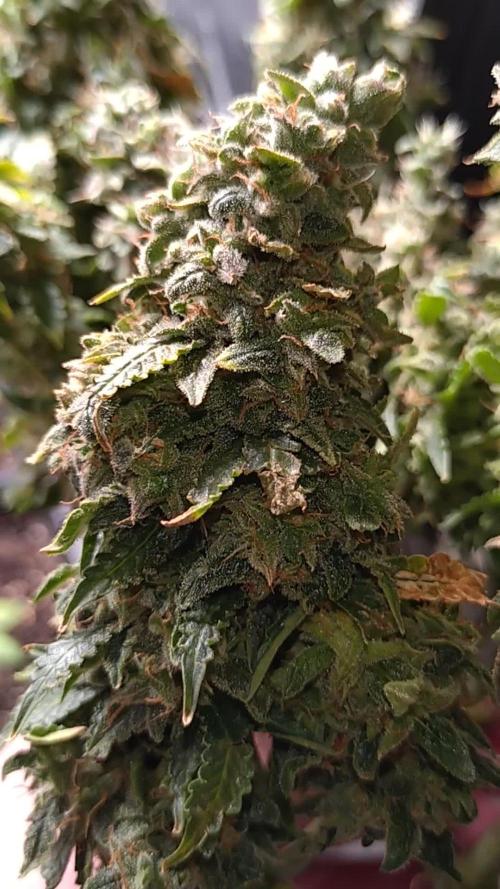
Sticky Broccoli Auto von Zamnesia für den Cup ist rdy to Cut. Hab mich Heute für die Harvest entschieden und finde sie wirklich sehr gelungen 😌
Sie hat ein sehr gutes Blüte zu Blattverhältnis, die Budstruktur ist wirklich sehr Sticky, wie der Name vermuten lässt. Bin gespannt, wie die Wirkung ist. Hoffentlich nicht zu Couch-Lock mäßig aber wenn, ist auch nicht schlimm. Freut mich die Dame auf ihrem Weg begleitet haben zu dürfen 😊
Likes
Comments
Share


@Robom069
Follow
Day 70/71
gotta install new fans, so we have a good circulation and airflow