The Grow Awards 2026 🏆 









Likes
Comments
Share
@DrDuhboto
Follow
Had a small issue this week where temp dropped a bit, I was on vacation for a few days and a window got left open to the room the tent is in.
The room got down to 62f with the lights on. lights off temp wasn't much cooler.
I noticed some canoeing on leaves near the center of the room, I am hoping this was just caused by the temperature stress that happened by the sudden drop.
I fixed the temp and issue and it should be back to normal.
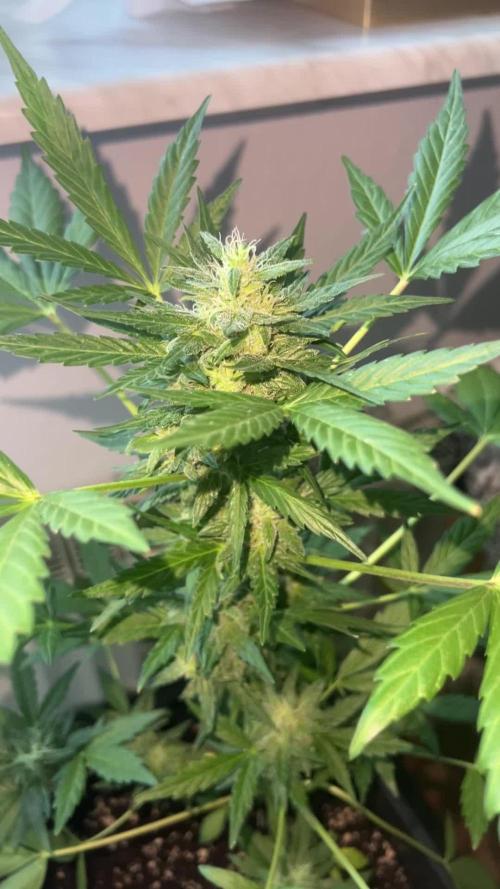
Trichome's look great under microscope. Getting tightly packed and very cloudy, very little amber color at this point.
Cheese #1 Has swelled up quite a bit over the last 5 days, The buds on it are noticeably larger than the ones on Cheese #2
I have moved the led light to cast more on cheese #2 in hopes to get the buds on it to catch up to #1
Still dealing with small calcium deficiencies, I will do a light flush this week of 1/2 strength nutrients and Cal at 6.5
Mid Weekupdate:
Flushed plants with 1/3rd nutrient dose and full strength cal mag.
Adjusted ph. to 6.5 to allow for better uptake of calcium. The calcium issue isnt bad just some small spotting but I am trying to get ahead of it as there is supposed to be 4 weeks left on the strain.
The buds have started to tighten and get more dense. Hairs are about 40% red, some are receding into the bud.
Smells like citrus.


Likes
18
Share
@Barcelona_Farmers710
Follow
Una experiencia realmente buena toda una gozada os la recomiendo Farmers!🍯🌈🍨🍓🍌




Likes
5
Share
@CalGonJim
Follow
2/17 MONDAY They are getting TALL. I did this video last night.
2/18 Tallest canopy Ive had in a while, I need supplemental lighting!!!
Finally found a use for the extra AC Infinity Nursery lights!!!!! Extra lights only use 15.5W max!!!
2/19 8am the light setup works pretty good, I do turn them every couple of hours they work great. The canopy is very dense and I have one more plant than I expected so this will have to do.
2/20 530pm They did great, not sure if the light is helping. I will have to defoliate very soon.
2/21 defolate day
2/22 430pm took off LST clips doing gre


Likes
86
Share
@JuanHaze_Arg
Follow
28/02 se riega con Amazonia roots 3g/L
Viene creciendo muy rápido
02/03 se riega con agua
04/03 se riega con 700 cm3 de agua de ósmosis inversa + 300 cm3 agua de la red + 0.7ml de cal mag. + 0.5 de top auto (macro y micro nutrientes) en una pequeña dosis para que se mueva más rápido! Ec final 0.7 ph 6.2
06/03 se riega con agua + calmag

Likes
8
Share
@HeartStrong_Garden
Follow
I had to skip a week as we went out of town for the 4 th of July. My AC Infinity self watering pots worked great. I gone seven days. I let them dry back a bit for the couple of days prior to the trip, then watered from the top until nice and wet and filled the reservoir completely. The reservoir was dry when i got back and only one (plant 2) showed just barely signs of needing water again. Now I'm doing trichome checks almost daily. Lots of clear and cloudy, some amber here and there. I'm guessing I'll probably see another 4-7 days max before harvest?
Likes
150
Share
@Ferenc
Follow
Day 106, 17th of November 2020:
We need to say goodbye to her very soon. The judgement is harvest.
Time has come and she is old enough to be cut. I have checked trichomes all good some days darkness and no more water also and she will be just outside on the table for some days.
Really nice little plant not strong smell. I really wanna try the smoke the ratio 1:1 CBD:THC and only 7.5% CBD and 7.5% THC haha :)
Processing
Likes
7
Share
@gablmo
Follow
I finally turned 600 watts on, would love to get comments from you folks, so clueless here. If you see something wrong, please let me know.

Likes
4
Share
@XoticGROW666
Follow
Happy wk for this gelato41 (pheno small busy)
All organic grown compost tea & SST TEA

Likes
22
Share
@GermanGrower416
Follow
Ich muss bei diesem Grow wirklich fast nichts machen, Sie macht ihr Ding auf der Fensterbank alleine.
Habe ein paar Thripse auf den Blättern, bleibt leider nicht aus bei Outdoor grow bzw Fensterbank.
Gieße mit Plagron Bloom, Green Sensation und ein bisschen Calmag, bislang keine Mangelerscheinungen.

Likes
13
Share
@TerpTurtle
Follow
Eyes on bud swelling and trichome cluster ripen ratios /./ harvest prep //


Processing
Likes
20
Share
@GrimbolTheDruid
Follow
Grow Specs:
Breeder: Mephisto Genetics
Strain: Cosmic Queen F4
Nicknames: Timantha - CQ1
Genetic heritage: Spacedawg From TGA Seeds x Chemdogging F4
Indica/Sativa: 30/70
Est. cycle time: 65-75 days from sprout
Medium: CQ1 = Soil, Mephisto Genetics Super Soil, Worm Castings. CQ2 = Soil, home made Subcool Super Soil variant, worm castings
Lights: 132W actual LED
Update schedule: I will try to send out the updates every Saturday or Sunday.
For more frequent updates, add me on Instagram @grimbolthedruid
Grow Schedule to Date:
Sprout: 3/1/17 (Full moon)
Age: Day 25 as of 3/25/18
Updates/Observations:
- Water only for this last week and next. Soil is very hot so I don't need to cycle any of those nutrients down right now.
- Plants showing light burns on lower foliage but nothing serious yet.
- Trying to keep the soil always slightly moist and never let it dry completely to keep microbes (and by extension the soil) at optimum health.
- CQ1 is still miniaturized and has shown sex so I think she is going to finish very small, if she makes it at all. I am worried the hot soil will burn her down because she wont ever get big.
- CQ2s leaves show a very strong Sativa expression and I love it.
- CQ2 is growing very vigorously.
- All plant showing sex (F).
Worm Feeding:
- This week I fed my worms about a pound or so total of: Banana, mango, dill, tomatoes, carrots, strawberries, aloe filet, green beans, covered in a dash of oyster shell and alfalfa meal.
- I layer down some canna leaves, layer diced up worm food, sprinkle dry amendments (kelp, oyster shell, neem, etc.), layer canna leaves, then replace bedding and they are happy!
- Creating the food layer protected by the green manure gives the worms a nice buffer zone to move freely through eating as much as they want.
- This method is inspired by HerbinFarmer on Youtube. I really enjoy his videos so if you have time, check him out!
Cheers!
G


Likes
6
Share
@LX1977
Follow
J-29 arrosages eau (pH 6.6)
J-31 arrosages avec engrais (pH 6.6)
J-33 arrosages eau + diamond sugar (pH 6.5)
J-35 arrosages eau + nématodes bénéfiques (2eme phase du traitement contre les larves de mouches de terreau)
Likes
55
Share
@Ultraviolet
Follow
What's in the soil? What's not in the soil would be an easier question to answer. 16-18 DLI @ the minute. +++ as she grows.
Probably not recommended, but to get to where it needs to be, I need to start now.
Vegetative @1400ppm 0.8–1.2 kPa 80–86°F (26.7–30°C) 65–75%, LST Day 10, Fim'd Day 11
CEC (Cation Exchange Capacity):
This is a measure of a soil's ability to hold and exchange positively charged nutrients, like calcium, magnesium, and potassium. Soils with high CEC (more clay and organic matter) have more negative charges that attract and hold these essential nutrients, preventing them from leaching away.
Biochar is highly efficient at increasing cation exchange capacity (CEC) compared to many other amendments. Biochar's high CEC potential stems from its negatively charged functional groups, and studies show it can increase CEC by over 90%. Amendments like compost also increase CEC but are often more prone to rapid biodegradation, which can make biochar's effect more long-lasting. biochar acts as a long-lasting Cation Exchange Capacity (CEC) enhancer because its porous, carbon-rich structure provides sites for nutrients to bind to, effectively improving nutrient retention in soil without relying on the short-term benefits of fresh organic matter like compost or manure. Biochar's stability means these benefits last much longer than those from traditional organic amendments, making it a sustainable way to improve soil fertility, water retention, and structure over time. Needs to be charged first, similar to Coco, or it will immobilize cations, but at a much higher ratio.
a high cation exchange capacity (CEC) results in a high buffer protection, meaning the soil can better resist changes in pH and nutrient availability. This is because a high CEC soil has more negatively charged sites to hold onto essential positively charged nutrients, like calcium and magnesium, and to buffer against acid ions, such as hydrogen.
EC (Electrical Conductivity):
This measures the amount of soluble salts in the soil. High EC levels indicate a high concentration of dissolved salts and can be a sign of potential salinity issues that can harm plants.
The stored cations associated with a medium's cation exchange capacity (CEC) do not directly contribute to a real-time electrical conductivity (EC) reading. A real-time EC measurement reflects only the concentration of free, dissolved salt ions in the water solution within the medium.
98% of a plants nutrients comes directly from the water solution.
2% come directly from soil particles.
CEC is a mediums storage capacity for cations. These stored cations do not contribute to a mediums EC directly.
Electrical Conductivity (EC) does not measure salt ions adsorbed (stored) onto a Cation Exchange Capacity (CEC) site, as EC measures the conductivity of ions in solution within a soil or water sample, not those held on soil particles.
A medium releases stored cations to water by ion exchange, where a new, more desirable ion from the water solution temporarily displaces the stored cation from the medium's surface, a process also seen in plants absorbing nutrients via mass flow. For example, in water softeners, sodium ions are released from resin beads to bond with the medium's surface, displacing calcium and magnesium ions which then enter the water. This same principle applies when plants take up nutrients from the soil solution: the cations are released from the soil particles into the water in response to a concentration equilibrium, and then moved to the root surface via mass flow.
An example of ion exchange within the context of Cation Exchange Capacity (CEC) is a soil particle with a negative charge attracting and holding positively charged nutrient ions, like potassium (K+) or calcium (Ca2+), and then exchanging them for other positive ions present in the soil solution. For instance, a negatively charged clay particle in soil can hold a K+ ion and later release it to a plant's roots when a different cation, such as calcium (Ca2+), is abundant and replaces the potassium. This process of holding and swapping positively charged ions is fundamental to soil fertility, as it provides plants with essential nutrients.
Negative charges on soil particles: Soil particles, particularly clay and organic matter, have negatively charged surfaces due to their chemical structure.
Attraction of cations: These negative charges attract and hold positively charged ions, or cations, such as:
Potassium (K+)
Calcium (Ca2+)
Magnesium (Mg2+)
Sodium (Na+)
Ammonium (NH4+)
Plant roots excrete hydrogen ions (H+) through the action of proton pumps embedded in the root cell membranes, which use ATP (energy) to actively transport H+ ions from inside the root cell into the surrounding soil. This process lowers the pH of the soil, which helps to make certain mineral nutrients, such as iron, more available for uptake by the plant.
Mechanism of H+ Excretion
Proton Pumps: Root cells contain specialized proteins called proton pumps (H+-ATPases) in their cell membranes.
Active Transport: These proton pumps use energy from ATP to actively move H+ ions from the cytoplasm of the root cell into the soil, against their concentration gradient.
Role in pH Regulation: This active excretion of H+ is a major way plants regulate their internal cytoplasmic pH.
Nutrient Availability: The resulting decrease in soil pH makes certain essential mineral nutrients, like iron, more soluble and available for the root cells to absorb.
Ion Exchange: The H+ ions also displace positively charged mineral cations from the soil particles, making them available for uptake.
Iron Uptake: In response to iron deficiency stress, plants enhance H+ excretion and reductant release to lower the pH and convert Fe3+ to the more available form Fe2+. The altered pH can influence the activity and composition of beneficial microbes in the soil. The H+ gradient created by the proton pumps can also be used for other vital cell functions, such as ATP synthesis and the transport of other solutes. The hydrogen ions (H+) excreted during photosynthesis come from the splitting of water molecules. This splitting, called photolysis, occurs in Photosystem II to replace the electrons used in the light-dependent reactions. The released hydrogen ions are then pumped into the thylakoid lumen, creating a proton gradient that drives ATP synthesis.
Plants release hydrogen ions (H+) from their roots into the soil, a process that occurs in conjunction with nutrient uptake and photosynthesis. These H+ ions compete with mineral cations for the negatively charged sites on soil particles, a phenomenon known as cation exchange. By displacing beneficial mineral cations, the excreted H+ ions make these nutrients available for the plant to absorb, which can also lower the soil pH and indirectly affect its Cation Exchange Capacity (CEC) by altering the pool of exchangeable cations in the soil solution.
Plants use proton (H+) exudation, driven by the H+-ATPase enzyme, to release H+ ions into the soil, creating a more acidic rhizosphere, which enhances nutrient availability and influences nutrient cycling processes. This acidification mobilizes insoluble nutrients like iron (Fe) by breaking them down, while also facilitating the activity of beneficial microbes involved in the nutrient cycle. Therefore, H+ exudation is a critical plant strategy for nutrient acquisition and management, allowing plants to improve their access to essential elements from the soil.
A lack of water splitting during photosynthesis can affect iron uptake because the resulting energy imbalance disrupts the plant's ability to produce ATP and NADPH, which are crucial for overall photosynthetic energy conversion and can trigger a deficiency in iron homeostasis pathways. While photosynthesis uses hydrogen ions produced from water splitting for the Calvin cycle, not to create a hydrogen gas deficiency, the overall process is sensitive to nutrient availability, and iron is essential for chloroplast function.
In photosynthesis, water is split to provide electrons to replace those lost in Photosystem II, which is triggered by light absorption. These electrons then travel along a transport chain to generate ATP (energy currency) and NADPH (reducing power). Carbon Fixation: The generated ATP and NADPH are then used to convert carbon dioxide into carbohydrates in the Calvin cycle. Impaired water splitting (via water in or out) breaks the chain reaction of photosynthesis. This leads to an imbalance in ATP and NADPH levels, which disrupts the Calvin cycle and overall energy production in the plant. Plants require a sufficient supply of essential mineral elements like iron for photosynthesis. Iron is vital for chlorophyll formation and plays a crucial role in electron transport within the chloroplasts. The complex relationship between nutrient status and photosynthesis is evident when iron deficiency can be reverted by depleting other micronutrients like manganese. This highlights how nutrient homeostasis influences photosynthetic function. A lack of adequate energy and reducing power from photosynthesis, which is directly linked to water splitting, can trigger complex adaptive responses in the plant's iron uptake and distribution systems.
Plants possess receptors called transceptors that can directly detect specific nutrient concentrations in the soil or within the plant's tissues. These receptors trigger signaling pathways, sometimes involving calcium influx or changes in protein complex activity, that then influence nutrient uptake by the roots. Plants use this information to make long-term adjustments, such as Increasing root biomass to explore more soil for nutrients. Modifying metabolic pathways to make better use of available resources. Adjusting the rate of nutrient transport into the roots. That's why I keep a high EC. Abundance resonates Abundance.
Processing
Likes
3
Share
@camo420
Follow
NEW BOX: 130x60x120
DIY: storage shelf, solid sheet metal
ELECTRO ################################
thermometer top
thermometer bottom
hydrometer
wlan ip cam (+ir filter)
----------------------------------------------------------------
input: x2 USB PC fan
exhaust: x2 USB PC fan
circulation: x2 USB fan
----------------------------------------------------------------
led panel 1: 300W ASUNDOM LED (Veg/Bloom/Full)
led panel 2: 300W XHGrow Reflector-Series LED (Full)
----------------------------------------------------------------
studio light 1 (vegetation): 36W TaoTronics LED Gold
studio light 1 (vegetation): 50W Balai LED full
studio light 2 (vegetation): 8W VINGO LED blue ligh
studio light 2 (vegetation): 50W Balai LED full
----------------------------------------------------------------
studio light 1 (bloom): 36W TaoTronics LED Green
studio light 1 (bloom): 36W TaoTronics LED Gold
studio light 1 (bloom): 50W JADIDIS LED IR full
studio light 2 (bloom): 36W TaoTronics LED Green
studio light 2 (bloom): 36W TaoTronics LED Green
studio light 2 (bloom): 36W KINGBO LED Deep red 660nm
4x PLANTS ###############################
FastBuds Girl Scout Cookies
pots: 14L
soil: plagron grow mix
Likes
13
Share
@Felix_DeSouza
Follow
Подверг серьезному стрессу, LST+defoliation, надо же опыта набираться 😉
На листьях коричневые пятна, полил чистой водой с pH 6.3


