


Likes
Comments
Share


@leliantu
Follow
4 semana de floración. Se están formando las flores en las puntas y a lo largo de los brazos, empece a aplicar abono de floración pero en bajas dosis, conforme la planta vaya creciendo y necesite mas nutrientes voy a ir subiendo la dosis, quiero evitar a toda costa la sobre fertilización que ha sido mi principal problema y obstáculo en cultivos anteriores. De momento las plantas crecen muy bien. Esta semana voy a aplicar un preventivo para hongos foliares y bichos chupadores (trips, cuanto los odio!). Disculpen la calidad de las fotos, mi cámara no es muy buena.

Likes
12
Share

@Arcadium
Follow
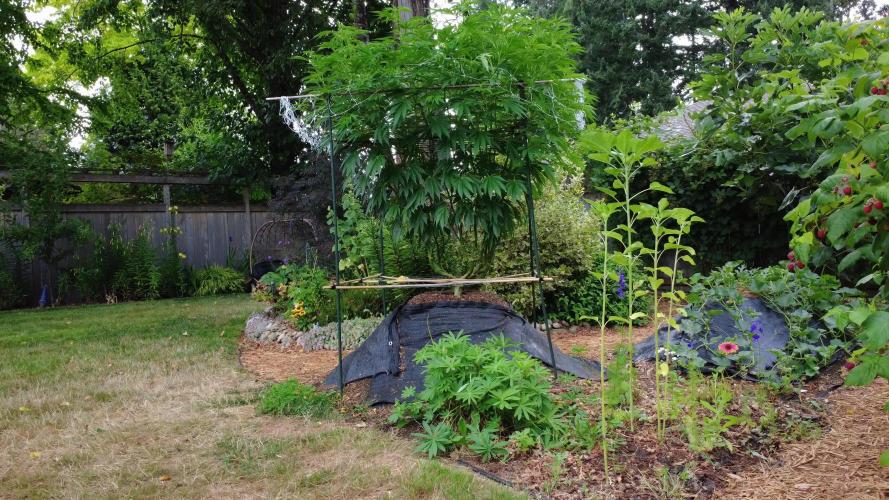
Hot and dry all week, we've only seen 6mm of rain in 2 months! Over 30c most days, but just cooling down a bit now. Light LST on some of the taller nodes using bud clips. Removed some inner nodes that just didn't catch up to the overall canopy. Pistils starting to show, maybe mark start of flower shortly. Tossed another net over to add some support will double it up over in another 2 weeks and she should be fine till the end of flower.
Just drip and LCPT this week.

Likes
14
Share


@TherealNICOGREEN
Follow
Jeg har set så meget frem til at kunne STARTE KANNABIA FRØ OP OG SOM ER BASERET TIL AT FLYTTE UDEN DØRS OM CA4-5 uger:) !jeg GLÆDER MIG ISÆR TIL AT FÅ mine cbd frø i jorden også:) DA DET ER MIN Kones medicin :-) 💚☮️ . Jeg har fået en masse gode gødninger og jord sorter hjem og , 12 14 liter potter KUN TIL MINE KANNABIA PIGER 😉😇🖤🧡💚

Likes
4
Share

@Ninjabuds
Follow
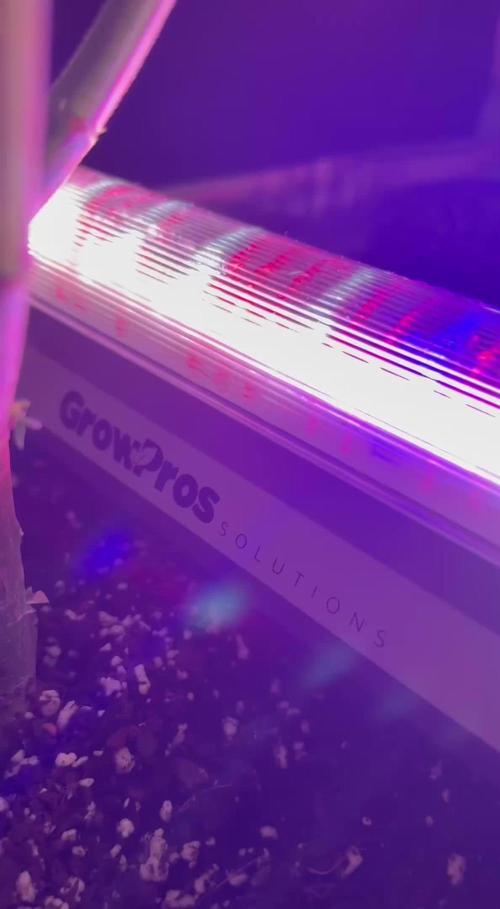
My nine Week 7 flowers are thriving under the new GrowPro Solutions under-canopy lights. The lights have really brought out some amazing colors in the buds. It's so cool to see how much they've changed in just a day! I'm excited to see how they develop even more in the coming weeks

Processing
Likes
12
Share


@Fleetwood
Follow
Still fighting with pH. It was 5.5 when I add the plants, but when I check a few hours later, it's already above 6.5
Days 2: I trimmed the bottom fan leaves from Purple Kush to keep them off the ground. I also topped Purple Maroc. pH was still below 6
Day 4: Veg is gone wild..... I have been shoving the large fan leaves on the Autos underneath other branches to allow light in. Red Purps may get topped yet again.
Day 6:. Switched autos to bloom nutrients. Added Purpanator to them. pH set to 5.5.
Topped bottom and mid branches of Red Purps to keep canopy more even.
Day 7: replaced CO2 generator.


Likes
24
Share


@MrPott
Follow
This is the final week of nutes for the ladies! Time to flush her for the coming week. Also read that Purple Punch needs cold temps at night to turn color. Since I can't do that where I live, an alternative is to flush her with ice water. Giving that a try and will keep you guys updated.


Likes
12
Share


@Drtomb
Follow
Day 54.
Im about 3 or 4 days away from a 1 week flush and then a 48hr no water. Prior to harvest. Buds are very nice and dense and the smell has really increased.

Likes
5
Share


@BuddyHolly
Follow
Recovering very well, noticeable growth daily. Topped, Lst, and pruned over the last week. Adjusted light height and spectrum to encourage more lateral growth. Hope I didn’t overdo it. The og kush(right) growing a little slow, strawberry gorilla(left) is an autoflower and its leaves are looking a little funky.


Likes
67
Share


@HazeyBobby
Follow
The week starts Monday, Jan-13 in flowering stage.
The plant is growing thick and fast, with very short node intervals creating a thick canopy.
Carried out substantial defoliation of almost all the big fan leaves and a few little stems that were not likely to make it above the canopy. Avoided defoliating the major cola branches. This encourages the plant not to waste resources on a node which is only going to produce “popcorn” buds.
The plants reacted well to the defoliation and were looking good by the end of the light cycle for the day. The net is completely full and this will be the last week of applying any LST as part of the ScrOG setup.
Light is maintained at 30cm distance from canopy, with daily fertigation at lights on - watering almost 2.5L per day. Lowered the average RH in the space to 50%.
----prior 4 weeks updates -------------------------------------------------------------------------------------------------------------------------------------------------------------------------------------------
-----------------------------------------------------------------------------------------------------------------------------------------------------------------------------------------------------------------------
The week starts Monday, Jan-06 in flowering stage.
The net is filling up nicely with the ScrOG process being enjoyable - just tucking branches nicely under squares once stretched enough. The Indica dominant strain is really shining with incredible dense growth and thick branches that don't bend as easily as it's Sativa neighbour.
Light is maintained at 30cm distance from canopy.
-----------------------------------------------------------------------------------------------------------------------------------------------------------------------------------------------------------------------
The week starts Monday, Dec-30 in vegetative stage - switching the light regime to flowering.
Initiated flowering with an extended dark period prior to switching light regime - this practice is supposed to promote a faster initiation of flowering by the plant. Maintain lights off from Dec-31, 10:00 until Jan 1 - 18:45 allowing a 32hr darkness period prior to switching the light regime. Light regime is set for 12.5/11.5 on/off allowing me a better maintenance window for my living situation.
Both plants are growing fast and strong, showing their genetic traits. Some shoots are going through the net already. Have started to tuck branches as they grow to fill up any gaps. Did minor defoliation on both plants near their stem base and centres.
Some green algae on roots/coco medium on the surface of the pot. Have defoliated some more which hopefully helps with air circulation at the area. Will monitor over the week - may need to decrease watering frequency, although they seem to be keeping up drinking.
Lowered the High Humidity setting of the extraction fan to 60% - which effectively keeps it running at least 75% of the time, and removed the humidifier. Will monitor and adjust as necessary lowering the setting to 50% in a few weeks whilst flowering.
-----------------------------------------------------------------------------------------------------------------------------------------------------------------------------------------------------------------------
The week starts Monday, Dec-23 in vegetative stage.
Installed the ScrOG net - Set at 20cm from the base of the plants, being 55cm from ground.
The plant is showing great growth, lots of branching and new growth sprouts. A few branches are beginning to come through the net and almost all main branches are now tied down horizontally after the two recent toppings. Applied more LST and will wait for the branches to reach the net and start tucking.
The AC Infinity fan is currently only running intermittently with its current settings. This seems to impact the utilisation and effectiveness of the carbon filter in use. The desired outcome is for the fan to be running for longer periods whilst in Auto config.
Lowered the High Level Humidity from 70% to 60%, and more importantly, lowered the Max Speed from 4 to 2 with the intent that a lower fan speed will result in longer periods where the extraction fan is operated to remain below threshold targets for the grow space.
Plant growth continues to be strong at the end of the week. Big fan leaves near the top are beginning to look a little serrated and dark, similar to the start of this grow. This may be due to the extra CalMag being added which was the issue at the start of the grow. Will keep monitoring and half the CalMag dosage on next feed. Importantly, I have learnt nutrient mixing of the CalMag should be done prior to the Canna Coco A & B. To date I have done the opposite which may explain my earlier issues.
Fertigating daily at the start of the light cycle. One more week of vegetative growth before switching to flowering although I may need to switch earlier due to the vigorous growth and considering the stretch yet to come.
-----------------------------------------------------------------------------------------------------------------------------------------------------------------------------------------------------------------------
My grow setup includes;
- Secret Jardin DS120W tent (120cm x 60cm x 180cm) placed inside the bedroom. Passive intake of air is from a closed off section of the room where the central heating boiler sits - the intake is warm air (20 degC.) and fairly dry (40% RH) during the winter months.
- Mars Hydro SP250 LED light
- extraction fan - AC Infinity Cloudline T6
- ventilation fans
- aquarium heater
- small oil heater
- small dehumidifier
- 20L Airpots and 3.5L general pots for seedling stage
- Canna Coco substrate and nutrients
- pH and EC/TDS meters
- Thermo/Hygro meter
Likes
5
Share


@LeedsCityFarmz
Follow
Nice strain to grow overall especially for the terps it produced, yield was more on the low side as expected from one for these "hype" strains or whatever you want to call them.


Likes
1
Share

@Northern_Ent
Follow
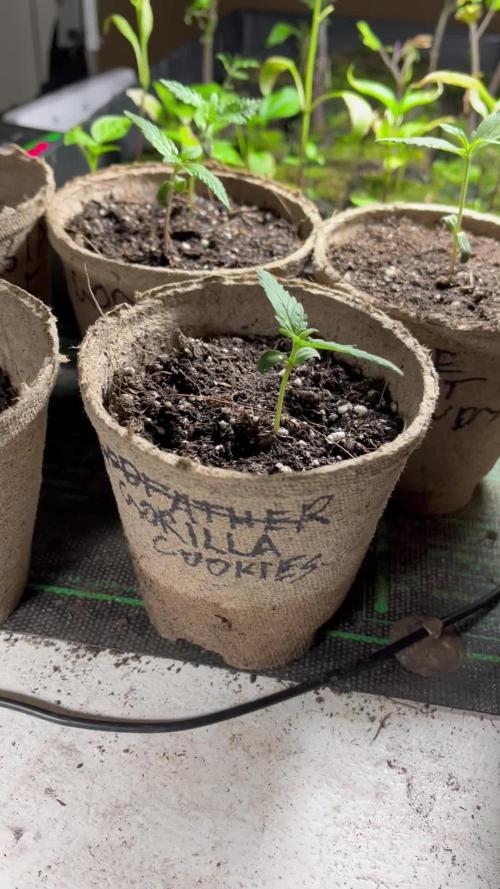
May 10 Day 9: Gorilla Cookies Fast is the most vigorous of the seedlings this year. Fast Buds consistently wins on strong germination at lowish temperatures.
Filled 7 gallon soil bags using a ‘ring’ or donut of spruce cones at bottom of the grow bag. Did a single wedge last year but roots obviously preferred the air exposure so doing the whole bottom edge this time.
Soil is mostly recycled from last year. Mixed in wheelbarrow with addition of peat and compost, some (5 tbps?) Azomite, 3 tbsp of Extreme Blend and 3 tbsp of about six year old Myco Grow (oh well, seems fine).

Processing
Likes
19
Share


@Targona
Follow
Like my sisters in the box, I added Jungle Indabox PH Down nutrients to the girl to prevent soil acidification. The little girl grows beautifully, blooms are done everywhere. I continuously cut the leaves from the bottom. It just makes me happy. 😍
Likes
5
Share

@RanTanPlan_69
Follow
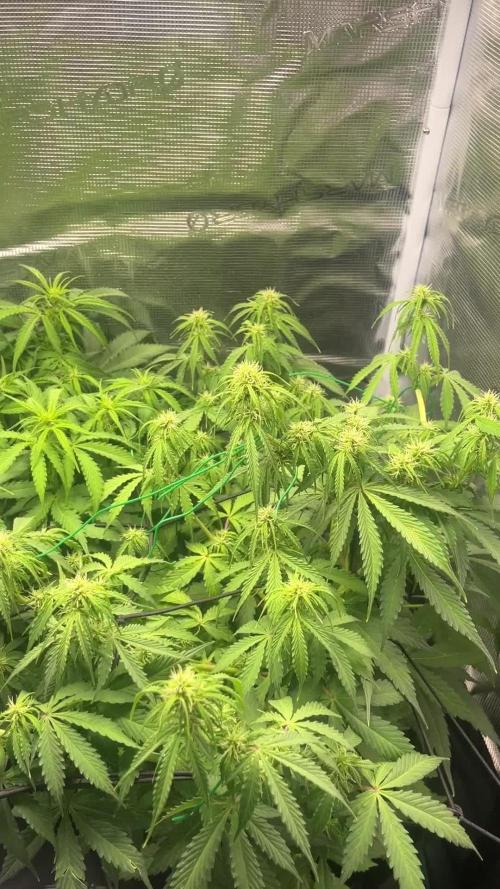
Starting the sixth week of my ladies. Cleaning the bottom and removing the « suckers » (future popcorn buds at the basis) to get more energy to the top !

Likes
7
Share


@Skull
Follow
Had good growth has anyone grown this strain Buddha magnum Auto the leaf looks indica it suppose to be roughly half half never seen leaf like this looks different to hybrids grown in the past


Likes
12
Share


@SmylinPupil
Follow
Another week down. As some of you will see, from the three purple kush autos one defiantly has the characteristics of a “purple kush plant” it is very small with odd shaped buds and almost purpley/black. The other two are monsters with no purple traits. I did loose a plant at the start that was also stunted, which likely would have produced another “purple budded” plant. Anyway it has been hotter than hell here, and they pretty much survived a hurricane and tornado, so I think these girls will finish out the summer just nice. I gave them a feed of some cal mag and some fox farms tiger bloom. Other than that they be chillin. Enjoy the weather!
Cheers.

Likes
55
Share


@Max1973
Follow
Day 57 - The girls are bursting with flower....... looked abit light (the main tops looked a light green, showed signs of nutrient deficiencies), so upped the Dutch Master Gold One Flower, it's 1000 ppm now.... thinking about Defoliation... outside temperatures are middle of winter, 0oC to 20oC (32oF to 70oF) .... but typical high low is 5-15oC (40-60oF)......... surprisingly the LED's warm the tent upto 20-24oC,
this is important point.... i am running the lights, 6 pm to 6 am... 12hrs lights on all night, and all day is night mode...... during the day is the highest temps of the day... and during the lowest temps, they have the light heat .......
Day 61 - I trimmed em .... this was the third defoliation..... things are starting to get sticky..... ah i'm just going to wing it.... they are 2 months (8 wks) from seed.... idk what i'm doing.......
i did some serious stress bending today, and had to put afew tie downs in..... my theory is to hurt em as much as i can without killin em....
to make em harder, stronger, faster, more stressed, so they can survive anything..... grow em stronger......
the smell is zero in the home, but once i got them out for their 2 week haircut, they started producing some strong wet kisses, that were sticky and wet.... the
aroma of heavenly ladies was abundant...... 😎😎
idk... this tastes so good.... it's like some kind of weird berry combo goodness.... i'm vaping vanilla custard atm and this is so good with vanilla custard.... vanilla custard kush n cookies... haha
watch the video......... 😎
Likes
332
Share


@OrganicNature420
Follow
Germination date 🌰 10/03/2021
Day 78 🌱 01/06/2021
Strain 🍁
Purple Matcha, Humboldt seed bank
Nutrients 💉
Advanced nutrients
PH perfect sensi grow A+B (veg)
PH perfect sensi bloom A+b (flower)
B-52 (through veg until week2 of flower)
Voodoo juice (🖕🏻)
Tarantula (🖕🏻)
Piranha (🖕🏻)
Sensizym (all the way through)
Rhino skin (🖕🏻) add first leave for an hour
Big bud coco (week2+ of flower
Bud xfactor (🖕🏻)
Nirvana (🖕🏻)
Bud igniter (first 2weeks of flower)
Overdrive (last 2weeks of flower)
Flawless finish (flush week)
RockHoldings Rockresinator(week2+ of flower)
Vitalink calmag
Set Up
⛺ amazon special 1.2m x1.2m
💡 spiderfarmer sf4000
📤📥 AC infinity 6inch
💧 10lt dehumidifier
Notes🗒️✏️
Smells amazing looks amazing.. going to run this what Humboldt say to, 9/10weeks so last week of nutrients this week and will use the Advanved nutrients flush following week. Can't see this being a huge yielder but I can only imagine the buds will taste amazing and hopefully a heavy high.
Stay turned and happy growing fam ❤️🍁🌱👍🏻
