The Grow Awards 2026 🏆
Processing
Likes
Comments
Share
@OleGrow
Follow
11-Nov: Topped up the soil with 15ml of Gaia Green All Purpose 4 4 4. 13-Nov: Trimmed leaves that weren't getting any light
Likes
19
Share
@Freedonia
Follow
Day 29. I adjust the LST to form the canopy. pH at 5.8 Day 30. It's not necessary to adjust anything, just a little the main stem. pH at 5.7. Growing well :D Day 32. I change the water in the tank, I go from the vegetative table to the flowering stage, keeping the same Ec pH to 5.9. I make some small adjustments to the LST and remove a few fan leaves. Day 35. Growth is pretty good. The pH drops about 0.5 by day, the plant drinks about 1 liter a day, (I think this is due to the decrease in pH). First defoliation. In general, the week has been good. Now I have to deal with the daily pH drops I think caused by the water intake of the plant. Possibly one more week of stretching remains, Auto Mandarina is 70% sativa 30% indica, so an Indica dominance would be better for my set up.
Likes
8
Share
@Rfulton1
Follow
Started flowering these from seed 1-1/2 weeks after germination. Buds are kind of airy but it is nice quality. Gonna move in a month and start a new grow with purple urkle and walking dead!
Likes
121
Share
💩Holy Crap Growmies We Are Back💩 Code Name FBT2307 Well growmies we are at 21 days in and everything is going great 👌 👉 Started to do some light low stress training and its looking good 👈 We got , some Pre-flower showing already 👌Let the stretch begin 💪 Lights being readjusted and chart updated .........👍rain water to be used entire growth👈 👉I used NutriNPK for nutrients for my grows and welcome anyone to give them a try .👈 👉 www.nutrinpk.com 👈 NutriNPK Cal MAG 14-0-14 NutriNPK Grow 28-14-14 NutriNPK Bloom 8-20-30 NutriNPK Bloom Booster 0-52-34 I GOT MULTIPLE DIARIES ON THE GO 😱 please check them out 😎 👉THANKS FOR TAKING THE TIME TO GO OVER MY DIARIES 👈
Likes
22
Share
Seed to harvest day 67 Sticky buds Fruity smell Good strees performance Total Used power 400w
Likes
Comments
Share
Notas/Registos: 19/06/2025 - Fiz uma rega apenas com agua mineral, usei 1L para cada uma. 21/06/2025 - Algumas fotos. 23/06/2025 - Fiz uma rega apenas com agua mineral, usei 1L para cada uma, fiz aplicação foliar de rega "C", 200ml para cobrir todas as amostrar, comecei hoje o LST, vou esperar responderem ao treino para decidir quando refaço as amarras.
Likes
154
Share
💩Holy Crap Growmies We Are Back💩 Code Name FBT2311 Well growmies we are at 21 days in and everything is going great 👌 👉So the low stress training been going well 👈 We got some major Pre-flower showing already 👌 let the stretch begin 💪 Lights being readjusted and chart updated .........👍rain water to be used entire growth👈 👉I used NutriNPK for nutrients for my grows and welcome anyone to give them a try .👈 👉 www.nutrinpk.com 👈 NutriNPK Cal MAG 14-0-14 NutriNPK Grow 28-14-14 NutriNPK Bloom 8-20-30 NutriNPK Bloom Booster 0-52-34 I GOT MULTIPLE DIARIES ON THE GO 😱 please check them out 😎 👉THANKS FOR TAKING THE TIME TO GO OVER MY DIARIES 👈
Likes
4
Share
Likes
148
Share
@BioBuds
Follow
Gorilla, gorilla, my problem child. The only one popping out of 5 but she is weaker than her roommates. She stays behind compared to them. But what can I do other than TLC, she has the best conditions, which are optimal in this grow room, also judging by the other two plants. Until I have a bigger operation, which in the current political climate, is not soon, where I can make mothers and clone them, breed my own strains, and root out runts like this, we do it like life. We play the hand as it is dealt to us and we love all our children the same... although this one is special. So not a genderfluid Silverback yet, but it ain't over till the voluptuous lady sings. We shall nurse this little runt until adulthood, who knows she might surprise us, she should have the mighty Gorilla Glue Number Fouh genes in there somewhere. Now come on out here and show daddy what you're made of... This week we spread out the leaves and branches, some leaf tucking and gentle LST, to prepare for some higher stress and super cropping today. Two days back we made the switch and set the lights to 12/12. Now the flowering stretch will begin, thus we bend the branches further outward in preparation for the canopy. When I do this I notice the branches are thick and sturdy, with no breakage at all unlike my previous grow, the gelato 33. I snapped some branches applying the super cropping and just normal bending with those. It seems like the fan (I didn't have a good option previous grow, hence the flimsier branches there) but also this lighting and soil regime are topnotch, asides from outdoor I haven't seen such lush bushiness yet, even on a more runt-like plant. This MarsHydro SP3000 is still performing great, such controlled temperatures, such an ocean of light. I only wish I started growing with this earlier. Thanks again @MarsHydroLED for trusting us to test your mighty flagship light. It is so well made, it oozes quality, I just want to touch it every time (also to check if it stays cool) and it is just sexy, slender, and compared to my other 300 watt light, a completely different spectrum and clarity. If you are looking for new lights, look no further. At www.mars-hydro.com they have excellent and unbeatable deals on tent and light combinations where you practically get a tent for free, it is ridiculous. I was afraid the light wouldn't cover the sides of my tent with my 4.5-foot space. Penny at MarsHydro had to laugh at this a bit, said not to worry. What an understatement. This light could signal to other galaxies. I sincerely recommend good sunglasses with this light. Only thing I'm adding is an infrared light Sunshine found. With this I'm going to simulate sunrise and sunset and try to prevent stress by easing the light in and out, like in nature. We are in flowering now, very excited to see what she will do here. What can she perform? Will she cover the net? Will she deliver gorgeous buds, like she is known to do? On these cliffhangers I hope you will tune in next week for more gorilla-related plantporn... go on... you know you want it. Hug Bud!!
Likes
55
Share
@w33dhawk
Follow
So liebe grower, 20 Wochen voller Spannung sind für mich ins Land gezogen und ich muss sagen ich bin begeistert von dieser Sorte, das Wachstum verlief gut und sie hat sich fast garnicht für mein topping und lst Interessiert und einfach weiter gemacht mit ihrem Wachstum. In der blüte gab es dann ein paar Probleme mit Überdüngung die ich verursacht habe was mich sicherlich Ertrag gekostet hat aber dank der fleißigen Helfer hier auf Grow diaries war das Problem schnell gelöst und der Schaden minimal gehalten danke schon mal an euch ihr seid die besten. Aber ein ganz besonderes Dankeschön möchte ich an Mrs Larimar richten da er/sie mir bei einigen Fragen geholfen hat und eigendlich immer gleich zur Stelle war wenn was mit meinen Ladys war, also danke Mrs Larimar du hast 1000 likes verdient für deine Arbeit die du hier auf Grow diaries leistest. Zum eigendlich en Ergebnis zurück gelato 41#1 hatt 374,94 gramm abgeworfen, gelato 41#2 hatt 361,01 gramm her gegeben, gelato 41#3 satte 370,37 gramm und zu guter letzt gelato 41 #4 330,29 gramm sind insgesamt 1436,61 gramm nass Gewicht. Ich bin mehr als zufrieden mit dem Ergebniss und finde das gelato 41 ein guter produktiver Cannabis stamm ist. Zu dem Wachstum der Knospen im allgemeinen kann ich sagen das bei 4 Ladys 3 verschiedene Profile raus kamen gelato 41 #1 und #4 haben eher längliche colas entwickelt die relativ fest sind gelato 41 #2 hat eher tennis Bälle produziert die echt hart wie holzbälle sind und gelato 41 #3 war ne Mischung aus den beiden. Zum Geruch der sich über die gesammte blüte immer wieder verändert hat es fing an mit zitrus Noten die dann gepaart wurden mit so nem cremigen touch dann kam ein hauch von Minze hinzu und ganz am Ende Rochen die Ladys nach cremigen sauerlichen Beeren mit leichtem Zitronen Duft der gepaart mit cremiger minz Note einher geht einfach nur lecker im Duft. Trocken Gewicht werde ich updaten wenn die Ladys in die Gläser gehen und Rauch Bericht nr.1 folgt dann ca 14 Tage später und Rauch Bericht Nr2 weitere 14 Tage später, euch allen noch einen wunder schönen Grow mit reichlich ernte und bis zum nächsten Bericht cu........
Likes
57
Share
Finally at the swelling stage and growing out nicely , this lady has been a joy too grow , no decency's what so ever , she really did stretch in here flower stage going from the size of the Zkittlz plant into a plentiful branched beast she is today stacked with bud sites and let me tell you she smells absolutely amazing ! her buds look frostie already and are starting too swell lovely and there are plenty of them too ,
Likes
4
Share
It's always good to reach the finish line and I am very pleased with the final result and like ive said its no wonder this is one of fast buds most popular strains
Likes
109
Share
Welcome to the Green House Company Cup 🏆. Day 41 since time change to 12/12. Hey everyone . It smells better and sweeter every day 😍. Your buds are developing beautifully 😄. The look of the buds is also beautiful. She takes her GHSC Powder Feeding very well, so I'm really excited about the stuff ☺️. Very easy to feed. It doesn't take too long until these beautiful flowers reach their end ✌️🏼. I am very curious how I will like this variety and especially how it will taste 😃. I wish you all a lot of fun with the update, stay healthy 🙏🏻, and let it grow 😛 You can buy this Strain at : https://greenhouseseeds.nl/ ☝️🏼☝️🏼☝️🏼☝️🏼☝️🏼☝️🏼☝️🏼☝️🏼☝️🏼☝️🏼☝️🏼☝️🏼 Green House Seeds Company Cup 🏆 Type: Wonder Pie ☝️🏼 Genetics: Wedding Cake x OG Kush 👍😍 Vega lamp: 2 x Todogrow Led Quantum Board 100 W 💡 Flower Lamp : 2 x Todogrow Led Cxb 3590 COB 3500 K 205 W 💡💡☝️🏼 Earth: Canna Bio ☝️🏼 Fertilizer: Bio Grow Feeding ( GHSC ) , Enhancer ( GHSC ) , Bio Bloom ( GHSC) ☝️🏼🌱 Water: Osmosis water mixed with normal water (24 hours stale that the chlorine evaporates) to 0.2 EC. Add Cal / Mag to 0.4 Ec Ph with Organic Ph - to 6.0
Likes
10
Share
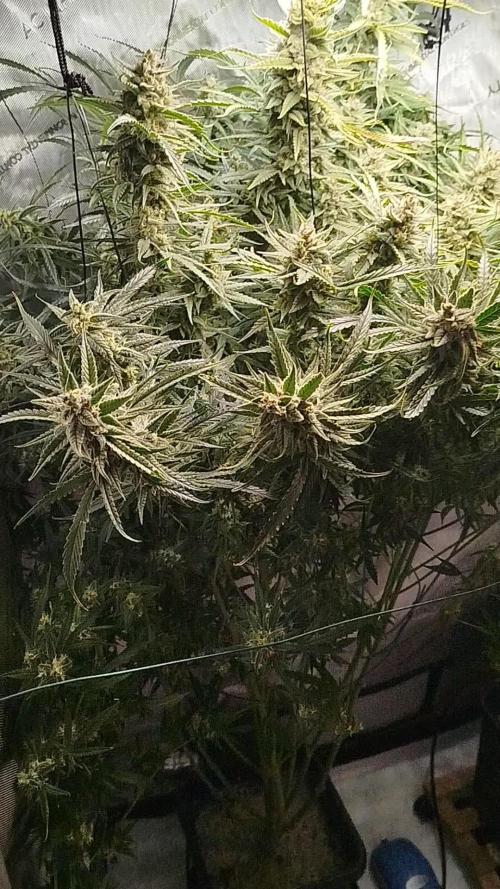
Noticed that four out of the five plants have began to pre-flower at week five so I’m beginning to switch my nutrients from grow to bloom and soon after that I’ll be adding my bloom booster..I’m wondering if I should Switch from my grow nutrients to my bloom nutrients as soon as I seen those pistols or should I give it another week
Likes
5
Share
03/01 - Day 57 All the girls have their pistils changing colors, buds growing by the day, (B) has has very sweet aromas coming out, & (C) is more earthy and peppery. Still losing some fan leaves here and there on (A) & (D) from the Cal/Mag & Phosphorus defiance but nothing like 2 weeks ago. 03/05 - Day 61 Enjoying the process and maintaining the environment. Buds on (B), (C), & (D) are starting to get heavy. Maybe some foxtails starting on (C)??
Likes
112
Share
Likes
6
Share
Because of the wind some branches were broken. Fixed with bamboos .
Likes
2
Share
@Luke_Lee
Follow
——————————————— WEEK 9 / DAY 58-64 BLOOM WEEK 2 / DAY 8-14 Mars Hydro FC-E3000 Floragard Professional GrowMix 11L fleece bags Light: 50cm Schedule: 12/12; PPFD: 875umol/m2/s DLi: 38mol/m2/d 20° C - 65RH 2L per Plant Hesi Bloom Complex (5ml/2L water) Hesi BOOST (2ml/2L water) PH 6,5 Fan, extractor and pump ON 24/0. ———————————————————— - DAY-58 / Bloomday-08 The second week of flowering begins. The plants are doing very well so far and are developing magnificently. They have gained a lot of leaf mass since the time change. The light has been adjusted PPfd: 875 / DLi: 38. - DAY-59 / Bloomday-09 Today each plant was watered with 2L of water with 4ml Hesi Bloomcomplex and 2ml Hesi BOOST. - DAY-62 / Bloomday-12 Today, at the end of the second week of flowering, the plants were little defoliated. They were then each watered with 3 liters of water with 2 ml HESI BOOST and 4 ml HESI Bloomcomplex. - DAY-64/ Bloomday-64 The last day of the second flowering week.
Likes
28
Share
2024/05/12 : nothing special to do this week, but there is yellowing too early... No more height gain, stretch is over. I set DLI to 36~45 and let LED at 20 cm from the tallest cola. RH still about 65% despite deshumidificator... biggest problem (for me) with Autopot system. I hope it will be OK. 2024/05/14 : I saw burned tips, that and the yellowing made me quick flush blueberry with 20 L of rain water at ambient temperature, pH=6.0. I thought I would avoid yellowing this time... 😅 I guess last shot of PK was a bit too much : I'll go for half of it for the next one. As plant was out of its grow space, I checked it and removed a few dead leaves, nothing more to notice. It was not easy to remove and reset plant without breaking anything!
Likes
25
Share
ANTHOCYANIN production is primarily controlled by the Cryptochrome (CR1) Photoreceptor ( !! UV and Blue Spectrums are primary drivers in the production of the pigment that replaces chlorophyll, isn't that awesome! 1. Diverse photoreceptors in plants Many civilizations, including the sun god of ancient Egypt, thought that the blessings of sunlight were the source of life. In fact, the survival of all life, including humans, is supported by the photosynthesis of plants that capture solar energy. Plants that perform photosynthesis have no means of transportation except for some algae. Therefore, it is necessary to monitor various changes in the external environment and respond appropriately to the place to survive. Among various environmental information, light is especially important information for plants that perform photosynthesis. In the process of evolution, plants acquired phytochrome, which mainly receives light in the red light region, and multiple blue light receptors, including his hytropin and phototropin, in order to sense the light environment. .. In addition to these, an ultraviolet light receptor named UVR8 was recently discovered. The latest image of the molecular structure and function of these various plant photoreceptors (Fig. 1), focusing on phytochrome and phototropin. Figure 1 Ultraviolet-visible absorption spectra of phytochrome, cryptochrome, phototropin, and UVR8. The dashed line represents each bioactive absorption spectrum. 2. Phytochrome; red-far red photoreversible molecular switch What is phytochrome? Phytochrome is a photochromic photoreceptor, and has two absorption types, a red light absorption type Pr (absorption maximum wavelength of about 665 nm) and a far-red light absorption type Pfr (730 nm). Reversible light conversion between the two by red light and far-red light, respectively(Fig. 1A, solid line and broken line). In general, Pfr is the active form that causes a physiological response. With some exceptions, phytochrome can be said to function as a photoreversible molecular switch. The background of the discovery is as follows. There are some types of plants that require light for germination (light seed germination). From that study, it was found that germination was induced by red light, the effect was inhibited by subsequent far-red light irradiation, and this could be repeated, and the existence of photoreceptors that reversibly photoconvert was predicted. In 1959, its existence was confirmed by the absorption spectrum measurement of the yellow sprout tissue, and it was named phytochrome. Why does the plant have a sensor to distinguish between such red light and far-red light? There is no big difference between the red and far-red light regions in the open-field spectrum of sunlight, but the proportion of red light is greatly reduced due to the absorption of chloroplasts in the shade of plants. Similar changes in light quality occur in the evening sunlight. Plants perceive this difference in light quality as the ratio of Pr and Pfr, recognize the light environment, and respond to it. Subsequent studies have revealed that it is responsible for various photomorphogenic reactions such as photoperiodic flowering induction, shade repellent, and deyellowing (greening). Furthermore, with the introduction of the model plant Arabidopsis thaliana (At) and the development of molecular biological analysis methods, research has progressed dramatically, and his five types of phytochromes (phyA-E) are present in Arabidopsis thaliana. all right. With the progress of the genome project, Fi’s tochrome-like photoreceptors were found in cyanobacteria, a photosynthetic prokaryotes other than plants. Furthermore, in non-photosynthetic bacteria, a homologue molecule called bacteriophytochrome photoreceptor (BphP) was found in Pseudomonas aeruginosa (Pa) and radiation-resistant bacteria (Deinococcus radiodurans, Dr). Domain structure of phytochrome molecule Phytochrome molecule can be roughly divided into N-terminal side and C-terminal side region. PAS (Per / Arndt / Sim: blue), GAF (cGMP phosphodiesterase / adenylyl cyclase / FhlA: green), PHY (phyto-chrome: purple) 3 in the N-terminal region of plant phytochrome (Fig. 2A) There are two domains and an N-terminal extension region (NTE: dark blue), and phytochromobilin (PΦB), which is one of the ring-opening tetrapyrroles, is thioether-bonded to the system stored in GAF as a chromophore. ing. PAS is a domain involved in the interaction between signal transduction-related proteins, and PHY is a phytochrome-specific domain. There are two PASs and her histidine kinase-related (HKR) domain (red) in the C-terminal region, but the histidine essential for kinase activity is not conserved. 3. Phototropin; photosynthetic efficiency optimized blue light receptor What is phototropin? Charles Darwin, who is famous for his theory of evolution, wrote in his book “The power of move-ment in plants” published in 1882 that plants bend toward blue light. Approximately 100 years later, the protein nph1 (nonphoto-tropic hypocotyl 1) encoded by one of the causative genes of Arabidopsis mutants causing phototropic abnormalities was identified as a blue photoreceptor. Later, another isotype npl1 was found and renamed phototropin 1 (phot1) and 2 (phot2), respectively. In addition to phototropism, phototropin is damaged by chloroplast photolocalization (chloroplasts move through the epidermal cells of the leaves and gather on the cell surface under appropriate light intensity for photosynthesis. As a photoreceptor for reactions such as escaping to the side of cells under dangerous strong light) and stomata (reactions that open stomata to optimize the uptake of carbon dioxide, which is the rate-determining process of photosynthetic reactions). It became clear that it worked. In this way, phototropin can be said to be a blue light receptor responsible for optimizing photosynthetic efficiency. Domain structure and LOV photoreaction of phototropin molecule Phototropin molecule has two photoreceptive domains (LOV1 and LOV2) called LOV (Light-Oxygen-Voltage sensing) on the N-terminal side, and serine / on the C-terminal side. It is a protein kinase that forms threonine kinase (STK) (Fig. 4Aa) and whose activity is regulated by light. LOV is one molecule as a chromophore, he binds FMN (flavin mononucleotide) non-covalently. The LOV forms an α/βfold, and the FMN is located on a β-sheet consisting of five antiparallel β-strands (Fig. 4B). The FMN in the ground state LOV shows the absorption spectrum of a typical oxidized flavin protein with a triplet oscillation structure and an absorption maximum wavelength of 450 nm, and is called D450 (Fig. 1C and Fig. 4E). After being excited to the singlet excited state by blue light, the FMN shifts to the triplet excited state (L660t *) due to intersystem crossing, and then the C4 (Fig. 4C) of the isoaroxazine ring of the FMN is conserved in the vicinity. It forms a transient accretionary prism with the tain (red part in Fig. 4B Eα) (S390I). When this cysteine is replaced with alanine (C / A substitution), the addition reaction does not occur. The effect of adduct formation propagates to the protein moiety, causing kinase activation (S390II). After that, the formed cysteine-flavin adduct spontaneously dissociates and returns to the original D450 (Fig. 4E, dark regression reaction). Phototropin kinase activity control mechanism by LOV2 Why does phototropin have two LOVs? Atphot1 was found as a protein that is rapidly autophosphorylated when irradiated with blue light. The effect of the above C / A substitution on this self-phosphorylation reaction and phototropism was investigated, and LOV2 is the main photomolecular switch in both self-phosphorylation and phototropism. It turns out that it functions as. After that, from experiments using artificial substrates, STK has a constitutive activity, LOV2 functions as an inhibitory domain of this activity, and the inhibition is eliminated by photoreaction, while LOV1 is kinase light. It was shown to modify the photosensitivity of the activation reaction. In addition to this, LOV1 was found to act as a dimerization site from the crystal structure and his SAXS. What kind of molecular mechanism does LOV2 use to photoregulate kinase activity? The following two modules play important roles in this intramolecular signal transduction. Figure 4 (A) Domain structure of LOV photoreceptors. a: Phototropin b: Neochrome c: FKF1 family protein d: Aureochrome (B) Crystal structure of auto barley phot1 LOV2. (C) Structure of FMN isoaroxazine ring. (D) Schematic diagram of the functional domain and module of Arabidopsis thaliana phot1. L, A’α, and Jα represent linker, A’α helix, and Jα helix, respectively. (E) LOV photoreaction. (F) Molecular structure model (mesh) of the LOV2-STK sample (black line) containing A’α of phot2 obtained based on SAXS under dark (top) and under bright (bottom). The yellow, red, and green space-filled models represent the crystal structures of LOV2-Jα, protein kinase A N-lobe, and C-robe, respectively, and black represents FMN. See the text for details. 1) Jα. LOV2 C of oat phot1-to α immediately after the terminus Rix (Jα) is present (Fig. 4D), which interacts with the β-sheet (Fig. 4B) that forms the FMN-bound scaffold of LOV2 in the dark, but unfolds and dissociates from the β-sheet with photoreaction. It was shown by NMR that it does. According to the crystal structure of LOV2-Jα, this Jα is located on the back surface of the β sheet and mainly has a hydrophobic interaction. The formation of S390II causes twisting of the isoaroxazine ring and protonation of N5 (Fig. 4C). As a result, the glutamine side chain present on his Iβ strand (Fig. 4B) in the β-sheet rotates to form a hydrogen bond with this protonated N5. Jα interacts with this his Iβ strand, and these changes are thought to cause the unfold-ing of Jα and dissociation from the β-sheet described above. Experiments such as amino acid substitution of Iβ strands revealed that kinases exhibit constitutive activity when this interaction is eliminated, and that Jα plays an important role in photoactivation of kinases. 2) A’α / Aβ gap. Recently, several results have been reported showing the involvement of amino acids near the A’α helix (Fig. 4D) located upstream of the N-terminal of LOV2 in kinase photoactivation. Therefore, he investigated the role of this A’α and its neighboring amino acids in kinase photoactivation, photoreaction, and Jα structural change for Atphot1. The LOV2-STK polypeptide (Fig. 4D, underlined in black) was used as a photocontrollable kinase for kinase activity analysis. As a result, it was found that the photoactivation of the kinase was abolished when amino acid substitution was introduced into the A’α / Aβ gap between A’α and Aβ of the LOV2 core. Interestingly, he had no effect on the structural changes in Jα examined on the peptide map due to the photoreaction of LOV2 or trypsin degradation. Therefore, the A’α / Aβ gap is considered to play an important role in intramolecular signal transduction after Jα. Structural changes detected by SAXS Structural changes of Jα have been detected by various biophysical methods other than NMR, but structural information on samples including up to STK is reported only by his results to his SAXS. Not. The SAXS measurement of the Atphot2 LOV2-STK polypeptide showed that the radius of inertia increased from 32.4 Å to 34.8 Å, and the molecular model (Fig. 4F) obtained by the ab initio modeling software GASBOR is that of LOV2 and STK. It was shown that the N lobes and C lobes lined up in tandem, and the relative position of LOV2 with respect to STK shifted by about 13 Å under light irradiation. The difference in the molecular model between the two is considered to reflect the structural changes that occur in the Jα and A’α / Aβ gaps mentioned above. Two phototropins with different photosensitivity In the phototropic reaction of Arabidopsis Arabidopsis, Arabidopsis responds to a very wide range of light intensities from 10–4 to 102 μmol photon / sec / m2. At that time, phot1 functions as an optical sensor in a wide range from low light to strong light, while phot2 reacts with light stronger than 1 μmol photon / sec / m2. What is the origin of these differences? As is well known, animal photoreceptors have a high photosensitivity due to the abundance of rhodopsin and the presence of biochemical amplification mechanisms. The exact abundance of phot1 and phot2 in vivo is unknown, but interesting results have been obtained in terms of amplification. The light intensity dependence of the photoactivation of the LOV2-STK polypeptide used in the above kinase analysis was investigated. It was found that phot1 was about 10 times more photosensitive than phot2. On the other hand, when the photochemical reactions of both were examined, it was found that the rate of the dark return reaction of phot1 was about 10 times slower than that of phot2. This result indicates that the longer the lifetime of S390II, which is in the kinase-activated state, the higher the photosensitivity of kinase activation. This correlation was further confirmed by extending the lifespan of her S390II with amino acid substitutions. This alone cannot explain the widespread differences in photosensitivity between phot1 and phot2, but it may explain some of them. Furthermore, it is necessary to investigate in detail protein modifications such as phosphorylation and the effects of phot interacting factors on photosensitivity. Other LOV photoreceptors Among fern plants and green algae, phytochrome ɾphotosensory module (PSM) on the N-terminal side and chimera photoreceptor with full-length phototropin on the C-terminal side, neochrome (Fig. There are types with 4Ab). It has been reported that some neochromes play a role in chloroplast photolocalization as a red light receiver. It is considered that fern plants have such a chimera photoreceptor in order to survive in a habitat such as undergrowth in a jungle where only red light reaches. In addition to this, plants have only one LOV domain, and three proteins involved in the degradation of photomorphogenesis-related proteins, FKF1 (Flavin-binding, Kelch repeat, F-box 1, ZTL (ZEITLUPE)), LKP2 ( There are LOV Kelch Protein2) (Fig. 4Ac) and aureochrome (Fig. 4Ad), which has a bZip domain on the N-terminal side of LOV and functions as a gene transcription factor. 4. Cryptochrome and UVR8 Cryptochrome is one of the blue photoreceptors and forms a superfamily with the DNA photoreceptor photolyase. It has FAD (flavin adenine dinucle-otide) as a chromophore and tetrahydrofolic acid, which is a condensing pigment. The ground state of FAD is considered to be the oxidized type, and the radical type (broken line in Fig. 1B) generated by blue light irradiation is considered to be the signaling state. The radical type also absorbs in the green to orange light region, and may widen the wavelength region of the plant morphogenesis reaction spectrum. Cryptochrome uses blue light to control physiological functions similar to phytochrome. It was identified as a photoreceptor from one of the causative genes of UVR8 Arabidopsis thaliana, and the chromophore is absorbed in the UVB region by a Trp triad consisting of three tryptophans (Fig. 1D). It is involved in the biosynthesis of flavonoids and anthocyanins that function as UV scavengers in plants. Conclusion It is thought that plants have acquired various photoreceptors necessary for their survival during a long evolutionary process. The photoreceptors that cover the existing far-red light to UVB mentioned here are considered to be some of them. More and more diverse photoreceptor genes are conserved in cyanobacteria and marine plankton. By examining these, it is thought that the understanding of plant photoreceptors will be further deepened.