


Likes
Comments
Share


@Professor_Daank
Follow
Holy shit we boomin'. I actually had to super crop (i think that's what i did) bc one red poison was getting so tall. I had to pull her to 90 degrees... she's already back reaching for the light - I'm not sure what impact this has on my grow, but I think it will be a positive one. She was going to be insanely tall if I hadn't done this.


Likes
7
Share


@Dairon
Follow
Hola, como podéis ver en las fotos han dado un buen estirón tres de los ejemplares pero el resto aún sigue con un ritmo de crecimiento muy lento, para solucionar esto voy a subir la dosis de Fish Mix de Biobizz hasta 1.2 de EC y agregaré micorrizas, también le haré a algunas una poda apical para aumentar la producción, así como a las más pequeñas les quitaré lo que pueda de la parte inferior a fin de estimular el desarrollo vertical, como mínimo deben estar un par de semanas más en crecimiento.
También estoy considerando hacer otro trasplante a 11l, pues son pocas plantas y necesito sacar producción para cubrir mis necesidades.
Como siempre voy pulverizando con productos preventivos para evitar la aparición de hongos o insectos, yo siempre utilizo Leaf Coat de Biobizz y va a las mil maravillas.



Likes
13
Share


@Skinnytalls420
Follow
Day 1- 08/04/22 14:30pm Germination Time!!!!! Here we have 21 wonderful seeds from the amazing fastbuds!!!! Placed in a glass of water for 18-20hours!!! So excited!!!!
-
Day 2-09/04/22 seeds have been placed on a wet paper towel!!!!!
-
Day 3-10/04/22 getting the pots filled with soil ready for planting tonight or tomorrow!!!!!
-
Day 4-11/04/22 most of the seeds had popped last night so I planted most of them and the rest I planted this morning!!! 1 seed out of the 21 didn’t pop so germinating another to make it back up to 21!!!! So there all in the tent except 1!!!!
-
Day 5-12/04/22 one has come through so far and should be planting the last seed tonight!!!! A few more should pop out by tomorrow!!!!
-
Day 6-13/04/22 14 out of the 21 have come out so far!!!!
-
Day 7-14/04/22. 19 of the 21 have come through!! I think one isn’t going to come through so I’m germinating another seed to replace it and if the other one doesn’t come through tomorrow I’ll germinating another one to replace that Aswell!!!.

Likes
27
Share


@Trickybis82
Follow
OK so this week I have officially changed yje light cycle and have been running a 12/12 and will of course carry that on now until the end if we get there.
The food amounts have now changed on to flowering amounts and even though the plants are different in size they both look really well.
I have started to feed them both the following
Micro 32ml
Grow 12ml
Bloom 48ml
Ph is 6.0
These amounts are based on 20 litres of water.
So I am hoping to see changed and some flower heads popping through (I hope).
Let's wait and see what happens as again this is my first 12/12 run. So really hoping for the best here lol.
Peace out growmies
Likes
9
Share


@PlumpPelican
Follow
With this strain I vegged for 5 weeks and flowered for just over 10 weeks.
The plants produced some impressive size buds with minimal popcorn bud.
The buds are coated in trichomes which produce a sweaty-like resin which I haven’t seen before.
Man this plant is LOUD - I loved it.

Likes
18
Share


@Diips
Follow
d.50 a few spots appeared on the leafs.
gave a 10 ml dose of bio p k and waiting a week before giving a dose of orgatrex and bactrex
edit: d.50 i also gave 0.5 ml of calmag from Biobizz
edit d.53 will i be giving her the orgatrex and bactrex treatment ✌️🌞
d.53 she got 20 ml orgatrex, 1g of bactrex and 0.5 ml of biobizz calmag
d.54 added scrog and did lst with clips to even out the height and space… still need to adjust it.
Likes
40
Share


@SubliminalSociety
Follow
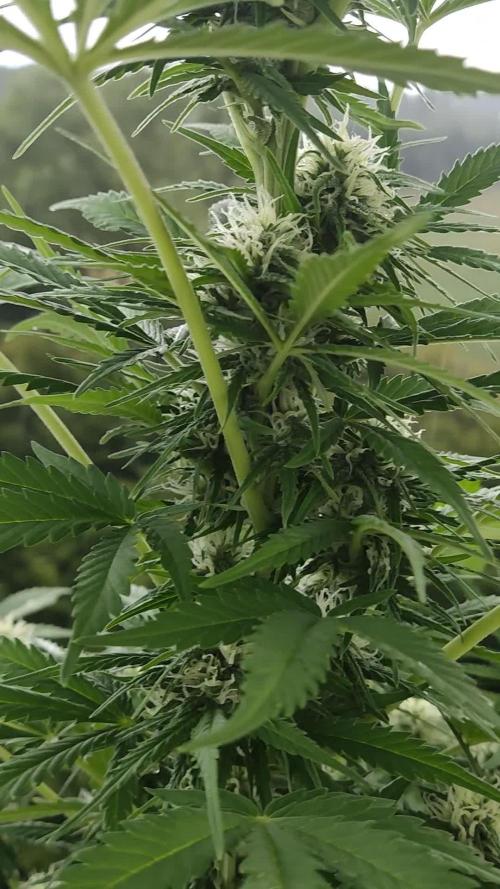
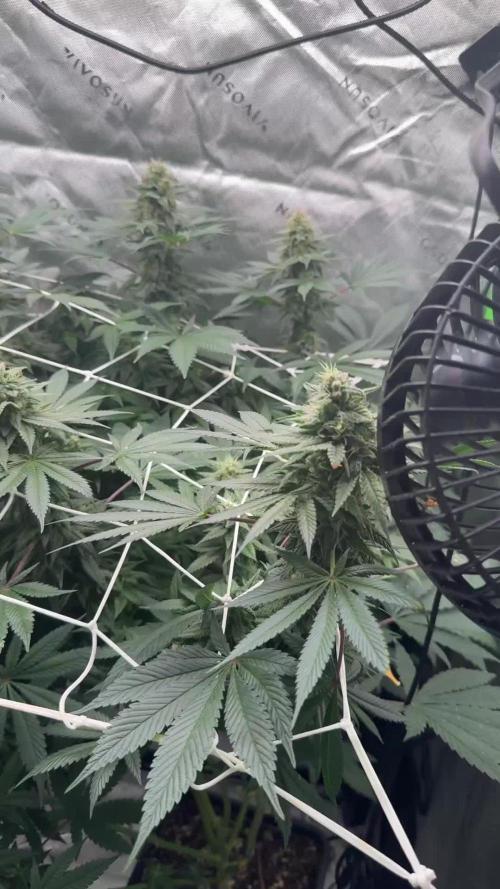
Week 15 - unstoppable growth!
My measuring stick is at its end. It only reaches 180cm and we are above that. It's getting hard to reach and prune the top but I'm not giving up.
Temp is stable, humidity at a nice level, lots of sunshine. This summer is really something.
But we had a huge storm. Nothing a little tape cant fix. One of the early branches broke off, but my net caught it and with a little tape it's as good as new




Likes
1
Share



Likes
7
Share


@Oklahomasunrise
Follow
Girls are going into preflower, gaining a lot of height. Working on my IPM outside.
So far so good.
They hate the 100+ heat but they recover each night.


Likes
6
Share

@IvanPalma
Follow
En la segunda semana de floracion le he sujetado un par de hojas muy grandes a la rama porque estan tapando las demas plantas, ahora solo utilize el engordador de cogollos, he tenido que dejar el calentador encendido porque con las 12 horas de luz la habitacion se esta enfriendo mucho y las temperaturas han bajado hasta los 16 grados, prefiero no estresarlas pero por lo demas van bien. He notado tambien que algunas hojas grandes de abajo, como que se pudren o se ponen muy debiles y se caen solas.

Likes
9
Share


@Cannabot
Follow
By far the hardest nugs ,I swear they like concrete.Colours are super nice on the buds,smells great.Really smells sweet asf.Been a real pleasure growing this strain
Likes
26
Share


@MG2009
Follow
03/21/2021
All going well with the exception of the broken branch, but she is still looking healthy she(cutting) is in vermiculite and soil blend and soaked with Grow Rich 4-10-3 with IBA,to see if she roots. If not at least mother should have better buds with one less top.
1st video is at lights on, 2nd is just before lights out.
Likes
47
Share


@Master_weeda
Follow
Bonjour à tous les padawans et maîtres jedis
Merci pour votre confiance et votre gentillesse
C'était un réel plaisir de faire cette culture cette génétique est incroyable
Likes
7
Share

@MadProfessor
Follow
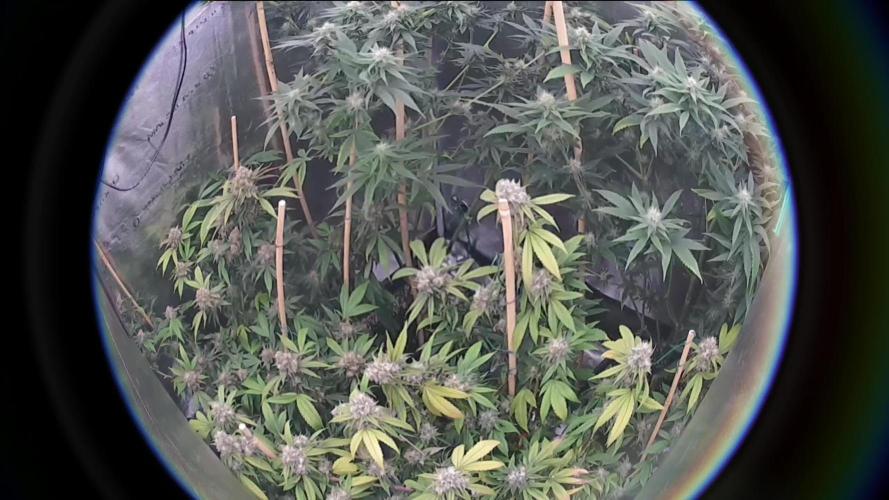
Now I made some high quality pics for you after giving the ladies some nutrition today.
I hope you enjoy the pictures and the imense growth of the Kolas like I do.
Stay tuned if you are interested in more nice pics and real frosty buds 💚
1. Lemon Skunk (Greenhouse Seeds)
Strain / Genetics: Photoperiod, Skunk hybrid (Sativa dominant)
Germination Date: Spring 2025, end of may
Setup:
Grow tent: 120 × 120 × 200 cm
Lights: Mars Hydro FC 4000-EVO & Spider Farmer G4500, dimmed to 60 % (~320 W each)
Climate: 24–27 °C / 45–55 % RH
Ventilation: 10 cm inline fan + carbon filter, 5 clip-fans for circulation
Medium: Biobizz All-Mix soil (18 L pots, refreshed with 3–4 L fresh soil when transplanted)
Nutrients: Green House Feeding BioGrow, Bloom, Enhancer, Calcium + Hesi mineral line (adjusted schedule)
Watering: ~2 L per watering, pH 6.2–6.5
Training: ScroG net, LST, defoliation
Flowering start: June 24, 2025
Notes: Strong stretch, similar height to Grape OG
Harvest: expected mid/late September
2. Grape OG (Cali Connection)
Strain / Genetics: OG Kush hybrid, photoperiod
Germination Date: Spring 2025, end of may (same as Lemon Skunk)
Setup: same as Lemon Skunk
Medium: Biobizz All-Mix, 18 L pots
Nutrients: Green House Feeding + Hesi combo
Watering: 2 L per plant, pH 6.2–6.5
Training: Net support, mild LST
Flowering start: June 24, 2025
Notes: Less stretch than Lemon Skunk, slightly more compact buds
Harvest: expected late September / early October
3. Blueberry Berry (Selfing Project)
Blueberry Berry Selfing – Ape Origin / Zamnesia line
Strain / Genetics: Blueberry self-pollinated line (own selection)
Germination Date: Summer 2025, end of june
Setup: same same
Climate: 24–26 °C, stable
Medium: 18l pots, biobizz all mix
Nutrients: Hesi + Green House Feeding Calcium & Enhancer
Watering: 2 L per plant, pH 6.2
Flowering start: August 15, 2025
Notes: Own breeding project, indica-leaning growth, compact bud structure
Harvest: expected early/mid October
4. Forbidden Blueberry (Crossing)
Forbidden Blueberry #1 – Blueberry × Forbidden Fruit
Strain / Genetics: Photoperiod, cross between Blueberry (Zamnesia / Ape Origin) and Forbidden Fruit
Germination Date: Summer 2025, end of june
Setup: same as Blueberry Berry
Medium: 18 L pots, biobizz allmix
Nutrients: Green House Feeding, BioGrow, Bloom, Enhancer, Calcium (2 L watering schedule, pH 6.2–6.5)
Watering: 2 L per plant as needed
Flowering start: August 15, 2025
Notes: fruity terp profile, medium stretch
Harvest: expected early/mid October


Likes
46
Share


@eldruida_lamota
Follow
Que hay familia, vamos con la séptima semana de floración de estas Candy Rain de Zamnesia, para el concurso POWER BUDS Plagron x Zamnesia CONTEST.
Las flores van formandose progresivamente y empieza a desprender unos aromas bastante dulces, también empiezan a tricomar bien y a madurar.
Esta vez regué con una aplicación de Sugar Royal, 1 ml x litro de agua, Alga Bloom 2 ml x litro y Power Bud 0.8 ml x litro, Green Sensation 0.8 x litro, por supuesto controlando siempre el Ph, que ahora mismo lo dejamos en 6.
Tragan alrededor de 1 litro por planta cada 48 horas.(3 riegos semanales).
Me da que será última semana que reguemos con productos y las aguantemos solo con agua las próximas semanas.
La temperatura máxima está en 22 grados y la humedad está entorno al 40%.
Hasta aquí es todo, vamos viendo estas semanas como se forman y progresan nuestras flores.
Os comento que tengo un descuento y para que compréis en la web de Zamnesia de un 20%, el código es ZAMMIGD2023
The discount 20% and the code is ZAMMIGD2023
https://www.zamnesia.com/
Hasta aquí todo, buenos humos 💨💨💨


Likes
69
Share


@DeepWaterGrower
Follow
[DAY 64] - 3/8/2022
- Lamp 40 cm from the center of the canopy (20 cm from the top) and 100% dimmer (144 watt);
- TEMP. 30°/31° - RH 40-50%;
- EC 1.7 - PH 6; started with EC 1.7 and after 24 hours EC is 1.95;
- 73 cm height;
- LST on 4 branches to open the canopy;
- Removed some damaged leaves;
- Added new PH down: CANNA PH DOWN BLOOM (instead PH DOWN by GHE). I prefer GHE, it seemed more effective;
- Let's see what happen this week, I want to see big flower by the end of this week; next one I'll add Bloombastic again;
- A lot of leaves with yellowed tips, I hope it is not suffering excessively the temperatures.
[DAY 65] - 4/8/2022
- Lamp 40 cm from the center of the canopy (20 cm from the top) and 100% dimmer (144 watt);
- TEMP. 30°/31° - RH 50%;
- EC 2 - PH 6; tomorrow I add lighter solution to keep EC to 1.7;
- In the last couple days I noticed plant drank less than usual, the half. I guess it was very stressed due defoliation, but seems to be recovering well.
- Today I did bit defoliation and in the coming days I let the plant rests, then we'll see if another defoliation is still needed. I don't want to exaggerate.
[DAY 66] - 5/8/2022
- Lamp 40 cm from the center of the canopy (20 cm from the top) and 100% dimmer (144 watt);
- TEMP. 31°/32° - RH 60%;
- EC 1.7- PH 6; tomorrow I add lighter solution to keep EC to 1.6;
- Did a growquestion about some brown spots on some leaves: https://growdiaries.com/grow-questions/49286-brown-spots-on-some-leaves.
[DAY 67] - 6/8/2022
- Lamp as yesterday;
- TEMP. 31°/32° - RH 60%;
- Plant is having problems. It is drinking little and I believe it drinks very few nutrients. For this reason I did a DWC change and added a lighter solution (EC 1). Despite this, the EC is continuing to rise. I hope it recovers soon! If tomorrow it continues to rise, I try to further dilute the solution.
- Added a new better quality video.
[DAY 68] - 7/8/2022
- Lamp as usual;
- Temp. 31°/32° - RH 60%;
- EC still rising, that's the reason why I added 2 l. demineralized water to bring EC to 1.1;
- Solution in DWC at the moment has this composition: Silicate 0.25 g/l - Calmag: 0.25 ml/l - A: 0.8 ml/l - B: 1.6 ml/l up to EC 0.94 - Bloom stim. 0.5 ml/l and Bloombastic up to EC 1.05.
[DAY 69] - 8/8/2022
- Lamp as usual;
- Temp. 32° - RH 50%;
- EC 1.2, almost blocked all day long. Added 2 l. dem. water to lower EC a little bit;
- I guess plant is drinking about 2 l. of solution / day, good!
[DAY 70] - 9/8/2022
- Lamp as usual, I'm planning to lower it near the tallest bud (from 20 cm to 15 cm) to reach better the lower bud sites
- Temp. 30° - RH 50%;
- Last day of this week, some problems last days.