


Processing
Likes
Comments
Share


@Snowy
Follow
Started some Fox Farms Grow Big this week, and they seem to have taken well. Growing very nicely, I'm tentatively trying a very mild LST on one of the Trainwreck plants, the one that is the smallest so far. I've never done any LST and am curious to see if this even works. Am normally partial to just letting the plants grow on their own.



Likes
6
Share

@Mexicanasseeds
Follow
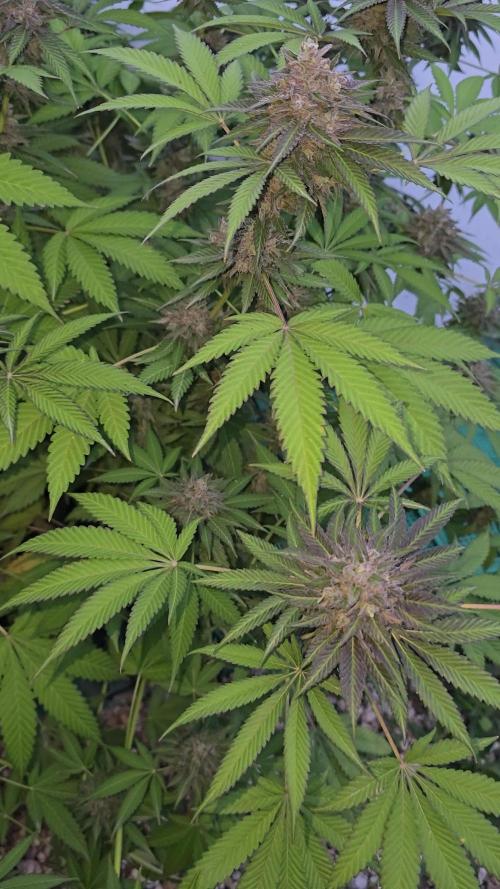
Séptima semana de floración (Maduración y Pico de K) La planta entra en su fase de cierre con una relación de Nitrógeno prácticamente nula. El Molibdeno continúa trabajando en la asimilación de nitrógeno orgánico. Se observa una senescencia inducida y saludable, donde la energía se concentra exclusivamente en el remate de la floración. La estructura se mantiene firme y el perfil aromático llega a su punto máximo gracias a la ausencia de interferencia por exceso de sales.
Likes
10
Share


@Cannabot
Follow
They pretty much growing uniform to each other,minimal side branching on this strain it seems.Upward growth is good,subtle smell coming through.

Likes
16
Share


@Mikeinthekeys
Follow
11-25 I had planted 2 Granddaddy purple seeds that had been soaking in water, one for 72 hours that had no taproot, and another that had been soaking in a glass of water for 24 hours that had a 1/2" taproot. I planted both in the same spot thinking the one with no taproot would not sprout. I was wrong they both sprouted which left me with 2 sprout growing within a cm of each other.
Above is a video of me actually digging out the sprout and a pic of the plant 24 hours after transplant. Looks like she will survive as well as the other.

Likes
74
Share


@Mr_Maes
Follow
Nothing but colas on all 3 this is going to be a big harvest. Another 2 or 3 weeks max.

Likes
44
Share


@XperencdGmanXG
Follow
fungus gnat issue resolved with some Raid earth blends. Predatory mites deployed into the canopy to eradicate a 2 spotted spider mite bloom. Can't wait to plant this outdoors for the season.
Likes
24
Share


@TerpTurtle
Follow
Week 2 from flip & All is well, plants are starting to uptake more water-about to get loud&wild.
Small stretch!
Likes
8
Share


@TommyBVRSA75
Follow
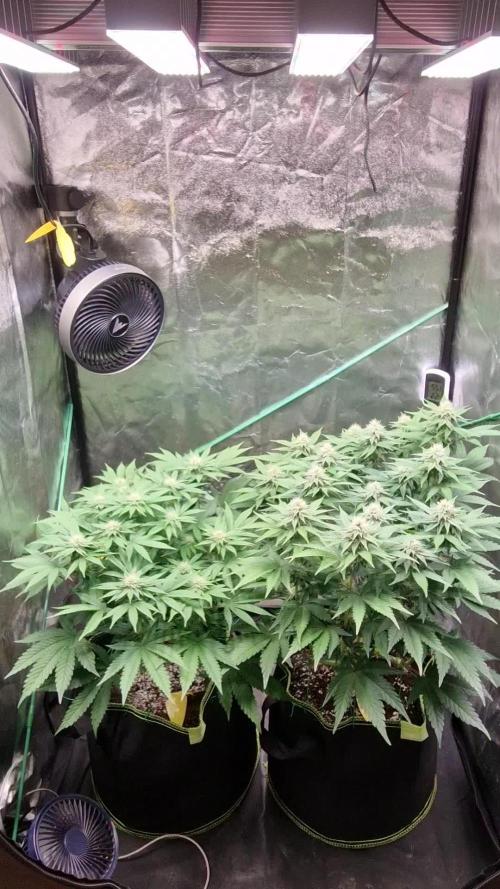
Entrada dia 30 (sin marcación de desarrollo de plántula) : Señores y Señoras, un mes desde el comienzo de vegetativo y creo que cuando miréis el vídeo que he colgado no vais a creerlo, por que yo tampoco me lo creería, ni por un millón de florines filipinos.
Os explico, todas las cuentas de crecimiento, nutrición y desarrollo expectables se han ido sencillamente a la basura y os explicó por qué.
Primero, estamos en un ritmo que en cerca de seis dias, los cuatro cultivars están tomando la friolera de 24 litros, o sea que estamos con un ritmo de 4 litros de absorción diarios y eso sencillamente y por aritmética nos va con un litro por grow. El calor ha sido impiedoso la pasada semana y incluso ahora que la temperatura ya ha caído en torno a cinco grados (en temperatura máxima), la increíble tasa de absorción de agua se debe ahora esencialmente al increíble tirón que la cepa afgana fast de Sweet Seeds, ha tenido en los últimos días.
Hubo cambio en el ciclo lumínico pasando ya a 12/12, y en este limbo entre final de vegetativo y empiezo de floración, en los últimos cinco dias los cultivars han ganado como 25 centímetros en altura y la multiplicación de ramas laterales ha sido exponencial. Sencillamente os invito a que echéis un vistazo a la entrada del pasado viernes y que registréis, la diferencia de crecimiento en tan solo 5/6 días. Con ello, cuestión número 1 : hasta que talla seguirán las chiquillas afganas "tirando"...todo lo que tenía pensado de cultivars sobre los 65/70 centímetros se han ido al garete y tendremos cultivars de talla de metro muy próximamente y con ello un armario abarrotado y sin un palmo más de espacio.
Cuestión número 2: que vamos a hacer con el olor de esta cepa?!? En entrada de pré-floración, ese olor dulzón (casi al puro skunk) ya se hace sentir tremendamente en la habitación donde está el kit del armario de grow. Ya he instalado el ventilador de ozono y algo de olor se dispersa pero si la realidad en pré-floración es esta, cuando empezemos a ganar cogollos, hojas de azúcar y tirón de terpenos, no se a lo cierto, lo que será necesario para evitar la dispersión del olor y eso en un apartamento en un condominio, no es algo que pueda ser despreciable y habrá que intentar crear algún cultivo de plantas de compañía en mi terraza de modo a que se pueda ocultar el fuerte aroma que esta cepa tiene.
Cuestión número tres - nutrientes necesarios y consumo de solución nutritiva. Como os he dicho, ahí vamos con nuestro Quadgrow, "chupando" por via de los "smart mat" que caben a cada una de las macetas, más de 20 litros en 5 días...empezé la entrada del diario haciendo aritmética simple, o sea que cada uno de los cuatro grows se toma un litro al día. No hay misterios, grows con crecimiento tremendo, sujetos a calor elevadísimo y humedad relativa que en los días más próximos, llegó a los casi 75% (os había dicho en otras entradas que estuvimos con humedad muy baja, sobre 40%, pero en la última semana y con el tiempo de "levante" (vientos de norte de África y con humedad llegada del Mediterráneo) hemos tenido días de casi 80% de humedad. Si en invierno, 80% ya es una humedad respectable y que no puede prolongarse mucho tiempo, por las condiciones de aparecimento de hongos, en verano, si sumamos a temperaturas sobre los 35ºC, humedades a los 80%, tenemos el "cóctel" perfecto para cualquier ser viviente (sea animal, vegetal o de otro reino biológico) tenga necesidad casi permanente de água (el calor y humedad, tienen la función reversa de causar deshidratacion rapidísima y con ello, hay necesidad biológica de reponer el agua perdida.
Estos factores son también determinantes para que nuestra hidroponia y su reserva de 25 litros, sea suplida a los grows en cada 6 días, cuando mi idea sería que habría que rectificar solución nutritiva tan solo a cada diez/doce días, pero la verdad es simple y salta a la vista, a menos de cada semana es necesario hacer nueva cuba de solución y dejar que el sistema radicular de los grows se encargue de marcar el ritmo de riego.
Como podéis también ver, esta semana ya hemos empezado a aplicarle la "forma" deseable para sacar renta a los grows. Ya ha sido colocado el entranzado SCROG para que podamos direccionar el sentido de crecimiento de las ramas laterales y también ha sido puesto en práctica, una primera defoliación, para limpiar exceso de hojas y sobretodo por la necesidad de la no existencia de áreas de sombra junto al sustrato de coco y evitar que puedan crearse hongos patógenos, pese a que mis grows siempre son "brindados" con micorrizas y trichodermas, justo para evitar cualquier disgusto a causa de un "menos pensado o deseado" Botritys, Fusarium o "amiguete" del estilo.
Para final, que Dios Jah siempre nos proteja a todos, en los grows, en los que mal nos desean y a los que nos pueden hacer daño sin que algo tengamos echo para tal.
Green greets y la semana que viene, espero volver y para enseñaros algun esbozo de floración inicial.

Likes
21
Share

@BabaHase
Follow
28. BT. Sie wächst und gedeiht. Der Stretch ist soweit abgeschlossen - wirkt sehr vital und stabil. Freu mich auf das was noch kommt :)

Likes
7
Share


@Mo_Powers
Follow
not much has happened this week. there is still some sun per day. however, the temperatures drop to 4-8 degrees at night. these are not exactly the best conditions. maybe this late outdoor experiment was not a good idea after all. however, they have not died yet.
Likes
69
Share


@nonick123
Follow
Día 30 (01/07) Riego con 250 ml H20 pH 6,5. Se muestran sedientas
6 días después del topping, las nuevas ramas se están formando rápidamente!
Día 31 (02/07) Se muestran saludables y potentes!
Día 32 (03/07) Riego con 500 ml H20 pH 6,5
Día 33 (04/07) Las plantas están creciendo muy rápido! Me planteo hacer supercropping o LST en algunas de ellas...
Día 34 (05/07) Se muestran sedientas. Las macetas se le empiezan a quedar pequeñas
Riego con 250 ml de H20 pH 6,5
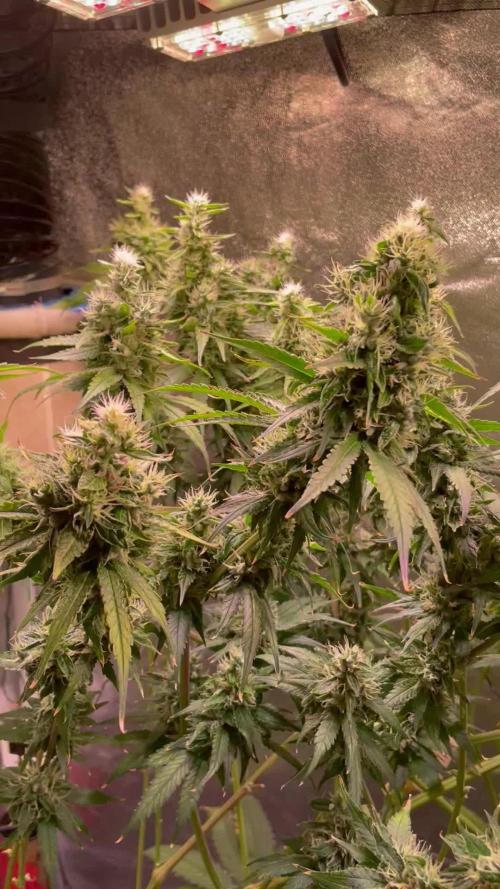
Día 35 (06/07) Training session! Aplico LST a todas y supercropping a la OnionOG mutante con 4 colas por nodo
Riego con 500 ml H20 pH 6,5
Día 36 (07/07) Riego con 500 ml de Té Vegetativo de Lurpe Solutions
Aplico foliarmente Kelp hidrolizado a 0.25 ml/l
Ajustes de LST. Están respondiendo estupendamente al entrenamiento! 😍💥
💦Nutrients by Lurpe Solutions - www.lurpenaturalsolutions.com
🌱Substrate PRO-MIX HP BACILLUS + MYCORRHIZAE - www.pthorticulture.com/en/products/pro-mix-hp-biostimulant-plus-mycorrhizae

Likes
218
Share


@DevilsBud
Follow
Week 5 Flowering phase Critical supported by @Marshydro
Unboxing tomorrow stay tuned !!!
special thanks to @Marshydro
From tomorrow 20/07/2021
I will be teleporting my plants into another atmosphere 🖖🚀☄️👾
I will be growing completely @Marshydro
Tent+lamp
Mars Hydro TS-1000
Mars Hydro GT 100x100x180cm(3.3'x3.3'x5.9')
Come that a look at website of marshydro:
www.marshydro.eu
https://www.marshydro_aliexpress.
Day 28 IT IS TIME!!!!
READY FOR LIFT OFF IN 10!!!!!
9
8
7
6
5
4
3
2
1
LIFT OFF HEADING FOR MARSHYDRO!!!!!
The launch of the marshydro tent was a great success! A simple and easy setup! From the moment you open the box you know you have a high quality product! 👌🏻👌🏻👌🏻. I literally had the tent up in 20 min! While setting up the marshydro tent i could already see the huge difference in the quality of the material. This mylar is awesome and when compared to the mylar in my old tent there is immediately a huge improvement in quality, brand and results! 💪🏻💪🏻👌🏻👌🏻.MarsHydro save me with the height problem i had the 20 cm Extra is blessing in the sky my plants love it
Day 29 Critical
Hallo Growmies what a day what a day i loving the new and improved marshydro.eu set up . The peek hole is perfect no more opening the tent All the time 🤯 mind blown . It's definitely Lock All Light Inside and No light leaks or rips 💯🚀 Critical is doing great nicely building up some frosty buds
I Gave them a full range of nutrients today 1,25 L. pH 6.2
And boy o boy they are looking good I am very excited for the weeks to come
These quality products are from marshydro and are available at:
www.marshydro.eu
Mars Hydro TS-1000 LED Lamp
Mars Hydro GT 100x100x180cm(3.3'x3.3'x5.9') Tent
Day 30 Critical
Critical is going oké 💪🏻💪🏻 . I checked the Runoff water pH and ppm. And the pH was fine around 6.3 the ppm was a little to high so i probably have to lower down next watering with nutrients . Other than that humidity and temperature are 👌🏻. The environment of the baby's are out of this world . Loving the Marshydro set up even i am running a TS-1000 in a 100X100X180 tent it works like a charm absolute little power house 💪🏻💪🏻. The GT100X100X180 is doing wonderful Love everything about it the zipper are top Notch the strong heavy-duty SBS zippers and double layer lining to create a light-proof seal.
Also made nice video today come have look and see what you think of it.
These quality products are from marshydro and are available at:
www.marshydro.eu
Mars Hydro TS-1000 LED Lamp
Mars Hydro GT 100x100x180cm(3.3'x3.3'x5.9') Tent
Day 31 Critical
Starting of today with making the new nutrients bottle for next watering . Cut a couple of leaves away for more light for the small buds . I own the marshydro TS-1000 lamp now for couple of months. And it's simply perfect the dimmer is great for all your stages of the grow . Also i love that the power bill not going to be sky high 🤣🤣 because of the very low Power Draw off : 150W ±10%👌🏻 .
Some good news today by Mars hydro they provide me with discount code so
Come visit www.marshydro.eu
for your best gear and use the PROMO CODE: DEVILSBUD
And you will get a nice discount.
These quality products are from marshydro
Mars Hydro TS-1000 LED Lamp
Mars Hydro GT 100x100x180cm(3.3'x3.3'x5.9') Tent
Day 32 Critical
Everything good in the hood both criticals are doing well . Did nothing today but looked at them and admire them in full glory how they are developing . Never went this far in growing stage. The bud's compare to the cookies gelato are definitely different but i wanted a higher and lower THC plant . Both are VERY plesent to smell squeeze the buds of the Critical and there smelling very Pine and Skunky very pleased with both
I did for my other diaries today the transplant to there soil pots let th germinate for 48 hours and drop straight into soil . I ain't doing the wet towel anymore ones i see they open up drop them like there soft 🤣
Come look at my other diaries! I appreciate it a lot 🤘🏻
Come visit www.marshydro.eu
for your best gear and use the PROMO CODE: DEVILSBUD
And you will get a nice discount.
Day 33 Critical
Gave the Critical 1L water per plant they are fine easy day today.
Critical having a good ass time next to the cookies gelato you can def see different plant and leaf structure and buds are totally different critical getting nice and plump and orange.
Come look at my other diaries! I appreciate it a lot 🤘🏻
Come visit www.marshydro.eu
for your best gear and use the PROMO CODE: DEVILSBUD
And you will get a nice discount.
DAY 34 END OF WEEK 5 OF FLOWERING!!!!!
What a great week for cookies Gelato and Critical and me! 😎 With a new complete marshydro setup straight up best thing ever. the Marshydro TS-1000 works how lamp needs to work. And has every handy things you can think off dimmer, Daisy chain,removeble driver to place outside the tent . What more do you want . TO SMOKE THOSE DELICIOUS BUDSSSSS 🤣🤣🤣🤣. But patience is a virtue they say . Hurry the F up 😎 . See you hopefully in next week's thanks for stopping by and you know Growmies . Don't reach for the stars but go for marshydro .
Come look at my other diaries! I appreciate it a lot 🤘🏻
Come visit www.marshydro.eu
for your best gear and use the PROMO CODE: DEVILSBUD
Mars Hydro tent handy info
Lock All Light Inside: MARS HYDRO Grow Tent Interior is made of diamond mylar. Non-toxic to the environment, no harm to plants. High-quality 1680D canvas being double stitched, (ALL OTHERS BRAND grow tent is 601D canvas) which is tear-proof for perfect light locking, No light leaks or rips at all.
Durability Grow Tent :Stable Metal corner adapters and poles are the trustful supporters of the tent. No rusting nor paint-falling. Quick easy tool-free installation. Carries strong heavy-duty SBS zippers, double layer lining to create a light-proof seal.
Easy Observation of your Plants: Special peek👀 window made by double layers of cloths. Observe the growing conditions of your plants without opening the tent and avoid disturbing plants. The peek window also serves to dissipate heat and ventilate air.
Removable Tray Keep Clean: The package includes a removable waterproof floor tray to hold soil and fallen leaves. The tray can be taken out easily to wash. Removable and water-proof cleaning easy.
Good Ventilation&Fast Assembly: Circular double-sleeved vent holes with adjustable nylon strap for air circulation by exhaust fan, ducting, carbon filter, or reflector. Better allows proper light, heat, and airflow. Quick tool-free installation. Reinforced by a sturdy metal frame to ensure security and stability, supports up to 140lb. Perfectly safeguard your plants to thrive even in winter.


Likes
9
Share

@XperencdGmanXG
Follow
Well tied the girls down some more and did some FIM here and there. Expecting growth to explode once the plants have finished making new roots, and the microbes get their wheels rolling on all the amendments. Then out the door they go into the pot patch.
Processing
Likes
1
Share


@Teddy01500
Follow
Bonjour à tous, ces derniers jours ce sont bien passé pour mes petit bébés elles grandissent doucement mais sûrement.C’est la première fois que je travail avec cette gamme de produits (je vous est mis des photos des produits 😉) pour l’instant j’en suis satisfait après, il faut voir le résultat final ce qui est moins facile 😂. Mes petit bébés commence leurs 5ème semaine (je me suis trompé d’une semaine 😕 désolé 😉) trop pressé!!! 😂 de mettre de nouvelles photos 😜. Je vous dis à là semaine prochaine vivement 😉 bonne journée à tous. Je vous remercie 😉.


Likes
38
Share


@B4niTa
Follow
She have good size to fill full tent💪 and hope so she will grow alone in that one. I'm waiting for new tent and Mimosa will move to new. Lot of nutrients to mixing in next run definitely less

