


Likes
Comments
Share


@Vincenzo
Follow
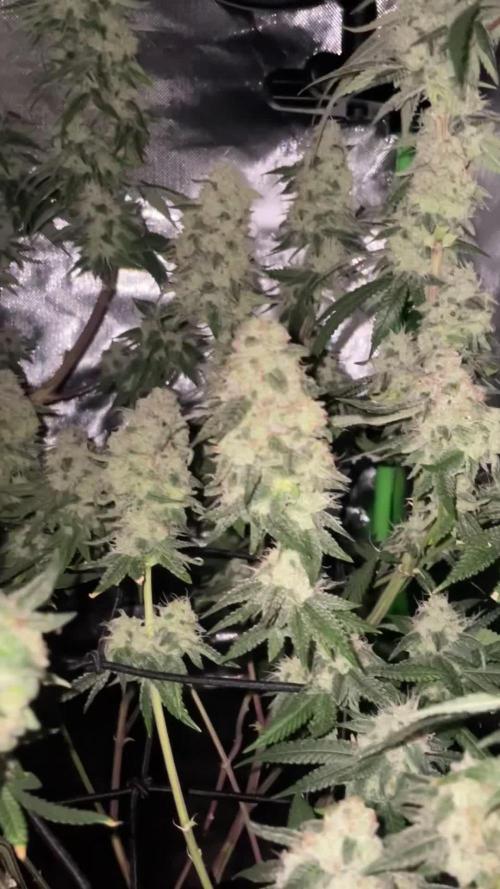
Oggi inizia la 7°settimana. I tricomi e la resina aumentano di gg in gg 👍🙂
Speriamo bene..
Buona fortuna a tutti noi!👍😉

Likes
9
Share


@maxpain
Follow
Week was good smell getting stronger Trichromes looking good ....about to start 12 day flush ...just regular water ... about 4-5 liters every 2_ 3 days still new to this is my first grow ever ..so we will see how it goes...organic way ...

Likes
28
Share


@GrowInger420
Follow
This week was good, she grow nice, but very slow...have a nice week✌️✌️

Likes
14
Share


@Tried_and_Tested
Follow
Another steady week of bud development. I haven't really done much with those apart from the occasional removal of yellow leaves and tucking nuisance leaves under the net.
The plants are all still growing in line with the previous expectations, with Topping and LST being the biggest, Mainlined next and then LST only in last place. It will be interesting to see the results though.
Should only be a few more weeks until harvest, as a large majority of trichomes are already milky.

Likes
5
Share


@eldruida_lamota
Follow
Que pasa familia, vamos con la tercera semana de vida de estas GG4 Sherbet Fast Flowering, de FastBuds.
Agradezco a Agrobeta todos los kits obtenidos de ellos 🙏.
Vamos al lío, El ph se controla en 6.2 , la temperatura la tenemos entre 21/24 grados y la humedad ronda el 50%, esta semana realicé el correspondiente trasplante a maceta de 7 litros. Iremos viendo cómo avanzan.
Agrobeta:
https://www.agrobeta.com/agrobetatiendaonline/36-abonos-canamo
Hasta aquí todo, Buenos humos 💨💨💨
Likes
24
Share


@dataTwiiix
Follow
01/22: Début de la récolte (fin: 4jours plus) première essaye de la récolte par etapes (la prochaine je donnerai 1 ou deux semaine aux fleurs les plus basses.). A part ça le résultat est bluffant toutesz les buds sont bien dense et colorée, belle a croquer :)
Likes
40
Share


@valiotoro
Follow
The trim was easy and the buds are super fat full of resin✂️🤩
The smell is delicious🤤


Likes
24
Share


@3lementa1
Follow
The colas keep filling out and getting longer and smell amazing. It's been warmer and more humid outside so RH in the tent has gone up. I added a mini air purifier I wasn't using (no ozone) as an extra precaution against mildew.
I woke up in the middle of the night on Monday and realized that the air purifier has a light on it so I got up and turned it off. I was worried that I'd messed with the dark cycle so I left them in darkness for an extra 2.5 hours.
My cool tube fan fell off the next day, onto my plants. They look undamaged. I taped it up again and set up a safety wire like the filter and fan have. I need a better solution for next cycle.
The buds are beautiful and having an even canopy is great. It's hard not thinking about the end result. The buds still look small compared to the big colas of a traditional grow shape but there's still a couple weeks left. There is some bud formation under the canopy but it's a little light. The tops of the colas are fat but short on the 7 gallon plants and taller and thinner on the 5 gallon plants.
I did leave a couple offshoots on that developed in late veg/early flower. By the time I caught them, I felt they were too mature to chop and I thought they helped fill out certain areas. But those ones have fewer bud sites and tend to be just a cola on a branch that shoots straight up which is still good. I do wonder if less crowding would have given me bigger buds, but I think it has more to do with pot size.
This is week 7 of flower. I switched to half strength nutes and started adding fancy molasses (18ml/gallon). I broke my pH tester and didn't replace my SCROG net until after I finally watered the next day so the canopy changed a bit. I took the opportunity to rearrange the plants a bit.
Crystal formation increased a crazy amount the day after I started adding molasses. I think I'll keep adding molasses even during flush.
The CBD Blue Shark has this really beautiful white glow. The pistils are very strong and white and the trichromes reflect back this silver light. The leaves are a nice semi-glossy dark green which gives great contrast. It's just a beautiful plant.
The Wedding Cake has a lot more colour with lots of red hairs and some yellow tones in the pistils. The fan leaves are more prone to yellowing and death than the leaves on the CBD BS. The buds seem more structurally dense and are really working on these pyramid shapes that look like delicious orange and green snacks. The buds on the CBD Blue Shark are more symmetrical and kind of otherworldly like some kind of sea creature.
Likes
18
Share


@Lorenzo96
Follow
3rd week of Veg
Day 18 26/02
I'm very happy how they are growing so far they look healthy so lets keep it this way 😁
Today I gave them nutrients, I mixed the nutes in 8ltr bucket of water, had to be a dose of 16ml of each nutrient and gave 2 cups to each plant.
Excited to see how they will go this week, all good so far.
Day 21 01/03
Its been 3 days after their feeding, they are growing day by day strong and healthy :)
I used LST on some of the auto's, some of them are still not ready for LST, by the end of this week they should be.
For the Mimosa Evo I used Topping technique on their 3rd node.
Also gave them water with PH 6.5 about 3 to 4 cups each
Day 24 04/03
Another 3 days past and they are rapidly growing. Mimosa Evo has been 3 days since there topping and they are already showing signs of recovery.
Today I used LST on all of the auto's. The critical kush auto that I used LST on them 3 days ago are doing very good, I also cut the fan leaf that blocks the light from the bottom stems and now they are stretching for the light 😌
I gave them their nutrients today same dose as before I haven't raised it yet, probably next feeding I will.
Likes
2
Share


@Ultraviolet_
Follow
We become aware at such times of man's wonderful ability to bring seemingly unrelated elements into harmonic balance, and receive a glimpse into a world where everything exists in conscious sympathetic attunement to everything else. When we listen to a piece of music that seems to strike a beautiful chord somewhere inside us, or view a painting that simply glows with harmonic awareness well executed, we probably do not spare much time to contemplate the wonderfully intricate combination of vibrations that our sensors make it possible for us to perceive. We tend to appreciate the relationship between the parts of something by an awareness of the harmony or dissonance of the whole. This ability enables us to say "what a beautiful house!" instead of "analysis has proven that this collection of building materials exhibits certain elements of harmonic proportion." While this ability to instinctively appreciate the beauty of true harmony has an important role to play in evolution, a more analytical understanding of the laws involved can be most useful. This is especially so if we wish to create works of art where each part exists in true harmony, not only with the other part of that particular whole, but with the universe within which the creator and the created exist.
Everything vibrates. From the most dense matter to the most subtle cosmic rays, everything which our senses allow our thoughts to become aware of, can be specified in terms of wavelength or frequency of vibration. These two terms define the same thing, but from different points of view.
The following are the approximate wavelengths of various energy carriers:
Cosmic rays 0.000,000,001 mm
Gamma rays 0.000,000,1 mm
X rays 0.000,500 mm
Ultraviolet rays 0.003 mm
Visible light 0.006 mm
Infrared 0.01 mm
Sound waves 1 meter
Radio waves 300 meters
Violet light 400 nm to 450 nm
Blue light 450 nm to 500 nm
Green light 500 nm to 570 nm
Yellow light 570 nm to 590 nm
Orange light 590 nm to 610 nm
Red light 610 to 700 nm
1 nanometer (nm) = 0.000,000,1 cm = 1/10,000,000 cm
If a guitar string is plucked and we hear a sound, it is not too difficult for the human mind to associate this sound with the vibration of the guitar string. With color it is quite different. It is difficult for us to conceive that the color of a substance is not an inherent property of the substance itself, but an indication picked up by our senses of that substance's ability to absorb or reflect the light which happens to be shining on it at that moment. Neither the matter nor the light is colored. What happens is that the brain learns to differentiate between the frequencies reflected or transmitted by the substance the eyes are focused on. The same thing happens with sound. When we say "Oh! Listen, they're playing my favorite song," what we really mean is: "My brain has stored within it a particular pattern of frequencies. I have compared the new information being received with this stored pattern and have deduced the answer that the two patterns are similar within certain specified tolerances." The 'pleasure' involved could have something to do with our running the pre-recorded pattern at the same time, in 'sympathy' with the new pattern as it is received.
The word sympathy describes very well our ability to appreciate color and sound. It also describes the reason behind certain elements of harmony. For instance, if a substance vibrating at 100 cycles per second (tone 1) is in the proximity of another substance vibrating at 200 cycles per second (tone 2), we could perceive, if we had the right equipment, a certain sympathetic relationship between the two.
We will see from this that there is a uniform doubling of the first tone seen in the second. At various points along the waves, the two are the same in amplitude. At other points, they are at opposite poles to each other. This doubled frequency has more points of similarity to the original than any other frequency except the original itself. If the equipment we had available for measuring these two frequencies was a soundboard amplifier and a pair of ears, then we would hear what would sound to us like one tone. If we had the opportunity to hear one at a time, we would hear that although they sound the same, one is higher in pitch than the other. This characteristic of 'the same but different in pitch', musicians have called the octave. Any two tones produced where one has exactly doubled the frequency of the other is called an octave. Speaking in ratios, an octave would appear then as the ratio 2:1 or 1:2, depending on whether we are talking of an octave up or down.
A single note produced by almost any instrument will contain more than one wavelength or frequency. It will have a dominant frequency, the wavelength of which we would call the note's 'fundamental' or 1st harmonic. It will also have a varying number of upper harmonics, gradually fading in intensity into infinity or silence.
Natural harmonics always have the same pattern of intervals between them. The interval between the 1st and 2nd harmonic is a perfect octave; between the 2nd and 3rd a perfect fifth; between the 3rd and 4th a perfect 4th; and so on, the intervals becoming smaller and smaller until they lose any relationship with the western 12 tone scale as it exists at the moment. Just as an octave has certain elements of sympathy with its fundamental, so some intervals have been noted to be more perfectly in sympathy with the fundamental than others. The ratio of the 'perfect 5th' or interval of 7 semitones, as it occurs in the harmonic series, is 3:2 or 2:3, while that of the 'perfect fourth" is 4:3 or 3:4. All the tones in the western 12 tone scale can be expressed in terms of the ratio between the upper tone and its fundamental. This would seem to be an ideal way of generating a scale from any given fundamental and several attempts have been made to do this, the Pythagorean system being probably the most well known. Although when working with a single tone instrument playing on its own, the Pythagorean formula works wonderfully well, if we had several instruments tuned this way together and asked them to play almost any western music, we would find that at times they sounded quite out of tune to each other.
The lack of flexibility of the various scale systems based on the harmonic series has led to what is known as the 'tempered' scale. This uses as its primary unit of interval the ratio of the octave or 2:1. It then proceeds to divide the interval between any fundamental and its upper octave into 12 smaller intervals by applying the ratio: two to the one-twelfth power, to one (21/12:1). This equals 1.059463094, so by multiplying any frequency by this number, we will obtain the tempered semitone next up from our fundamental. We will also find that any tone twelve semitones up from any other tone, in a scale generated in this way, will have exactly double the frequency.
If we took the note middle C on a piano and halved the wavelength, we would have the note C one octave above. If we halved this, we would have the C above, and so on. However, within about 6 octaves, we would find that although a 'sound' was being produced, no human ear could perceive it. If we kept on going, halving and producing upper octaves of our fundamental C, we would proceed through the infrared band, into the visible light spectrum. If we happened to be outside during the day, we would, for one octave only, see the note C with our eyes. The next octave above would already be in the ultraviolet band, and outside the eye's sensitivity range. If we can think of color as being an indication of a substance's vibratory rate or wavelength, we may begin to see a relationship that could exist between the color and sound spectrums.
The logical extension of what has so far been said is that there exists a scale in the color spectrum that corresponds exactly to the scale in the sound spectrum, each color tone being an octave of the equivalent note in the sound range.
This is not the end of the story but only the beginning. If we can for the moment accept that any wavelength in one band has upper and lower octave stretching out to infinity, then the next question is 'fine, but what shall we use as our fundamental? A particular color? A particular sound frequency?' The musicians among us will probably say 'A 440'. This means that the note A should vibrate at 440 Hertz, or 440 times per second. They would tell us that this is standard pitch has been adopted by most orchestras around the world; pianos are tuned to it, instruments are constructed to formulas based on it, and so to them it would probably seem the most appropriate place to begin. Some of these musicians may know of the battle that is still raging with regards to this being the standard, but few would know why A = 440 Hz was chosen except that it worked when it was set to be a suitable compromise between the many different pitches in use at the time.
432 Hz is said to be mathematically consistent with the patterns of the universe. Studies reveal that 432 Hz tuning vibrates with the universe’s golden mean PHI and unifies the properties of light, time, space, matter, gravity, and magnetism with biology, the DNA code, and consciousness. When our atoms and DNA start to resonate in harmony with the spiraling pattern of nature, our sense of connection to nature is said to be magnified.
Another interesting factor to consider is that the A=432 Hz tuning correlates with the color spectrum, while the A=440 Hz is off. Audiophiles have also stated that A = 432 Hz music seems to be non-local and can fill an entire room, whereas A=440 Hz can be perceived as directional or linear in sound propagation.
Once you adopt the idea that sound (or vibration in general) can have an equalizing and harmonizing effect (as well as a disturbing effect), the science of harmony can be applied to bring greater harmony into one's life or tune to specific energies. There is a form of absolute and relative harmony. Absolute harmony can, for example, be determined by the tuning of an instrument. The ancients tuned their instruments at an A of 432 Hz instead of 440 Hz - and for a good reason. There are plenty of music examples on the internet that you can listen to in order to establish the difference for yourself.
Attuning the instrument to 432 Hz results in a more relaxing sound, while 440 Hz slightly tenses up the body. This is because 440 Hz is out of tune with both macro and micro cosmos. On the contrary, 432 Hz is in tune. To give an example of how this is manifested microcosmically: our breath (0,3 Hz) and our pulse (1,2 Hz) relate to the frequency of the lower octave of an A of 432 Hz (108 Hz) as 1:360 and 1:90.
It is interesting to note that 432 Hz was the standard pitch of many old instruments and that it was only recently (19th and 20th century) the standard pitch was increased. This was done in order to be able to play for bigger audiences. Bigger audiences (more bodies) absorb more of the lower frequencies, so the higher pitch was more likely to “cut through”. One of the oldest instruments of the world is the bell ensemble of Yi Zeng (dated 423 BC), tuned to a standard F4 of 345 Hz, which gives an A= 432 Hz. The frequency of 345 Hz is that of the platonic year! Similarly, many old organs are tuned in A=432 as well; for example, St. Peter’s Capella Gregoriana, St. Peter’s Capella Giulia, S. Maria Maggiore in Rome.
Maria Renold’s book “Intervals Scales Tones and the Concert Pitch C=128 Hz” claims conclusive evidence that 440 Hz and raising concert pitch above scientific “C” Prime=128 Hz (Concert A=432 Hz) disassociates the connection of consciousness to the body and creates anti-social conditions in humanity.
The difference between concert pitch A=440 Hz and Concert A=432 Hz is only 8 cycles per second, but it is a perceptible difference of awareness in the human consciousness experience of the dream we share called existence.
Processing
Likes
21
Share


@Fullmeltalchemist
Follow
5.30
6.01 Herro squints and rabies. WElcme to me circus. We do it with water this week. dun Dun dUN! they finish on le morrow which really mean fucking never!!!!!!!!!!!!!!!!
Justa wait n see for them trichys to go ar RICKY RED biatch. REDRUM REDRUM REDRUM - dance with me danny boy.
..,,,,<<<::::,,,,,,,,,,,,,,,,,,,,,a,,a,,,a,,,a,,,,,,,a,,a,,,,a,,a,a,,a rehpleh** hsinif
6.5 F65
Oh, um hi. ^^ I don’t really remember that. Shit just comes out of me sometimes. Gotta go get my chakras checked. Uhh. This week finished up strong. Turns out I can’t count, and it has actually only been 65 days since 12/12. So yeah, they aren’t taking as long as I thought before. A few plants have really slowed/stopped their pistil output and are starting to amber over. SROG, Deadstar, a couple Passion berrys and 1 sweet pink. That’s all for now.


Likes
10
Share


@Rayner
Follow
This week I'll chop the Mimosa X Orange Punch. I could not give enough phosphor to the Mimosa as you can see in the pictures, but as harvest is close by it didn't bother me too much. The Dolato also shows some signs of an immobile nutrients' deficiency. For those I don't really have supplements right now, so I'll have to live with that.
In hindsight, I would've added 1 more BioTab per pot, which was recommended by the manufacturer anyway.
As for smells, it is just overwhelmingly fruity in the tent!!



Likes
3
Share

@skipakz
Follow
Kein Dünger mehr seit letzter Woche, habe heute angefangen auf Ernte vorzubereiten (deswegen manche so kahl, so muss ich später nicht so viel trimmen auf einmal sondern kann auf die letzten Tage verteilen…
Likes
33
Share


@Rollex420
Follow
23-07-21
Kosher Cake in its final week. In 7 days I think I will cut her and start proceeding for the drying phase. I am very satisfied with this plant! I will upload more photos in these days before the final cut.💚
Likes
8
Share


@Genussmittel420
Follow
she is fadeing into red/purple at the buds and sugar leafs while also completeley yellowing out because of nitrogen and a light bit of green is also here and there. love to look at her and the jucy buds. i think she might be done in about a week

Likes
184
Share


@Still_Smoq
Follow
#seedsman420growoff and #SeedsmanSeeds
📆 Week 4, 18-24 May 2024
18 May - Observed and let the plant grow.
19 May - Cut off lower suckers from main branches (see video).
20-24 May - Observed and let the plant grow.
📑 This plant is growing remarkably even and fast with very little training. Next week a scrog ring will be going on to spread and open her up just before flowering.
🍶 18 May nutrient solution changed
🍽️ 18 May feeding schedule updated
💧 Using reverse osmosis water with EC/TDS at 0
🐉 Nutrient Solution EC 2.1 at 72 degree F
🔆 Light power at 60%, DLI 25 canopy coverage at 18hrs
😤 Using General Hydroponics, HGC728040, Dual Diaphragm Air Pump, 320 GPH
That is it for this week. Thanks for the look, read and stopping by.

Likes
1
Share


@bigsmoke42069
Follow
Week 9 of flowering 11/13/24
The lady is at her final phase,
Giving her only water.
Buds packing some nice weight,
Leaves color change is very noticeable, pink leaves showing more and more.
Chop day sooner than later. :)
Likes
1
Share


@StarSkream
Follow
The Big Detroit energy will be my go to
Strain taste smell and appearance all there!

Likes
5
Share


@BasementGrowers
Follow
So flower has seemed very slow. We are on day 60 of flower, and they are NOT ready. The past two weeks the pH has been dropping tremendously every day. I couldn’t imagine it would be a root issue since I use hydroguard and we have a chiller set at 67 degrees, plus the plants look healthy! So I did my research and tried everything. Finally I decided to go ahead and treat with hydrogen peroxide because nothing else was helping, and Bam! Stable pH! Lesson learned. I hope the plants now start putting on weight over the next week and maturing. I was hoping to flush in a week, but I will just base it off what they are telling me.

Likes
4
Share


@fadedgreentaurus
Follow
Really coming along nice trying to get established in case I am called away for work or anything else over summer ideally these ladies will continue getting fed as long is there given clean balance water I’m going to hit em heavy with seabird guano at flower, probably crank up the molasses on that end, really just properly letting water sit oxygenated mixing and letting solutions hit microbial levels that put the real work in, I’m hitting with a nute I’m making myself 3 times a week at point all water is being carbon filter dechlorinated the aerated then to casting or mycorrhizae brews that I rotate my mycorrhizae brew is Bigfoot water soluble and dechlorinated water except I do more then recommended ok on the each time. Results are stunning my cover are dense earthy and rich bio smells tons of spiders and other good predators a large toad made a home in the clover also he must be chowing cause he’s healthy. I will be making a drive and coming back with a bunch of nutes I’m picking up out of state as well as some Carolina mantis cocoon I’m staying up on pest this year. I’m steady rotating neem bt since birth I’m not fucking around this time. Crank up concentration slowly but hitting light preventative pest spraying at least twice per week as it get warmer I’m gonna be in a constant panic about the stupid moths. Plants drink a lot of water already and technically my outdoor season has not begun for most around me till Mother’s Day. I’m already 11 weeks deep. Cages are rough on leaves but I’m not to worried about the ladies are
Strong a week of cages they Wii all be locked hugging there cage in place. Something in particular that’s rather stunning is the leaf quality health of all strains, it’s def what I’m doing with the soil. it appears that microbiological forces at work influences aspects of the plants of which results I’d yet to receive. The greenness and the crisp leaf sound when the leaf’s brush against something. Getting REALLY Excited about things! near perfect start. My big healthy wendigo not the cripple is def a top perform when I comes to sheer mass that is because that plant is super definitely tallest sitting at about 2ft. They are topping and splitting real well, black phoenix v2 isn’t performing to my expectations so far, though it’s new branches that coming in will be game changer come solstice. So we are now over month and a half left of healthy veg and flower stretch on these, all things willing I’m betting three these size ration looking for. (12ft or bust) Hoku seems to be great seeds for people trying to do outdoor for quantity. Mind you I have yet to see the flower this is mere speculation from what I’m witnessing of its veg time. The gluey c99 though.. that plants a straight beauty. Short but kicking perfectly shaped little sativa shaped hybrid leafs this plant took to topping perf one the best veg ladies I’ve ever had In this garden so far. Not the tallest but a stunner none the less. The snow jokez are really going for the gain lane too both are topped real well but one particular was my earliest successful top I was able to establish clean two cola fresh off the rip. Perfect fork Excited if these end up becoming trees all these stems and tops are gonna be bursting out the seams. Really want to find something cool to make our massive outdoor cannabis stem knots into one of days if anyone seen any thing cool holler fs.
So I did not anticipate the plants flowering so quickly and will be monitoring the situation in the case I need to remove small flowers with a nice top on everything going two weeks or so into may. Got small bud sites developing on every plant.

