The Grow Awards 2026 🏆
Likes
Comments
Share
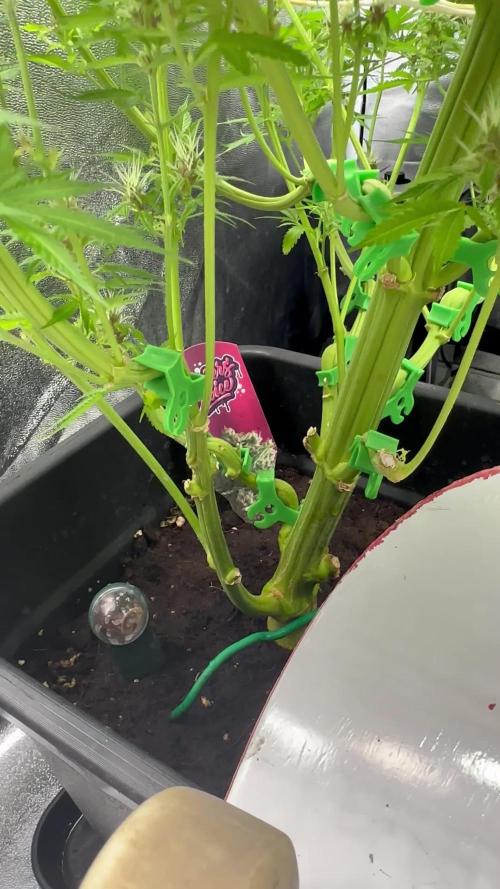
Jan 25th - both photos are from last nite (24th) Water and Nutrients are now Max’d and will be for the next 3 feeds before tapering off towards a flush, end of week 9 - pics tonight of the skinny-assed Sativa leaves in and around the plants crown. -reined-in some of the taller branches by affixing them back onto the fabric pot. Pulling them down slightly. Jan 26, - raised the lights a couple of inches. Trying to keep top-leaf temps under the Room temp by at least a degree ~ 1.5 avg -seems that the blossoms have responded to all the food and water. Sticky Buds for the 1st-time and a Strong (beautiful) smell I cannot get my head around yet. Funky Citrus for sure. - R.H. dropped again ~ 50% - 3 tablespoons Molasses added for tonight’s feast. day 5 since last nutes *** just an observation; I’m either just at the right time in Flower, (week 6 of 11-13) or increasing the Ocean Magic content 3x has HAD a huge impact on the Bud development & Terpene population. There are Crystals galore on the sugar leaves and bud surfaces. 2ml/L on their Bottles product Label vs 8ml/L on the G.P. Nutrition Calculator, are each company recommendations on how to use the product... ? ! I’ve made the move to 8ml/L in the last 3 feeds. 30th Jan - big growth in the actual blossoms and hairs. The Left plant has flowers that have begun to wrap around the branches and join the other buds above and below. The stretch in the L plant had drastically slowed and the R plant is catching-up nicely ~ 7-10 days behind. 31st - top dressing the pot(s) tonight, ahead of their next feed. Quite a “settling” of the top surface since the first waterings. And now that they are getting some serious water (usually over a 3-4 hour period) there is room for ~ 2” soil, and another inch of Sand. Everything else has been Max’d, might as well include the playground !! - retained some of the original potting mixture, minus perlite & shrimp compost... that goes on tonight, 31st. ** ha, should be fun with all of the Stakes in the soil... focus, pic to follow Feb 1 - 16 Litre feeding tonight, to send the Ladies into the 2nd half of Flower. Planning & Maintenance is all I am thinking is left to do. Between the lines till 2nd week March ... -will try and get an image tonight showing the terpene explosion and changes happening on the plants - small increase in Molasses took TDS to 1370. No higher from here on in.
Likes
5
Share
All and all I popped 19 seeds lost one after it came above ground 5 of those I will be posting on here which are mandarin cookie crossed with zweet og they are regular photoperiod plants so I will have to sex them it is a small pheno hunt looking for something to keep as a mother plant didn’t use any nutes for the first week
Processing
Likes
7
Share
@x_grower
Follow
Very fast seedling process, seeds stayed soaking for 24h and in the water they were already showing the first white root hair, another 48h in the paper towel and the day I potted them up they showed cotyledons. They took around 11 days to reach third node and complete germination but honestly I belive it could be faster if in better enviroment, mainly the humidity which was low and I transplanted them a day late. From day 5 I started feeding them exact same nutrients and ratio from the first vegetative week but starting at 0.4EC and increasing by 0.1EC/day until 1.1EC
Likes
8
Share
@DWCpaqy
Follow
New week! Tips and help from last week, I had around 1500 ppm and I did flush my roots in water and change everything. Now is around 1000 ppm and dropping 150 ppm a day. Did read about water level in DWC and how to increase the grow with water. I had the water almost up to the root or the level of there the basket is. Now I have 1-2 inch (2-5 cm) below where the roots come out. This create air roots. I'm not sure if it's the air roots or the ppm but my flower is boosting. Can se buds grow!! Trimming so I can keep the same hight. Have any tips or rekomandation? Only have one question for next week and this is: it's looking a bit thigth between the buds and all of the leaf is cristal on it. Should I cut some more leaf? And what leaf should I trim? Is so thigth in there. Or will it grow fine?
Likes
85
Share
@tschw1
Follow
This week didn‘t started really well. There were big rainfalls all over germany but especially in my region. I had the plants in the greenhouse so they were safe but after days of rain the water started to drip into the greenhouse. I tried to keep the plants in dry spots but just saw that one of my plants had mold in her flowers. I immediately cut the piece with mold off to keep the rest of the plant safe. As I removed the leaves from the buds I carefully looked all over the buds and cut the mold and the area around it off. I also cut all the buds off the stem and will dry them seperated from each other and not hanging on the stem like last time. This way the risk of another mold infection after the harvest is lower. The next bad news is that the Painkiller looked really sad. Lower leaves were turning yellow or white and the leaves were hanging down. I decided to remove some big fan leaves and to cut off the yellow and white small leaves. Then I watered her good and gave her some self made nutrients out of nettles. In the evening the plant already stood straight again and looked good!
Processing
Likes
Comments
Share

@Hampoop35
Follow
This week it seems like they are starting to flower or getting ready to. Day 42 and they are smelling great. I’m super excited to see the difference in plant A and plant B. The runt seems to be bouncing back. After I did some LST it really started to take off.
Likes
55
Share
What's in the soil? What's not in the soil would be an easier question to answer. 16-18 DLI @ the minute. +++ as she grows. Probably not recommended, but to get to where it needs to be, I need to start now. Vegetative @1400ppm 0.8–1.2 kPa 80–86°F (26.7–30°C) 65–75%, LST Day 10, Fim'd Day 11 CEC (Cation Exchange Capacity): This is a measure of a soil's ability to hold and exchange positively charged nutrients, like calcium, magnesium, and potassium. Soils with high CEC (more clay and organic matter) have more negative charges that attract and hold these essential nutrients, preventing them from leaching away. Biochar is highly efficient at increasing cation exchange capacity (CEC) compared to many other amendments. Biochar's high CEC potential stems from its negatively charged functional groups, and studies show it can increase CEC by over 90%. Amendments like compost also increase CEC but are often more prone to rapid biodegradation, which can make biochar's effect more long-lasting. biochar acts as a long-lasting Cation Exchange Capacity (CEC) enhancer because its porous, carbon-rich structure provides sites for nutrients to bind to, effectively improving nutrient retention in soil without relying on the short-term benefits of fresh organic matter like compost or manure. Biochar's stability means these benefits last much longer than those from traditional organic amendments, making it a sustainable way to improve soil fertility, water retention, and structure over time. Needs to be charged first, similar to Coco, or it will immobilize cations, but at a much higher ratio. a high cation exchange capacity (CEC) results in a high buffer protection, meaning the soil can better resist changes in pH and nutrient availability. This is because a high CEC soil has more negatively charged sites to hold onto essential positively charged nutrients, like calcium and magnesium, and to buffer against acid ions, such as hydrogen. EC (Electrical Conductivity): This measures the amount of soluble salts in the soil. High EC levels indicate a high concentration of dissolved salts and can be a sign of potential salinity issues that can harm plants. The stored cations associated with a medium's cation exchange capacity (CEC) do not directly contribute to a real-time electrical conductivity (EC) reading. A real-time EC measurement reflects only the concentration of free, dissolved salt ions in the water solution within the medium. 98% of a plants nutrients comes directly from the water solution. 2% come directly from soil particles. CEC is a mediums storage capacity for cations. These stored cations do not contribute to a mediums EC directly. Electrical Conductivity (EC) does not measure salt ions adsorbed (stored) onto a Cation Exchange Capacity (CEC) site, as EC measures the conductivity of ions in solution within a soil or water sample, not those held on soil particles. A medium releases stored cations to water by ion exchange, where a new, more desirable ion from the water solution temporarily displaces the stored cation from the medium's surface, a process also seen in plants absorbing nutrients via mass flow. For example, in water softeners, sodium ions are released from resin beads to bond with the medium's surface, displacing calcium and magnesium ions which then enter the water. This same principle applies when plants take up nutrients from the soil solution: the cations are released from the soil particles into the water in response to a concentration equilibrium, and then moved to the root surface via mass flow. An example of ion exchange within the context of Cation Exchange Capacity (CEC) is a soil particle with a negative charge attracting and holding positively charged nutrient ions, like potassium (K+) or calcium (Ca2+), and then exchanging them for other positive ions present in the soil solution. For instance, a negatively charged clay particle in soil can hold a K+ ion and later release it to a plant's roots when a different cation, such as calcium (Ca2+), is abundant and replaces the potassium. This process of holding and swapping positively charged ions is fundamental to soil fertility, as it provides plants with essential nutrients. Negative charges on soil particles: Soil particles, particularly clay and organic matter, have negatively charged surfaces due to their chemical structure. Attraction of cations: These negative charges attract and hold positively charged ions, or cations, such as: Potassium (K+) Calcium (Ca2+) Magnesium (Mg2+) Sodium (Na+) Ammonium (NH4+) Plant roots excrete hydrogen ions (H+) through the action of proton pumps embedded in the root cell membranes, which use ATP (energy) to actively transport H+ ions from inside the root cell into the surrounding soil. This process lowers the pH of the soil, which helps to make certain mineral nutrients, such as iron, more available for uptake by the plant. Mechanism of H+ Excretion Proton Pumps: Root cells contain specialized proteins called proton pumps (H+-ATPases) in their cell membranes. Active Transport: These proton pumps use energy from ATP to actively move H+ ions from the cytoplasm of the root cell into the soil, against their concentration gradient. Role in pH Regulation: This active excretion of H+ is a major way plants regulate their internal cytoplasmic pH. Nutrient Availability: The resulting decrease in soil pH makes certain essential mineral nutrients, like iron, more soluble and available for the root cells to absorb. Ion Exchange: The H+ ions also displace positively charged mineral cations from the soil particles, making them available for uptake. Iron Uptake: In response to iron deficiency stress, plants enhance H+ excretion and reductant release to lower the pH and convert Fe3+ to the more available form Fe2+. The altered pH can influence the activity and composition of beneficial microbes in the soil. The H+ gradient created by the proton pumps can also be used for other vital cell functions, such as ATP synthesis and the transport of other solutes. The hydrogen ions (H+) excreted during photosynthesis come from the splitting of water molecules. This splitting, called photolysis, occurs in Photosystem II to replace the electrons used in the light-dependent reactions. The released hydrogen ions are then pumped into the thylakoid lumen, creating a proton gradient that drives ATP synthesis. Plants release hydrogen ions (H+) from their roots into the soil, a process that occurs in conjunction with nutrient uptake and photosynthesis. These H+ ions compete with mineral cations for the negatively charged sites on soil particles, a phenomenon known as cation exchange. By displacing beneficial mineral cations, the excreted H+ ions make these nutrients available for the plant to absorb, which can also lower the soil pH and indirectly affect its Cation Exchange Capacity (CEC) by altering the pool of exchangeable cations in the soil solution. Plants use proton (H+) exudation, driven by the H+-ATPase enzyme, to release H+ ions into the soil, creating a more acidic rhizosphere, which enhances nutrient availability and influences nutrient cycling processes. This acidification mobilizes insoluble nutrients like iron (Fe) by breaking them down, while also facilitating the activity of beneficial microbes involved in the nutrient cycle. Therefore, H+ exudation is a critical plant strategy for nutrient acquisition and management, allowing plants to improve their access to essential elements from the soil. A lack of water splitting during photosynthesis can affect iron uptake because the resulting energy imbalance disrupts the plant's ability to produce ATP and NADPH, which are crucial for overall photosynthetic energy conversion and can trigger a deficiency in iron homeostasis pathways. While photosynthesis uses hydrogen ions produced from water splitting for the Calvin cycle, not to create a hydrogen gas deficiency, the overall process is sensitive to nutrient availability, and iron is essential for chloroplast function. In photosynthesis, water is split to provide electrons to replace those lost in Photosystem II, which is triggered by light absorption. These electrons then travel along a transport chain to generate ATP (energy currency) and NADPH (reducing power). Carbon Fixation: The generated ATP and NADPH are then used to convert carbon dioxide into carbohydrates in the Calvin cycle. Impaired water splitting (via water in or out) breaks the chain reaction of photosynthesis. This leads to an imbalance in ATP and NADPH levels, which disrupts the Calvin cycle and overall energy production in the plant. Plants require a sufficient supply of essential mineral elements like iron for photosynthesis. Iron is vital for chlorophyll formation and plays a crucial role in electron transport within the chloroplasts. The complex relationship between nutrient status and photosynthesis is evident when iron deficiency can be reverted by depleting other micronutrients like manganese. This highlights how nutrient homeostasis influences photosynthetic function. A lack of adequate energy and reducing power from photosynthesis, which is directly linked to water splitting, can trigger complex adaptive responses in the plant's iron uptake and distribution systems. Plants possess receptors called transceptors that can directly detect specific nutrient concentrations in the soil or within the plant's tissues. These receptors trigger signaling pathways, sometimes involving calcium influx or changes in protein complex activity, that then influence nutrient uptake by the roots. Plants use this information to make long-term adjustments, such as Increasing root biomass to explore more soil for nutrients. Modifying metabolic pathways to make better use of available resources. Adjusting the rate of nutrient transport into the roots. That's why I keep a high EC. Abundance resonates Abundance.
Likes
Comments
Share
@mihixd
Follow
Plants are looking good! I harvested the 2 plants on the left on D82. Drying them in a 4x2 rn, the 2 remaining plants will stay in flower tent until the drying tent clears up. They could use an extra 10 days for a little more size :). Very strong smell! my carbon filter was struggling haha. D78 10L D81 8L D82 2 harvested
Likes
3
Share
the fresh kit easy for beginner i have to do no watering, only open and wait. the first flush was arround 12 day‘s after openin the box. very big thanks to Zamnesia @Zamnesia #Zamnesia. some are goes blue by pull out. and i had so much luck. 1 mushroom was opening and let fall his spores and this would kill the next charge, my luck was that all spore‘s falls down on the polymäre bag. so i hope that the next charge goes like this. stay clean and this will go very easy and fast. give a new feedback for the trip, and the hope of this 2.nd flush
Likes
22
Share
The yellow lid make for some really bad pictures. Playing around with things, as usual I gave in and added a filter pump to my reservoir as the water temp can peak near 23c during the day. I dont have my ambient chiller inline this time. The filter also oxygenates the water so this wouldnt be a pure fog run, oh well. Half fog, half dwc🤷‍♂️
Likes
25
Share
@Aleks555
Follow
Anesia Seeds - Chimera Cut, hello everyone! Our beauty is 60 days old, and she looks absolutely stunning. 12 days ago, we pruned and tied down her branches, and the results have been fantastic. You can see for yourself by checking previous weeks and comparing. This lady has quite the appetite, and Xpert Nutrients are clearly to her taste. Just look at the color and shape of her leaves, and it’s obvious that this lady is surrounded by care and love.
Likes
26
Share
Day 51 20/08/24 Tuesday Feed today using de-chlorinated tap water pH 6. With Plagron PK13-14 and power buds. Noticing the stretch stop, and now packing out there bud sites 💪💚 ACOP , Melonade Runtz have Xmas tree structure where as orange bud is pure tall sativa structure... The Overdose is a compact indica looking dwarf but the bud sites are packing out a punch 👊🤣 Day 54 23/08/24 Friday Watering only today using de-chlorinated tap water pH 6, I'm watering in 350ml no run off. 400ml I'm seeing tiny run off. Day 56 25/08/24 Sunday Water today using de-chlorinated tap water pH 6. Added bud candy and rhino skin 1ml per litre
Likes
46
Share
good evening to all, brothers of the weed! Welcome back to the PEAKY gardens where it is grown for passion A good perfume all made in Holland comes out of the tent! The beautiful Punch are the ones that surround the whole tent, while the barneys cookies are the purple ones in the center of the tent! They seem to travel quite well and without irregularities ! We begin to see the first little heads of trichomes
Likes
16
Share
@osmrducks
Follow
Day 15: Plants looking healthy as can be! I didn't make a rack for the lights but I got em in. Looks jankie, but I think its gonna work. 🙏 Day 16: Trying to work out kinks in my grow. Since I put the other 2 lights in, I'm now battling the heat and humidity. Switch the fans around. Got the cold air coming in down low. Will feed them in the morning. Day 17: The girls were showing signs of being thirsty this morning for sure! They received their first drain to waste watering. They will be getting some additional nutes on the next feeding (AN B-52, AN Sensizyme, AN CalMag Extra). Day 18: Looking amazing today! I tried my hand at a little LST. Wish the girls luck.!! 🙏 Tomorrow is the official 2 week mark from breaking ground. So, not sure. I've got the humidity finally dialed in at around 50-55% and the temp around 78°. Also gave them another drink as they were already dry about 1.5" down?? Day 19: This is the official 2 week mark. I think I stressed the girls pretty good yesterday, but they look to be recovered today. Should start seeing good growth in the day to follow. Will just be tucking a leaf here and there for a bit. I will being doing a straight water feed next with Great White. Day 20: Nothing new to report other than found 2 leaves that had some yellow mottling. I added Sensizyme, Recharge, and Great White to this feeding. Did not do drain to waste. Just watered the outside perimeter. PPM was 260 at 5.8 ph. Day 21: NO MORE NUTES for these girls! Tips on a couple of em are turning yellow!!! Stupid me. Over watering and giving too many nutes.
Likes
3
Share
@jaydee702
Follow
No hermi flowers from these two clones from a hermi.This grow has been hard to keep contained ive been bending branches for 4 weeks and it sill stretches 4to 6 inches every few days i am out of space under the lights its been a jack n been stalk grow
Likes
20
Share
Que pasa familia, vamos a añadir la primera semana de vida de estas Apple Fritter de RoyalQueenSeeds, de las 5 semillas, una de me a podrido por enterrarla mal, las otras 4 están perfectas, empezamos con la temperatura que la tenemos entre los 21/24 grados, la humedad está entorno al 60%, el ph está en 6.2 , el foco actualmente lo tengo encendido 18 horas y la potencia es al 50% de lo que da el foco. También añado la gama de nutrientes de Agrobeta, que no falla, sin duda de la mejor alimentación que hay para tus plantas. Mars hydro: Code discount: EL420 https://www.mars-hydro.com/ Agrobeta: https://www.agrobeta.com/agrobetatiendaonline/36-abonos-canamo Hasta aquí todo, Buenos humos 💨💨💨
Likes
17
Share
@Lazuli
Follow
She grew slow in winter and flowered hard in spring
Likes
9
Share
-4/9/23 Start of Week --Week 3 -4/9/23 (Day 22) --Changes: lowered the light and move the pot about 6 inches closer to the middle of the light (light intensity not changed). --Diary Enter; harvested half of the other plant that is in the same space, allowing me to drop the height of the light. will be watching for problems because light intensity was not changed (about 60%). -4/12/23 (Day 25) --Observations: Branch node are forming at the spade leaves at the first level shade leaves, also the third set of shade leaves are forming. growing quicker now that the light was lowered, also looks darker than at the beginning of the week. --Diary Entry: started growing faster after lowering the light and looks like it has increased chlorophyll production. will be changing the light cycle at the beginning of next week to 18/6 light/night, it will get that light cycle for 3 weeks then change back to 12/12 because of the fast flower competition. Fast Buds information on this cultivar clams that the flowering cycle takes 7-8 weeks so that's what I'm accounting for, leaving 1-2 weeks for hang dry and the start of curing. -4/15/23 (Day 28) --Observations: branch nodes doing very good, growing at good rate. --Diary Entry: will be changing to 18/6 light/night cycle beginning tomorrow, will also be transplanting and starting training soon. -4/15/23 End of Week
Likes
6
Share
Likes
10
Share
@Sadhus
Follow
Sa pousse tranquillement, toujours pas de signe de fleurs chez les boutures en 12/12 , quelques nouvelles bouture qui racines et la mère prête a envoyé plein de petits #khalifa genetics #madamegrow #trolmaster