


Processing
Likes
Comments
Share

@CrackinBeans
Follow
Well I'm a bit upset last week I ended up dropping my ph meter in a tank of nutes I was mixing and by the time I got it out the meter was junk. I was planning on flushing the crystal but had to wait another week for the meter.
I suppose the good thing to take from this was I found out why I was having issues with my plants. When the new ph meter came in I went to check my run off and my nutes that I had all ready mixed up. It turns out that my meter i had been using this whole grow was off by about -2-2.5 so this whole time I had been feeding the plants at around 3ph smfh. I cant believe they look how they do knowing what went on this whole time.
Fastbuds crystal meth is 3days into flush and i will be cutting it down this weekend most likely.
Mephisto hubbabubbasmelloscope is smelling like sweet sweet candy and is thick in resin
Bighead seeds freeze berry/ blueberry crumble has a dank pungent stank to it and also is frosty but larrfy
Big bomb is still growing thick and have bud sites everywhere
Now I'm ready for the next batch and ready to get dialed in!



Likes
7
Share


@MrSpunk
Follow
This week we start with some LST... The second Runtz didn't make it, so I've thrown it away now.

Likes
18
Share


@berlinbeginner
Follow
High temperatures and nutrient burn. At this point i have no idea what i am doing. Every now and then SD2 and SD3 release typical weed smell but apart from that no other smell. The stems upon rubbing and touching smell like cinammon,cloves and orange zest.It reminds me of fanta drink.


Likes
Comments
Share


@Jbcultivates
Follow
Going into the final week of flower, will be harvesting the next week. Buds are super dense and frosty! Purple Queen is sweet and sticky while the Girl Scout Crack is more pungent and stinky.


Likes
12
Share


@kersenberg
Follow
Flower Week 3 / Day 2: The plants each received 2 liters of water and nutrients. I only gave them half the dose of fertilizer. They are doing wonderful. The leaves have a rich green color and are praying.
Flower Week 3 / Day 5: Today I defoliated them again a little, as some parts were getting a bit too bushy. They are now quite sticky and the trichomes glisten in the light. Unfortunately, it doesn't look quite the same on the video. All of Taylor's buds develop evenly. In Beyoncé's case, one half is already well developed and the other half behaves completely differently. In any case, both are healthy. Perhaps it is also due to the genetics of the plant.
Likes
6
Share

@xTaps
Follow
05.09.
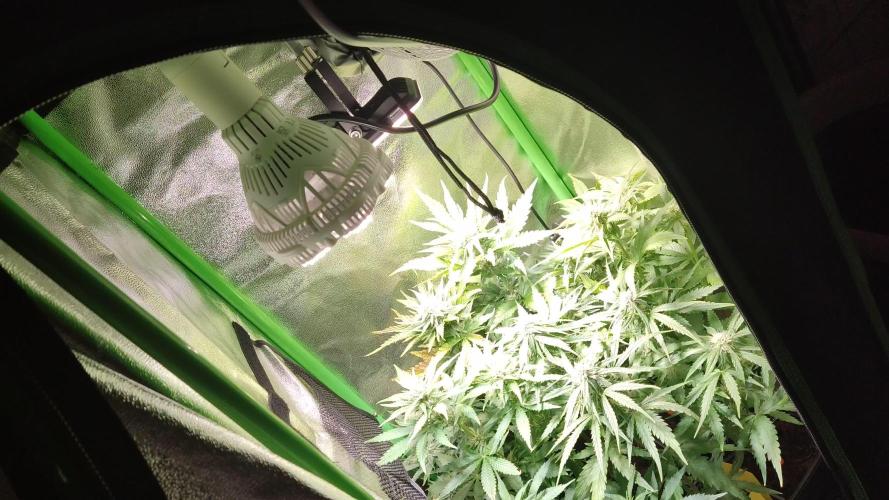
Dimmed one light to the half, they begin to smell lightly.
10.09.
Moved the Spiderfarmer Dehumidifer into the room, lowering the humidity from 80% down to 52%.
Likes
4
Share

@DogDoctorOfficial
Follow
🥒 Project Blue Tent – Week 8
Pickle Lemon Haze F1 – Pheno B (Folder 14B)
Hello everyone, and welcome back to another chapter of Project Blue Tent! 💙🌱
If you're discovering this diary for the first time, welcome aboard!
Project Blue Tent follows four individual plants from seed all the way through harvest, with each phenotype receiving her own dedicated diary.
All four sisters share the same tent, lighting, irrigation, nutrition, environmental conditions and overall training strategy.
The idea is simple:
Keep the variables as consistent as possible and let the genetics tell the story.
And this week...
The story is getting very interesting.
Because all four girls have entered flowering with absolutely no intention of slowing down.
Today we're giving the spotlight to Pickle Lemon Haze F1 – Plant B.
And once again...
She's shining. 💙🌱
────────────────────────
🌸 Week Eight – Flower Has Arrived
The Blue Tent has officially entered the next chapter.
After seven full weeks of vegetation, we're now running 12/12, and the response from the plants has been immediate.
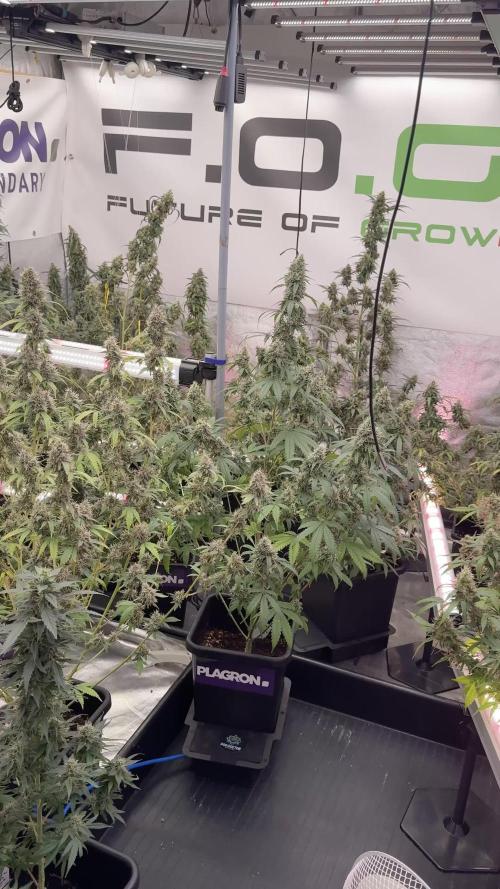
Plant B is now sitting around 81 cm, compared with approximately 60 cm when we finished the vegetative phase.
That's a serious amount of growth in a very short period.
And what's particularly impressive is that the plants aren't simply stretching upward.
They're developing everywhere.
The branches are extending.
New growth is appearing rapidly.
Flowering sites are becoming more obvious every day.
And the first real signs of bud development are now beautifully visible throughout Plant B's structure.
This is the point where all those weeks of preparation start becoming meaningful.
The SCROG gave us the structure.
The defoliation opened the canopy.
The training created the framework.
And now...
Flowering is filling that framework.
────────────────────────
🌿 Pickle Lemon Haze F1 – Plant B
Plant B continues to be one of those girls that makes me stop and look twice.
Her foliage is lush, vibrant and beautifully green, and the overall health of the plant is exactly where I want it to be.
The developing flowers are progressing quickly, with fresh pistils and new growth appearing throughout the canopy.
And despite the speed at which she's developing, she's still maintaining a remarkably even structure.
That's something I really appreciate about this phenotype.
She has always been a cooperative plant.
She responds well to training.
She builds strong lateral growth.
And even now, with flowering underway and the stretch accelerating, she's still giving us a canopy that is relatively easy to manage.
At least...
As easy as four extremely vigorous plants can be. 😂
────────────────────────
💥 Super Cropping – Keeping the Canopy Under Control
The biggest challenge right now isn't getting these girls to grow.
They've already made that part very clear.
The challenge is managing how quickly they're growing.
We're continuing to use super cropping on selected branches as another tool for managing the most vigorous vertical growth.
The idea is to reduce the dominance of certain shoots, redistribute growth and encourage stronger branching points as the plants continue developing.
And these girls are making me work for it.
I'll carefully work a branch down...
Come back later...
And somehow it's already standing back up again.
😂🌱
They're determined.
But that's actually what makes this stage so interesting.
We're not trying to stop their natural growth.
We're trying to work with it.
The canopy is already very even, and we're simply making small interventions where necessary to keep the most aggressive growth from getting too far ahead.
Whether we'll successfully keep everybody compact throughout the stretch?
Well...
Let's see.
They certainly haven't read that part of the plan.
────────────────────────
🌸 Bud Formation – Things Are Moving Quickly
One of the most exciting changes this week is the speed of flower development.
We're only at the beginning of flowering, yet Plant B is already showing beautiful formation throughout the canopy.
The sites we've spent weeks creating and positioning are now beginning to transform.
Pistils are appearing.
Clusters are becoming more defined.
And every day there's another little sign that tells me:
We're properly in flower now.
This is one of those moments where you can finally see the purpose behind all the earlier work.
The individual branches aren't just branches anymore.
They're becoming future flowers.
And Plant B has plenty of them.
────────────────────────
🌱 Seven Weeks of Vegetation – Was It Too Much?
Looking at Plant B now, I'm still wondering whether I gave these girls too much vegetative time.
Seven weeks of vegetation is considerably longer than I normally run.
Usually, I'd flip earlier.
But the extra time gave us something valuable:
A very established canopy.
Strong branches.
A developed root system.
And a structure capable of supporting a lot of flowering growth.
The downside is becoming very obvious now.
These plants have an incredible amount of momentum.
They grew from roughly 60 cm to around 81 cm incredibly quickly, and they're still moving.
So there is definitely a little bit of:
"What have I created?" 😂
happening in the grow room right now.
But worrying about it isn't going to make the plants grow slower.
We've prepared them.
We've trained them.
We've opened the canopy.
We're managing the stretch.
Now we watch.
And we see where these girls want to take us.
────────────────────────
💡 Strong Light From the Beginning
The transition into flowering also means we're starting with approximately 800 PPFD across the canopy.
I want these girls to have strong light available from the beginning of flower rather than slowly creeping toward higher intensity.
They're already extremely vigorous, so the idea is to give them the photons they need while closely observing how the canopy responds.
The challenge is balancing that strong light with the environmental conditions and the very significant stretch we're already seeing.
I'm particularly interested in seeing whether the combination of strong light and continued canopy management can help keep the plants from becoming excessively elongated.
Because if there's one thing Plant B has demonstrated this week...
It's that she has absolutely no shortage of energy.
────────────────────────
🌡️ Blue Tent Environment
The room continues to run with remarkably consistent conditions across all four sisters.
This week's recorded averages were:
• 🌡️ Day Temperature: 27°C
• 🌙 Night Temperature: 27°C
• 💧 Relative Humidity: 67%
• 🥥 Substrate Temperature: 24°C
• 💦 Nutrient Solution: 19.1°C
• ⚗️ pH: 5.81
• ⚡ EC: 2.09 mS/cm
• 💨 CO₂: approximately 666 ppm
• 💡 Light Schedule: 12/12
• 💧 Irrigation: approximately 1.4 L/plant/24h
• ? Pot Size: 8 L
• 📏 Plant Height: approximately 81 cm
One thing that continues to stand out is the relatively small difference between day and night temperatures.
We're sitting around 27°C for both.
That can contribute to continued stretching, and considering how quickly these girls are already growing, it's something I'm keeping firmly in mind.
But for now, Plant B is responding beautifully.
Healthy foliage.
Strong development.
Rapid flower formation.
And no obvious signs that she's unhappy with her environment.
────────────────────────
🥥 Feeding – Supporting the Transition
The flowering nutrition is now established.
Current feeding:
• Plagron Hydro A — 2 ml/L
• Plagron Hydro B — 2 ml/L
• Plagron Hydro Roots — 1 ml/L
• Plagron Power Buds — 1 ml/L
• pH Plus — 0.03 ml/L
• pH Min — 0.03 ml/L
Current EC:
2.09 mS/cm
pH:
5.81
The plants are consuming aggressively and developing extremely quickly, so the nutritional strategy is now supporting that transition without making unnecessary changes simply for the sake of changing something.
Plant B's colour is exactly what I want to see.
That beautiful, lush green foliage is telling me that she's handling the current program very well.
And when I look at the flowering sites developing throughout the canopy...
I'm certainly not seeing a plant asking me to interfere.
So for now:
We stay consistent.
Observe.
Measure.
Adjust only when necessary.
────────────────────────
💧 The Drip & Drainage System – One Continuous Loop
The automatic irrigation and drainage setup has become one of my favourite parts of this project.
Plant B is now receiving approximately 1.4 litres of nutrient solution every 24 hours through the drip irrigation system.
The process is beautifully simple.
The drippers deliver the nutrient solution directly to the coco.
The solution passes through the substrate and feeds the root zone.
The resulting runoff drains into the collection trays underneath the grow bags.
From there, the drainage pipe carries the water toward the pump.
The pump removes the collected runoff and returns it toward the reservoir, creating a recirculating irrigation and drainage loop.
Water goes in.
The plants use what they need.
Runoff is collected.
The pump moves it away.
And the system continues its cycle.
It's a remarkably elegant setup when everything is working properly.
And right now...
It is working wonderfully.
The plants are growing rapidly, their water demand is increasing, and the system is keeping irrigation consistent without requiring me to manually water four increasingly thirsty plants every day.
That consistency is especially valuable in a project where we're deliberately trying to keep the four sisters under comparable conditions.
It's another variable we can keep controlled while we watch the genetics express themselves.
────────────────────────
🕸️ Managing the Canopy During the Stretch
The SCROG has already done its main job.
Now we're using the structure we've created to manage flowering growth.
The canopy remains impressively even.
There are no huge dominant towers completely taking over the room.
Instead, the flowering sites are distributed across the surface we've spent weeks building.
But the stretch is happening quickly.
So we're continuing to watch the taller shoots and selectively using training and super cropping where necessary.
This isn't about constantly manipulating the plant.
It's about making small corrections before a branch becomes a major problem.
A little intervention now can be much easier than trying to fix an overly dominant branch later.
And Plant B has responded very well so far.
She's stretching...
But she's stretching into a structure.
That's exactly what I wanted.
────────────────────────
🌿 Plant B's Personality Is Still There
This is one of my favourite things about Project Blue Tent.
From above, the four sisters can look almost identical.
Same tent.
Same lights.
Same irrigation.
Same nutrients.
Same environment.
And yet...
Spend enough time with them and their personalities start becoming obvious.
Plant B remains one of the more naturally cooperative phenotypes.
She's vigorous, but her structure remains usable.
She's growing rapidly, but the canopy hasn't become chaotic.
She's producing flowering sites quickly, while maintaining that beautiful green foliage we've been watching since vegetation.
And now she's showing another characteristic:
She doesn't seem particularly interested in slowing down.
😂🌱
Which, honestly, is a pretty good problem to have.
────────────────────────
🌸 From Canopy to Flowers
There is something incredibly satisfying about looking at Plant B now and remembering what she looked like only a few weeks ago.
Back then, we were talking about:
Topping.
SCROG.
Empty squares.
Branch positioning.
Defoliation.
Canopy management.
Now we're talking about:
Flowering sites.
Pistils.
Stretch.
Bud formation.
And eventually...
Bulk.
That's the transition we've been working toward.
The plant has moved from building the machine to using the machine.
The canopy is the foundation.
Now the flowers get to take over the story.
────────────────────────
👀 Looking Ahead
The next couple of weeks should be fascinating.
All four sisters are moving incredibly quickly, and Plant B is right there with them.
We'll continue managing the canopy as needed.
We'll keep an eye on the stretch.
Super cropping will remain one of the tools available when individual branches get too ambitious.
The irrigation system will continue providing its consistent cycle.
The flowering nutrition will continue supporting development.
And the environmental conditions will remain under close observation.
Most importantly...
We don't need to panic about the speed.
Yes, they're growing fast.
Yes, I may have kept them in vegetation longer than usual.
Yes, the warm nights aren't exactly helping us keep the stretch compact.
But the plants are healthy.
The canopy is remarkably even.
The flowers are forming beautifully.
And Plant B is looking absolutely fantastic.
So...
Let's see where this goes.
🌸💙
────────────────────────
💙 Thank You
A huge thank you to Zamnesia for making Project Blue Tent possible and for giving us the opportunity to explore these Pickle Lemon Haze F1 genetics phenotype by phenotype.
A heartfelt thank you to Plagron for the Premium Growbags and Hydro nutrient line supporting these girls throughout their journey and now through the beginning of flowering.
A special thank you to Zamnesia for the Phytonaut LED lighting helping us create such a strong, even canopy and now providing the intensity we're using during the transition into flower.
And a massive thank you to Mars Hydro for the automatic drip irrigation and drainage system.
Watching the drippers, coco, runoff collection, drainage lines, pump and reservoir work together has been incredibly satisfying.
The system has become an important part of keeping the entire room consistent.
Thank you as well to GrowDiaries for providing a place where growers from around the world can document their journeys, exchange experiences and learn together.
And finally...
Thank you to everyone following Project Blue Tent. 💙
Plant B has officially entered flowering.
She's stretching.
She's building flowers.
She's producing lush, beautiful growth.
And she's making it very clear that seven weeks of vegetation gave her plenty of momentum.
😂🌱
For now, the canopy remains beautifully even.
The flowers are developing quickly.
The super cropping is helping us manage the most ambitious branches.
The irrigation system is doing its job.
The nutrition is supporting the transition.
And Plant B...
Well...
She's simply shining.
Four sisters.
One environment.
One experiment.
And four plants that somehow manage to make every week more interesting.
Let's see what the next chapter brings.
Until next week...
Growers Love, happy growing, and take care everyone! 🌱💙



Likes
28
Share


@Borberad
Follow
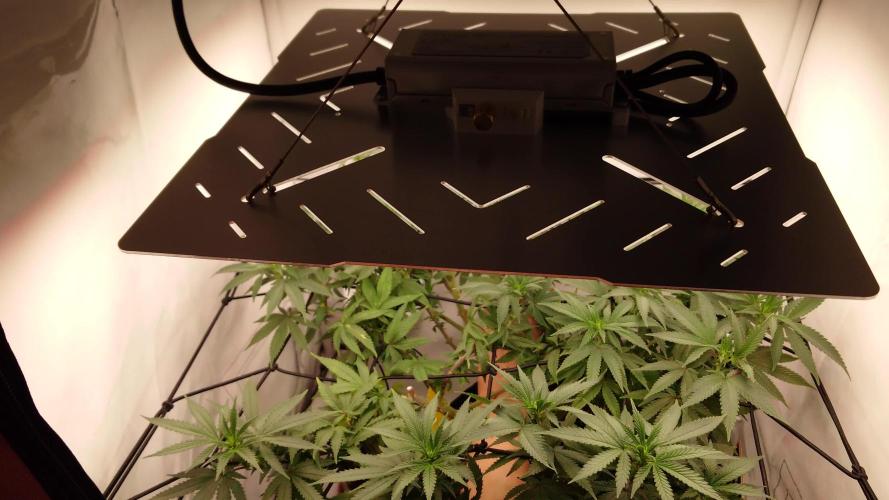
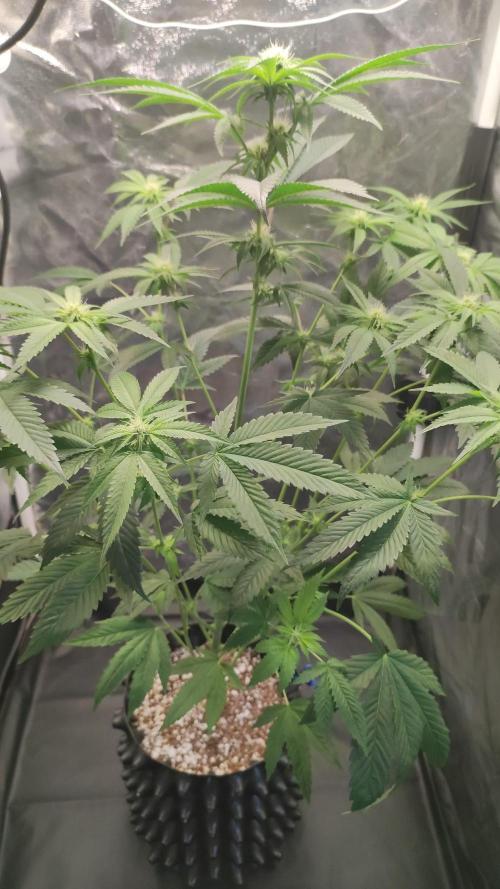
Woche drei der Blüte und alles Bestens! Aufgrund der dichten Struktur habe ich die Pflanze an Blütetag 19 großzügig ausgedünnt. Bei photoperiodischen warte ich damit bis mind. Blütetag 21. Die kleine Auto Blueberry Banana scheint aber schon recht weit, daher habe ich hier keine Bedenken. Seit Mitte der Woche scheinen die Blattspitzen etwas Überdüngung anzuzeigen. Der Drain mit Osmosewasser bei ph 6,4 und 20 microSiemens hat ph6,7 und 800microSiemens. Setze die Stickstoffgabe etwas herab indem ich Hesi Blüte reduziere und pk13/14 ergänzend zuführe. Erhöhe somit gleichzeitig Phosphor und Kalium.

Likes
9
Share


@traxxx
Follow
this week 20 gallons of ro water armor si
50ml
cal-mag
60ml
hydrogaurd 40ml
flora micro 100ml
flora gro
100ml
flora bloom 100ml
transition week
low stress training

Likes
2
Share

@gr3g4l
Follow
Semana de lavado, regando cada dos días solo con agua de ósmosis inversa.
Esta semana continuaron mostrando un cambio de color más acelerado.
At 59 days they already showed a high percentage of amber trichomes, more than enough to harvest before 60 days.
A simple, uncomplicated grow, the plants are truly rewarding, not so much for the quantity of trichomes as for their growth, yield, and aroma—an aroma that suggests it will be delicious, possibly earthy, sweet, perhaps pine, or who knows, maybe even a hint of citrus, lemon. Something along those lines. What I can say for sure is that it smells terrible; it wouldn't be recommended for grows that want to go unnoticed.
After 61 days, harvest and dry inside the closet.


Likes
36
Share


@Salokin
Follow
Hi Growmies,
My apologies for the delayed update, but work life balance got a bit out of wack recently. Anyways, water was changed on time and general maintenance took place. Continued with very light defoliation to really guarantee that all the shoots get equal light exposure. She is turning out to be a real beauty and literally no Scr.O.G was necessary due to her natural structure. Buds are already forming very compact and dense to touch, something that’s always a good sign ;) Since this is my first proper DWC grow I am actually quite impressed by the root growth and the resulting nutrient uptake, as well as vigor in plant growth.
Is it btw just me or is this website getting slower, buggier and laggier by the day? Videos won’t upload, weeks don’t reflect, diaries won’t update….


Likes
7
Share


@Coughy
Follow
Res change today. All the goodies. Gonna top everything, maybe LST this week.
Likes
38
Share


@GODSGIFT_2005_JM
Follow
For LIQUIDS & NUTES ******GREEN BUZZ NUTRIENTS***** organic.
Also i’m using their LIVING SOIL CULTURE in powder form!
MARSHYDRO ⛺️ has large openings on the sides which is useful for mid section groom room work. 🤩
☀️ MARSHYDRO FC 3000 LED 300W
💨MARSHYDRO 6” in-line EXTRACTOR with speed-variation knob, comes complete with ducting and carbon filter.
Likes
5
Share


@Ieiogrow94
Follow
Eccoci di nuovo qui!!!
Super eccitato per questa nuova collab con Exotic Seed, team davvero al top, che mi ha dato l’opportunità di testare questa nuova genetica e di condividere i progressi con tutti voi!!!
Come sempre partiamo nei bicchieri per poi travasare.. Questa volta verrà svolto tutto sotto la Lumatek Zeus 465 ProC, mi aspetto molto da questo ciclo!!
WOOOOW!!
Grazie a tutti per il supporto ❤️🍀🔥

Likes
2
Share


@High_Grade_Dadli
Follow
#1 is fully on her way to make life great can't complain no problem so far....just did a lil LST so she have more room to do her thing..
#2 problem has been solve to an extent..just have to watch her and see what up
Likes
2
Share


@Ultraviolet_
Follow
The main purpose of chlorophyll is to capture photons of energy. When growth is no longer a priority for a plant in nature, it will naturally sink its "no longer needed" nitrogen and switch pigments to carotene and anthocyanin, which are better-suited pigments for environmental protection rather than capturing photons (growth). This is because of all nutrients used by a plant, nitrogen in its nitrate form is highly stable and required for the rigours of electron capture, ammoniacal nitrogen readily evaporates into the air during cure/dry. The ripening stage is no longer about growth, but the main priority is protecting trichomes and opening up the oxidative capacity of the plant so it can focus 100% of filling those trichomes. Nitrogen in its elemental nitrate form is no longer required during ripening to the same degree as it was; the vast majority of growth is over. Understanding when to shift a plant's focus from rapid growth to maturation is the key to maximizing the trichome quality and terpene profile of the final product. That is the single most important decision you will make during a grow in terms of dictating smoothness, taste, and smell, I have found from my limited years of dedicated and driven study into the matter.
Synthetic nutrients maintain a near full nitrate ratio comparable to ammoniacal nitrogen, whereas organic nutrients maintain a supply of ammoniacal and convert only to nitrate what is needed. This is far more beneficial for organic growers when it comes to smoke smoothness, as the higher levels of ammoniacal nitrogen are far easier to dispose/convert than nitrates come harvest, cure/dry with far more efficient margins held within leaf/bud when it comes to conversion to aminos. A good dry and cure can go a long way to a quality smooth smoke, but without a proper senescence sequence or triggered autophagic sink of nitrogen, then you will be asking far more than can be expected from a dry/cure. It's one thing to sink the last 5-10% and convert the last drips to amino acids during the dry and cure, but leaving the plant fully charged with nitrogen in the form of nitrate is simply not going to taste good, no matter how much smoke you blow up your own ass or how long you have been growing. Means nothing. Smoke quality relies on pre-harvest physiology, not just the dry and cure! The dry and cure cannot fix poor pre-harvest metabolic states. A high-quality, smooth smoke requires correct signalling before harvest. While a proper dry and cure can gently soften the edges and convert the last 5-10% of sugars into amino acids, it fundamentally cannot perform magic on a fully fertilised plant. You cannot oxidise stable nitrates (+5 charge) into a smoother state during drying. Ultimately, accept it's going to be a heavy smoke and be grateful, onwards upwards!
The way in which ammoniacal nitrogen reacts to carbon sugars is critical in how it acts during oxidation and is responsible for oxidizing leftover sugars that can make the buds smoke harshly. Limited ammoniacal equals limited oxidation of excess carbons held within tissues. Just so you know, it's not an anecdotal rule that's unresolved and unsubstantiated. It's called the Maillard reaction. Signal triggers and stressors. Normally, you can only use 10-30% ammoniacal nitrogen, but as harvest closes, it is beneficial to increase this ratio 50% of ammoniacal as it assists in steering the plant towards maturation. Rather than running 50% ammoniacal nitrogen continuously until harvest, use it in short, targeted flushes/additions (e.g., 7 days) to slow internode elongation and hasten maturity. Use alongside forced larger "dry backs" (allowing the root zone to dry out significantly between watering events). Raising the Electrical Conductivity EC of the medium to create mild osmotic stress. Widening the day-to-night temperature difference and increasing the vapour pressure deficit VPD.
How would you like your cola's sir? Arm length, please, no gaps with trichomes as thick as snow.