


Likes
Comments
Share


@Mr_Maes
Follow
this is by far the tallest Auto i have ever had. Next time i will use a smaller pot or grow it in its own tent because she is HUGE. Im excited to see how the buds start stacking.

Likes
4
Share


@CannaIGrow
Follow
Plant is growing well. Transplanted them from a 1 gallon pot into a 3 gallon pot this week.
Likes
11
Share


Processing
Likes
84
Share


@Hempire
Follow
Im doing a bit of defoliation, moreover the leaves that covering the buds, i cut some small branches on the bot of the plants, to keep energy for the distal parts of the branches.
Every 2 day approximately, to no stress a lot the plants, I pinch the apex of MD1, MD2 and BB1, that my secondary branches go up, until the height of the apex central.
Nutriments :
2,0 mL/L of rhizotonic, 2,5 mL/L of cannazym every watering.
2,0 mL/L of terra vega every 2 or 3 watering in case of they need (N) until the final of the strecht (first 2 weeks of bloom).
I will put 5L every watering (pots of 18L) and I will analysed the drain of every plants to check pH and the fertilizer amount.
Im really proud of theses plants, they are strong, resistant (the trunks are huuuge, moreover the Moby dick from Dinafem) and so healthy !! The MD 3 has reacted really really good with the topping ! Im impressed and quite sure do topping next time ;)
I hope they will give me the best of themselves !!!! Lets wait the final of the strecht 😉


Likes
9
Share


@Tobecobe
Follow
04/09 - Started minor defoliation. Shes getting too bushy and blocking bud sites and causing moisture spots. Will remove a couple of leaves every other day for the next week.
05/09 - Full res change. Realised I mucked up the ratio. Went 35ml Micro, 25ml grow, (Shouldve been the other way around, so added an extra 10ml grow), 15ml Bloom and 15ml Silica. EC 1.4, PH 5.7. Will keep an eye on her and add some additional grow if she does alright.
06/09 - Minor defoliation. Removed about 12 leaves total so far. LST to spread the canopy a little more. PH stable at 5.8, EC at 1.4, Water level dropping. Seems to be stretching and pistils have begun to form! Responding well to the uptick in nutes from the res change.
07/09 - Leaf tucking, LST and took a leaf or two. Shes getting her stretch on for sure. PH stable at 5.8, EC stable at 1.4. Water level still dropping.
09/09 - After much deliberation, I ended up going for a fairly heavy defoliation session and am now going to leave her the hell alone until at least mid flower. I removed a large chunk of shaded leaves and bud sites and effectively ended up lollipopping her. I also removed all the old LST, and added a couple to pull leaves out of the way. The canopy remains largely unchanged, but shes much more airy now, and Im seeing far fewer damp spots where leaf perspiration has occured. Now to see if I can keep my hands off for a few weeks!
Likes
50
Share


@TheCannaProphet
Follow
The Grow:
This was an outdoor grow, although I started the Wedding Cheesecake FF (Fast-Flowering) indoors in early spring as the weather was still too cold to put her outside (nighttime temp's were dipping regularly into the 30's℉).
The plan was simple... let her grow inside under a 19/5 light schedule until the nighttime temperatures stay above the mid 40's℉, at which point she was moved outside and transplanted into the soil which I had already setup with slow release dry amendments and inoculated with beneficial microbes, followed up with top dressings every 3-4 weeks with amendments and worm castings! She was a thirst and hungry girl and grew and enormous trunk as well as having a root system that was expansive! The Wedding Cheesecake FF grew for a total of 182 days from breaking ground to harvest, with 55 days of it in flower.

Likes
Comments
Share

@DogDoctorOfficial
Follow
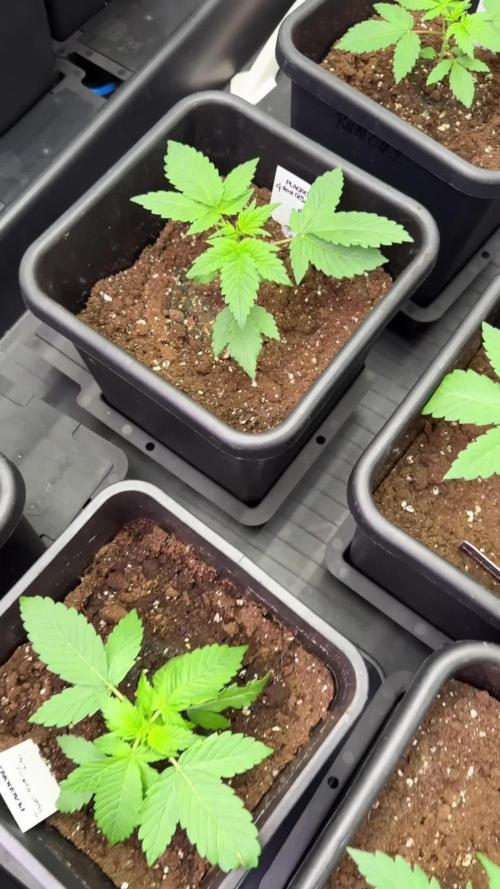
🌱 Folder 10B | Guava Auto
Week 2 – The Elegant Sister Begins to Stretch
Welcome back to another week of the 8×8 Adventure, where every phenotype receives its own individual diary, allowing us to appreciate the subtle differences that make each plant unique.
Meet Frosted Guava Auto 10B.
Although she shares exactly the same genetics, growing medium, feeding schedule and environmental conditions as her sister, she has already chosen her own path.
Where Plant A remained exceptionally compact, Plant B immediately showed a little more ambition toward vertical growth.
Not excessive.
Not uncontrolled.
Simply a slightly more open architecture that gives her a graceful appearance while still maintaining excellent structural balance.
This is exactly why pheno hunting is so rewarding.
Even sisters have their own personalities.
⸻
🌿 Growing Conditions
Every plant in this project grows under identical controlled conditions, allowing the genetics—not environmental differences—to shape each phenotype.
Environmental Conditions
* 🌡️ Day Temperature: 27°C
* 🌙 Night Temperature: 25°C
* 💧 Relative Humidity: 55%
* 🌱 Root Zone Temperature: 21°C
* 💦 Nutrient Solution Temperature: 20°C
* ⚡ EC: 1.3
* pH: 6.0
* 💨 CO₂: 666 ppm
* 💡 Light Schedule: 12/12 From Seed
* ? Pot Size: 15 Litres
The consistency inside the grow room continues to provide an ideal environment for comparing every individual phenotype fairly throughout the entire project.
⸻
🌿 Feeding Program
Throughout the week Guava Auto 10B continued receiving the complete Plagron Terra feeding schedule.
Weekly Feeding
* Terra Grow — 1.8 ml/L
* Power Roots — 1 ml/L
* Pure Zym — 1 ml/L
* Sugar Royal — 1 ml/L
* pH Plus — when required
* Lemon Kick — when required
The goal remains to encourage strong root development while supporting healthy vegetative growth before flowering begins to accelerate.
Healthy roots today become heavy flowers tomorrow.
⸻
🌱 Plant Development
Watching these two sisters side by side has been one of the highlights of this week.
From the first few days after transplant it became obvious that Plant B was expressing a different growth pattern.
Her internodal spacing is just a little wider.
The central stem continues extending steadily while producing beautifully symmetrical branches from every node.
She still remains compact compared with many autoflowers, but there is a noticeable elegance to her overall structure.
Rather than forming one dense cluster of leaves, she naturally creates a slightly more open canopy that allows light to penetrate deeper into the plant.
The result is a structure that feels balanced, relaxed and incredibly healthy.
Every photograph taken this week reflects that quiet confidence.
⸻
🌿 Training Progress
As with her sister, this week focused on gentle canopy management rather than aggressive manipulation.
Leaf tucking became part of the daily routine, exposing developing secondary branches and improving airflow throughout the centre of the plant.
A small amount of low-stress training encouraged the side branches to begin catching up with the main stem while preserving the plant’s naturally elegant architecture.
One thing quickly became apparent.
This phenotype almost seems to cooperate with the training.
She opens naturally.
She responds quickly.
She seems eager to build multiple flowering sites without needing much encouragement.
Sometimes a plant simply tells you how she wants to grow.
The best growers know when to listen.
⸻
📸 Behind This Week’s Photos
The photographs beautifully capture the difference between the two Guava sisters.
Early in the week, the camera highlights a strong central leader with perfectly healthy new growth and vibrant colour.
As the days pass, the overhead images reveal a wonderfully symmetrical arrangement of fan leaves, creating an almost star-shaped canopy.
The close-up macro shots show vigorous new shoots emerging confidently from each node, while the side profile demonstrates her slightly taller, more graceful posture compared with Plant A.
She isn’t trying to become oversized.
She’s simply expressing a little more vertical elegance while maintaining excellent balance.
The camera tells that story perfectly.
⸻
🌱 Looking Ahead
Next week should become particularly interesting.
With every new node, Plant B is creating more opportunities for lateral branching while continuing her gentle upward growth.
As low-stress training progresses, I expect those side branches to begin forming a beautifully even canopy capable of supporting numerous flowering sites.
Her slightly longer internodes may ultimately provide excellent light penetration during flower, reducing congestion while still maintaining impressive bud density.
She may not look identical to her sister.
But that’s exactly what makes her special.
Two sisters.
Two personalities.
One incredible genetic line.
⸻
💚 Thank You
Thank you for joining me for another chapter of this incredible journey.
Every week reminds me that growing isn’t about creating identical plants—it’s about discovering the unique personality hidden inside every single seed.
A heartfelt thank you to GrowDiaries for giving growers around the world a place to document, learn, inspire and celebrate this incredible hobby together.
A huge thank you to Plagron for providing the complete Terra nutrient line that continues to support this project with remarkable consistency from seed to harvest.
To the breeders whose dedication makes these genetic expressions possible—thank you for years of passion and hard work. Every phenotype tells its own story, and it’s a privilege to watch those stories unfold.
Finally, thank you to everyone following along.
The growers who share advice.
The newcomers asking their first questions.
The supporters who never miss an update.
The skeptics who keep us thinking.
The silent readers.
The friends made along the way.
Every one of you adds something valuable to this adventure.
The 8×8 Adventure continues…
One phenotype.
One lesson.
One discovery at a time.
Growers Love 🌱💚

Likes
98
Share


@CBD_Sweden
Follow
The growing cycle itself worked out as expected, except that the pH-level was way off from where it should be, and I found out a bit too late. Because of this the outcome of the harvest didn't say much about the potential of this strain, but as soon as I got enough time and space, she will get a new chance to shine.000

Likes
9
Share


@Franco123
Follow
this week the plant has grown well I'm being struck by the compactness of the plant which is very close between one internode and another I hope it continues like this and stays nice and compact, or started using the water produced by the dehumidifier which is basic ph 6.4/6.6 and an ec between 0.3 and 0.5 and however not with chlorine or other added things as it is water recovered from the air and allows me an error regime with a higher ec because it is based on a lower ec than the tap water which I used to use after decanting with this I hope I don't have problems but we'll see for now and ok, rating for the performance held this week and a nice 10 ahaha
unfortunately for me it's a male I'm right but I don't despair I'll use it to mix it with my don diablo and try to make it stay more compact between one internode and the other, since she has a very compact growth while easing a male.
Likes
13
Share


@goeser
Follow
Doing a bit of defoliation thats it
Giving all the plants more clear water because i overfeed them. Next time definitely with scrog . Good genetics love it
Likes
6
Share


@NLHydroponics
Follow
Not much has changed other than size. I have her locked down in a ring to direct even growth. She will stay in the pattern for another week or so before I'll release the branches and move her to the 4x4 flowering tent. I'd like to note that I have also removed the first 2 nodes on every branch on the entire plant. And cleaned up all growth for the first 5 nodes from the main stalk. As well as any branch that is facing down.

Likes
20
Share


@The_Bearded_Grower
Follow
welcome to 📅 day 86 5/31/2021 harvest went great and now its all drying I will update in 3 days till then Happy Growing and keep your stick on the ice 🏒

Likes
4
Share


@Ferenc
Follow
Week 10: 20/4 light schedule, 150 mp water per plant 2x, no fertilization anymore. Day 65: Next week Tueasday/beggining week 11/ we need to harvest because they will come from the council to check the house😂 Well, the previous one finished in 69 days, but I think they won't be properly ready by next week. I tried it and made me high anyways. I would give at least 2 weeks more to be done. Tomorrow I will check the trichomes with magnifying glass. They are beautiful stinky girls. Flowers are getting thicker and pistils are getting brownish. Day 66: I checked the trichomes with magnifying glass and it will be ready by next Tuesday. 7 days left with this day. They are beautiful just check in the video (Day 66).
Day 67: It is crazy the last 3 days was so hot here in London. Today was 38 degrees!!!!!! Poor plants even with ventilation it goes up to 30-31 degrees. Well, it is alright because direct ventilation goes on so they won't be cooked. 😓😛 Day 70: It is the last day when they receive water and they just get once and half of the daily intake. 2 days before harvest I will not water them. Harvest day is on Tuesday 30th of July when they are 72 days old. I have checked the trichomes all good they are matured nicely cloudy so now it is very strong. They are very stinky girls 😋 Day 71: No more water for them..... Tomorrow is harvest day!!!!!😋

Likes
17
Share


@EGPharouh
Follow
The harvest wasn't the biggest. But high quality. I will increase the light density by adding CFL to the grow room. And test the nest grow how much I can push the yeild.

Likes
1
Share


@Mr_Motalovah
Follow
Hello Growers and Tokers!
Welcome to another run where I'll be testing something from a local breeder.
The cultivar is Orange Apricot x Mimosa from Mallorca Breeders.
This cultivar is a treat, I've had the delight of smoking this grown from the actual breeder.
If it comes out anything like that I'll be more than happy.
Frosty buds, very oily, very tasty, very hard, very nice, very everything! It was a 10/10 smoke
Let's hope we have a 10/10 grow to have some 10/10 nugs.
Strain description from breeder:
Genetic Background: Orange Apricot x Mimosa
Type: Feminized
Sativa 50% Indica 50%
THC:
CBD:
Yield Indoor : gr/m2
Height Indoor: 0 - 0 cm
Flowering time: 8 - 9 weeks ( 55 - 60 days)
Aroma:
Effect:
Expectations and training method:
I know these genetics are a bit delicate so I’ll be taking things very easy.
The breeder suggests waiting until the fan leaves come out to decide the training technique.
If the fan leaves are thinner then it’s leaning more towards Orange Apricot and will be a bit more sativa and has more ramifications so most likely LST. Thicker fan leaves would be leaning towards Indica which is what I actually want, the Mimosa side. Breeder recommends topping this Pheno to increase yields. Let’s hope they’re Mimosa leaning..
As for the yields I’m not expecting more than 40 grams per plant but always shooting for more.
I’ve already smoked this strain grown by the breeder and other local breeders, which is what made me want to grow it myself. I expect nothing but trichomes and terps from these ladies.
Equipment used in this cycle:
Tent: Dutch Masters 120x240x220cm
Lights:
1 x Mars Hydro TSW2000
1 x Mars Hydro FC3000
Ventilation:
Garden HighPro - ProFan TT Extractor Fan - 150mm
Garden Highpro - ProActiv Carbon Filter - 150mm
Garden Highpro - ProFan Oscilating Clip Fans - 25cm
Blauburg - Inline Fan - 125mm
Humidifier:
Garden Highpro - Humipro Digital Humidifier - 4 liters
Pots: Garden Highpro 11L Fabric pots
Medium: Biobizz Light Mix
Nutrients:
Grotek - Mycrorizo
Plagron- Alga grow, Alga Bloom, green sensation and royal sugar.
PH down
Calmag
Measuring instruments:
Hygrometer/Thermometer - Govee:
EC Meter - HM Digital: COM-80S Hydrotester
PH Meter - Vanguard Hydroponics
Happy Growing! 😃


Processing
Likes
4
Share


@DoItBigGrows
Follow
Made some major upgrades to the environment. Moved the girls into a Vivosun 4x4 Tent and certainly not looking back. Loving it so much. Also grabbed a Spiderfarmer LED SF1000 or the rest of veg and by the time flower hits we shall have 2 Spiderfarmers ;) also did an extra topping on both! Not gonna undermine this grow one bit.

Likes
18
Share


@Herroqitti
Follow
Looking good, smelling sweet. I’ve been having the urge to ask people to smell my fingers because it honestly smells THAT good 😂 some of the trichomes have a little amber but she’s no where near done. I want her to bulk up some more. I was hoping the flower fuel would assist with that.

Likes
4
Share


@matias_scrog
Follow
TODO VA GENIAL, MUCHISIMA RESINA Y OLOR EN ESTA ETAPA. HE NOTADO QUE ALGUNAS HOJITAS SE ESTAN QUEMANDO EN LAS PUNTAS Y DOBLANDOSE HACIA ARRIBA, SUPONGO QUE FUE DEMASIADA COMIDA. DE TODOS MODOS ES MINIMO, NADA DE QUE PREOCUPARSE POR EL MOMENTO, VOY A HACER DOS RIEGOS CON AGUA Y LUEGO VOLVEMOS A FERTILIZAR!

Processing
Likes
30
Share


@DrewbieDoobieNoobie
Follow
Well these seeds are a bit unstable I think. 4 of the 6 were Hermie, so I don't know if it was the exotic light shedule or if this strain needs more work?
anyway I got 2 that are all girl and I think I'm gonna pull the last Hermie and work the 2. on a brighter note o got 110 gallons of free water. thank you mother nature see the video. gonna keep on keeping on with the last 2 hate to lose the yield of 4 plants but it is what it is. 😭

Processing
Likes
6
Share


@metlotter
Follow
Switching nutrients to "Mid Bloom" ratios as of Sunday (I've been starting and ending my weeks on Thursday, so this is like a half week of early, half week of mid).