




Likes
67
Share


@GanjaReaper
Follow
Day 10:
The plants and the leafs grew a bit in size, they are still focusing on rooting.
Added some veg nutrients today to the feeding schedule, because I saw some green spots,
not to confuse with full green leafs, which is normal with new leafs and young plants or in later stage a (n)itrogen deficiency.
No this indicates that they need just a little bit nutrients.
Normaly this would not be the case with normal soil(it has nutrients in it for the first weeks), but again it can happen with cocos as a soil.
The leafs on the pictures are like that because the lights are off + the humidifier makes the leafs wet which results in it getting heavy😝.
Will update again this week,
Enjoy for now 🙏

Likes
7
Share


@Naujas
Follow
The girl is growing perfectly :) I think next week, I will have to cut her :) inside is a real forest :D

Likes
15
Share


@FishTankGrow
Follow
Day 32 - Heater was blowing directly on a couple of the leaves that turned brown. Cut them off. Raised lights up again. I think my development is a little slower than others but I have had a lot of trial and error.
Day 33 - added tomato rack for LST. growing nicely.
Day 34 - Stopped nutes as I was getting a little leaf burn in lower leaves. Looks good otherwise. Lights are dialed in.
Day 35.- This is what too much light looks like.
Day 37 - Switched to the grow light. Moved the heater. Growing nicely.
Day 38 - Lights dialed in REDUCED water. Stopped watering for 2 days.
Day 39 - Full Lights on now. Put more holes in the pot. Draining nicely now.

Likes
11
Share


@Bluemels
Follow
Tag 53: Ab heute beginnt die Blüte bei der Chocolate Haze. Obwohl ich sie vor 2 Tagen nochmals entlaubt habe, ist die Pflanze schon wieder enorm gewachsen 😳
Ich hoffe ich kriege sie in der Blüte gebändigt 😬

Likes
5
Share


@Capzinator
Follow
I want to start LST on Day 23. I will just bend her down and tie the leaves to the side.
Every Strain is doing really good, im watering them all 3 days adding the nutritions above. But i also see some strains that didnt like the overwatering at the start. And i burned my strawberry gorilla a bit with waterdrops on the leaves. but she seems to be unimpressed by that. Today i also noticed a very little smell when i opened my tent. im curious which one is making this scent, it was really sweet.
i raised the light intensity from 70% to 85%, leavin the rest for bloom.
Day 24: i watered them yesterday with about half a litre of water. i included lacalva stress treatment before making the LST. i kind of feeling like im a bit too late, but we will see.
Day 26: we had a blackout, because a constructionworker hitted the main cable. 2,5 hours less light, im so glad that these are automatics!
Day 27: Damn guys, i think i did bad on this LST stuff. all of them are really bushy and very strong showing upward. in my first grow, i never had these issues. but all of the stems are so huge. they are close to be bigger than the final stem of my first grow. i think i need to defoliate them soon. i removed the wire and let them do what they want, until they get to know the net.

Likes
4
Share


@Shivashamboom1
Follow
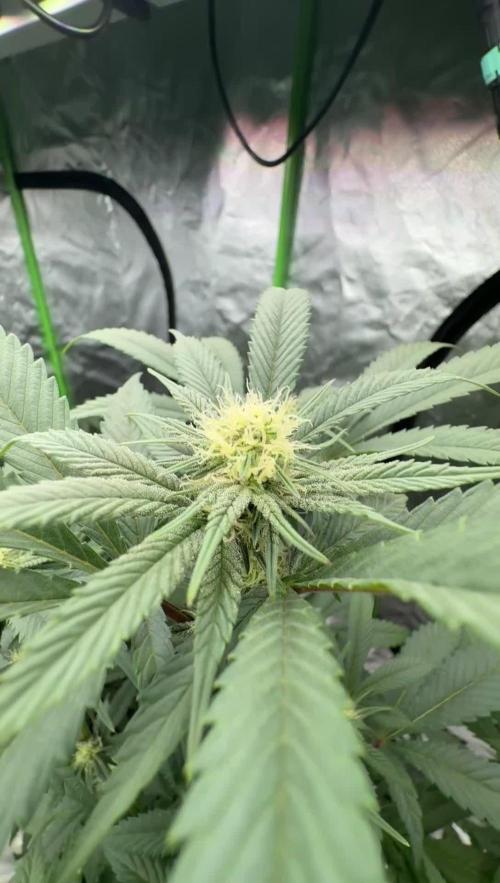
questa creamzilla cresce Super bene robusta spero che anche i fiori vengano Super grandi 😂😉




Likes
30
Share


@Roberts
Follow
Runtz is doing better now that I got her feed and irrigation better. I did her first lst today. She is set to go for another week. Thank you Medic Grow, Plagron, and Zamnesia seeds. 🤜🏻🤛🏻🌱🌱🌱
Thank you grow diaries community for the 👇likes👇, follows, comments, and subscriptions on my YouTube channel👇.
❄️🌱🍻 Happy Growing 🌱🌱🌱
https://youtube.com/channel/UCAhN7yRzWLpcaRHhMIQ7X4g.
Likes
3
Share


@StickyFingah420
Follow
Semana 9 y estimo que la próxima será la de cosecha, ojalá en el día 75 o algo así. Ya veo los tricomas lechosos y en menor cantidad ámbar, por lo que estimo esa fecha para el corte puesto que luego de cosechada la planta sigue madurando debido al proceso de secado/curado, huele muy bien y luce genial // Week 9 and I estimate that the next will be the harvest, hopefully on day 75 or something like that. I already see the milky trichomes and in less amber, so I estimate that date for the cut since after harvesting the plant continues to mature due to the drying / curing process, it smells very good and looks great
Likes
2
Share

@DaedalusGrow
Follow
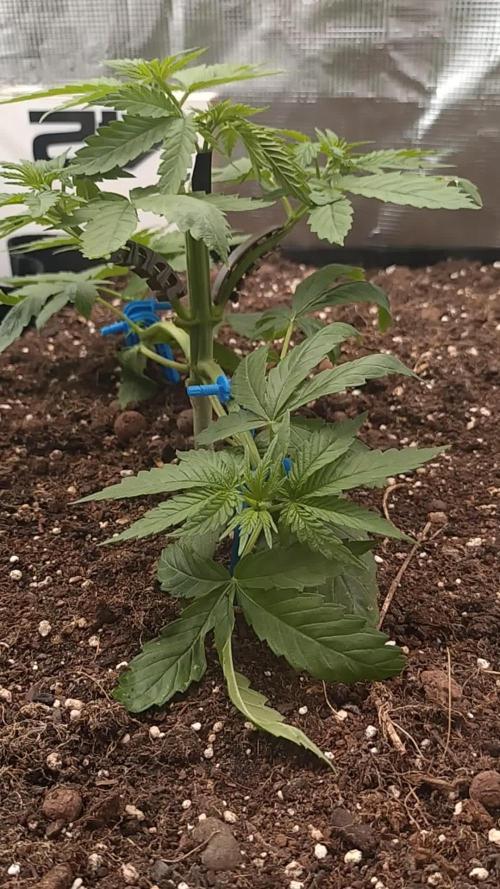
Schon schön Gewachsen die kleine!
Habe heute das Topping gemacht, mal sehen wir sich alles entwickelt 🌱✌️Etwas Topping+Training.


Likes
7
Share


@Mokorelsare1
Follow
Soo yeah 50g dry from this tortured plant not bad at all, it may seems nothing but, 2-3 hits and you're out of this world😃 if you want something strong, sweet sour flawor and sweet smoke then go for this plant you're gonna love it😁
Likes
19
Share


@eldruida_lamota
Follow
Vamos familia primera semana de floración de estás apollo black cherry de SeedStockers.
Que ganas tengo de ver el progreso de esta variedad, las plantas están sanas, se ven con buen color.
La cantidad de agua cada 48h entre riegos.
Esta semana añadimos nutrientes de la gama Agrobeta.
Ya puedo confirmar que elimine la plaga de tripa con aceite de nene jabón potásico e insecticida para ácaros.
Las plantas están bastante bien ya llevan una semana en 12 horas de luz 12 oscuridad.
Estas próximas semanas veremos como avanzan.
Mars hydro:
Code discount: EL420
https://www.mars-hydro.com/
Agrobeta:
https://www.agrobeta.com/agrobetatiendaonline/36-abonos-canamo
Hasta aquí todo, Buenos humos 💨💨.


Likes
17
Share


@PottingShed
Follow
Day 33 and she's looking great, getting bushy.
Day 31 and 8" tall. she's sprouted a little overnight. fed with biogrow today app 400ml
Likes
12
Share


@Cannabizoid_X
Follow
Natural gardening can be tough but is well worth it in the end y'all, keeping steady and everybody stay safe and take care of each other


Likes
3
Share

@ThreeLittleHerbs
Follow
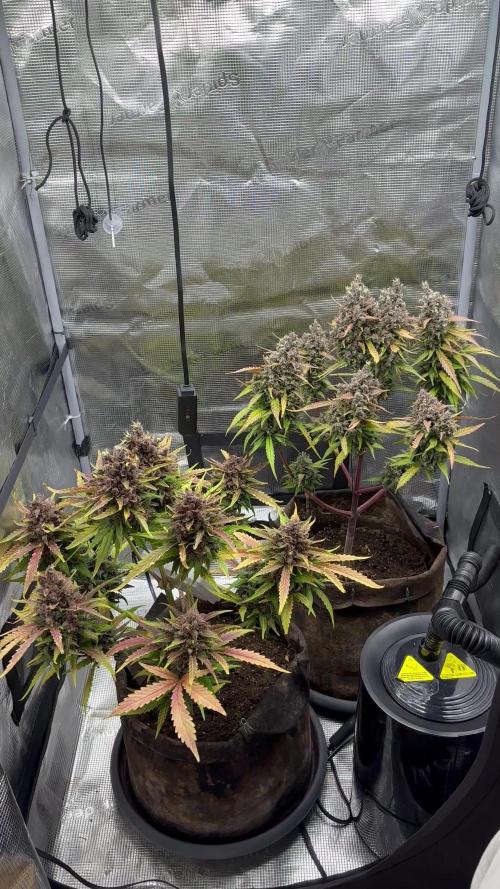
After 12 weeks -in week 13 you can see that nice autumn look on both plants. Buds are filling out, getting more frosty and smelly. Finally i got two very beautiful Ladys again 😍😍😎
Especially the white labeled Tropicana, where i had no idea how it supposed to look etc. makes me happy. She has a very colorfull look right now, with the leaves turning into the same purple like the buds already have.
The Strawberry Gorilla has a similiar look and smell to the one i grew a year ago: Buds are mint-green with some pink shiny parts and neon Green/yellow hairs on it - overall it almost gets a light blue color-effect.👽
I Think i have to wait for another week, check Trichomes again and see if it is ready for harvest.
Likes
5
Share


@Mo_Powers
Follow
the weather is just wonderful at the moment. i'm happy to be growing it so early in the year. it's branching out like crazy and the first flower buds are already appearing. let's see how much higher it will go. once again, i'm totally convinced by the FAST BUDS genetics.
Likes
56
Share


@Ultraviolet
Follow
What's in the soil? What's not in the soil would be an easier question to answer. 16-18 DLI @ the minute. +++ as she grows.
Probably not recommended, but to get to where it needs to be, I need to start now.
Vegetative @1400ppm 0.8–1.2 kPa 80–86°F (26.7–30°C) 65–75%, LST Day 10, Fim'd Day 11
CEC (Cation Exchange Capacity):
This is a measure of a soil's ability to hold and exchange positively charged nutrients, like calcium, magnesium, and potassium. Soils with high CEC (more clay and organic matter) have more negative charges that attract and hold these essential nutrients, preventing them from leaching away.
Biochar is highly efficient at increasing cation exchange capacity (CEC) compared to many other amendments. Biochar's high CEC potential stems from its negatively charged functional groups, and studies show it can increase CEC by over 90%. Amendments like compost also increase CEC but are often more prone to rapid biodegradation, which can make biochar's effect more long-lasting. biochar acts as a long-lasting Cation Exchange Capacity (CEC) enhancer because its porous, carbon-rich structure provides sites for nutrients to bind to, effectively improving nutrient retention in soil without relying on the short-term benefits of fresh organic matter like compost or manure. Biochar's stability means these benefits last much longer than those from traditional organic amendments, making it a sustainable way to improve soil fertility, water retention, and structure over time. Needs to be charged first, similar to Coco, or it will immobilize cations, but at a much higher ratio.
a high cation exchange capacity (CEC) results in a high buffer protection, meaning the soil can better resist changes in pH and nutrient availability. This is because a high CEC soil has more negatively charged sites to hold onto essential positively charged nutrients, like calcium and magnesium, and to buffer against acid ions, such as hydrogen.
EC (Electrical Conductivity):
This measures the amount of soluble salts in the soil. High EC levels indicate a high concentration of dissolved salts and can be a sign of potential salinity issues that can harm plants.
The stored cations associated with a medium's cation exchange capacity (CEC) do not directly contribute to a real-time electrical conductivity (EC) reading. A real-time EC measurement reflects only the concentration of free, dissolved salt ions in the water solution within the medium.
98% of a plants nutrients comes directly from the water solution.
2% come directly from soil particles.
CEC is a mediums storage capacity for cations. These stored cations do not contribute to a mediums EC directly.
Electrical Conductivity (EC) does not measure salt ions adsorbed (stored) onto a Cation Exchange Capacity (CEC) site, as EC measures the conductivity of ions in solution within a soil or water sample, not those held on soil particles.
A medium releases stored cations to water by ion exchange, where a new, more desirable ion from the water solution temporarily displaces the stored cation from the medium's surface, a process also seen in plants absorbing nutrients via mass flow. For example, in water softeners, sodium ions are released from resin beads to bond with the medium's surface, displacing calcium and magnesium ions which then enter the water. This same principle applies when plants take up nutrients from the soil solution: the cations are released from the soil particles into the water in response to a concentration equilibrium, and then moved to the root surface via mass flow.
An example of ion exchange within the context of Cation Exchange Capacity (CEC) is a soil particle with a negative charge attracting and holding positively charged nutrient ions, like potassium (K+) or calcium (Ca2+), and then exchanging them for other positive ions present in the soil solution. For instance, a negatively charged clay particle in soil can hold a K+ ion and later release it to a plant's roots when a different cation, such as calcium (Ca2+), is abundant and replaces the potassium. This process of holding and swapping positively charged ions is fundamental to soil fertility, as it provides plants with essential nutrients.
Negative charges on soil particles: Soil particles, particularly clay and organic matter, have negatively charged surfaces due to their chemical structure.
Attraction of cations: These negative charges attract and hold positively charged ions, or cations, such as:
Potassium (K+)
Calcium (Ca2+)
Magnesium (Mg2+)
Sodium (Na+)
Ammonium (NH4+)
Plant roots excrete hydrogen ions (H+) through the action of proton pumps embedded in the root cell membranes, which use ATP (energy) to actively transport H+ ions from inside the root cell into the surrounding soil. This process lowers the pH of the soil, which helps to make certain mineral nutrients, such as iron, more available for uptake by the plant.
Mechanism of H+ Excretion
Proton Pumps: Root cells contain specialized proteins called proton pumps (H+-ATPases) in their cell membranes.
Active Transport: These proton pumps use energy from ATP to actively move H+ ions from the cytoplasm of the root cell into the soil, against their concentration gradient.
Role in pH Regulation: This active excretion of H+ is a major way plants regulate their internal cytoplasmic pH.
Nutrient Availability: The resulting decrease in soil pH makes certain essential mineral nutrients, like iron, more soluble and available for the root cells to absorb.
Ion Exchange: The H+ ions also displace positively charged mineral cations from the soil particles, making them available for uptake.
Iron Uptake: In response to iron deficiency stress, plants enhance H+ excretion and reductant release to lower the pH and convert Fe3+ to the more available form Fe2+. The altered pH can influence the activity and composition of beneficial microbes in the soil. The H+ gradient created by the proton pumps can also be used for other vital cell functions, such as ATP synthesis and the transport of other solutes. The hydrogen ions (H+) excreted during photosynthesis come from the splitting of water molecules. This splitting, called photolysis, occurs in Photosystem II to replace the electrons used in the light-dependent reactions. The released hydrogen ions are then pumped into the thylakoid lumen, creating a proton gradient that drives ATP synthesis.
Plants release hydrogen ions (H+) from their roots into the soil, a process that occurs in conjunction with nutrient uptake and photosynthesis. These H+ ions compete with mineral cations for the negatively charged sites on soil particles, a phenomenon known as cation exchange. By displacing beneficial mineral cations, the excreted H+ ions make these nutrients available for the plant to absorb, which can also lower the soil pH and indirectly affect its Cation Exchange Capacity (CEC) by altering the pool of exchangeable cations in the soil solution.
Plants use proton (H+) exudation, driven by the H+-ATPase enzyme, to release H+ ions into the soil, creating a more acidic rhizosphere, which enhances nutrient availability and influences nutrient cycling processes. This acidification mobilizes insoluble nutrients like iron (Fe) by breaking them down, while also facilitating the activity of beneficial microbes involved in the nutrient cycle. Therefore, H+ exudation is a critical plant strategy for nutrient acquisition and management, allowing plants to improve their access to essential elements from the soil.
A lack of water splitting during photosynthesis can affect iron uptake because the resulting energy imbalance disrupts the plant's ability to produce ATP and NADPH, which are crucial for overall photosynthetic energy conversion and can trigger a deficiency in iron homeostasis pathways. While photosynthesis uses hydrogen ions produced from water splitting for the Calvin cycle, not to create a hydrogen gas deficiency, the overall process is sensitive to nutrient availability, and iron is essential for chloroplast function.
In photosynthesis, water is split to provide electrons to replace those lost in Photosystem II, which is triggered by light absorption. These electrons then travel along a transport chain to generate ATP (energy currency) and NADPH (reducing power). Carbon Fixation: The generated ATP and NADPH are then used to convert carbon dioxide into carbohydrates in the Calvin cycle. Impaired water splitting (via water in or out) breaks the chain reaction of photosynthesis. This leads to an imbalance in ATP and NADPH levels, which disrupts the Calvin cycle and overall energy production in the plant. Plants require a sufficient supply of essential mineral elements like iron for photosynthesis. Iron is vital for chlorophyll formation and plays a crucial role in electron transport within the chloroplasts. The complex relationship between nutrient status and photosynthesis is evident when iron deficiency can be reverted by depleting other micronutrients like manganese. This highlights how nutrient homeostasis influences photosynthetic function. A lack of adequate energy and reducing power from photosynthesis, which is directly linked to water splitting, can trigger complex adaptive responses in the plant's iron uptake and distribution systems.
Plants possess receptors called transceptors that can directly detect specific nutrient concentrations in the soil or within the plant's tissues. These receptors trigger signaling pathways, sometimes involving calcium influx or changes in protein complex activity, that then influence nutrient uptake by the roots. Plants use this information to make long-term adjustments, such as Increasing root biomass to explore more soil for nutrients. Modifying metabolic pathways to make better use of available resources. Adjusting the rate of nutrient transport into the roots. That's why I keep a high EC. Abundance resonates Abundance.