


Likes
Comments
Share


@Moss420
Follow
Ended up flushing Mumma for about 10 days - got her ppm down real low. Night before harvest I set the timer so the light would not come back on in the morning before I harvested (I've seen people who swear by this and other who say it doesn't do anything but figured it couldn't hurt). At this point the other plants are pretty disappointing compared to Mumma so they aren't getting as much "love" lol.

Likes
16
Share


@MadeInGermany
Follow
Flowering day 7
since time change
to 12/12 h.
Hey guys :-)
The flowering started last week because otherwise the space in the small tent would end up being too narrow :-)
Cuttings were taken from each phenotype beforehand.
To change the flower, I rinsed it very lightly with clean fruits.
With the next watering she gets a mix of grow liquid and bloom liquid before she only gets bloom.
The heating mat works perfectly in the small tent and the parameters are all in the optimal range 🙏🏻👍.
Now we hope that everything stays that way and that the cold days will slowly pass :-) .
Everything was cleaned and checked.
have fun and stay healthy 🙏🏻
👇🏼👇🏼👇🏼👇🏼👇🏼👇🏼👇🏼👇🏼👇🏼👇🏼👇🏼👇🏼
You can buy this Nutrients at :
https://greenbuzzliquids.com/en/shop/
With the discount code: Made_in_Germany you get a discount of 15% on all products from an order value of 100 euros.
👇🏼👇🏼👇🏼👇🏼👇🏼👇🏼👇🏼👇🏼👇🏼👇🏼👇🏼👇🏼
You can buy this strain at :
https://www.ripperseeds.com/en/feminized/kmintz-feminized-cannabis-seeds
Water 💧 💧💧
Osmosis water mixed with normal water (24 hours stale that the chlorine evaporates) to 0.2 EC. Add Cal / Mag to 0.4 Ec Ph with Organic Ph - to 5.8 - 6.5
MadeInGermany

Likes
35
Share


@eldruida_lamota
Follow
Que hay familia, adelantamos semana de las red hot cookies, ÚLTIMA semana antes del machetazo, estoy deseando cortar estos caramelos llenos de polen, que parecen caramelos de fresa, olor Muy afrutado, cepa muy bien trabajada de sweetseeds que antes de cosechar, ya la recomendaría.
No tienen ni 60 días de floración , y a mi parecer , están bien hechas. 50% tonalidades rojas , 50% tonalidades verdes con toques rojos.
.
La humedad esta al 45% la temperatura está entre 21/27 grados , y como siempre el ph , ya que es de lo más importante,está en 5,8/6,0.
.
Nos vemos de nuevo para la COSECHA, un saludo y buenos humos fumetillas💨💨💨.

Processing
Likes
4
Share


@CarpediemOK
Follow
From 3 leads i cut due to yellow spots, grows better and trying to reach up

Likes
21
Share

@TrickzCutz
Follow
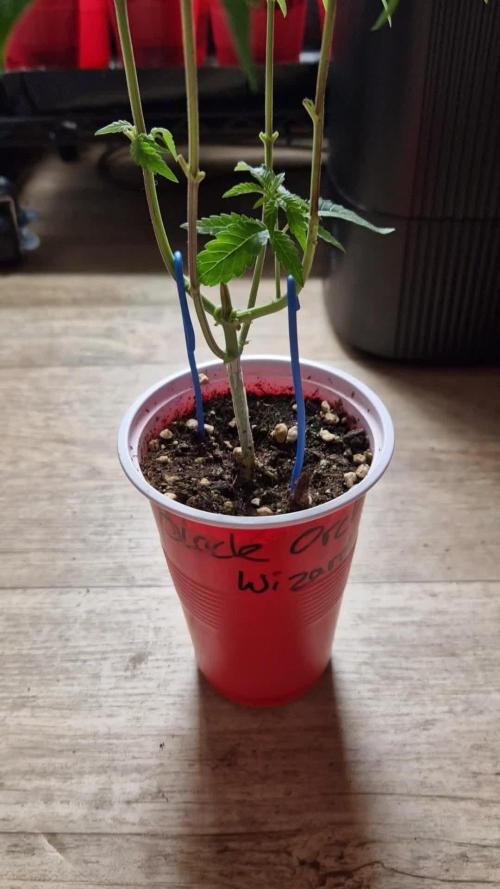
Servus Moin!
Die Black Orchard wächst auch vor sich hin und wartet auf das umtopfen.

Likes
4
Share

@DarbGrowDiaries
Follow
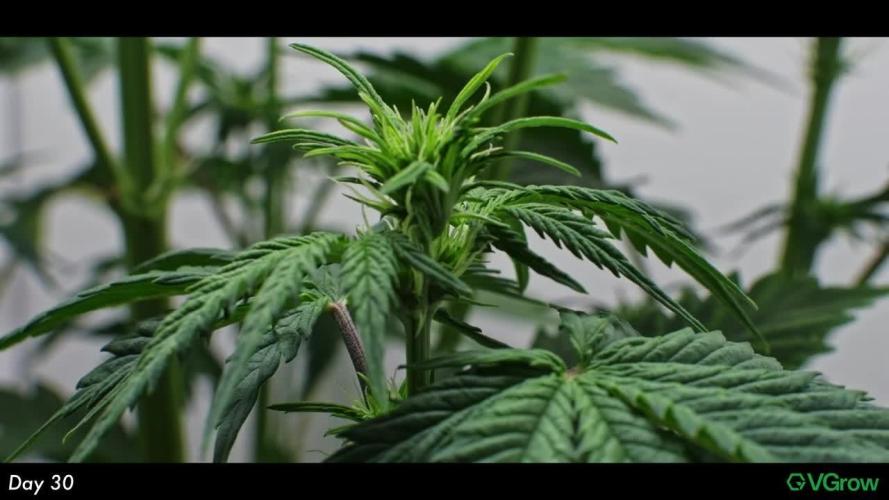
This little candy is very pretty, I think it should stay under 60 cm as it looks like it's about to end the stretch.
This is crucial as the VGrow can only handle a 70 cm plant without removing the bottom.
The irrigation for the feeding is working well, I can increase the amount if the pot feels light.
Hoping it goes ok into flower, will try to add calmag to every watering from now on.

Likes
55
Share


@Hempface86
Follow
Ladies and gentlemen we are on day 82 and this girl is no more, through the loophole I can't find one clear trichome I understand the white hairs but I also understand the trichomes is what we go by.. also wanted to get her down because I was worried of possible root issues and did not want to ruin such a beautiful little plant.. Divine seeds has some great genetics this thing was topped and in such a small cup handled the training well and rewarded me with what I'm assuming is going to be between 28 and 35 grams so I'm thinking over a gram per ounce of dirt that's not too shabby.. I hope everyone in the contest is doing well and I hope everyone else is doing just as good.. we are all in this together, to be able to grow our own medicine at our own discretion and know what we're smoking is worth its weight in gold.. again big shout out to Divine Seeds for putting together this competition I thought I would do something a little different to stand out by doing a mini pot grow I don't know if it'll get me a trophy or not but it was sure fun growing it and was very beneficial to me in my personal development as a grower.. until next time folks and a month or so I will have the smoke report.. I tried to upload today for another strain and it wasn't working so hopefully grow diaries fixes the bug of not being able to update a smoke report.. happy growing everyone ✌️😎
ladies and gentlemen after 8 days of drying I trimmed her up today and as you can see from the video 46 g or 1.625 Oz which is extremely good considering the small amount of medium... Now I know during the cure I will probably lose around 1/8 of my total weight but still I will be definitely over 40 grams my guess will be at least 42 to 43 .. now for 28 Oz of soil I could not be happier.. between the genetics being great and the plants loving my feeding remedy all has been well.. I want to thank Divine seeds for throwing such an awesome contest and giving us enough time to do it right and also for providing the seeds but not just that they really hooked it up.. Big ups to them and I have more genetics that I will be running from them in the future.. hope everyone is doing well good luck to everyone in the contest and to everyone happy growing ✌️😎
Likes
10
Share


@Bunterbiber
Follow
Everything is still running smoothly this week. We’ve got more rain and less sun right now, but honestly, it’s all working out just fine.
The little lady is looking great and seems really comfortable in her 9L pot. I checked the leaves under the microscope and couldn't spot any active pests, even though there are a few minor punctures visible here and there.
Today, I decided to do a little bit of LST (Low-Stress Training) on a few of the side shoots for the first time. Aside from that, I’m mostly just letting her grow the way she wants naturally.
Following the schedule, she also received her 10ml of PK fertilizer this week. Everything is ticking along nicely!

Likes
5
Share


@Gingercannacat
Follow
This week they grew a lot. One pheno reached 35cm and the other 30cm, that's with training. These girls will stretch a lot . I will switch them to flowering tomorrow. So far the LST only is bushier and 5cm taller but still early to to judge.

Likes
17
Share


@smoking_hills9
Follow
Great lemon strain. Grew and smoke it before, very nice smell and dence buds, weight update soon. Ok can't be happier 🤩🌴 total weight from 3 trees are 316 gr of rock solid top quality bud. Didn't weight all the bottom trim but that's another 70gr on top of that at least. So almost 400gr 🤩😶🌫️ Seedsman genetics rocks hard💚🔥
Total harvest weight of 54 trees is 5kg, of solid quality buds, around 2kg of small bottom buds

Processing
Likes
21
Share


@JuicyFruit
Follow
Day 48 - 11/11/19 started this week early by accident.
Plant smells like tropical cheese and i cant see the stalk anymore except from the leaves, very bushy and seems to be in a mid stage of flowering. buds are getting bigger by the looks of it. very sticky also!
Ive been removing about 2 leaves per day from this one, started with a couple touching the soil and removed a few higher ones today to expose the buds to more light and fresh air. when looking at this plant side on the main cola looks huge and growing more every day. im assuming this is about 2 weeks away from harvest so il probs flush next week. roll on harvest time! other than that the humidity has went up to 50-55 the odd time when watering all the plants. it doesnt stay high long with the heat from the lights so it should be fine.
Day 51 - 14/11/19
Still removing the odd couple of leaves every day to let the fresh air get near the main cola, i still cant see it very well but it looks like what a 6-7g bud looks like when its dried aha.
the smell can be described as if someone took a cheese strain and added something powerful and herbal/tropical to it.
cant wait to order my jewelers loupe in a few days to see where im really at :) and i added a video to show the plant looking all frosty. a few weeks to go now!

Likes
17
Share


@Hashy
Follow
Week 1
Light cycle=24/0
Light Power=73w 30%
Extractor controller settings
High temp= 23c
Low temp= c
Temp step=0c
High Rh= 70%
Low Rh= %
Rh step=0%
Speed max=5
Speed min=1
Smart controller settings (during lights on).
Lights on=am
Radiator on= not in use.
Radiator off= not in use.
Humidifier on= below 63%
Humidifier off= above 68%
Dehumidifier on= not in use.
Dehumidifier off= not in use.
Smart controller settings (during lights off).
Lights off=pm
Radiator on= not in use.
Radiator off= not in use.
Humidifier on= not in use.
Humidifier off= not in use.
Dehumidifier on= not in use.
Dehumidifier off= not in use.
VPD aim=0.4-0.8
DLI aim=15-18
EC aim=0.4
PH aim=6.2
Fri 22/12/23
#1 (Day 1)
📋 5.00pm Leaves open and working on its 1st set of true leaves.
💧💧💧💧💧💧💧💧💧💧💧💧💧💧💧💧
Method= manual
Neutralise=0.1ml/L
Roots=5ml/L
Feed=nutes
Volume=100ml
Easy Ph down=0 drops/L
Ec=0.36PH=6.3/6.0
Time=10.00pm
Runoff.
Total runoff=10ml
Ec=2.85 PH=5.7
💧💧💧💧💧💧💧💧💧💧💧💧💧💧💧💧
📋 Calibrated ph pens in ph 4/7 solution.
Older pen read 6.8
Newer pen read 7.1
Sat 23/12/23
#1 (Day 2)
📋 Looks ok. Root has hit the bottom of the pot.
H=5cm D=82cm DLI=15.8
Sun 24/12/23 (Christmas eve)
#1 (Day 3)
📋 Still working on its 1st set of true leaves.
Mon 25/12/23 (Christmas Day)
#1 (Day 4)
📋 Merry Christmas everyone. 10.30pm This tester looks good, 1st true set of leaves are developing fine. Started developing 2nd set of leaves.
Tue 26/12/23 (Boxing Day)
#1 (Day 5)
📋
💧💧💧💧💧💧💧💧💧💧💧💧💧💧💧💧
Method= manual
Neutralise=0.1ml/L
Roots=5ml/L
Feed=nutes
Volume=150ml
Easy Ph down=0 drops/L
Ec=0.28PH=6.2/6.2
Time=7.00pm
Runoff.
Total runoff=20ml
Ec=2.91 PH=5.6
💧💧💧💧💧💧💧💧💧💧💧💧💧💧💧💧
Wednesday 27/12/23
#1 (Day 6)
📋 She has got a massive lean on her, probably through watering yesterday.
9.30pm decided to stake her as she's nearly touching the soil.
Before changes.
H=8cm D=80cmDLI=14.8
After changes.
H=8cm D=77cm DLI=18.3
10.00pm
Light cycle=22/2
Light power was=73w=30%
Light power now=86w=36%
Lowered light by 3cm.
Extractor controller settings
High temp= 24c
Low temp= c
Temp step=0c
High Rh= 70%
Low Rh= %
Rh step=0%
Speed max=5
Speed min=1
Smart controller settings (during lights on).
Lights on= 02.00am
Radiator on= below 19c
Radiator off= above 20c
Humidifier on= below 64%
Humidifier off= above 67%
Dehumidifier on= not in use.
Dehumidifier off= not in use.
Smart controller settings (during lights off).
Lights off=00.00am
Radiator on= below 16c
Radiator off= above 18c
Humidifier on= not in use.
Humidifier off= not in use.
Dehumidifier on= not in use.
Dehumidifier off= not in use.
Thursday 28/12/23
#1 (Day 7)
📋 H=8cm D=77cm DLI=18.3
She will probably only need the support for a few more days, the lean was from over watering. So this week she has developed her single fingered true leaves and is working on the next set of 3 fingered leaves.
Conditions for the week have been good.
Back soon.
Take it easy.
Likes
4
Share

@ohcibi
Follow
Update July 24
Fungus gnats were significantly reduced by skipping watering for one and a half day longer than usual. 💪💪💪
Update July 19
Second to last week started. Those damn gnats came back although I thought I had fought them. But I’m not to worried at this point. Put a few more yellow cards up and that should maintain the number low to none.
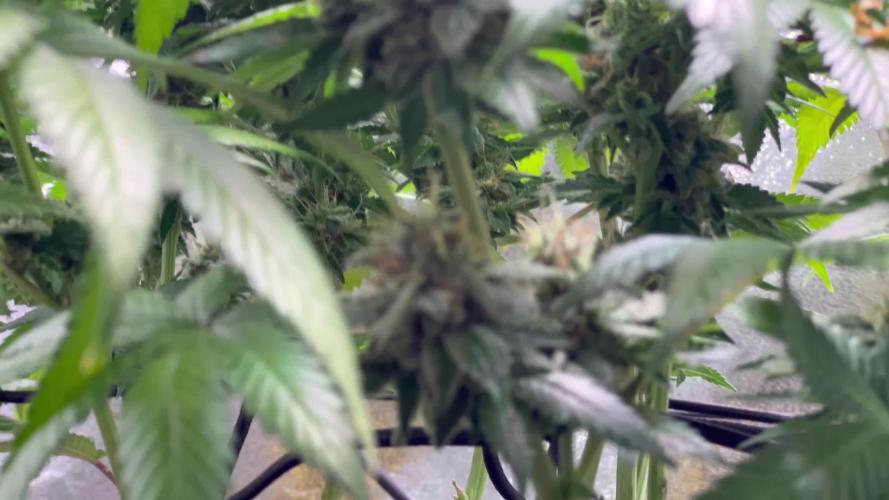
Smell is great. And it really is sticky icky. Trichome coverage and density is very strong. Those are remarkably long trichomes. I’m excited how the bubble hash from the trim will turn out.
Fingers double-u'd to not have happen anything bad in the final two weeks now.
Processing
Likes
20
Share


@BudXs
Follow
"Chugging" along this week. Weather is hot, girls are loving the all time drip system. Forgot that my nutes and hot sun dont mix well and created a bad case of algae. Will monitor more often and maybe increase the drip flow


Likes
Comments
Share


@Mnterpteam
Follow
Put on A LOT of frost this week. Fan leaves are covered to the tips, I love this pheno so far.

Likes
27
Share

@BudXs
Follow
Final painting and floor trim completed. Walls are white and bright.
I started to construct the main flood table. It is made of 2x3's and a sheet of chipboard. I fastened some rails at the perimeters and used caulking to seal all gaps. I will coat the face of the chipboard with a polyurea flat roof coating to make it completely watertight. I have 1/4 : 12 slope on it right now so that it drains to the reservoir end. I stained the sides of the table grey to match the floor trim because ambiance matters
Shelves are up to hold my nutes/test pens/genetics/nug/papers/etc...
I brought in one of the 3 HLG 550 clone qb's to test for light as I have never seen them in action. WOW!! Having one running is quite intense, I cant wait to see what all 3 going over the 4x10 area will look like (with shades on of course)
A minor adjustment is needed to the height of the A/C exhaust vent. It is currently too high by 2" and needs to be lowered. Kind of a pain in the ass, but needs to be done for the table to fit snug.
Previous total spend $2430
This weeks spend =
$50 (hardware)
$165 - killer deal on ebay for 8 inch fan/filter/ducting. open box, new
Likes
3
Share


@TizioQualsiasi
Follow
In questa settimana un colpo di vento forte ha fatto cadere il vaso e si è leggermente spezzato lo stelo alla base
Likes
178
Share


@NuggetPawn
Follow
This week things have stabilised a bit, my bigger humidifier came on D26, so hopefully that will help slow transpiration a little!
Not really much to report, plants are growing okay, one of them is still struggling a bit, they’ve all been topped for the second time. As I have one plant per 4ft sq, I think I might only mainline to 4 mains, haven’t decided yet! Have bought a Torus Hydro PH balancer, will see if that helps with the PH swings going forward 🧐
Happy growing guys!
Likes
10
Share


@Jerrza
Follow
So yeah here we in week 3 starting some LTS btw i’m growing on plagron terra grow some in not adding any nutrients yet i’m gonna use like more nutrients on my nexr grow but for the first time i took it all easy

Likes
42
Share


@GODSGIFT_2005_JM
Follow
⛺️ MARSHYDRO
💡VIPARSPECTRA
🍼GREENHOUSE FEEDING BIO GROW
🌱 WEEDSEEDEXPRESS
