




Likes
37
Share

@RakonGrow
Follow
+
data+charts online rakongrow.lima.zone/growme-mango-kush-auto-015.html
Tag 89:
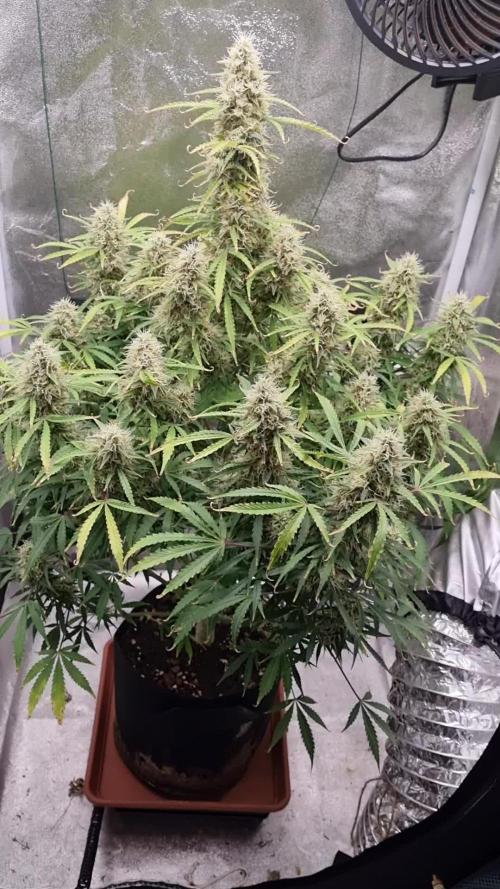
blüten werden fetter , alles altert langsam , dünger funktioniet wieder .
+

Likes
25
Share


@Grower_Of_Persia
Follow
my dry and cure style is this:
4 days of hanging upside down to get water activity lower to around 0.6 in 50% humidity and 26 C temp (i know its a little high but we are in a hot summer right now and i cant get it lower even with air conditioner) and then after 4 days of drying i remove leaves and stalks, trim buds and move them to jar for the rest of their life :D . and in the first 4 days of curing i open the jar door and let hem get some fresh air in the jar for about 5 minutes and close the jar door again, after 4 days of curing like that buds are smokable but they will get better as they getting cured about 1 month.
buds are one of the hardest as fucking rocks type of buds! very dense , compact , sticky , smelly , amazing at every aspect
growing stage was 60 days and flowering stage was 70 days total (harvested tops at day 63th)
the total weight of dry buds was : top buds 174 G + lower buds 55 G = 229 G
my overview of strain with details:
the seeds:
unfortunately i only got 1 seed cracked out of 5 so i will not know how much this genetic can get different but at least i got the chance to grow once of this wonderful strain
the plant :
in every stage you can ensure that you are dealing with a high level plant ,
she will get big so you have to control her height LST and SCROG highly recommended , will grow very well with tick stalks and big fan leaves , has good resistance for stress and will respond very well to stress trainings , she really has gorilla power in herself ,
fresh buds on plant :
buds are very compact and dense even from start , fresh blossoms smells like pineapple and mango , 2 different shades of sweet smells like you hold 2 junks of pineapple and mango in your hand and you smell them together, she is a trichome and resin factory , very very sticky , very oily , strong smell
dried buds:
very compact and dense , hard as rocks , has dark colors with purple hues inside it , it smells sweet
smoke :
very smooth and sweet like lollipop , pineapple , mango like , after 2 minutes it'll kick in and you'll get higher and higher with every breath , has a strange and especial high mind high mostly

Likes
6
Share


@masterofsmeagol
Follow
5/4 I stupidly watered everything this morning. They were pretty much perfect weight for transplant......then I watered them. Oh well. If that's the worst mistake I make I'll be ecstatic. Went back over and found my 1 gal and 2 of those wierd slanty airports that tapers and holds like a gallon and a half and washed them. I mixed up 12 gallons of soil in a garbage bag and mixed it thoroughly with my gloved hands. It's mixed good. Looking at my plants in sadness thinking, "today could've been the day" and noticed a Special Kush of average size I didn't water that weighed in the 220's. I was happy. I filled the pit arpund a cup before removing it leaving the perfect hole. Mykos and water were poured in. Plant came out of the cup REALLY easy. Suprisingly easy. This wasn't totally dry. I was amazed it came out so easy so I kinda rolled it around looking at the roots. I started lowering it in the hole and I felt something break away but it webt DIRECTLY into the hole made for it. I tucked some soil around it but it was pretty tight from packing it around the empty cup. Didn't take a picture but the plant is fine. That was an average size plant too. So I may have to give some of the strains I popped later a little longer before I transplant. After everything's been transplanted I'll need to change lighting again. I think I'll open the window and use the hps and the l.e.d on the days and nights cThat's these girls won't be hardening off. I so wanna go plant those others but my intuition tells me to wait until morning and it's been serving me well. A couple can stay in cups longer. Not much longer but still.
5/5 Transplanted everything but two this morning into 1 gals with 1/2 happy frog half ocean forest. Mykos and water used during transplant. Found put the l.e.d was on for 24hrs for a while. I made sure the timer switch was ON but it was a different cord plugged in. Oh well. All transplants went perfect. I'm picking up an adapter for the outlet so I can plug the power strip into the timer and only use one timer. I had to hang the 150watt hps back up with the 1,000 watt equivelant 105 true watts. I hope this lighting setup works. Chemdog #4 and One MK Ultra will be transplanted later today or later in the morning. I also opened the shade to the south facing window. Shits getting real.
EDÌT: I FINISHED TRANSPLANTING THE LAST TWO PLANTS AND PICKED UP THE ADAPTER SO I COULD HANG THE HPS NEXT TO THE L.E.D. THEY WERE FIBE WHILE I WAS GONE. EASIEST TRANSPLANTS EVER. THEY ALL LOOKED PERKY AND HAPPY SIX OR SEVEN HOURS POST TRANSPLANT. I OPENED THE CURTAIN TO (SOUTH FACING WINDOW) BUT I MADE SURE THE PLANTS WEREN'T IN THE DIRECT LIGHT. EVEN THOUGH IT WOULD PROBABLY BE FINE. LAST TIME I HAD SEEDLING IN DIRECT LIGHT. I'LL PLAY IT BY EAR BUT IM HAPPY.
EDIT 2. Went back over to meditate by the stream and do my qigong. It's 75 and BEAUTIFUL today. The girls will be going out for a few hours on days like this. Anyway when I went in I was surprised to see everything looking nice and happy with praying leaves. Nothing is in direct sunlight but damn that window let's in a lot of light.
5/6 Girls LOVED the transplant! They seem to be all happy. No stress. Easiest transplant I've done. Leaves are praying upwards so I think the lights are approx tje right distance. They'll be going outside soon to harden off. It's been in the 70s but it's rainy now. I'll play it by ear according to weather. I'll continue to monitor lighting and I may lower the hps.
5/7 The soil was super dry when I went over this morning. Everything looked awesome though. I used about a half gallon watering. I don't want to water to run off. I want to keep the nutes IN the soil. It's also easier to fix an undet watered plant than an over watered one. It came out to about a half gaterade bottle on the biggest and half that on the smallest. I'll gradually increase water after I monitor the response. The water sat on the soil for quit a while so they definitely needed it. Looking good so far.
5/8 Soil lookeddry this morning. I think I'm going to up the water. Last time I dod seeds I gave like a pink. Some plants still had a little dampness where I watered that I could see. Others looked dry but happy. I gave the REAL dry bigger ones a small circle around the rootball. Just in case. I'm thinking of lowering the hps slightly so it's at least level with tje L.E.D. That window being open gives tons of light. If u moved them slightly left they'd get DIRECT sun most of the time. I'll be bringing them outside soon to start hardening them off.
EDIT: WENT TO CHECK THE GIRLS AT 5 TO MAKE SURE THEY WERENT DRIED OUT. THESE GIRLS ARENT JUST GETTING BIGGER BY THE DAY THEYRE LOOKING BIGGER FROM MORNING TO NIGHT! ITS BEEN RAINING LIKE CRAZY BUT WE WILL HAVE GREAT WEATHER NEXT WEEK AND I'LL BE BRINGING THEM OUTSIDE. I'M SUPER HAPPY WITH GROWTH SO FAR. ILL PROBABLY HST (TOP/FIM) AT THE NEXT NODE. I WANT THEM TO SETTLE IN NICELY BEFORE STRESSING THEM.
5/9 I may have stupidly uploaded doubles of pictures from today. Soil LOOKED real dry. I gave the plants their first real watering. I still went light. Almost a gallon with all plants. I know many say I should be watering to runoff but I want to keep the nutes in the soul as long as I can I don't want to overwater. I always start out careful. Once they show they xan tolerate it I'll increase water next time. This weekend it will be raining but after that we are getting some real good weather and I'll he taking the girls out to begin hardening off. I also need to take a look and top/FIM the plants now that they are settled. Also need to wash grow bags and sanitize outside.
5/10 It's pouring out. Horrible night and morning but this is about cannabis. After the watering ALL the plants shot up in size! Substantially. Leaves are over the sides of containers. I think I'm somewhere close with the watering schedule. I may bring the hps light down a little. I also NEED to start HST. I need to FIM and/or top these girls. Unfortunately I've been dealing with medical problems of my wife so I haven't got to it. If I get some sleep I may do something this morning or in the afternoon.


Likes
2
Share


@Vincentsta7
Follow
Nearly 2 weeks from 12/12. Some of the plants are having a good Stretcheing
Likes
1
Share

@Dendegrow
Follow
🌈 Mental Rainbow (Sweet Seeds) – Week 7 | Flowering Day 1 🌸
Here we go – the bloom begins! 🚀 Yesterday I flipped her, so today is officially Day 1 of flowering. She’s thriving in my own homemade Living Soil, and the root structure is crazy thanks to my custom booster 🌱.
The smell is already phenomenal – sweet, intense and super fresh 🌿💨. Today I removed a few leaves 🍃✂️ to let the light penetrate deeper into the canopy. She also got just a light dose of Greenhouse Feeding Bloom – nothing heavy, since the Living Soil is already full of life ✨.
This lady looks ready for a colorful journey – follow along to see how bright this rainbow will shine 🌈🔥.
---
🌈 Mental Rainbow (Sweet Seeds) – Woche 7 | Blütetag 1 🌸
Jetzt geht’s los – die Blüte startet! 🚀 Gestern umgestellt, heute offiziell Tag 1. Sie wächst in meiner selbstgemachten Living Soil Erde und hat durch meinen eigenen Booster eine extrem starke Wurzelstruktur entwickelt 🌱.
Der Geruch ist schon jetzt phänomenal – süß, intensiv und richtig frisch 🌿💨. Heute habe ich ein paar Blätter entfernt 🍃✂️, damit das Licht besser nach unten kommt. Dazu gab’s eine kleine Portion Greenhouse Feeding Bloom – nur ganz leicht, da die Living Soil schon genug Power hat ✨.
Das wird ein richtig bunter Run – bleibt dran und schaut zu, wie dieses Rainbow in voller Pracht erstrahlt 🌈🔥.

Likes
42
Share


@Ganjagrandaddy
Follow
DAY 21 FLOWERING: Howdy folks. Here we are on day 21 flowering for these willing and healthy Zamnesia ladies. They took no time at all to relish back up again following their defol earlier in the week. I took a fair bit of leaf matter out and also did a little popcorn stripping too. Now it looks as if I never did anything at all. This used to be my dilemma with the debate surrounding defoliation, however , the size and shape of the leaves that were removed, would have been huge and needed a lot of space and airflow to remain healthy alone , never mind flourishing in flower !. Removing those leaves has not stunted the flowering process or halted the stretch period either. The smaller helpers have now become the bigger powerhouses and filled the plants frame with big green spectrum grabbers. I am going to remove some more leaf to allow more airflow and light to get around the multiple bud sites that litter the canopy from every angle but have been shaded and tucked away behind leaves. Getting light on to the stem is a goal too . If light gets there , so can fresh air !.
They have all grown a lot this week and containing them is going to be fun as the get buds fattening too. I am considering putting my new light in for a little wider coverage now as I think they will need it possibly. I have a viparspectra p4000 getting Ansy in its box and it wants to get involved.lol
The Girl scouts are thriving with so much growth on the #2 that she doesnt know which site to focus on so it going for them all. She has a lot of potential bid sites. #1 is a more natural growth pattern with lots of secondaries wanting g main status.
The Amnesia haze had a good strip out to get that huge bushy appearance change , they have all cone back with a vengeance and will be stripped again a little now. The signs of calmag def are still around but I am trying to avoid having to add it in in flowering this run to see how much difference it makes with the feeds I am using. So far no issues with feeding at all and they are only showing a slight tip burn from the
strength probably. I am still pulling them lateral each room visit to encourage them to find their own growing space that works for them and so far so good and they are playing ball. They are drinking all of their feed very quickly now so i will have to up the feed times now I think . I am feeding every 3 days with approx 3L each pot . seeing how the 1# Girl scout looked , I think every other day now . Let's see what the next week brings. Be happy growmies.
Likes
5
Share


@PortkeyCannabis
Follow
Well she just keeps surprising me I thought she was close but she just keeps getting bigger and thicker and stinkier so he’ll yeah. She is getting some beastie blooms nothing else at this point.
Likes
29
Share


@Smokwiri
Follow
Welcome to my Runtz gum diary by Original sensible seeds
Almost finished, i think a week or two.
Waiting for the fruits to mature...
Viparspectra discount:
Amazon: http://url-9.cn/0y9i
Amazon US: https://amzn.to/3e0P2bk
Amazon CA: https://amzn.to/3bTnEJC
Amazon discount Code:
it10smokwiri XS1000 10%
XSsmokwiri XS1500 8%
it20smokwiri XS2000 5%
it40smokwiri XS4000 5%
Music is with authors permission. All rights reserved

Likes
28
Share


@JiggleBudz
Follow
Day 50 - The entire tent is now filled up. Humidity is slightly higher than ideal but she looks happy. Moved the fan a bit higher to get more top canopy air circulation.
Day 51 - Keep on growin'
Day 52 - Pot was pretty light and dried out this morning after a couple of windy warm days in my area. Watered the usual 2L with run off of 170ml (9%).
After gaining 3.5cm per day over the last 3 days, she was getting a bit too close to the light. - I moved the light up with 13cm today to be 30cm above the top most flower.
Day 53 - Run off today was only 150ml(7.5%). I did some bottom defoliation removing small flower branches and leaves coming to the end of life. This cleared up some of the bottom for better watering access and definitely better airflow.
Day 54 - Humidity in my area has dropped a bit leaving the room around 47% and inside the tent around 52%. Still a bit high but with her being so big in the 2x2 I pretty much have to keep the tent open at all times.
Installed a second fan today to increase ventilation and try lower humidity. I've got one blowing over the top canopy and one circles around off the walls.
Day 55 - Had both fans running overnight, seems to have gone ok. I have each fan pointed at a wall now this seems to make for the best all over ventilation without too much direct blow on the plant.
Day 56 - That's the end of Week 7! The flower stretch this week has been pretty crazy. After raising the light she's exploded in height. Run off was 120ml (6%) today - this might be because of the double fans drying her out a bit more but also her size of course needing more water.
Likes
13
Share

@Suemchen
Follow
🌱 Glue Prom – Harvest Day 128
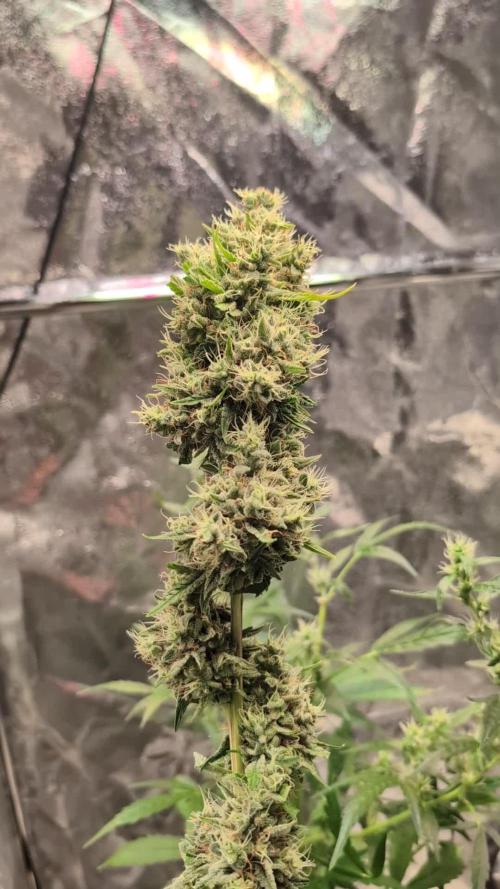
Harvested on Day 128!
What a beautiful plant! Glue Prom turned out to be a really impressive girl with huge, incredibly compact buds and a fantastic overall structure.
The smell is insanely good – strong, complex and exactly what I was hoping for. 🤤🔥
Very happy with how she finished and definitely looking forward to seeing how she performs after drying and curing.
Now comes the waiting game… 😎🌿
Likes
7
Share


@MrEarlyBird
Follow
Really healthy leaves, however salt buildup starting to become evident on the roots, been giving occasional flushes with tap water that still has chlorine, and 40ml of h202 then the next day giving the next weeks bucket with 6mL of hydrogaurd and 3/4tsp of Great White (Every bucket) Have to change bucket every 2-3 days, at 3 days it’s damn near empty.

Likes
11
Share


@YehGreen420
Follow
Excelente planta não deu mais rendimento por minha culpa mas é algo que estamos sempre aprender

Sour Jealousy Auto · Fast Buds
Pound Cake Auto · Fast Buds
Papaya Cookies Auto · Fast Buds
Orange Sherbet Auto · Fast Buds
Amnesia Haze Auto · Fast Buds
Wedding Cheesecake Auto · Fast Buds
Moby Dick Auto · Fast Buds
Gorilla Cookies Auto · Fast Buds
Lemon AK Auto · Fast Buds

Auto Pineapple Glue · Advanced Seeds


Likes
24
Share


@JUNGLE_B4RNS
Follow
Week 3 of flowering, last week for the Veg nutrients, will switch to bloom nutrients next week.
All the legs under the trellis has been cleaned up.
Getting septic on 2 of the GSC, buds development is too slow and abnormal... compared to the one who’s doing her thing normally... will see later on.
Buds development under the Mars-Hydro SP250 is really amazing, I’m always impressed !
Stay tuned folks 😉
(I’m looking for a job in the Cannabis industry as Master Grower, Mineralogist, Quality Control)

Likes
91
Share


@MrCOCO
Follow
The girls grew up again and are already 110 cm tall. I don't see any problems ... I did supercroping and they are fine too ... We keep going ...🍃🍃🍃
Likes
6
Share


@Young_agronomist
Follow
23.09.23- 85 день жизни .
Глобальных изменений не происходит , шишки продолжают толстеть и оплакать глаз . Это самое большое растение из тех , которые мне доводилось растить !
На данном этапе ее рост около 180-185.
Сегодня я подвязал и распределил все толстые ветки под лампы , из-за своих размеров они прогибаются под своим весом .
Теперь она получает все 300 w
28.09.23- 90 дней от прорастания !
Изменения идут медленно , цветы растут а листья желтеют . Думаю еще 2 недели и финишь !
Сейчас она очень огромная , а ее цветы размером с бутылку ✨🍁


Likes
54
Share


@BudXs
Follow
"Chugging" along this week. Weather is hot, girls are loving the all time drip system. Forgot that my nutes and hot sun dont mix well and created a bad case of algae. Will monitor more often and maybe increase the drip flow

Likes
8
Share


@sweetkaya
Follow
Everything's doing great, the ladies are healthy and growing faster and faster!