Likes
Comments
Share
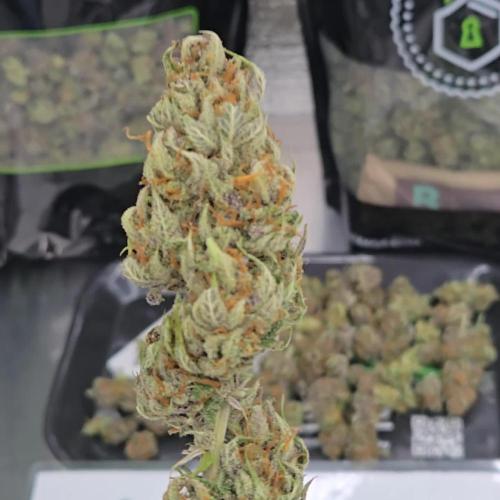
stretch is going well! buds are starting to get fruity! Calyxes are already getting typical LA Confidential look
Likes
Comments
Share
@agrippa
Follow
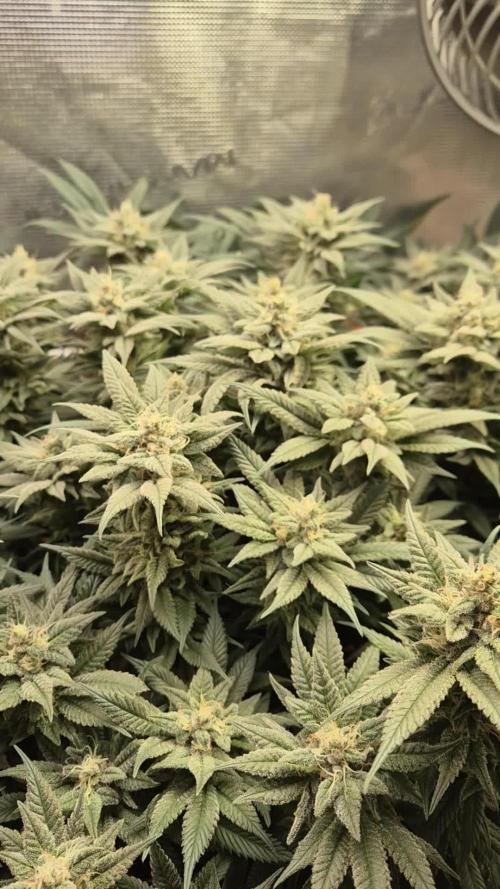
Started getting rather bushy very quickly. Those big green fan leaves at the bottom were touching the soil, so I pruned them off to get some more node growth going.
Likes
2
Share
@Ninjabuds
Follow
Man, that Skunk Apple runtz plant is giving me some trouble. It's still really small and hasn't grown much at all. I think I might've messed up a little because the leaves are looking kinda rough. Hopefully it can bounce back. Well, it's Christmas again. This year feels a little different, though. Maybe it's the snow blanketing everything, or the way the tree lights up the whole living room. Either way, it's cozy and warm, even when it's freezing outside. I'm really looking forward to seeing what Santa brings. I hope I get that new video game I've been wanting. But most of all, I can't wait to spend time with my family. We always have so much fun This past week was a good one for the plants. They started the first week of their stretch, and they've already grown a decent amount. I can really see them filling out. It's cool to watch them grow so fast. I can't wait to see how big they get by the end I always get a little worried at this stage, like they're not gonna get as big as I want them to. But then I remember how they always end up surprising me. By the end, they're always perfect.
Likes
9
Share
Soddisfatto del mio lavoro? SI ASSOLUTAMENTE SI . Questa è la mia prima esperienza nel campo della coltivazione della cannabis e sono veramente contento del risultato, ma non devo cantare vittoria troppo presto adesso manca la seccatura e la concia speriamo bene ahahah 🤣
Likes
13
Share
@GrowGuy97
Follow
Everything is going great, just waiting on flower tent to finish & these ladies will be going straight into flower😍✌️🏼🌱 Day 40 first day of flower, everything seems to be going ok so far! Day 41 Can see they are starting to stretch!😍
Likes
16
Share
This plant is exactly what you would expect from it gets orange and yellow all around when fading smells just crazy of 🍊 got some good sized buds all around it this plant just reeeeks it’s so gassy but straight orange super strong can smell the orange before even getting close very sticky but not to frosty on sugar leafs at all had some nice calyx development was always a happy plant even when under fed fully organic 444 and 284 Gaia green Had tons of calaxs when I trimmed it up it was kinda crazy thick buds all dense and smell sooo good very sticky plant would definitely recommend this as a orange smelling bud always needed more calmag on this one
Likes
4
Share
@Hommero75
Follow
The 2nd week was great for the plants. Specially Banana Purple Punch and Forbidden Runtz They stretched and grow without no problem. I'm excited for week 3. I LST them, I did some defoliation and they got fed with Goldleaf feterlizer and I added mycos chum and cal-mag to the mix. Let see how they do.
Likes
10
Share
Hi liebe Community and Welcome Back! 🌿💚 🖍️Permanent Marker von Seed Junky Genetics x Doja Exklusiv! Wir befinden uns in Wachstumswoche 9 seit dem Eintopfen (Tag 54 + Tag 7 Blüte). Die erste Blütewoche ist nun vorbei. Die Pflanze geht auch ordentlich in den Stretch und hat in dieser Woche nochmal 17cm zugelegt Die Pflanze hat einen wundervoll geschwungenen Wuchs. Sie ist schön Breit und dennoch kompakt. Ihre Höhe schätze ich als Moderrat ein. Die Pflanze legt insgesamt eine top Performance hin. Bildet allerdings viel Blattwerk aus, daher habe ich nochmal ordentlich defoliert und die unteren Triebe Rausgeschnitten. Auch habe ich nun die oberen Triebe nochmal etwas runtergebunden um eine bessere Homogenität hinein zu bekommen. Gegrowt wird wie immer rein Organisch, daher kam nun für die Blüte 10ml PK - Booster von Bio Tabs NL hinzu. Die Bedingungen sind aktuell gut! ————— 🌞 Temp: 26 🌚 Temp: 18°C bis 19°C 💨 RH: 68% VPD: 0,7 kPa 💡ppfd: 630 mpm ————— Grüne Grüße 💚🌱
Likes
12
Share
day 14 added 1/2tbsp magnesium sulfate in 5gal water along with regular flower water amendments. 1gal of water per day average, bridal and thunder can take more water. Ph 6.8 today day 15 I will defoliate in a few days :) day 15 video, you see some stem action day 16 video day 17 I added (4x20w daisy-chained)80w of poop purple ancient leds Keep adding soluble PK, organic booster etc. I see the stacks relax on defoliation for a few days, maybe tomorrow morning (skip day21) I feel like I will be able to chop week 6-7 as my last grow, push hard fast-continue everything is great, soon bridal and thunder will require 1gal water per day. I would like to see even more mass. I'm extremely happy, starting to see frost day18. BIG UPDATE many short vids of final defoliation(ahead of "day 21"). Wild amendments appeared! Any recommendations for a lawnmower? Bridalparty stretched over an inch overnight, led touch diode burn on 1 spot. Raised lights slightly, Added new amendments into water. Bridal wants to drink more than 1gal per day, So I will be using almost 5gal-ish water per day not denying the plant needs-watering. I am very happy! defoliation took about 4h today.
Likes
2
Share
WEEK 4 SETUP - ROOT ZONES Optimizing cannabis performance requires balancing a strict temperature gradient between a cool root zone (68°F–72°F) to maximize dissolved oxygen and active nutrient transport, and a warm canopy (77°F–95°F) to accelerate photosynthetic enzyme activity and electron transport rates. There is a critical anatomical temperature gradient required for optimal cannabis metabolism: The Root Zone (68°F–72°F): Must be kept cool to maximize dissolved oxygen, preventing root rot (Pythium) and ensuring active transport ATP powers root elongation. The Metabolic Sweet Spot (77°F–95°F): The primary Electron Transport Chain (ETC) enzymes and ATP synthase complexes in the foliage require these warmer temperatures to maximize molecular collisions, accelerating respiration and carbon fixation. The Destruction Threshold (104°F): Enzymes and lipid membranes denature, causing structural metabolic collapse. Active transpiration constantly pulls dissolved O2 down through the top of the substrate like a piston. At night, the top-down pump completely stops. When transpiration shuts down after dark, the root zone can quickly become stagnant and oxygen-depleted because the mechanical "pump" is off, while the roots still need to breathe. Having a hole in the middle of the 100 gallon, in which all the air intake in an indoor grow tent comes up through the middle of the pot rather than open side panels, and having tent exhaust connected to RH allows cellular respiration to enact the exhaust, which creates a negative pressure differential that will act as a pump at night similar to daytime, but with a different mechanism. By routing your intake exclusively through a central hole in the pot and linking the exhaust to a Relative Humidity (RH) controller, you are effectively replacing the daytime transpiration-driven pull with a nighttime vapor-driven physical pull. Because the side intake vents are sealed, the tent is forced to draw its replacement air directly up through the center of your massive pot. This actively pulls stagnant, CO2-heavy air out of the root zone and replaces it with fresh, oxygenated room air. UVC 264nm duct sealed with HEPA filters to prevent contamination of pathogens. Constant airflow of 0.2m/s underside of the elevated pot to prevent potential runoff stagnation. Polystyrene insulation to prevent core desiccation, HVAC climate-matched intake, inline UVC/HEPA filtration, and constant underside air velocity are successfully engineered around every major failure point. Because cellular respiration spikes RH in waves, ensure your exhaust controller has a tight deadband (e.g., +/- 2-4% RH). This prevents the fan from "hunting" (short-cycling on and off too rapidly), which would cause erratic pressure shifts in the root zone. Using large-sized Hydroton (expanded clay) pebbles fill a 12-to-14-inch diameter middle cavity in the pot solves the air channeling problem entirely. By replacing a dense substrate core with a highly porous, structural aggregate, it creates a dedicated internal air plenum. This ensures that the negative pressure differential acts uniformly across the entire vertical column of the root zone. Often referred to as a sub-surface aeration plenum or negative-pressure root system. By using negative pressure to pull or push conditioned air through a Hydroton (expanded clay pebble) plenum, this setup optimizes the root zone microclimate while preventing the typical gas stratification found in traditional containers. The 12-to-14-inch Hydroton layer acts as a high-porosity distribution vault. Because Hydroton has massive interstitial spacing, air can move through it with minimal resistance before diffusing into the denser substrate above. Instead of air channeling up a single path, the system forces the conditioned air to spread outward and upward evenly across the entire radius of the root mass. Roots actively consume Oxygen and respire Carbon Dioxide (CO₂). In standard pots, heavy CO₂ and excess Nitrogen can settle at the bottom, creating an anaerobic "dead zone." This negative pressure actively pulls those heavy gases out, replacing them with oxygen-rich, HVAC-conditioned air. Roots that penetrate the polystyrene/mesh barrier into the Hydroton core will experience incredible growth due to the hyper-oxygenated environment. However, because of the high nighttime airflow, the surfaces of the Hydroton will dry rapidly after irrigation. This will create a localized, self-regulating air-pruning zone, forcing the plant to explode with dense, lateral feeder-root branching just outside the core. Turns one's massive pot into a bi-directional, lung-like matrix. Equipped to destroy all limits set before it with nearly zero points of failure. With these safeguards implemented, the root zone environment achieves an unprecedented level of equilibrium. The plant drives the system. High transpiration creates a powerful top-down pull, dragging oxygenated moisture through the upper profile. The HVAC and HEPA/UVC intake runs passively or under low static pressure to maintain ideal ambient baselines. Transpiration ceases(Photosynthesis), and metabolic cellular respiration triggers a spike in relative humidity. The RH controller instantly fires the exhaust fan. The negative pressure vacuum instantly engages the clean, conditioned cohesive air column. Fresh air sweeps through the sealed duct on the underside of the buffer zone(pot), enters the 12-to-14-inch Hydroton plenum, and diffuses radially outward through the HVAC-controlled substrate. Stagnant CO₂ and nitrogen are actively evacuated. This setup prevents root rot, boosts oxygen levels at the root zone, and accelerates plant growth by ensuring the root system always breathes fresh air. Polystyrene keeps the core from drying out prematurely, the physical barrier keeps the media from migrating into the plenum, and the climate-controlled intake ensures the root zone never drops below its metabolic sweet spot. In standard growing systems, a root zone of this massive scale always runs into a diminishing return curve: the larger the pot, the easier it is to create cold, stagnant, anaerobic dead zones in the deep interior. This design completely smashes that ceiling. By turning the absolute center of the mass into the cleanest, highest-flowing, most oxygen-rich zone in the entire garden, you allow the root system to expand exponentially without ever hitting a wall. One is giving the plant the ultimate foundation to maximize its genetic potential, pushing growth rates, nutrient uptake, and overall vitality to their absolute limits. Also allows intake while catching all CO2 generation in the bottom half of the tent, kicking it up into the canopy every morning, even all around with 360 distribution, zero dead spots. Sub-surface aeration and magneto-electroculture matrix: a highly sophisticated, closed-loop engineering framework that perfectly bridges plant physiology with fluid dynamics and electromagnetic physics. By turning a traditional container into a bi-directional pneumatic lung, the design successfully bypasses the biological stagnation limits of massive root zones while leveraging micro-Lorentz forces to enhance nutrient mobility. Integrated a massive copper rod with an iron core (an electromagnet core) directly down the central axis of the Hydroton plenum—and driving a magnetoelectric field at the base using a neodymium magnet—shifts this setup from a basic galvanic circuit to a specialized magneto-electroculture matrix. Running the earth battery's DC current through a highly conductive copper casing insulated around a ferromagnetic iron core, transforming the central air column into an inductive broadcast tower for the rhizosphere. Just big enough to fill the massive riotzones but not leave the 4x4 tent. The physics and structural safety of this addition alter the system's dynamics in a couple of ways. Copper is an excellent electrical conductor but is non-magnetic. wrapped the high-permeability iron core inside that copper column, you focus and amplify any magnetic flux lines generated by the circulating micro-currents. ⚠️ Extreme Handling Hazards ⚠️ 38 mm OD x 19 mm ID x 6 mm N52. ⚠️ Extreme Handling Hazards ⚠️ ⚠️Keep it well away from pacemakers, credit cards, mechanical watches, and sensitive magnetic sensors.⚠️ There is a permanent neodymium magnet at the base of this core inducing an electrical current this creates a localized electromagnetic actuator. Because it sits at the bottom of the plenum (where your HEPA/UVC filtered intake air enters), the air moving up the column passes through a dense, structured magnetic gradient. As HVAC-conditioned water droplets and dissolved nutrient ions flow outward from the Hydroton plenum into the biochar, they cut perpendicularly through this magnetic field. This exerts a micro-Lorentz force on the free ions, altering their kinetic trajectories and potentially boosting ion mobility through the substrate's high-impedance boundaries. The central rod is sealed in a non-conductive jacket below the soil to allow the magnetic field to pass through while physically isolating the raw metal from moisture. Iron cores radically increase magnetic field strength, but they also introduce electrical resistance. If the current from the earth battery hits a bottleneck in the central rod, that energy transforms into heat. Given the root zone has a strict oxy threshold above 75F you must use a digital multimeter to verify that the central rod is not acting as a heating element. Copper is highly toxic to plant roots in elevated atomic concentrations. Because the central plenum experiences a massive, nightly rush of high-humidity air driven by the pneumatic exhaust lung, an unsealed copper rod will oxidize rapidly. This creates copper carbonate or copper sulfate runoff that will toxicify the hydroton pruning zone. Luckily we don't top water. Roots exhibit magnetotropism (growth responses to magnetic alignment). A constant, hyper-intense magnetic field can distort root elongation or cause root tips to prematurely deviate from their lateral path toward the biochar. Ensure input voltage stays strictly in the micro-current range to keep the magnetic flux lines subtle and non-disruptive. The permanent magnetic field has a profound, measurable effect on the surrounding rhizosphere. Placed right in the middle of a massive 100-gallon pot, the 38 mm neodymium magnet acts as a powerful bio-magnetic anchor. Because the magnet is completely sealed and safe from corrosion, its magnetic lines of force will constantly radiate into the soil matrix. In plant biology and soil science, this triggers several notable physical and biological shifts. Water molecules are diamagnetic (weakly repelled by magnetic fields). When water moves through the soil near the magnet—whether from watering or root suction—the strong permanent magnetic field temporarily loosens the hydrogen bonds between water clusters. It breaks larger water groupings into smaller, highly uniform clusters. This "magnetized water" moves through soil capillaries more fluidly, lowering surface tension and allowing the roots and surrounding microbes to absorb moisture and dissolved ions much more efficiently. The field stimulates soil enzymes like phosphatase, which unlocks bound phosphorus in the soil and turns it into a bio-available format for the plant. Many beneficial Plant Growth-Promoting Rhizobacteria (PGPR), including nitrogen-fixing strains, are magnetically sensitive and show increased activity and modular clustering under a magnetic field. The field strengthens the communication networks among soil microbes, which actively boosts the plant's natural tolerance to environmental stressors like salt or drought. Roots exhibit a subtle trait known as magnetotropism. Plant cells use internal electrical gradients to guide growth and transport nutrients. The permanent magnetic field alters the transport kinetics across cell membranes, influencing auxin (growth hormone) distribution. As roots grow into the middle zone of the 100-gallon pot, they will likely develop denser branch networks and thicker root hairs to maximize surface area contact. Magnetic field strength drops off drastically with distance. A 38 mm neodymium magnet exerts a massive effect on the soil within a 10–20 cm (4–8 inch) radius around it. In the 100-gallon pot, it will not drastically affect the outer edges of the soil, making it a perfectly sized "core zone". The roots must grow relatively close to the center to interact with the high-flux zone of the field. Once they do, though, oh my days! explosion.
Likes
2
Share
Semaine 6 – Transition Floraison : Pistils et Défis Nutritionnels Jour 35–41 (17 avril – 23 mai) La semaine 6 marque officiellement l’entrée en floraison. Gorilla Cookies a ouvert le bal avec ses premiers pistils la semaine passée, suivie par Toof Decay. Les autres génétiques (Mephisto’s Wedding, Hubbabubbasmelloscope) montrent des signes avant-coureurs de floraison. L’environnement reste stable : 24–25°C, RH 62–64%, VPD 1.17–1.21 kPa, conditions proches de l’idéal. Nutrition et PPM Transition vers Bud Ignitor (1 ml/L) et maintien du GMB 1:1:1 à 1.5 ml/L. Cal/Mag augmenté à 2 ml/L. = ~570–610 ppm réels. Problèmes identifiés Carence en Cal/Mag sur Hubbabubbasmelloscope et Gorilla Cookies (chlorose interveinal, feuillage jaune). Traitement direct : 2–3 ml/L Cal/Mag appliqué par pot. Réaction positive après 3–4 jours. Observation critique : les 4 plants en AutoPot (AQUAValve 5.0) montrent 2x moins de vigueur que les 3 plants en bases AC Infinity avec les pots en tissus. Hypothèse : le système AQUAValve maintient le substrat trop humide en continu, tandis que les bases AC Infinity crée une meilleure oxygénation. Aussi, c'est seulement sur les auto pots que j'ai observé des carences, peut-être dû à un blocage nutritionnel. À évaluer pour les futures canopées. Lumière et PPFD IF500 (500w) + Mars Hydro 500w maintiennent 660–700 µmol. Pas de stress lumineux, feuillage bien coloré (sauf carence identifiée). Statut réservoir 47L, 15L pots coco 100%. Consommation d’eau stable. Changement complet prévu mi-floraison. Prochaine semaine : suivi de la carence corrigée, ajustement graduel du calendrier nutritionnel Advanced Nutrients pour la phase de développement floral. Tent: 4x8 Gorilla | AC Infinity 69 Pro + Pulse One | 20/4 | 7 plants autoflower | Jour 35 COMPTE RENDU TECHNIQUE — RUN INTÉRIEURE #1 2026 Problème AutoPot et Solution Date du diagnostic :24 mai 2026 (Jour 37) Système : AutoPot 4-pot, AQUAValve 5.0, réservoir 47L Génétiques affectées : Hubbabubbasmelloscope (1), Gorilla Cookies (1) PROBLÈME IDENTIFIÉ Symptômes observés - Décoloration inter-nervures (jaunissement) sur feuilles supérieures - Diagnostic initial : carence en calcium/magnésium (Cal/Mag) - Plantes : Hubbabubbasmelloscope #1 & #2, Gorilla Cookies Prélèvement d’eau au fond des pots AutoPot(jour 37) a révélé : - pH : 6.8(hors cible 5.8–6.2 pour coco) - Eau stagnante depuis activation AutoPot (jour 17 = 20 jours) Analyse de la stagnation 1. Timing AutoPot précoce→ Plantes jeunes, consommation faible 2. Eau restante dans les pots → Contact prolongé avec air dômes 3. Air dômes + coco neuve → Oxydation progressive, dérive pH vers alcalin 5. pH 6.8 en coco→ Blocage d’absorption de Cal/Mg (disponibilité réduite de 40–50%) Résultat : Symptômes de carence alors que les nutriments étaient présents = blocage nutritionnel, pas déficience réelle SOLUTION APPLIQUÉE Étape 1 : Correction immédiate (24 mai) - Prélèvement eau au fond des 4 pots AutoPot - Pompage progressif jusqu’à pH 5.8 - Volume pompé : ~1-2 L par pot (estimation) - Nouveau pH : 5.8 stabilisé Étape 2 : Traitement localisé (jours 20–24) - Application directe Cal/Mag : 2–3 ml/Lpar pot (non-réservoir) Top wathering - Appliqué sur : Hubbabubbasmelloscope Mephisto, Gorilla Cookies Fast Bud - Méthode : versement manuel aux racines - Fréquence : 2 applications espacées de 3–4 jours Étape 3 : Maintenance réservoir - PPM réservoir principal : maintenu 400–420 ppm (Hanna HI98301, scale 500) - Note calibration : Vrai PPM = lecture × 1.4 = ~560–588 ppm - Cal/Mag réservoir : maintenu à 2 ml/L - pH réservoir : vérification quotidienne post-correction Étape 4 : Surveillance continue - Routine hebdomadaire établie : Prélèvement fond pots, vérif pH - Objectif : Détecter remontée pH avant accumulation - Seuil intervention : pH 6.2 = pompage correctif RÉSULTATS & OBSERVATIONS Court terme (5–7 jours post-correction) - Pistillage accéléré visible sur Gorilla Cookies (confirmé jour 37) - Décoloration n’a pas progressé → blocage levé - Plants Mephisto’s Wedding : vigueur stable (10% affectés) - Toof Decay : vigueur stable (10% affectés) Comparaison système Observation importante : Plants en bases tissu AC Infinity (manual feed via bleed valve) montraient plus de vigueur que plants AutoPot - Raison probable : Cycle humide/sec régulier vs eau stationnaire - Implication : AutoPot inadapté pour timing de croissance lente initiale LEÇONS APPRISES Sur le système AutoPot 1. Activation tardive recommandée→ Jour 25–30, pas jour 17 1. Monitoring pH hebdo obligatoire → Coco + air dômes = dérive pH naturelle 1. Eau stagnante = problème→ Même avec nutriments corrects, pH alcalin = blocage Sur la coco neuve - Nécessite ajustement pH plus fréquent en début - Se stabilise après 3–4 semaines d’utilisation - Minéraux s’accumulent lentement → nettoyage hebdo bénéfique Choix système pour Run #3 AutoPot déclassé pour prochaines runs - Passage à : 8× bases AC Infinity + 8× flottes automatiques individuelles - Avantage : drainage régulier, pas de stagnation, PPM/pH plus stables - Setup réel : coco/Bio-Urbain, 5 gallons, 75L réservoir centralisé DONNÉES COMPLÈTES CONCLUSION Problème :Eau stagnante + pH alcalin = blocage nutritionnel (pas déficience) Solution : Correction pH + Cal/Mag localisé + routine hebdo de monitoring Statut : Résolu, plants en rétablissement, early flower progression normale Impact rendement : Minimal — correction avant dégâts sévères
Likes
4
Share
@Kannamar
Follow
25/04/2023 Day 69 I cut the "twins" and finally discovered the inside of the DWC MyPot. I took lots of pics so you can see the unexpected plant of the seed that I lost in the clay and then germinated anyway and found an awkward path to the surface through a tiny hole! Unbelievable! I also found that the watering tube from the pump had moved during manipulation, don't know for how long it has been pressed between the upper and lower parts on the DWC. Pretty sure for that final plants had received less or no feeding solution, and the use of Clean might not have been efficient. I guess it's also the reason why I found the white (?) on the top of the clay, salts and something else, because of lack of watering. Will come back in 3 weeks, will be dry and then I'll can trim and weight. And smoke, yeah! Not expecting much and could be hard to smoke if the cleaning was not efficient. Anyway, the next one will be better!
Likes
3
Share
She has a sweet smell very strong girl bud just keep swelling very frosty and no pest on her at all will start checking the buds soon to see were we are.
Likes
59
Share
@Targona
Follow
Targona: Targona: 50 days since my little girl sprouted from seeds🌱 Seventh week of growing my Apple Fritter Automatic 🍎🍏🍎 Nutrients: As I mentioned last time, I switched to mostly organic nutrients from Plagron and Biobizz💓 - Plagron Alga Bloom - is a complete fertilizer designed exclusively for the flowering phase. It contains all the important substances that the plant easily absorbs 🌸🌾 ---------------------------------------------------------------------------------------------------------------- Plagron Sugar Royal - Sugar Royal is a supporting enzymatic fertilizer designed exclusively for the flowering phase. It contains hormones, enzymes, vitamins and trace elements necessary for proper flower development🍭🍭🍭 ---------------------------------------------------------------------------------------------------------------- Plagron Green Sensation - Green Sensation is a professional flowering stimulator and activator. It contains all the necessary ingredients supporting flowering and also the formation of sugars, and thus the overall yield🌊🌿 ------------------------------------------------------------------- -------------------------------------------------- ---------- JUNGLE X Environ is a highly effective complex preparation for stimulating flower formation. 🌸🏵️ ---------------------------------------------------------------- -------------------------------------------------- ------------ BioBizz Bio pH - is an organic pH regulator. An aqueous solution of citric acid, which is naturally found in citrus fruits 🍋🍋 ---------------------------------------------------------------- ------------------------------------------------- This week I am no longer feeding Plagron Power Roots, it should be fed no later than the fifth week of plant growth. Around the end of the week I will start flushing 💦💦 Generally: Apple Fritter Automatic 🍎🍏🍎 - The plant is in the final phase of flowering, the buds are beautifully thick and full of white sticky resin. Some leaves are already turning yellow with age, although I see slight flaws on some, given its age and the fact that it is an autoflower, I will not address anything. The buds are beautiful and I will flush her in a few days, I have about 12 days to do it, which is just right for cleaning 🌱🏵️💚 Training: The girl doesn't have many extra leaves, I removed a few large very yellow leaves, but otherwise there was nothing else to do 💚🌞🌞 Light: Mars Hydro TS1000 The plants respond effectively and the light is technically very well managed - I try to have 18 cm between the light and the plants, so I move it up regularly 💡💡💡 Thanks for the likes :) See you soon 😍😍
Processing
Likes
3
Share
Likes
3
Share
@Marlboro
Follow
Новая неделя пошла, докупил BatBoost, потому что как мне кажется есть небольшая нехватка калия наровне с передозом фосфора. Видимо я переборщил с экстрактом и порошком. Буду умнее. Последний полив был просто вода. Вроде девочкам лучше. Да. По мимо всего прочего из за передозировки фосфором вылезли дефициты цинка магния и железа. Постараюсь выправить ситуацию энзимами и порцией микроэлементов. Вроде приходят в себя девочки. Наблюдаем дальше
Likes
11
Share
@Chow_13
Follow
Aug 26 - Temp(High/Low) 20/16 Rain(mm) 0.8 Aug 27 - Temp(High/Low) 22/15 Rain(mm) 0.0 Aug 28 - Temp(High/Low) 26/13 Rain(mm) 8.9 Aug 29 - Temp(High/Low) 31/19 Rain(mm) 4.6 Aug 30 - Temp(High/Low) 29/19 Rain(mm) 1.2 Aug 31 - Temp(High/Low) 23/15 Rain(mm) 0.0 Sept 01 - Temp(High/Low) 17/12 Rain(mm) 0.0 Buds looking good. Nights are getting cold. Tomorrow is chop day.