Processing
Likes
Comments
Share
@russrahl
Follow
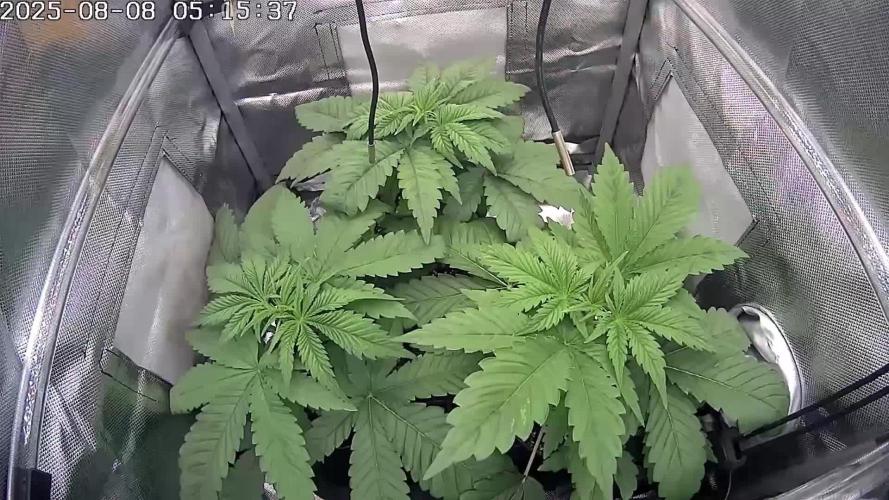
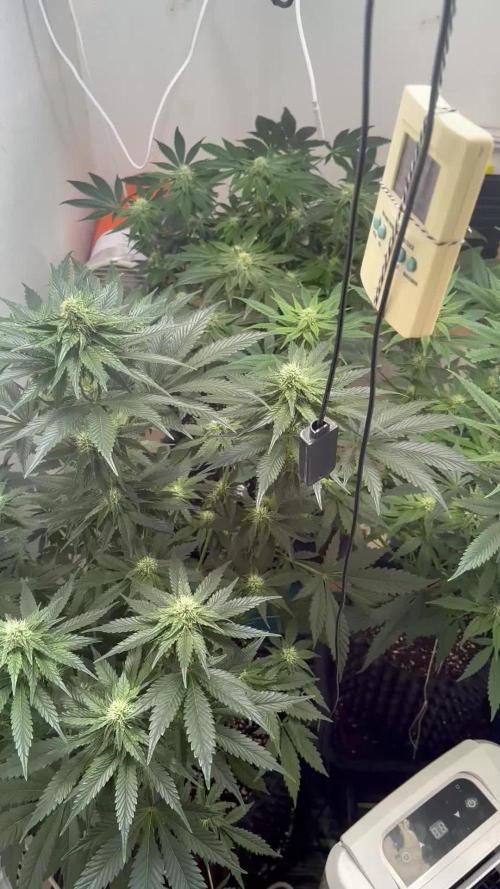
Beginning of week 4 in flowering and everything is coming along quite nicely. plants are loving there Remo nutes! just switched this tent over to a self watering drip system cause it was getting to be a real pain watering these girls by hand. Their siting in 7 gallon fabric pots and boy do they drink a mad amount of water/nutes! the pots are just packed with roots! really loving the Remo lineup of nutes so far! go Remo! Go Sports! Buds are starting to form nicely! Started to open up the bud sites a bit by tucking what i could but had to snip a few leaves up top to open a few lower sites up trying to get through.
Likes
18
Share
4/8 frosting up more and more and buds plumping up but not much. I feel its key to note that ine of the plants is more short stocky and the other has greater internodal spacing
Likes
47
Share
What's in the soil? What's not in the soil would be an easier question to answer. 16-18 DLI @ the minute. +++ as she grows. Probably not recommended, but to get to where it needs to be, I need to start now. Vegetative @1400ppm 0.8–1.2 kPa 80–86°F (26.7–30°C) 65–75%, LST Day 10, Fim'd Day 11 CEC (Cation Exchange Capacity): This is a measure of a soil's ability to hold and exchange positively charged nutrients, like calcium, magnesium, and potassium. Soils with high CEC (more clay and organic matter) have more negative charges that attract and hold these essential nutrients, preventing them from leaching away. Biochar is highly efficient at increasing cation exchange capacity (CEC) compared to many other amendments. Biochar's high CEC potential stems from its negatively charged functional groups, and studies show it can increase CEC by over 90%. Amendments like compost also increase CEC but are often more prone to rapid biodegradation, which can make biochar's effect more long-lasting. biochar acts as a long-lasting Cation Exchange Capacity (CEC) enhancer because its porous, carbon-rich structure provides sites for nutrients to bind to, effectively improving nutrient retention in soil without relying on the short-term benefits of fresh organic matter like compost or manure. Biochar's stability means these benefits last much longer than those from traditional organic amendments, making it a sustainable way to improve soil fertility, water retention, and structure over time. Needs to be charged first, similar to Coco, or it will immobilize cations, but at a much higher ratio. a high cation exchange capacity (CEC) results in a high buffer protection, meaning the soil can better resist changes in pH and nutrient availability. This is because a high CEC soil has more negatively charged sites to hold onto essential positively charged nutrients, like calcium and magnesium, and to buffer against acid ions, such as hydrogen. EC (Electrical Conductivity): This measures the amount of soluble salts in the soil. High EC levels indicate a high concentration of dissolved salts and can be a sign of potential salinity issues that can harm plants. The stored cations associated with a medium's cation exchange capacity (CEC) do not directly contribute to a real-time electrical conductivity (EC) reading. A real-time EC measurement reflects only the concentration of free, dissolved salt ions in the water solution within the medium. 98% of a plants nutrients comes directly from the water solution. 2% come directly from soil particles. CEC is a mediums storage capacity for cations. These stored cations do not contribute to a mediums EC directly. Electrical Conductivity (EC) does not measure salt ions adsorbed (stored) onto a Cation Exchange Capacity (CEC) site, as EC measures the conductivity of ions in solution within a soil or water sample, not those held on soil particles. A medium releases stored cations to water by ion exchange, where a new, more desirable ion from the water solution temporarily displaces the stored cation from the medium's surface, a process also seen in plants absorbing nutrients via mass flow. For example, in water softeners, sodium ions are released from resin beads to bond with the medium's surface, displacing calcium and magnesium ions which then enter the water. This same principle applies when plants take up nutrients from the soil solution: the cations are released from the soil particles into the water in response to a concentration equilibrium, and then moved to the root surface via mass flow. An example of ion exchange within the context of Cation Exchange Capacity (CEC) is a soil particle with a negative charge attracting and holding positively charged nutrient ions, like potassium (K+) or calcium (Ca2+), and then exchanging them for other positive ions present in the soil solution. For instance, a negatively charged clay particle in soil can hold a K+ ion and later release it to a plant's roots when a different cation, such as calcium (Ca2+), is abundant and replaces the potassium. This process of holding and swapping positively charged ions is fundamental to soil fertility, as it provides plants with essential nutrients. Negative charges on soil particles: Soil particles, particularly clay and organic matter, have negatively charged surfaces due to their chemical structure. Attraction of cations: These negative charges attract and hold positively charged ions, or cations, such as: Potassium (K+) Calcium (Ca2+) Magnesium (Mg2+) Sodium (Na+) Ammonium (NH4+) Plant roots excrete hydrogen ions (H+) through the action of proton pumps embedded in the root cell membranes, which use ATP (energy) to actively transport H+ ions from inside the root cell into the surrounding soil. This process lowers the pH of the soil, which helps to make certain mineral nutrients, such as iron, more available for uptake by the plant. Mechanism of H+ Excretion Proton Pumps: Root cells contain specialized proteins called proton pumps (H+-ATPases) in their cell membranes. Active Transport: These proton pumps use energy from ATP to actively move H+ ions from the cytoplasm of the root cell into the soil, against their concentration gradient. Role in pH Regulation: This active excretion of H+ is a major way plants regulate their internal cytoplasmic pH. Nutrient Availability: The resulting decrease in soil pH makes certain essential mineral nutrients, like iron, more soluble and available for the root cells to absorb. Ion Exchange: The H+ ions also displace positively charged mineral cations from the soil particles, making them available for uptake. Iron Uptake: In response to iron deficiency stress, plants enhance H+ excretion and reductant release to lower the pH and convert Fe3+ to the more available form Fe2+. The altered pH can influence the activity and composition of beneficial microbes in the soil. The H+ gradient created by the proton pumps can also be used for other vital cell functions, such as ATP synthesis and the transport of other solutes. The hydrogen ions (H+) excreted during photosynthesis come from the splitting of water molecules. This splitting, called photolysis, occurs in Photosystem II to replace the electrons used in the light-dependent reactions. The released hydrogen ions are then pumped into the thylakoid lumen, creating a proton gradient that drives ATP synthesis. Plants release hydrogen ions (H+) from their roots into the soil, a process that occurs in conjunction with nutrient uptake and photosynthesis. These H+ ions compete with mineral cations for the negatively charged sites on soil particles, a phenomenon known as cation exchange. By displacing beneficial mineral cations, the excreted H+ ions make these nutrients available for the plant to absorb, which can also lower the soil pH and indirectly affect its Cation Exchange Capacity (CEC) by altering the pool of exchangeable cations in the soil solution. Plants use proton (H+) exudation, driven by the H+-ATPase enzyme, to release H+ ions into the soil, creating a more acidic rhizosphere, which enhances nutrient availability and influences nutrient cycling processes. This acidification mobilizes insoluble nutrients like iron (Fe) by breaking them down, while also facilitating the activity of beneficial microbes involved in the nutrient cycle. Therefore, H+ exudation is a critical plant strategy for nutrient acquisition and management, allowing plants to improve their access to essential elements from the soil. A lack of water splitting during photosynthesis can affect iron uptake because the resulting energy imbalance disrupts the plant's ability to produce ATP and NADPH, which are crucial for overall photosynthetic energy conversion and can trigger a deficiency in iron homeostasis pathways. While photosynthesis uses hydrogen ions produced from water splitting for the Calvin cycle, not to create a hydrogen gas deficiency, the overall process is sensitive to nutrient availability, and iron is essential for chloroplast function. In photosynthesis, water is split to provide electrons to replace those lost in Photosystem II, which is triggered by light absorption. These electrons then travel along a transport chain to generate ATP (energy currency) and NADPH (reducing power). Carbon Fixation: The generated ATP and NADPH are then used to convert carbon dioxide into carbohydrates in the Calvin cycle. Impaired water splitting (via water in or out) breaks the chain reaction of photosynthesis. This leads to an imbalance in ATP and NADPH levels, which disrupts the Calvin cycle and overall energy production in the plant. Plants require a sufficient supply of essential mineral elements like iron for photosynthesis. Iron is vital for chlorophyll formation and plays a crucial role in electron transport within the chloroplasts. The complex relationship between nutrient status and photosynthesis is evident when iron deficiency can be reverted by depleting other micronutrients like manganese. This highlights how nutrient homeostasis influences photosynthetic function. A lack of adequate energy and reducing power from photosynthesis, which is directly linked to water splitting, can trigger complex adaptive responses in the plant's iron uptake and distribution systems. Plants possess receptors called transceptors that can directly detect specific nutrient concentrations in the soil or within the plant's tissues. These receptors trigger signaling pathways, sometimes involving calcium influx or changes in protein complex activity, that then influence nutrient uptake by the roots. Plants use this information to make long-term adjustments, such as Increasing root biomass to explore more soil for nutrients. Modifying metabolic pathways to make better use of available resources. Adjusting the rate of nutrient transport into the roots. That's why I keep a high EC. Abundance resonates Abundance.
Likes
10
Share
@NSABND
Follow
Day 29... afternoon very sunny and warm temp 👍 Day 30 damn hot and full of sun 😎👍
Likes
13
Share
Space is getting tight! The two new plants in the tent with the already flowering Bubblegum has me tinkering with leaves every night. Setting up a scrog this week possibly or might just do it open ended.
Likes
30
Share
@Kirsten
Follow
Bubble Kush is beginning to show some good growth this week, so I hope we will get going now. 13.8.25: I watered with 500mls of dechlorinated water PH'd to 6.6 with; 💜 1ml Trace 💜 1 TSP Biosys PH: 6.6 PPM: 351 17.8.25: I watered with 2ltrs of dechlorinated water PH'd to 6.0 with; 💜 2ml Trace PH: 6.0 PPM: 391 18.8.25: The plant was FIM'ed today, no watering was necessary. Thanks for checking in this week and hanging out in the comments 😊💚✌️🍃🙏
Likes
19
Share
Great Harvest, colors, smell, taste and bag appeal are all there . Finished exactly when they said it would . You dont need cold to achieve purple colors . Thanks 420 FastBuds
Likes
Comments
Share
@Albinius
Follow
🌱 GROW LOG: Gorilla Cookies Auto (x3) ╭────────────────────────────────────╮ 🗓️ MONDAY 11/08/25 - DAY 19 ╰────────────────────────────────────╯ → All stats in range, no attention needed 🌡️Temp (Day/Night): 24°C / 23°C 💦 Humidity (RH): 63% 🔁 VPD (Vapor Pressure Deficit):1.1 ⚡ Soil EC mS/cm: 0.3 💧 Soil Water Content (WC): 21% 💡 Light: 40% @ 25cm from canopy 🔆 PPFD (μmol/m²/s): 490 🌬️ CO₂ (ppm): 580 ╭────────────────────────────────────╮ 🗓️ TUESDAY 12/08/25 - 💧BATCH & WATERING - DAY 20 ╰────────────────────────────────────╯ → WC Dropped to 20% → Prepared batch 10L (3L Deminiralized + 7L tap feeding: 1.2 EC / 590PPM / 6.6 PH / 24C → Stats within range → Fed plant with fabric pot 3L: Runoff: 4.2 EC / 2140 PPM / 6.0 PH -- High Again → 2 plastic pot plants WC still in range, no watering → 2 plants in fabric pot seem a bit behind 🌡️Temp (Day/Night): 27°C / 25°C 💦 Humidity (RH): 68% 🔁 VPD (Vapor Pressure Deficit):1.2 ⚡ Soil EC mS/cm: 0.5 💧 Soil Water Content (WC): 25% 💡 Light: 45% @ 30cm from canopy 🔆 PPFD (μmol/m²/s): 480 🌬️ CO₂ (ppm): 700 ╭────────────────────────────────────╮ 🗓️ WEDNESDAY 13/08/25 - DAY 21 ╰────────────────────────────────────╯ → 2 Other plants WC still in range, no watering → Again some leaf removal and LST 🌡️Temp (Day/Night): 27°C / 26°C 💦 Humidity (RH): 68% 🔁 VPD (Vapor Pressure Deficit):1.2 ⚡ Soil EC mS/cm: 0.3 💧 Soil Water Content (WC): 20% 💡 Light: 50% @ 30cm from canopy 🔆 PPFD (μmol/m²/s): 480 🌬️ CO₂ (ppm): 650 ╭────────────────────────────────────╮ 🗓️ THURSDAY 14/08/25 - 💧FLUSH - DAY 22 ╰────────────────────────────────────╯ → More minimal LST and leaf removal → Flushing the plants till an average 700PPM - 1.1 EC - 6.0 PH runnoff with deminiralized water since last watering was over the treshhold 🌡️ Temp (Day/Night): 27°C / 26°C 💦 Humidity (RH): 68% 🔁 VPD (Vapor Pressure Deficit):1.2 ⚡ Soil EC mS/cm: 0.3 💧 Soil Water Content (WC): 20% 💡 Light: 50% @ 30cm from canopy 🔆 PPFD (μmol/m²/s): 480 🌬️ CO₂ (ppm): 550 ╭────────────────────────────────────╮ 🗓️ FRIDAY 15/08/25 - DAY 23 ╰────────────────────────────────────╯ → Waiting with feeding till plants recover from flush 🌡️ Temp (Day/Night): 25°C / 24°C 💦 Humidity (RH): 60% 🔁 VPD (Vapor Pressure Deficit): 1.1 ⚡ Soil EC mS/cm: 0.3 💧 Soil Water Content (WC): 20% 💡 Light: 55% @ 30cm from canopy 🔆 PPFD (μmol/m²/s): 480 🌬️ CO₂ (ppm): 600 ╭────────────────────────────────────╮ 🗓️ SATURDAY 16/08/25 - DAY 24 ╰────────────────────────────────────╯ → No feeding → Stats Stable 🌡️ Temp (Day/Night): 25°C / 24°C 💦 Humidity (RH): 60% 🔁 VPD (Vapor Pressure Deficit): 1.1 ⚡ Soil EC mS/cm: 0.3 💧 Soil Water Content (WC): 20% 💡 Light: 55% @ 30cm from canopy 🔆 PPFD (μmol/m²/s): 480 🌬️ CO₂ (ppm): 600 ╭────────────────────────────────────╮ 🗓️ SUNDAY 17/08/25 - DAY 25 ╰────────────────────────────────────╯ → No feeding → Stats Stable 🌡️ Temp (Day/Night): 25°C / 24°C 💦 Humidity (RH): 60% 🔁 VPD (Vapor Pressure Deficit): 1.1 ⚡ Soil EC mS/cm: 0.3 💧 Soil Water Content (WC): 20% 💡 Light: 55% @ 30cm from canopy 🔆 PPFD (μmol/m²/s): 480 🌬️ CO₂ (ppm): 600 ╭────────────────────────────────────╮ 🌿 OVERVIEW ╰────────────────────────────────────╯ Gorilla Cookies Auto trio had a hiccup but bounced back! 🌿 Monday was chill, but Tuesday’s 3L feed (fabric pot, 1.2 EC) spiked runoff to 4.2 EC / 2140 PPM—oops, too spicy! 🔥 Plastic pots stayed fine, no water. Fabric pot plants lagged a bit. Thursday’s flush fixed runoff to 1.1 EC / 700 PPM. LST and leaf trimming kept things tidy. Temps (24–27°C day, 23–26°C night), humidity (60–68%), VPD (1.1–1.2) were solid. Lights climbed to 55% @ 30cm (480–490 PPFD), CO₂ 550–700 ppm. 😎 Lessons: → Nutrient Overload: High runoff means cut back on feed strength for autos. Go lighter next time! → Flush Fast: Thursday’s flush saved the day. Act quick when EC spikes. 🚿 → LST FTW: Gentle LST helped growth—keep it up for even canopies. 🌱 → Fabric Pot Lag: Fabric pots dry faster, monitor closer to match plastic pots’ pace. 👀 Takeaway: Overfeeding glitch fixed with a flush. Stay vigilant with nutrients and keep LST going! 🚀😉
Processing
Likes
18
Share
Week 8 begins, the final feed! Divine storm 1&2 are both looking good, however DS1 appears to be a bit bigger in size and bud development. Both ladies are very frosty, I definitely understand the hype around in house genetics! Thanks for stopping by, tune in next week for the flush 👽🌳🔥
Likes
56
Share
@MrGrow
Follow
29.08.2022 10 settimana finita Inizio a breve la fioritura Ho montato la nuova luce, ho scelto una Fc 4800 della MarsHydro, che momentaneamente tengo al 60% per non cuocere tutte le piante. Tutto è pronto per cambiare ore di buio✌️🏻 Preso un po di talee per il nuovo ciclo💚
Likes
1
Share
21.08 - First leaves appear and start consuming light. Watering - 0.2 ml per plant - pH 6.30 Lamp distance - 50cm Humidity - 75% - 95% Temperature - 23 - 27 C Light - 18/6h - Dim - 50% 22.08 Watering - 0.25 ml per plant - pH 6.50 Lamp distance - 50cm Humidity - 75% - 90% Temperature - 22 - 27 C Light - 20/4h - Dim - 50% 23.08 Watering - 0.50ml per plant - pH 6.30 Lamp distance - 50cm Humidity - 70% - 90% Temperature - 22 - 27 C Light - 18/6h - Dim - 50% 24.08 Watering - 0.80ml per plant + Root Juice + Acti Vera- pH 6.30 Total 250ml water with 1ml Root Juice and Acti Vera - 0.5ml Lamp distance - 50cm Humidity - 62% - 79% Temperature - 25 - 28 C Light - 20/4h - Dim - 50% 25.08 I skip watering, the soil is wet Lamp distance - 50cm Humidity - 70% - 85% Temperature - 22 - 27 C Light - 22/2h - Dim - 55% 26.08 I skip watering, the soil is wet Lamp distance - 50cm Humidity - 55% - 85% Temperature - 22 - 27 C Light - 22/2h - Dim - 55% 27.08 Skip watering Lamp distance - 50cm Humidity - 70% - 85% Temperature - 22 - 27 C Light - 22/2h - Dim - 55% 28.08 Watering - The big one get 450ml water - pH - 6.3 The other 2 get 250ml per plant - pH - 6.3 Total 1L water with 2ml Root Juice Sprayed leaves with Acti vera Lamp distance - 40cm Humidity - 70% - 85% Temperature - 22 - 27 C Light - 20/4h - Dim - 80% Also at the end of the day I gave to the biggest one cal mag biobizz 2,3 pippet drops with 200ml water. Until September 2nd, I use one lamp. From the 2nd there are already two
Likes
150
Share
Une semaine de plus et ces demoiselles ce portes très bien ! Je continue tous les trois jours à les palisser un peu plus , avec comme arrosage du purin d'ortie tous les deux arrosages. Bien content des graines de chez @Sensi Seeds ! 🤝🙌
Likes
9
Share
@KcKush
Follow
*Increased PPM from 650 to 750 *Transplanted into 5 gallon pots. *Placed inside grow tent 5x5. Might start flowering tomorrow. *Might take clones.
Likes
57
Share
Si lets talk about my beautiful Medusa F1 from Royal Queen Seeds. This little lady is growing like a champ, and I've been giving her lots of love and care. One of the techniques I've been using with my Medusa F1 is leaf bending as a form of training. It's been amazing to see how much she's responded to this technique. I gently bend and manipulate the stems and leaves to encourage horizontal growth and create an even canopy. This helps to promote more even light distribution and allows for better nutrient uptake. My Medusa F1 seems to be loving it, as she's growing strong and healthy with lots of new growth popping up all over the place. In addition to leaf bending, I've been using Aptus Holland Nutri Spray as a foliar spray, and I can't say enough good things about it. This stuff is a game-changer! It's a high-quality nutrient-rich spray that I apply directly to the leaves of my Medusa F1. It's been absorbed quickly and efficiently, and I've noticed a significant improvement in the overall health and vitality of my plant. The leaves are looking lush and green, and the growth has been explosive! I believe that giving my Medusa F1 the best nutrients and care is crucial for her growth and development, and Aptus Holland Nutri Spray has been a key part of my regimen. It's made with love, just like how I care for my plants, and I can see the results every day. I'm so excited to see what my Medusa F1 will become with continued use of this amazing foliar spray. I highly recommend trying out leaf bending and incorporating Aptus Holland Nutri Spray into your routine. Your Girls will thank you with lush, vibrant growth, and you'll fall in love with the results, just like I have. As always thank you all for stopping by and for supporting me on this journey, i am super passion about growing and fell blessed to have you all with me on this new journey <3 <3 <3 Genetics - RQS MEDUSA F1 Ligth - LUMATEK ZEUS 465 COMPACT PRO 
Food - APTUS HOLLAND 
 
All info and full product details can be find in can find @ https://www.royalqueenseeds.com 

https://aptus-holland.com/
 
https://autopot.co.uk/ 

https://lumatek-lighting.com/ With true love comes happiness <3<3<3 Always believe in your self and always do things expecting nothing and with an open heart , be a giver and the universe will give back to you in ways you could not even imagine so <3<3<3 <3 <3 <3 Growers love to you all <3 <3 <3 Medusa F1 Medusa is a true F1 hybrid created from pure, inbred cannabis lines. She boasts uniform grow traits, mouthwatering aromas and flavours, and plenty of potency. If you're looking to bring stable, elongated plants into your room, tent, or garden, look no further. Mouthwatering Aromas, High Potency, and Mid-Size Plants Though she won't turn you to stone like the mythical goddess after which she's named, Medusa F1 is bound to get you plenty stoned in her own special way. Combining genetics from inbred lines deriving from Sugar Magnolia, a thick and sweet indica, and American Beauty, a fast, fruity hybrid loved for its well-balanced, positive high, the result is an autoflowering F1 variety that produces fresh flavours, a unique cannabinoid profile, and large yields. A very aromatic cultivar with a vibrant concentration of terpenes bearing notes of fresh mint alongside an upfront peppery kick, backed up by hints of fresh fruit, berries, and tangy fuel. Her thick, frosty flowers consistently produce high levels of THC and CBG, as well as high concentrations of myrcene, ocimene, farnesene, and caryophyllene. As a result, Medusa F1 has strong effects that relax and stone the body from head to toe (brought on by particularly high concentrations of myrcene and farnesene) while motivating the mind with an uplifting, creative, and motivating kick (thanks to high concentrations of ocimene). Medusa F1 seeds produce elongated autoflowering plants with long, strong branches and well-spaced internodes. Plants regularly grow up to 80–85cm tall and boast a fast flowering time of just 42–45 days (72 days from germination to harvest). Thanks to her genetics, Medusa F1 produces plenty of thick flowers with big, swollen calyxes that make for very easy trimming. Medusa F1 is very stable, handling stress and unfavourable growing conditions with ease, though she is somewhat susceptible to Botrytis, so make sure to keep tabs on the humidity in your grow room/garden.
Likes
55
Share
@mr_smooke
Follow
These strain deserves to bee in each groow . But i have to try anoder strains from Humboldt Next time i will go with CMOG in "one Plant Shou" Thanks to everyone who followed And commented Thank you very much Humoldt on your suport, you've done the best job here : 1:😉 And soory too all four my bad english In Grow room was these Blue Dream and 3 special Queen and those 3 are giwen 160g that means I produce 0,56g/w Next time i will chase 1g/w To the next time Happy growing and smooking allot of good weed0
Likes
19
Share
@Naujas
Follow
I'll wait until it's completely dry and then I'll cut it, only a few days left :) you know her difficult beginning in life, she coped with the stress perfectly :) the flowers look very resinous :
Likes
8
Share
@NugDragon
Follow
-Huge size difference between all 3 plants: Plant #1: 41cm Plant #2: 85cm Plant #3: 114cm -Defoliated all 3 plants. -I'm not sure why there is such a big size difference between the plants. Does anybody have a guess? -Plant #1 definitely seems to be significantly more mature. The buds are drastically more developed, frosty with much more trichomes, and many orange hairs already. The other plants are far behind it. -Plant #1 has a very sharp mint and lime smell to it, the other 2 are very skunky. -Very difficult to keep a consistent light distance between all 3 plants now, even when plant #1 is propped up on a bucket. My light can't go much higher now, and plant #3 is only about 6 or 7cm under it.
Likes
6
Share
@rvabudman
Follow
Topping appears to be working well. Began some LST via tie down to encourage growth to other branches.
Likes
105
Share
@BioBuds
Follow
One was more bushy and was a little behind. As I said, they had some heat stress and I think the 15-liter pots are too small when the environment is hotter. Still, they are totally worth growing and joy to smoke. They don't need much curing and the weed is very very strong. Going to try this strain again very soon!!