


Likes
Comments
Share


Likes
3
Share

@RebelSeedBank
Follow
🌸 Flowering Week 1 — Switch Day / 12:12 Initiated
LCG × Vitamin Z | Phenohunting N1/2026 | 35 plants | Ebb & Flow 2.5L | SOG
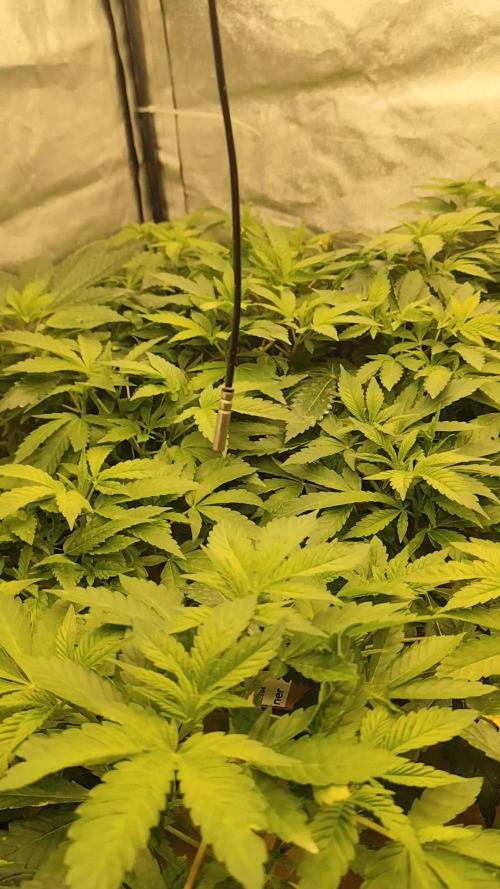
Switched to 12/12 today after 8 weeks total from germination (6-7 weeks active veg). Plants are sitting at 25–40cm, uniform canopy, compact internodes. No stress signs visible — healthy, turgid foliage across all 35 plants.
System: Hydro SOG Ebb & Flow, 2.5L pots, expanded clay + rockwool, 120×120 tent, 2× Figolite FG-E3000 Samsung LM301H EVO + UV/IR, Meanwell driver. RO water base.
Nutrition — Day 1 switch:
Running EC 1.2 (protocol calls for 1.3 F1, holding slightly lower for the first 3–5 days to avoid osmotic pressure during the metabolic transition). pH locked at 5.7. Full mineral salt program — Calcium Nitrate, MgSO4, Potassium Nitrate, MAP, Potassium Sulfate, Kelamix microchelates, Pepton Plus, Cellulase + Pectinase enzymes, Potassium Silicate.
Irrigation: 4 cycles/day, lights ON 22:30 / OFF 14:30. One pre-light cycle at 00:30 for root oxygenation. Substrate completing full dry cycle overnight.
Goals this week:
Pre-sex identification starting day 7–10. First phenotypic observations logged — leaf morphology, relative vigor, early aromatic signature by rubbing leaves. Light defoliation of large fan leaves blocking lower nodes planned before stretch kicks in.
Flavor target: Dominant citrus-sweet / lemon dessert / clean creamy base. Zero synthetic gas. Zero pine. Cup-level aromatic selection in progress across all 35 regular seeds.
Stretch expected to begin days 5–10. Will update with first sex identification and early pheno notes next week. 🔬
#LCG #VitaminZ #Phenohunting #EbbAndFlow #SOG #HydroSOG #CupQuality #RebelSeedBank #PureExpression #SamsungLM301H #Figolite
#LCG #VitaminZ #Phenohunting #EbbAndFlow #SOG #HydroSOG #CupQuality #RebelSeedBank #PureExpression #SamsungLM301H #Figolite


Likes
42
Share


@MadeInGermany
Follow
Info:
Unfortunately, I had to find out that my account is used for fake pages in social media.
I am only active here on growdiaries.
I am not on facebook instagram twitter etc All accounts except this one are fake.
Flowering day 1
since time change
to 12/12 h.
Hi guys :-) .
The time has finally come 👍
You have been switched to 12/12 hrs and are ready to flower.
Of course, cuttings were cut beforehand to keep the genetics.
For 4 days now she has also been getting Fast Buds from GreenBuzzLiquids.
They were also sprayed again with GBL Fast Plant spray.
She is very healthy and I am excited to see how she gets going again in bloom :-).
This week it was poured twice with 1.2 l each time (for nutrients, see nutrient table above).
Then I filled canisters with fresh osmosis water for the next few weeks 👍.
The tent was cleaned and every plant was checked for health.
At the moment I am tinkering with the ventilation because there are currently 4 fans with 4 activated carbon filters running, which I want to make more efficient by putting a hose through 2 tents.
These are the things about which you desperately at the beginning but learned from them in the end.
I wish you all a nice week.
Stay healthy 🙏🏻
You can buy this Nutrients at :
https://greenbuzzliquids.com/en/shop/
With the discount code: Made_in_Germany you get a discount of 15% on all products from an order value of 100 euros.
You can buy this Strain at :
https://sweetseeds.es/de/cream-caramel/
Type:
Cream Caramel
☝️🏼
Genetics:
Blue Black
x
Maple Leaf Indica
x
White Rhino
👍
Vega lamp:
2 x Todogrow Led
Quantum Board 100 W
💡
Bloom Lamp :
2 x Todogrow Led
Cxb 3590 COB 3500 K 205W
💡💡☝️🏼
Soil :
Canna Coco Professional +
☝️🏼
Nutrients :
Green Buzz Liquids :
Organic Grow Liquid
Organic Bloom Liquid
Organic more PK
More Roots
Fast Buds
Humic Acid Plus
Growzyme Big Fruits
Clean Fruits
Cal / Mag
Organic Ph - Pulver
☝️🏼🌱
Water:
Osmosis water mixed with normal water (24 hours stale that the chlorine evaporates) to 0.2 EC. Add Cal / Mag to 0.4 Ec Ph with Organic Ph - to 5.8 .

Processing
Likes
3
Share


@Dunk_Junk
Follow
She's still going! Not long now though, I'm thinking a week or two. She is so frosty and sticky! Incredible.

Likes
14
Share


@Kendoda
Follow
Feed 1
Grow 1ml, bloom 3ml, topmax 3ml.
Feed 2
Alg-a -mic 3ml.
Feed 3
Grow 1ml, bloom 3ml, topmax 3ml.
Three feeds of 1 litre.


Likes
20
Share


@eldruida_lamota
Follow
Que pasa familia, vamos a añadir la novena semana de floración de estas Apple Fritter de RoyalQueenSeeds, empezamos con la temperatura que la tenemos entre los 21/25 grados, la humedad está entorno al 50%, el ph está en 6.2 , el foco actualmente lo tengo encendido 12 horas y la potencia es al 100% de lo que da el foco.
Las flores estan poniéndose bien guapas
Veremos como acaban estas semanas, ya les retiré el alimento y llevan una semana solo con agua.
Mars hydro:
Code discount: EL420
https://www.mars-hydro.com/
Agrobeta:
https://www.agrobeta.com/agrobetatiendaonline/36-abonos-canamo
Hasta aquí todo, Buenos humos 💨💨💨

Likes
24
Share


@ThatoneAKguy
Follow
Day 22 of flower which according to dinafem means these ladies are about half way there. I erred this week by letting the reservoir dry out but it was only for half a day so they came back. Early in the week I tried super cropping for the first time and I can see the benefits to let others play catch up. I’ll probably do some light defoliation this week to get a little more air and light to the lower sites and branches. The LST I did early on in their life looks like it paid of as it’s just a sea of green.

Likes
6
Share


@weedelicious
Follow
Day 78
Hey growmies,
The girls received 2 liters of water with fertilizer and Cal-Mag today. Before that, I defoliated them for the last time – I hope it wasn’t too much, but I wanted to try a more radical approach to hopefully get an even better end result. Unfortunately, some of the Pink Gelato's leaves are showing clear signs of heat stress, but so far she’s still growing well. I hope the terpenes are okay.
Day 79
The girls are doing well so far. Unfortunately, the tips of the Pink Gelato are a bit burned, and it's supposed to get even hotter in the next few days. I hope she survives the heat. The other two ladies don’t seem to mind it. The smell and the buds are getting bigger and bigger. The carbon filter is managing to neutralize the strong smell. Now we're heading into the final days of flowering

Processing
Likes
2
Share


Likes
43
Share


@420DeepGrow
Follow
Gracias al equipo de Kannabia Seed y XpertNutrients, sin ellos esta magia no seria posible.
🍁💐 Runtz (Auto):
Si esta cepa se ha ganado su popularidad a pulso, esta versión autofloreciente es digna heredera de sus atributos. No es de extrañar que nuestros criadores hayan acertado con su programa de reproducción, al combinar dos de las cepas más fascinantes de la actualidad: Zkittlez y Gelato.
planta resistente y robusta, de cuerpo esbelto y fuerte ramificación lateral, que se puede cultivar prácticamente en cualquier entorno; pero prefiere los veranos largos y cálidos, tal y como quiere la madre naturaleza, donde bañada por el sol se eleva hasta los 120 cm. para producir unos rendimientos muy gratificantes de 100-150 gramos por planta.
En interior, y tras solo 70 días desde la semilla, también recompensará con cosechas abundantes de hasta 500 gr./m²
Inmediatamente después de encontrarte con ella, lo primero que notarás es su aroma descaradamente afrutado, con un toque tropical cortado con reminiscencias terrosas y amaderadas, que se entremezclan de forma agradable para ofrecer un combo que hace salivar las papilas gustativas.
Ofrece un sabor confitado, refrescante y similar a sumergirse en una piscina de frutas cítricas y flores de fragancia intensa. Al inhalar, obtienes la bondad de la dulzura; al exhalar, el humo se convierte en suave y cremoso, dejando suficiente profundidad en cada bocanada para satisfacer a aquellos que buscan los matices más complejos.
⛽ XpertNutrients: es una empresa especializada en la producción y comercialización de fertilizantes líquidos 🍶y sustratos🐛, que garantizan los mejores resultados y cosechas de la más alta calidad. A través de una cuidadosa selección de materias primas y un proceso de producción avanzado, sus productos son sinónimo de resultados confiables.
🛒 Consigue aqui tus fertilizantes:
https://xpertnutrients.com/es/sobre-nosotros/#:~:text=Xpert%20Nutrients%20es%20una%20empresa,de%20la%20m%C3%A1s%20alta%20calidad.
📆 Semana 11:
Empezando el engorde de los cogollos, esta tomando una pinta estupenda 😎


Likes
40
Share


@THcHunteR23
Follow
Maintenant elle est bien formé! Les pistils commencent à brunir en majorité. À partir d’aujourd’hui elle auras des températures beaucoup plus fraîche de jours et prêt de 16 la nuit Je vais attendre encore quelques jours avant de commencer à rincer


Likes
15
Share


@Herbangardener671
Follow
Week 8 of flower and ladies are really becoming more dense and frosting all little more. Thanks to the growmies and the experienced gardeners here I’ve decided to patiently wait to harvest until at least 65 days of flower to get the maximum potential from theses two strains. Much love and appreciation to this helpful growing community and look forward finishing up this run
Day 57- final week until harvest letting pots dry out and waiting for those beautiful fall color.
Day 60- pots drying quick, max of 5 days left until harvest trichomes increasing as the day go on
So far this run has been pretty easy I can say I’ve learned so much and gained a lot of experience. My biggest take away would be examine and care for plant each and every day if possible things can change daily and to insure health you have to give them all the attention they need.

Likes
120
Share


@NugLife420
Follow
Well here we go, I switched them to flower this week! These ladies have so many budsights it’s ridiculous. I will continue to update throughout the week.😎

Processing
Likes
11
Share


@Fibro_Witch
Follow
I'm very happy with this weeks progress. They transitioned very well to the garden, which I'm chocking up to the row cover. They didn't need any water due to the thunderstorm we had last night, but I did make a ring around the base of each plant and gave them about 1-2 TBSP of the Coast of Maine Stonington Blend fertilizer. They also got their tomato cages.
Likes
20
Share


@MrWolfe
Follow
So this round I just lollipopped and didn’t strip the top at all, with better veg next round it’ll work better but I’m having issues with some plants not quite trellised how I’d like. Everything smells great, BCS,BD and WM are getting fat and PKB is frosty and tight. Watering is more of a chore than I’d like I think I’m just going to use some 5s for the next round . Thanks for following along I hope your buds are fat and frosty.


Processing
Likes
13
Share


@kevgrow
Follow
Hey Friends, end of week 13 from seed.
This week i noticed colas are slightly getting thicker, but still a slower growth compared to my other plant (#2)
I had to install some yoyos because some colas are falling to the side due to its weight
Had trouble maintaining a steady humidity level
Leaves are beginning to fade, not sure if its normal or because I increased light intensity this week
Increased light intensity to 350 - 400 lux x100
Colas for some reason do not look thick enough and so far no amber on the trichomes, might need to wait Another week or two so I could begin flushing.
Smell is stronger like green lemon mango, that weird smell it use to have is slowly going away.
QUESTIONS
So I planned a trip with my family on oct 9th, when booking the trip around 3 weeks ago I estimated that the plant would need another month before harvesting. Will this plant be ready for harvest before oct 9th?
When should I begin Flushing ?
Likes
7
Share

@Sundancers
Follow
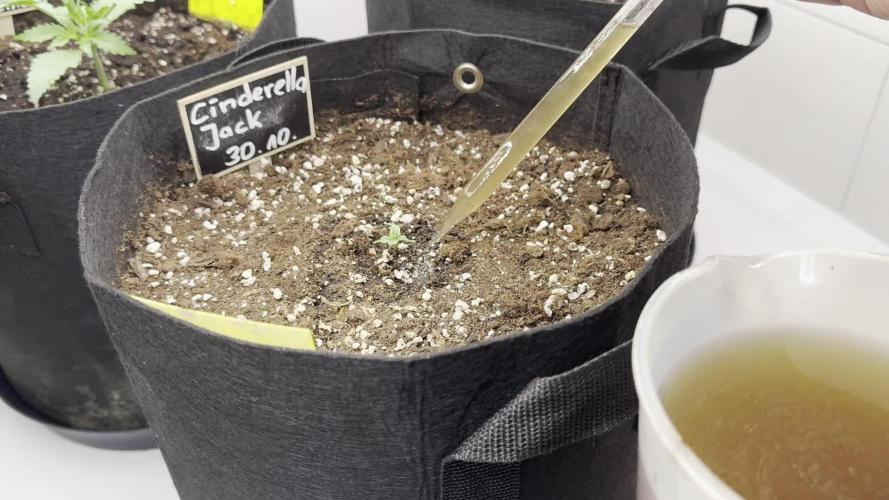
Die kleine Prinzessin macht Ihrem Namen alle Ehre. Kommt raus, und bleibt nach einer Woche 2 cm klein. Mal was neues. Man könnte vermuten, das es evtl. an der mittlerweile alten Genetik liegt. Moderne Strains sind bei gleichen Bedingungen ein zigfaches größer. Wir werden sehen wie es weiter geht. 🙀

Likes
15
Share


@Messypies
Follow
Sorry for the lack of uploading !
These plants have been perfect from the start. Budding out nicely and haven't shown any signs if defficiency.
All training has been stopped and I have started cutting back on the nitrogen for the 2 autoflowers.
The peanut butter cookies is growing to be very bushy so I have done some light defoliation to help with light penetrative to the lower canopy of the plant

