


Likes
Comments
Share


@Mr_nugs_lover_David
Follow
This lady has been Transplanted after 34 days since planted on may 5th, she's gonna be grown with FLO Living soil blend only, sorry for not having more pictures of this week but I had too many things to do and couldn't find time, stay tuned everybody!!

Likes
27
Share


@Ganjagrandaddy
Follow
Day 56 Flowering: Hi growmies. I hope we are all well and still sane during this madness.
Here we are at the harvest window for the Glueberry now and she is certainly up for it now. Her buds are stinky and sticky with the right amount of ripened pistils to cover around 60-70% of her structure. The next few days I will be using the microscope to keep watch on the trichromes for their sweet spot over the next few days.
Shebhas been an easy grow but I wish I had stripped her lower scrub out early on in flower now. She didnt look recovered enough to strip out at the time but her leaf and scrub are filling the pots interiors so I need to keep on the air flow checking to avoid any budrot issues.
Mimosa Lemon is everywhere!! She has been such a productive plant from the beginning. Her bud structures are very , very loose and I am dreading the dry and trim that will be awkward as to what to take off. while there are a lot of flowers , they are so loosely structured that it is very deceptive on appearances. Her Limonene is honking from her now and I can see her Lemon tag being so appropriate. The potency is becoming obvious by smell alone and her tacky feel at the slightest touch is a great sign too. I did quite a brutal defol and strip out very early in flower but she still threw so many mains out . This is one of the most productive flowering plants I have grown to date . I don't expect the yield to show this in totals but for bud growth and vigour , she has no rival so far. Another week for her at least but seeing the new pistils kicking out , it could be possibly 2 more.
Let's see what the next few days bring for them.
be safe and sane folks.


Likes
93
Share


@PEAKYPLANTERS
Follow
Hello, fellow growers
I thank you for having dedicated your attention to my garden and I hope that the contents are to your liking and help for your growth.
My central zkitt is about to explode

Likes
9
Share


@Luv2Grow
Follow
Day 64 - The start of week 10 and not much longer before chop. Looking like 2 weeks tops but I’m gonna keep an eye on the trichs and pistils and when they say she’s ready, she will get the chop.
Day 65 - Nothing much new today, she’s doing her thing and fattening up. Still thinking about 7-10 days till harvest so will run foxfarm sledgehammer through her next watering and nothing but water till the end.
Day 66 - Gave the girl a gallon of water and some sledgehammer today to try and push the nutes out. I’m thinking she’ll probably be getting chopped next weekend or a few days after that. Just want her to fatten up a bit more and get more amber in the trichs.
Day 67 - Nothing new today, just letting her suck all the nutes left in the soil and then suck her leaves dry. Hopefully it’s this weekend sometime but I’ll let her go until she’s ready.
Day 68 - Checking trichs daily and she’s not require ready yet. A couple amber in there with a few still clear and the rest milky. Once she dries, I will give her another gallon of water and sledgehammer and let her go until she’s done.
Day 69 - Coming to the end of week 10 and going to give her one more flush with the sledgehammer tomorrow and will just let her dry up until I decide to harvest. Really can be any day but will probably wait until the end of the weekend.
Day 70 - The end of week 10 and gave her a final flush with the sledgehammer tonight. Will let her ride it out without anymore water until it’s time to harvest. Trichs are all milky with a few amber so she’s getting close.
Likes
2
Share


@Autower
Follow
Bubba cheese #2 very different smell to the first one. The first one has that cheesy blues smell to it where as this one has a cheesy but fruit at the same time


Likes
5
Share


@BudBeat
Follow
Kabul #2 entwickelt langsam aber sicher ihre Blüten entlang der Haupttriebe. Die Knollen werden langsam praller. Die Entfernung von Blätter und den untersten Blüten zeigt ihre Wirkung. Die Energie geht jetzt in die Mainbuds. Ansonsten ist die Kabul sehr stabil und macht keinerlei Schwierigkeiten. Alles in Allem bin ich sehr zufrieden und schau der Kabul beim wachsen zu. ✌️

Likes
2
Share


@Belivitez
Follow
I must to wait for dry buds 😁.... After waiting to buds dry out i can finally write final weight 336g, of premium buds! Buds are fully covered with trichomes ❤️
Likes
4
Share


@distant_lights
Follow
4th vegetation week.
in this this week, plant goes slowly :(
looking forward with big hopes.
Likes
111
Share


@Teamdirtbag2
Follow
I have transplanted into Dutch buckets. Filled with perlite. And all are now in the Greenhouse. Doing great. These are watered 4 times a day for 1 minute.
She is doing great after the transplant.

Likes
39
Share


@CURATI_DA_SOLO
Follow
In realtà ho coltivato 2 semi di questa pianta una l'ho raccolta e seccata mentre un altra è ancora in flush e verrà raccolta tra 5-6 giorni. I fenotipi sono quasi identici e predilige un odore di gas e og! L'effetto è devastante molto narcotica e a breve pubblichero qualche foto di qualche estrazione a freddo! Spero che piacciano a qualcuno i miei lavori e che qualcuno di voi si possa ispirare a tutto questo.
Ringrazio ogni singola persona che è passata di qui a lasciare il suo like o commento e ricordo a tutti voi che potete trovarmi anche su Instagram 😘
Likes
27
Share


@Master_weeda
Follow
Bonjour à tous les padawans et maîtres jedis
Toujours arrosage avec 2 litres d'eau ph6.3 à laquelle j'ajoute madame grow
La plante est saine avec de jolies têtes chargée de trichomes

Likes
15
Share

@Oldwied
Follow
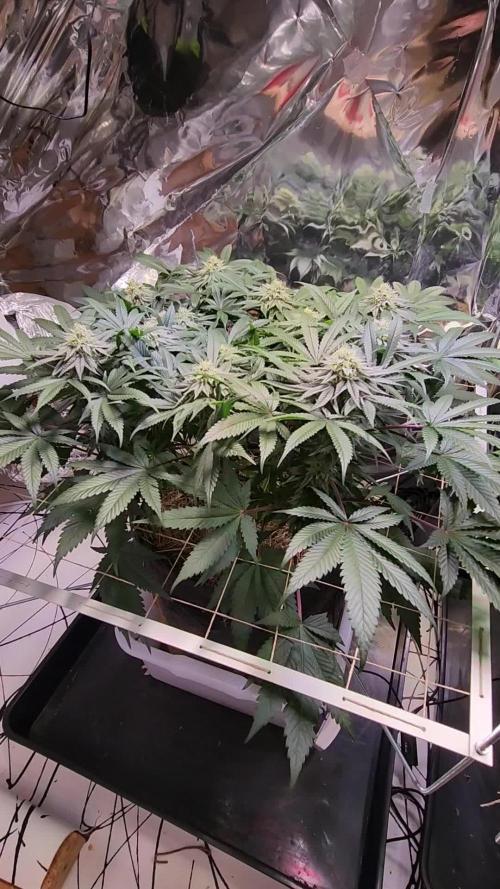
I added 10mL LAB (lacto acid bacteria, diy with rice water and milk) per liter of irrigation water, twice a week.
I installed a fan under the canopy to prevent mold. At the stage when the buds become denser.
Its excellent flowering characteristics will make you forget the challenges of training it during the veggi phase.
Light Power: 100%
Day 87
Flower #35
Photoshooting

Likes
24
Share


@el_cultivito
Follow
Plants started getting real bushy a couple of days after topping.
Low Stress Trained all the plants at the end of the week by tying them down using rubber coated garden wire to spread out the newly grown tops.
Also spaced out each plant evenly on the tray and turned on the other 2 PB2000 LED lights I had ready to go.


Likes
14
Share


@Xpie77
Follow
This week going to be her last week. I don't want to push her to much and get in trouble with fungus or other shit.
Processing
Likes
28
Share


@No_Clout
Follow
27/02/19 - This one is great, I popped the seed 24hrs after the gelato and this one seems to be developing its leaves a lot faster than the rest, so far really happy with DNA and with mills nutrients, it’s a lot easier to mix and I no longer have to use ph down because once all mixed it’s at a 5.8/5.9. 👌🏻
02/03/19 - Just transplanted all into their final pot, just in time I think as it looked like the roots were starting to circle at the bottoms of the pot, sprinkled half a tea spoon of Mykos on each hole prior to the transplant & fed them 2.5 litres each. I was going to saturate the whole pot but I’ll do that next feeding.


Likes
9
Share


@TheBulldozerSicily
Follow
Inizio nuovo ciclo
Giovedì 26 settembre 2024
Aggiungo 75 lt acqua osmosi inversa ec 146 ph 9
Aggiungo tutti I nutrienti ottenendo ec 908 ph 6.5

Likes
20
Share


@AsNoriu
Follow
Added first time molasses during feeding will be doing it for last 3 weeks before flush.
For couple plants with redish leaves stems gave epsom salt. Thinking to give it to all of them.
To me they look too skinny, but its aftermath of strech i quess ...
Would love to have one more hlg 240 ...

Likes
Comments
Share

@lolasher
Follow
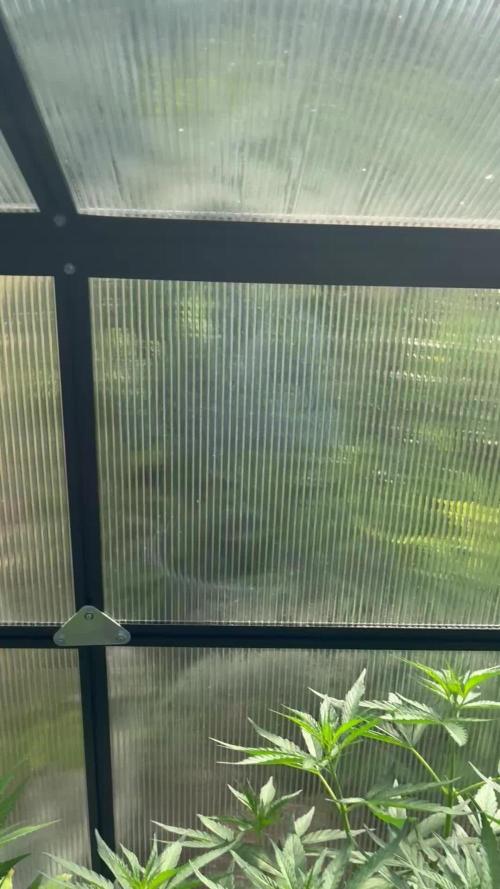
Die zehnte Woche ist rum. Die buds sind immer noch ordentlich am wachsen und bilden vuele neue Blütenstände. Die vom Hersteller angegebene Lebensdauer ist erreicht, aber optisch dürfen da noch einige Wochen folgen. Hab auch noch keine Trichome gecheckt.
Der Plan ist der Folgende:
Wissend, dass bei dieser Blütemenge Schimmel ein großes Risiko sein wird, möchte ich sie eigentlich noch mindestens zwei Wochen behalten. Sobald ich Schimmel irgendwo erkennen kann, wird umgehauen. Auch wenn die Blüten dann vermutlich noch nicht voll entwickelt sind.
Ich wohne im Norden an der holländischen Grenze im Moorgebiet. Die RLF hier ist hier - selbst bei diesen jetzigen, trockenen Bedingungen- selten unter 60 %. Nachts immer zwischen 80 und 90 (es ist hier super trocken aktuell).
Aber wer weiß… vielleicht Sorge ich mich auch zu unrecht und sie steht noch nen Monat.
Likes
47
Share


@Ultraviolet
Follow
The cannabis strain Grape Guava can be a purple strain, depending on its specific phenotype and genetic makeup. While not all phenotypes of Grape Guava are purple, some variations, such as the Zatix Grape Guava, are noted for their striking purple appearance due to the genetic expression of anthocyanin pigments.
https://www.youtube.com/watch?v=cKdVmdoKJ5k
In a garden of green, Grape Guava gleams,
With its fruity aroma, enchanting dreams.
Clusters of grapes, guava's sweetness ignite,
A strain so divine, in purple and white.
Euphoria whispers, a lush fruity haze,
Grape Guava's embrace, a tranquil daze.
Off and away.@1400ppm. The increased CO2 allows plants to thrive at higher temperatures, which in turn necessitates higher humidity to maintain the ideal VPD for healthy growth and transpiration. 80F -5F = 75F LST with 70% RH = 0.72 kPa. Higher temperatures and humidity promote rapid growth, nutrient uptake, and photosynthesis while maintaining a lower stress level. Temperature influences the rate of enzymatic reactions involved in aerobic respiration. Enzymes, such as those involved in glycolysis, the Krebs cycle, and the electron transport chain, work most efficiently at an optimal temperature range. In low temperatures, enzymatic activity will slow down, thus reducing the rate of aerobic respiration. In high temperatures, enzymes can become denatured, thus impairing their function and stopping the process of aerobic respiration. Glucose is the primary fuel for aerobic respiration. The rate of aerobic respiration increases with the availability of glucose, as it is the starting point for glycolysis. If glucose levels are low, cells may rely on alternative energy sources such as fatty acids or amino acids , but these processes may yield less ATP or be less efficient. To determine this effect, carbon dioxide volume was measured (as carbon dioxide is an output of aerobic respiration)
18/6 with the 6 being IR. The near infrared (IR-a) borders around 700nm up to 1400nm @ photon par flux density of 1.8 instead of darkness, keeping temps overnight a neat 77F-80F.
Think of my tent as a lung. What goes in must come out. When the rate of air going out exceeds the amount of air coming in, it creates a negative pressure. Tent concaves (bends in). If set up correctly, your RH will begin to drop slowly to the desired level you set, and the extraction turns off when it reaches desired% RH. The plant, as it performs cellular respiration, will always be releasing more water into the air, so the RH% of the tent overnight will always increase, so long as oxidative phosphorylation is occurring. As soon as the RH% creeps back up to 55%, the extraction turns back on, over and over. This creates a strong pressure differential which will work wonders on your grow. Replicating high and low-pressure fronts in nature. Critical for oxygen diffusion at the critical time of peak cellular respiratory function..
Moisture will not transfer from a saturated atmosphere to another if that air is already at or above its saturation point, meaning the air can't hold any more water vapor. Once I understood that water is produced as a by product during cellular respiration, specifically at the very end of the electron transport chain (ETC) where electrons are finally transferred to molecular oxygen, the higher the RH of the air, the more resistance there is for more moisture to be added to that environment, and effects the ease with which it does so. But none of that water comes from the pot; it's pulled from the air. If you run high daytime RH, your medium/pot is 100% reliant on transpirational root pull to move water. ZERO evaporation happens across the atmosphere if the tent air has high RH%, the medium cannot release its water through evaporation. Once a canopy develops, light no longer slowly wicks and evaporates from the topsoil. The Soil-Plant-Atmosphere Continuum (SPAC) describes the continuous pathway and process of water movement, driven by a gradient in water potential, from the soil, through the plant's roots, stem, and leaves, and finally evaporating into the atmosphere through transpiration. There is evaporation, there is transpiration, and then there is evapotranspiration; Evapotranspiration (ET) is the combined total of two processes: evaporation (water lost directly from soil and surface water into the atmosphere) and transpiration (water released from plants to the atmosphere through their leaves). Evapotranspiration represents the total amount of water that moves from the medium into the air. There is no such thing as a medium with too much water, only a medium that retains too much for too long.
The water must always flow efficiently from one atmosphere(Medium) to another(Air) in a timely manner. Moisture is a critical factor for bacterial growth and decay. Dictating how long it's allowed to sit in any one location for any given period is a key preferred control. To ensure a net reduction in a bacterial population, the rate of removal (ET) must exceed the rate of bacterial growth (decay rate), which is often modeled as a growth rate for the specific bacterium under the given conditions. By optimizing daytime VPD, we also optimize conditions for bacterial growth to explode exponentially above 77°F.. If water is allowed to sit in a medium without an escape within a timeframe, nothing good will happen. IF High RH is maintained overnight as well as during the day, placing 100% of water movement at the behest of daytime transpiration, roots can only pull where they can reach, and if soil is compressed above a certain point, moisture will become trapped in a medium with no way of moving day or night. This will begin the countdown for decay to take hold. When water stagnates in a medium, it loses oxygen, creating anaerobic conditions that foster the growth of harmful microorganisms like bacteria and fungi, which can produce toxins and disease vectors.
Thigmomorphogenesis, the process by which plants respond to mechanical stimuli like touch by altering their growth and development, results in significant morphological changes to improve survival against mechanical perturbations. This complex response involves sensing touch and initiating physiological and genetic responses, leading to changes in form and structure over days or weeks. The process is triggered by physical forces such as wind, rain, or touch. Plants adapt to these stimuli by changing their shape and structure, which may include slower growth, thickened stems, or altered leaf development. Plants possess sophisticated mechanisms to detect even subtle mechanical stimuli and initiate responses. A variety of molecules, including calcium ions, jasmonates, ethylene, and nitric oxide, are involved in signaling these mechanical inputs. Touch can induce the expression of genes that encode proteins for calcium sensing, cell wall modification, and defense mechanisms. A plant exposed to constant wind may become shorter and sturdier. A plant that is touched frequently might grow more slowly to conserve energy and develop thicker cell walls. These changes increase a plant's resilience and ability to survive in harsh environments.
Let's get Thiggy with it.